




There’s plenty of online chatter about a sex scene between Dylan O’Brien’s Rocky and James Sweeney’s Dennis in the dark comedy Twinless. But it’s the unlikely friendship between Rocky’s straight twin brother, Roman (also O’Brien), and Dennis that's the most intimate in the indie film that Sweeney wrote and directed.
The men meet at a support group for grieving twins following a freak accident that kills Rocky. They find companionship and an intimacy rarely depicted on screen between disparate men: Roman is a laconic jock type estranged from his mother, Lisa (Lauren Graham), who he believes loved his gay twin more, and Dennis is a lonely gay man with a sardonic wit.
“One of the most beautiful parts of the story to me was to see how this guy — who I'm sure has never had a relationship like this one in his life, nor is it something that's normalized from the community that he comes from, and who he grew up around — have that relationship sort of be the impetus to undergo this evolution that he's never encountered before in his life,” O’Brien, who recently starred in the queer film Ponyboi, tells Out.
That change the Teen Wolf and The Maze Runner star references is Roman’s de facto second chance with the brother he’d rarely saw who he mocked for being gay when they were young. The friendship with Dennis allows Roman to be the brother he never was and to atone for failing to accept Rocky.
But there’s a deception at the center of their friendship that threatens to unravel their bond and adds tension to the Twinless. Dennis has fabricated a twin to gain access to get closer to Roman, and Roman is unaware that his new friend and his deceased brother knew one another. It’s an unforgivable lie born out of loneliness.

“Loneliness is something that everybody experiences, but I think particularly for queer people, it can shape your experience, and your fear of abandonment, and how you navigate the world, and how you maybe cling to relationships because maybe you don't often experience somebody who sees you and understands you,” Sweeney shares.
Soon, Dennis’s lies snowball, and his colleague, the ebullient Marcie (Aisling Franciosi from Game of Thrones and Speak No Evil), catches on once she and Roman meet at a party. Jealous, Dennis perceives her as a risk to his friendship.
“[Relationships] can feel really devastating when it doesn't feel like that's going to be permanent. So I think we see that unfold in various respects in this film, and between the characters of Roman and Dennis who are, I think both seeing a counterpart to each other in some ways,” Sweeney says.
For Graham, who’s played iconic mothers in Gilmore Girls and Parenthood, Lisa is disconnected from her living son, the one her character is most like, she says.
“While my character is maybe less sympathetic than others I've gotten to play, I think the movie is so kind,” Graham says. “The movie just has such generosity thematically in terms of its understanding of complex human relationships, and ultimately, it's just a story of love and the power of love.”
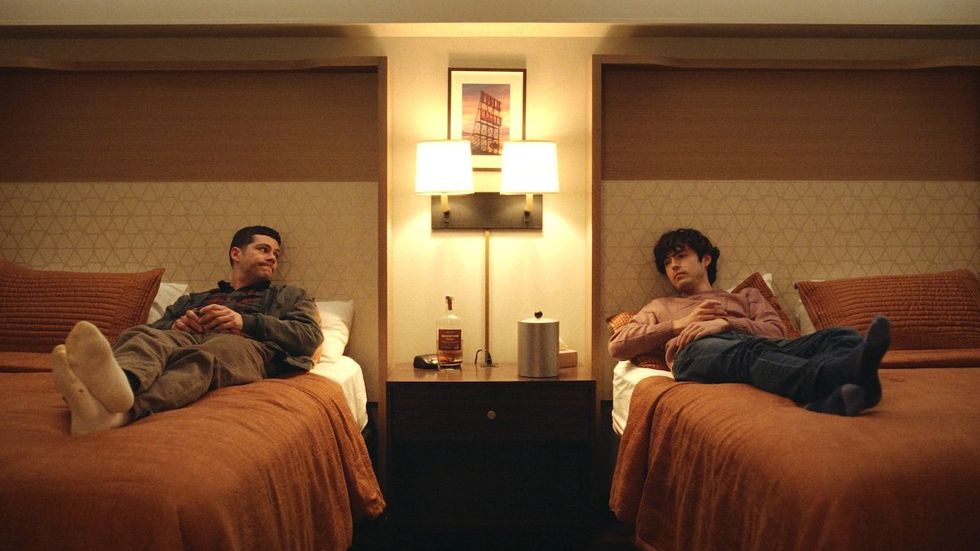 Dylan O'Brien as Roman and James Sweeney as Dennis in Twinless Roadside Attractions
“It is just a really positive portrayal of complicated people, and that can't do anything, I think, except be positive and bring us together,” she adds of the experience of watching it in the theater.
The driving force behind Twinless, Sweeney, who wrote, directed, and starred in 2019’s Straight Up, is excited for people to see his film in the theater at a time when fewer queer stories are making it to the big screen.
“I was thinking about the films that have even played in theaters with queer elements that had a wide theatrical release, and it's sort of far and few between,” Sweeney says. “It's especially meaningful that it will give opportunity for audiences to enjoy this and a communal experience.”
“I think I'm really excited when I see films that are sort of incidentally queer, and ultimately that kind of comes down to the decision makers,” he adds. “I got to make exactly the film that I wanted to make, and really, I feel like I got a good deal out of that at the end of the day.”
Twinless is in theaters now.