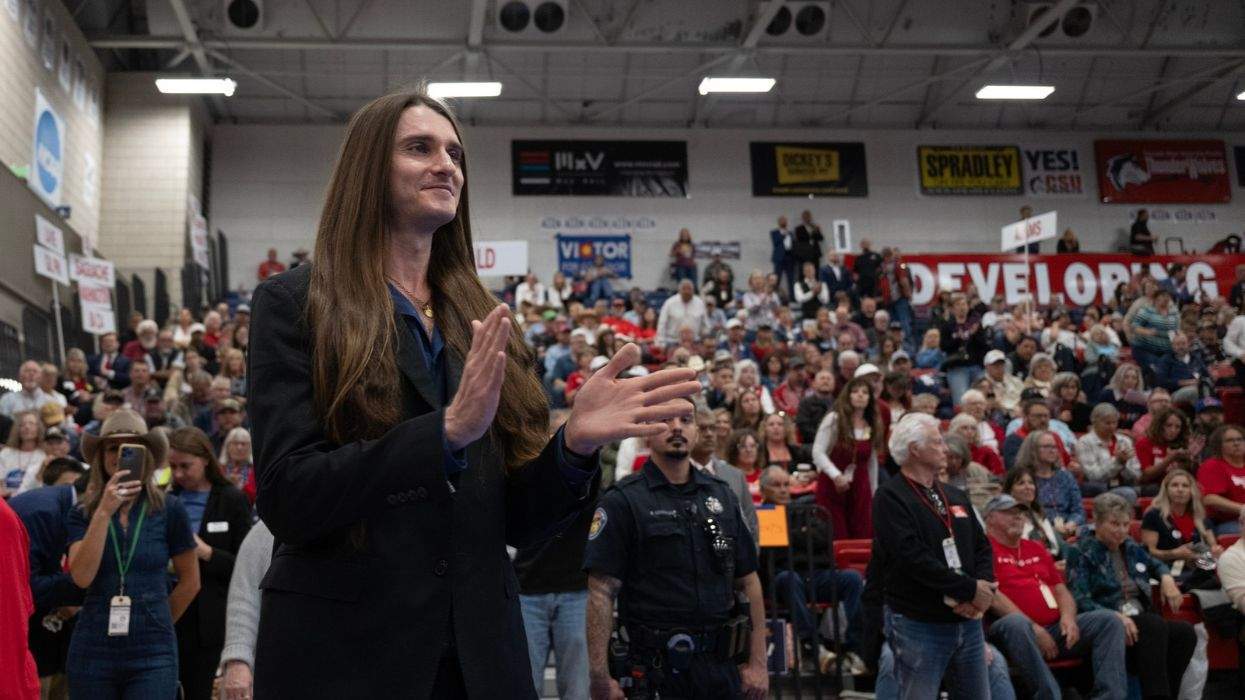


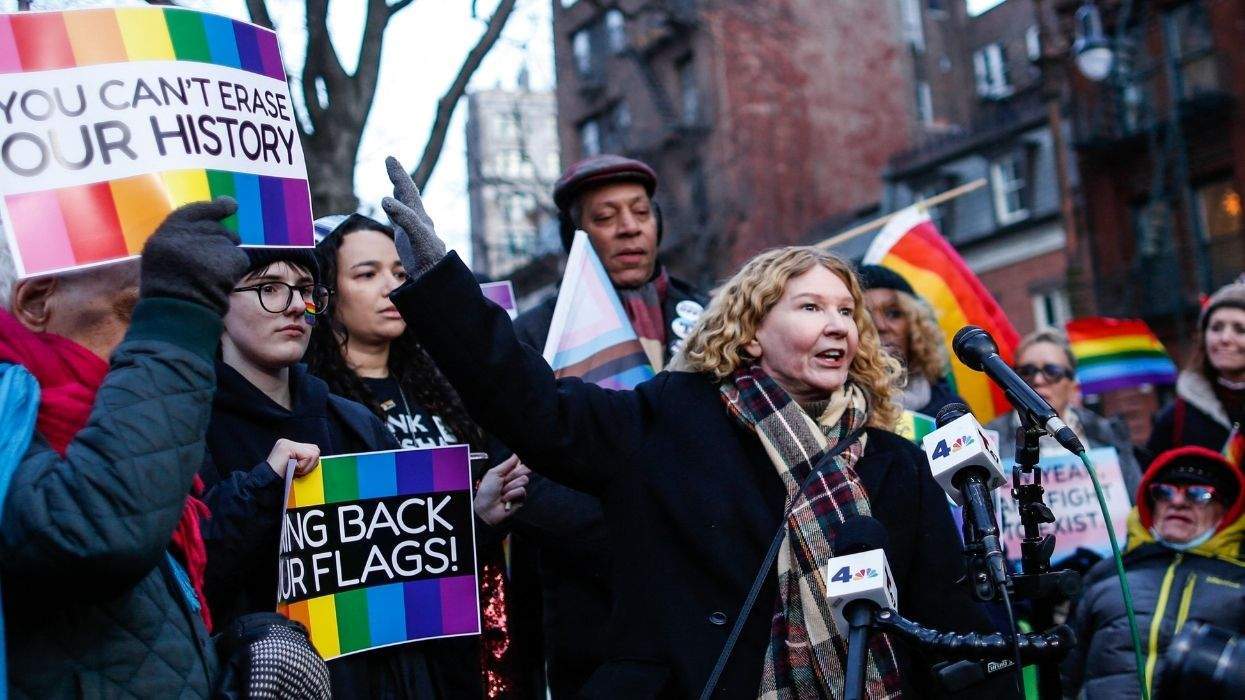
By the time dusk settled over Christopher Park in New York City’s Greenwich Village neighborhood on Tuesday, the narrow triangle of green across from the Stonewall Inn had become a small, loud commons. Rainbow flags were draped over shoulders. Chants rose and fell between the park’s statues. Attendees estimated that 500 to 750 people attended the protest against the National Park Service’s removal of the Pride flag from the Stonewall National Monument, a memorial dedicated to LGBTQ+ history.
Keep up with the latest in LGBTQ+ news and politics. Sign up for The Advocate's email newsletter.
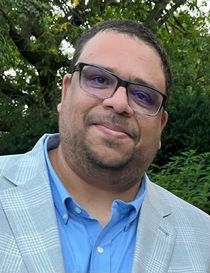
Jay Walker, 58, a longtime New York City resident and activist, organized the rally on short notice after word spread that the flag had been taken down. In an interview with The Advocate on Wednesday morning, Walker said he had heard some elected officials were planning an action later in the week but decided the community needed to respond immediately. “I said, ‘No, we need to do something in the community right now,’” he recalled.
Related: After trans people, Trump now erases bisexual people from Stonewall National Monument
Walker said he went “onto Canva, made a flyer, sent it out,” and shared it through social media and community networks before noon. By early evening, the response had snowballed. “Within six hours, we’d gotten about 500 people out into the park,” he said. The speed of the turnout, he added, showed that “our community just won’t stand for attacks against us.”
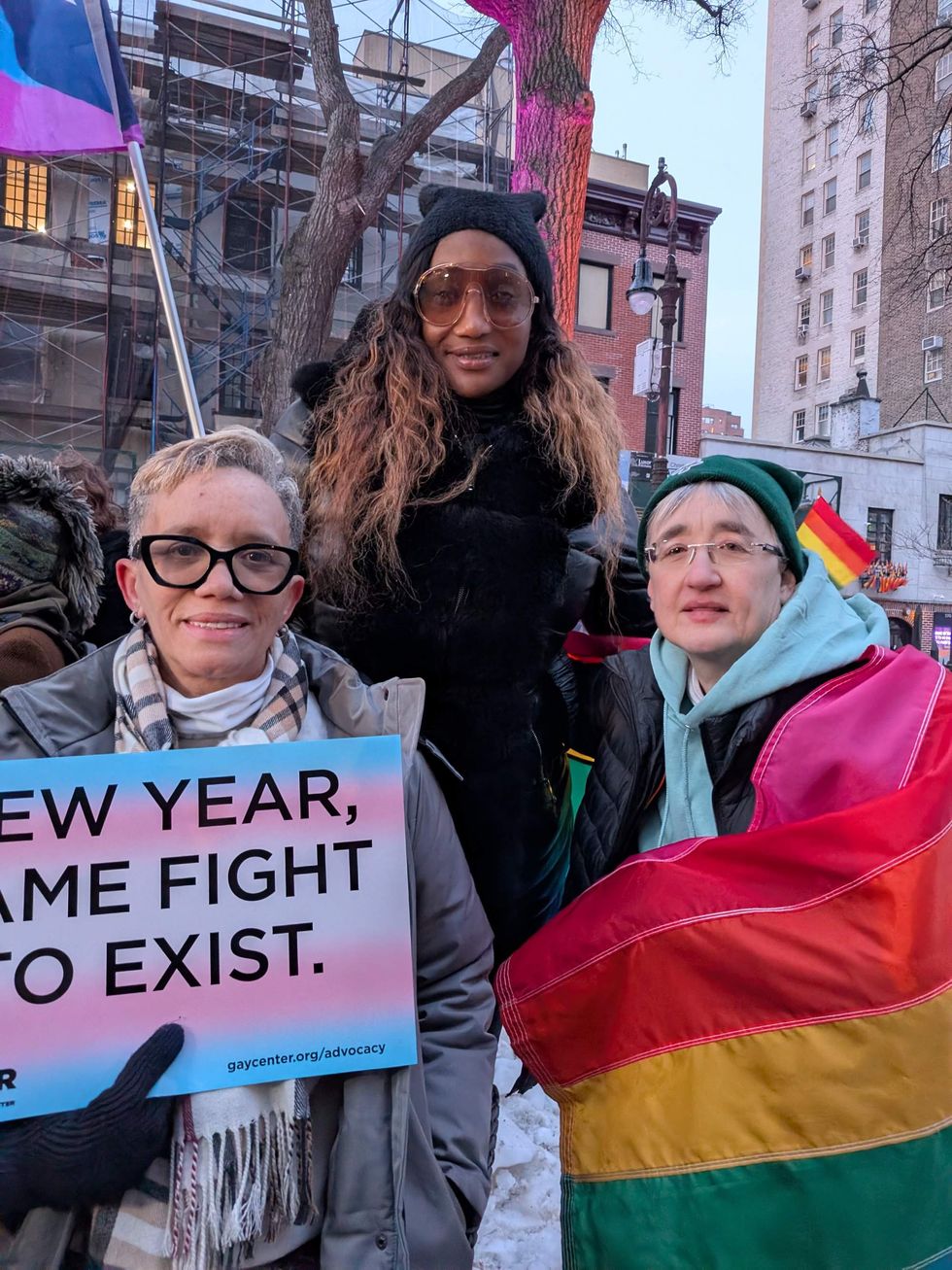 LGBTQ+ activists gathered at the Stonewall National Monument in New York City to protest the Trump administration's removal of the Pride flag.Cathy Renna
For Walker, the protest was never only about fabric on a pole. He described it as a defense of what he called Stonewall’s “living history,” the idea that the monument is not merely a curated site but a place still claimed and maintained by the community that made it historic. The rally, he said, was about “us saying, no, we’re not going to stand for this and getting our community out.” He added, “It’s just the first.”
Walker also drew a line back to 1969, arguing that the Stonewall uprising itself followed “years of constant micro and macro aggressions against queer people.” Today, he said, the response is faster and more organized. “We don’t wait for things to build up,” he said. “We act immediately.”
Related: Trump erased trans & queer history from Stonewall. Lawmakers are fighting to get it back
Related: National Park Service removes pages for transgender activists Marsha P. Johnson and Sylvia Rivera
That sense of accumulation, of small changes adding up to something larger, has been a constant in the debate over the monument since President Donald Trump took office for a second time. Last year, the National Park Service revised its public-facing Stonewall materials, including its website, to remove references to transgender people and changed “LGBTQ+” to “LGB,” an erasure that drew protests and condemnation from activists and Democratic lawmakers. Advocates have also criticized federal descriptions of the site for omitting bisexual and pansexual identities from the story of the uprising. Walker said those earlier edits are part of why this week’s decision hit a nerve. “They’re going to keep doing these actions against our community,” he said, “and we’re not going to take it lightly.”
The National Park Service has said the decision reflects long-standing federal rules limiting which flags may fly on NPS-managed flagpoles, with only narrow exceptions. Interior Department officials claimed that Stonewall’s history will continue to be interpreted through exhibits and programs.
Walker disputes that reading of the policy and argues that Stonewall already fits within the exceptions. “The limited exception was made at the moment that the monument was dedicated as a national monument,” he said. “That flagpole did not exist before it was made a national monument. … The only reason that flagpole is there is to fly the rainbow flag.” He added that the Pride flag removed this week was not federal property but one purchased and maintained by the park’s volunteer caretaker, saying the Park Service “clearly doesn’t know the history of that particular designation.”
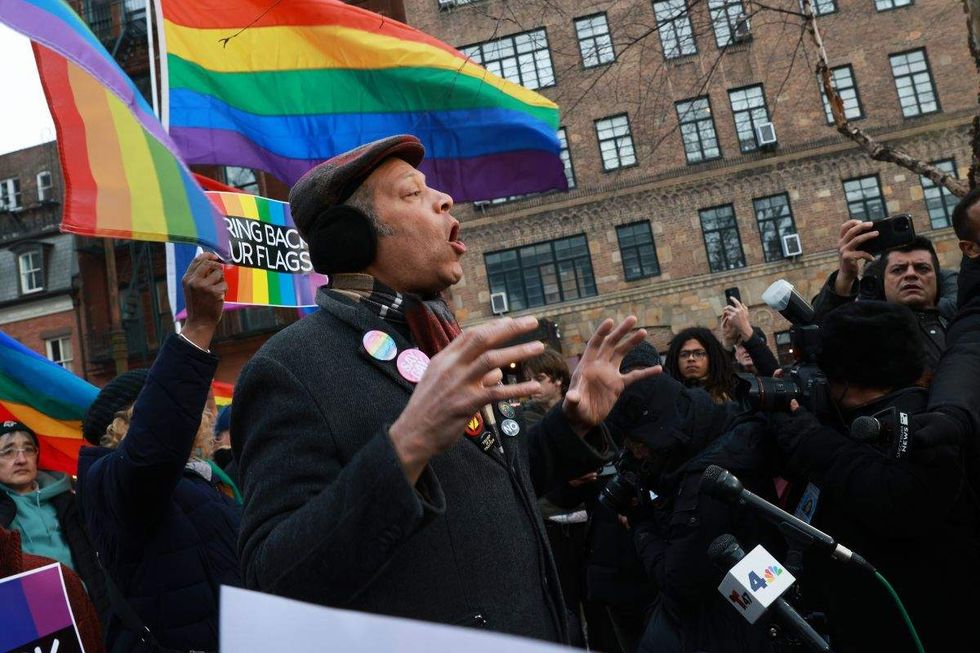 Jay Walker addresses the crowd and reporters at a rally opposing the Trump administration's removal of the Pride flag from the Stonewall National Monument in Lower Manhattan.Spencer Platt/Getty Images
Christopher Park is small. Walker described it as having “one sort of open sitting area that can only fit about 500 people,” and it filled quickly, with others clustering along the entrances and spilling onto the sidewalks of Seventh Avenue. As speakers prepared to begin, park rangers briefly attempted to close the gates, citing posted hours, according to Walker. “He starts saying, ‘Park’s closing, park’s closing,’” Walker recalled. “And I was like, ‘No, it’s not.’” He said community members pressed against the gates and chanted “Whose park? Our park,” until New York Police Department community affairs officers arrived and told organizers that “the park is staying open” and the rally could continue. “The Ranger didn’t apologize to anybody,” Walker said. “He just reopened those gates and got the hell out of Dodge.”
Related: What you need to know about the Stonewall uprising, which began 55 years ago
Walker praised the NYPD under Mayor Zohran Mamdani, who expressed outrage at the Pride flag’s removal. Walker said that since the new mayor took office, the city has seen a marked shift in the NYPD’s posture toward protesters. “It’s now Zohran’s NYPD. It is amazing the difference we have seen in the NYPD in activist and advocacy settings since Mayor Mamdani took office. It’s like night and day,” Walker said. “The word has clearly come down from the top that they’re going to respect people’s freedom of assembly and people’s freedom of speech and not be antagonistic to people that are exercising those rights peacefully.”
By the end of the evening, the park had thinned, but the argument had not. Across the street, the privately owned Stonewall Inn’s flags continued to ripple in the cold air.
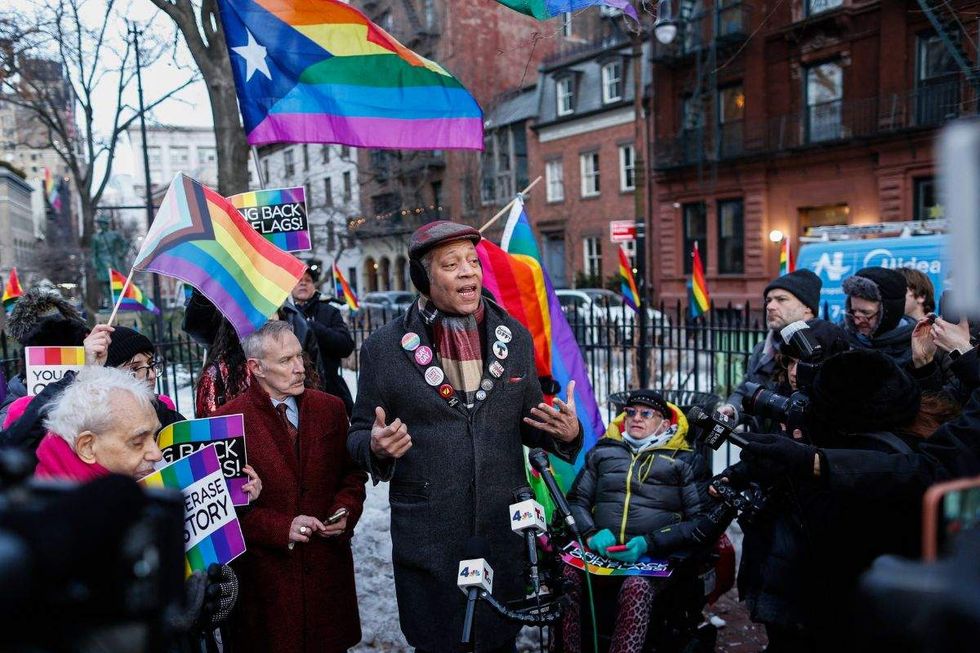 The LGBTQ+ community came together at the Stonewall National Monument in Lower Manhattan to protest the Trump administration's removal of the Pride flag from the historic site.Kena Betancur / AFP via Getty Images)
Elected officials and national advocates have increasingly joined the dispute. Rep. Ritchie Torres of New York, who is gay, told The Advocate through a spokesperson Tuesday evening that “Stonewall is sacred ground and the Pride flag belongs at the birthplace of the LGBTQ+ rights movement,” adding that taking it down “sends a message that the White House seeks to erase and minimize our history.” “We will fight to protect the legacy of Stonewall and the community that made it possible,” Torres said.
City leaders have also weighed in. Mamdani has called the removal an act of erasure, and the New York City Council has formally urged the National Park Service to restore the flag in a letter to Acting Director Jessica Bowron. Senate Minority Leader Chuck Schumer has demanded the decision be reversed, and Rep. Mark Takano, chair of the Congressional Equality Caucus, has argued the move reflects a broader federal agenda to curtail LGBTQ+ visibility. Advocacy groups, including GLAAD, the Human Rights Campaign, and the NEW Pride Agenda, described the episode as part of a pattern.
Walker placed Tuesday’s rally in that broader arc during his Wednesday morning interview, arguing that what’s happening at Stonewall is part of a wider effort to sanitize history at federal sites. Officials, he said, are “actively trying to erase our history,” not only at Stonewall but at places connected to Black, Indigenous, immigrant, queer, and trans histories. “They’re trying to erase anything that accurately conveys the history of struggle of marginalized communities in this country,” he said.
Related: Kamala Harris Makes Historic Visit to Stonewall Inn, Vows to Fight Anti-LGBTQ+ Hate
Related: No LGB without the T — queer community protests Trump's transgender erasure at Stonewall
In March 2025, Trump issued an executive order titled “Restoring Truth and Sanity to American History,” which directs federal agencies to review monuments, memorials, and exhibits to remove what the administration calls “improper ideology” and to emphasize a more “patriotic” account of the past. Critics argue the order has helped set the stage for actions like the flag’s removal at Stonewall, part of a broader effort to narrow how LGBTQ+ history is presented on federal land.
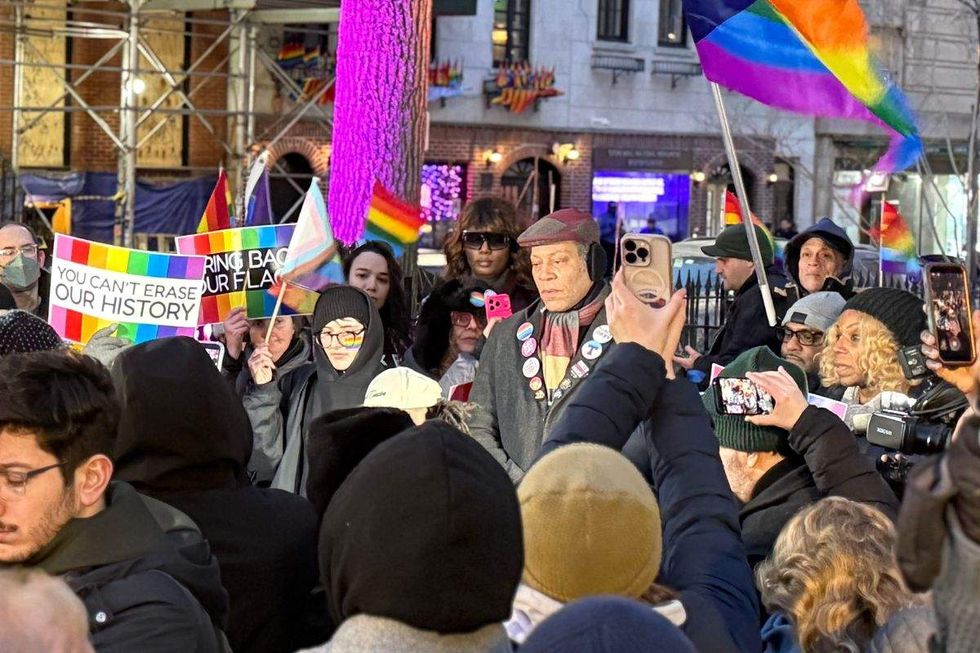 Cathy Renna
Walker said he does not expect Tuesday’s rally to be the last gathering. “They’re going to keep doing things like this. We’re going to keep responding,” he said. “It’s our city. It’s not Donald Trump’s city. We’re not going to let him keep bullying us.”
That response will carry forward on Thursday at 4 p.m., when New York officials and community leaders plan to raise the Pride flag again at the Stonewall National Monument in a show of solidarity and resolve. A flyer circulating on social media lists U.S. Rep. Dan Goldman, Manhattan Borough President Brad Hoylman-Sigal, state Sens. Erik Bottcher and Brian Kavanagh, and Assembly Members Deborah Glick and Tony Simone as participants. The message on the invitation notes, “They tried to take it down. We’re raising it back up.”
Walker said he expects Mamdani to attend as well, and described the planned re-raising as both a celebration and a statement of ownership over the site’s meaning.