

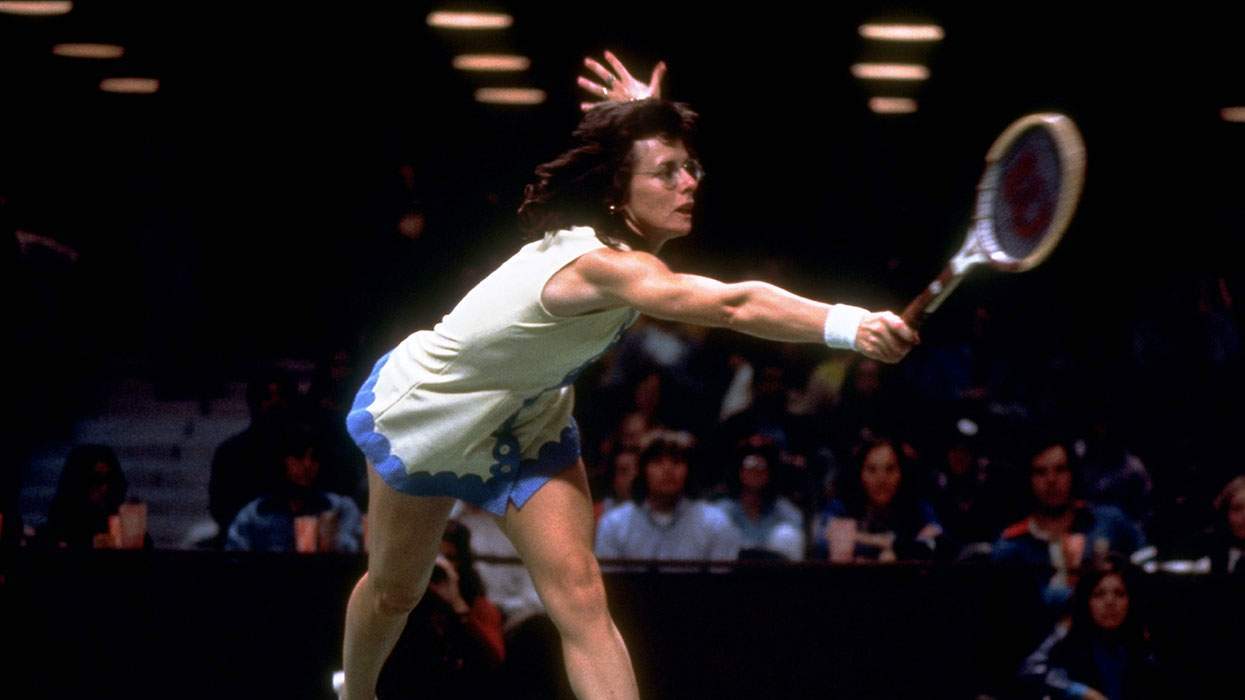

While watching archival footage of a 28-year-old Billie Jean King play her famous Battle of the Sexes tennis match against Bobby Riggs at the Sundance premiere of Liz Garbus and Elizabeth Wolff's new doc, Give Me the Ball!, I felt like I was actually in the Astrodome watching that day.
My heart was pounding with each hit and rally, and when King scored a winning point, the entire crowd erupted in cheers.
This is what a great sports documentary is. Sports have long been on the cutting edge of social issues and the culture wars. From Jackie Robinson and Greg Louganis to Megan Rapinoe and Caster Semenya, sports not only reflect society, but often guide it. In a movie like Give Me the Ball!, you can see exactly how that happens.
Documentaries like OJ: Made in America and Hoop Dreams beautifully weave social issues into sports, and Give Me the Ball! does the same. We may have an early frontrunner for the Oscar for Best Documentary.
Give Me the Ball! uses as its centerpiece the legendary 1973 Battle of the Sexes tennis match, where 90 million people around the world watched a then-29-year-old King beat the 55-year-old Riggs, who proudly identified as a male chauvinist, in three straight sets. It was hailed as a victory for women's sports and women's rights, and its impact is still felt today.
Billie Jean King made history, and she didn't do it by accident.
Give Me the Ball! features a mix of archival footage, including a lot of King's tennis matches, and up-close and personal interviews with King as she is now. These modern-day interviews elevate the film even further. King has an infectious energy and a laugh that makes you want to know all her inside jokes. Garbus and Wolff's up-close camera work invites viewers in, making you feel like you're her friend.
When King talks about her childhood, she says she became obsessed with sports as a young girl and that, no matter which game she played, she always wanted the ball in her hand.
That's the same way King lives her life. She's always ready for her next challenge and excited to face it. It's that attitude that made her the legend she is today.
After working hard as a teen to become a world-ranked tennis player, King was only getting started. Being number one wasn't enough. Soon, she and eight other women formed the first-ever women's pro tennis tour.
That still wasn't enough for King. In the doc, she talks about one tournament where she was at a press conference and, without really thinking, said she and the other pro women shouldn't come back the next year unless they got equal pay.
This was in the early 1970s, when women couldn't get credit cards without a man, own property or start businesses in some states, and were expected to be happy to earn just a few cents for every dollar a man made. King was having none of that.
After fighting for equal pay, women still weren't respected, and when former male tennis champ and outspoken male rights activist Bobby Riggs challenged her to a match to prove that women aren't as good as men, she knew she had to step up.
That's exactly what she did, dominating Riggs and beating him in straight sets. Afterwards, Riggs told King he underestimated her. It was hailed as a victory for women everywhere.
The film doesn't only cover King's tennis career. It also explores her personal life, loves, and struggles. While King is known as a gay icon today, she was actually married to a man, Larry King, from 1965 until 1987, six years after King decided to come out when a former lover sued her for palimony.
She eventually found the love of her life in her doubles partner, Ilana Kloss, and in 2018, the two got married.
The documentary also touches on a 1971 incident when King's husband outed her as having had an abortion, making her a spokeswoman for the pro-choice movement. Even though King didn't want to fight that battle, she still stepped up to the plate and hit it out of the park.
Towards the end of the film, we see some of the women's sports stars who carried the torch after King passed it, including tennis star Serena Williams, outspoken soccer player Megan Rapinoe, and Olympic gold medalist Simone Biles.
King fought for equal pay and respect for women, for abortion rights, and queer rights, and now it's up to the next generation to fight for issues like including trans people in sports, protesting on the field, and, still, respect for women.
King says that in order to shape our future, we need to understand our history. While this documentary should be watched by everyone, it's especially important for young women and girls in sports to watch, learn, and become inspired.
If they do, the future will be in good hands.
Out Review: 5 out of 5 stars.