




Every now and then, a truly exceptional book comes along that doesn’t just change how we see someone — it transforms how we see ourselves. Tourmaline’s MARSHA is that kind of book. Beautifully written and deeply researched, it’s more than a biography of Marsha P. Johnson. It’s a reckoning, a reclamation, and a radiant call to remember her in full, vibrant color.
Tourmaline has spent years creating work that blends art, activism, and Black trans liberation — from film and exhibitions to legal advocacy and community care. In MARSHA, she offers the first full-length portrait of one of queer history’s most iconic figures.
Our conversation, part of this month’s Out and About, touched on everything from Disney World to Tracy Chapman, sci-fi mystics to trans joy, and, of course, Marsha. Tourmaline’s insights are as tender as they are radical and should serve as a reminder that joy isn’t separate from resistance — it is the very heart of it.
That same point pulses through the pages of MARSHA. It’s the kind of read that pulls you in quickly and stays with you long after the final page. And at a time when trans communities are being scapegoated and targeted, this biography feels not just timely but truly essential. So, if you haven’t already, pick up a copy at your local bookstore, library, or anywhere books haven’t been banned.
Tourmaline is such a beautiful and evocative name — was there a specific moment or meaning that led you to choose it?
I chose Tourmaline as a way to honor my lineage and the multiplicity of who I am. Tourmaline is a gemstone known for its ability to reflect a spectrum of colors — just like queerness, just like joy, just like Marsha. It was less a single moment and more a shift into a deeper alignment with my own magic.
Favorite hotel you’ve stayed in — and what made it stand out?
Rosewood São Paulo. It’s stunning — the rooms are lush and the design is alive with history and futurity. What moved me most was seeing trans people of color working the front desk. That kind of representation at a luxury property changes everything — it made the space feel sexy, kind, and possible. That said, I have to give love to Nine Orchard in New York, too. They’ve given me a room many times so I could write MARSHA, and it became a sanctuary in the middle of the city. Both places remind me that care can be woven into even the most luxurious spaces.
 Rosewood São PauloCourtesy Rosewood São Paulo
Favorite restaurant that always feels like home?
Sant Ambroeus — especially for the princess cake. It’s not just about the food, it’s about stepping into a world where everything slows down. The lighting, the ritual of dessert, the way it makes you feel like the main character in a 1960s European film, it’s indulgent in the best way.
Are there any places still on your travel wish list that you haven’t had a chance to visit yet?
Bahia, Brazil. Afro-Brazilian traditions, trans lineage, Candomblé rituals, and coastal sensuality. I had a show at MASP in São Paulo, and so many people I met there told me, 'You have to go to Bahia.' It’s been calling me ever since. I also spent a few weeks in Tokyo in 2023, which rewired how I think about space and emotion. Now, I’m dreaming of places like Naoshima, the art island, or Koyasan, where time moves in reverence.
Do you remember your first Pride event? What was that experience like for you?
The first Pride I ever marched in was in 2006, with Queers for Economic Justice. I’d been to Pride before, but marching down Fifth Avenue — holding a banner, shoulder to shoulder with other people dreaming of a freer world — was transformative. I was in the middle of understanding myself in a new way, and that moment felt like a portal. Pride became less about being seen and more about stepping into who I already was.
Travel often sparks new ideas for artists. Have there been any places that have left a creative imprint on your work or helped you see something from a different perspective?
Disney World, truly. I’ve been spending time there not as a guest but more as a student — studying how they use architecture, scent, soundscape, and people flow to shape emotion. I’m fascinated by the mechanics of enchantment — how physical space can move us — and I’m interested in building something queerer, freer, and more truthful out of that knowledge. Tokyo was also deeply transformative. I spent a few weeks there in 2023 and hosted a screening of my films, Pollinator, and Atlantic is a Sea of Bones, with Normal Screen, who just screened Atlantic again this past weekend. That ongoing presence, the generosity of the audiences, and the city’s sensitivity to design and emotion completely shifted how I think about storytelling and worldbuilding. It reminded me that art can be a place we live inside. The first time I went to Naples felt like that; I remember walking through a summer carnival, and the street life was joyous and chaotic in the best way.
If you could guest star on any current TV show, which one would it be, and what kind of character would you want to play?
I’d want to be in the Star Wars universe so bad, it has room for so much queer dreaming. I’d play an alien mystic with force powers tied to ancestral memory.
Who’s your go-to guilty pleasure follow on Instagram, or someone whose content always makes you smile?
@abrahamhickspublications. It’s part manifestation scroll, part spiritual pep talk, part camp. Sometimes I’m just on there for the soft gradients and quotes like “The universe isn’t testing you, it’s responding to you.” It’s grounding, delusional, and deeply true—all at once.
What’s one album you always go back to, no matter how much time passes?
Tracy Chapman by Tracy Chapman. It reminds me to slow down and trust the version of myself I haven’t met yet.
You’ve traveled many creative paths — from film to activism to visual art — and now you’ve written the first full-length biography of Marsha P. Johnson. What’s your earliest memory of hearing her name or realizing her story might be part of your own?
I first began hearing stories about Marsha when I was in my late teens, attending school in New York City. I began exploring Christopher Street, a historically queer gathering space, as part of my own journey to live more authentically as myself. I joined the youth-led group FIERCE, organizing to make sure we could freely show up as ourselves in those spaces. Stories about Stonewall, street queens, and how people looked after each other were still being circulated, and through those stories, I began to get a sense for how vibrant, joyful, and fully alive Marsha was. It's that sense of joy and aliveness that has kept my attention for the past twenty years of research, interviews, and archive diving.
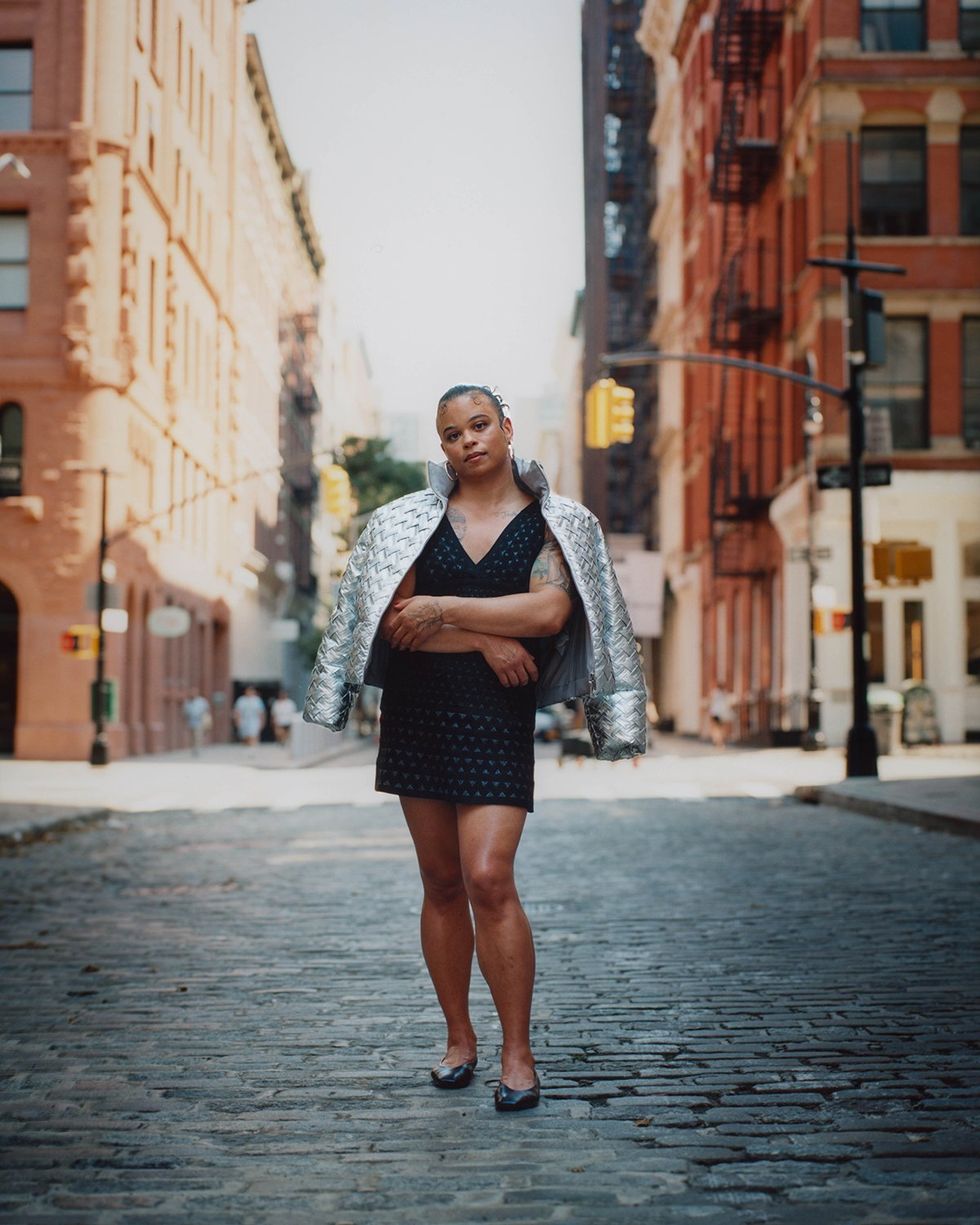 TourmalineSam Gregg for Tourmaline
In your book, you write that Marsha didn’t wait for permission to be free — she declared herself free and told the world to catch up. Did writing about her shift your own sense of freedom or possibility in any way?
Absolutely. I stopped waiting for the “right time.” Marsha taught me that joy is not a reward, it’s a practice. Writing about her unlocked a deeper trust in my own timing.
You also mention that tracing Marsha’s story helped you move away from shame and toward self-worth. For those just beginning to tell their own stories — especially trans or queer folks — what advice would you give?
Start from where you are, even if it’s messy. You don’t have to be “healed” or “whole” to be worthy of being heard. Your story is the ceremony.
Is there a trait you admired in Marsha that you try to carry forward in your own life? Why does that one in particular stay with you
Her audacity to be joyful in the middle of the storm. That adornment and glamour wasn’t a distraction; it was strategy. It’s something I carry with me every day.
Marsha’s legacy is often celebrated at Pride, but the full depth of her life and work isn’t always honored. From your perspective, what can the broader LGBTQ+ community, especially those with more privilege, do to better support Black trans lives year-round?
Move from allyship to co-conspiracy. That means redistributing resources, amplifying Black trans leadership without extracting from it, and recognizing joy as part of the resistance — not just pain.
Your portrait of Marsha moves beyond myth to reveal her contradictions, her care work, and her wild joy. Was there a moment from your research that really stayed with you — something that surprised you or cracked something open inside you?
Yes, she was a true performer. Whether as a child singing off-key in the style of Billie Burke (the original Glinda but also a vaudeville star) or later when she took the stage in London’s West End and moved audiences night after night, Marsha knew what she was doing! She perfected her craft over decades.
You’ve said joy should be recognized as part of the resistance — something Marsha lived fully. What’s bringing you joy lately, and how do you protect or prioritize that joy in your daily life?
Long walks with my cat Jean in the backyard. Planning my wedding with Cameron. Letting myself be silly, unproductive, and dreamy. I protect joy by reminding myself it’s not optional, it’s the point.