

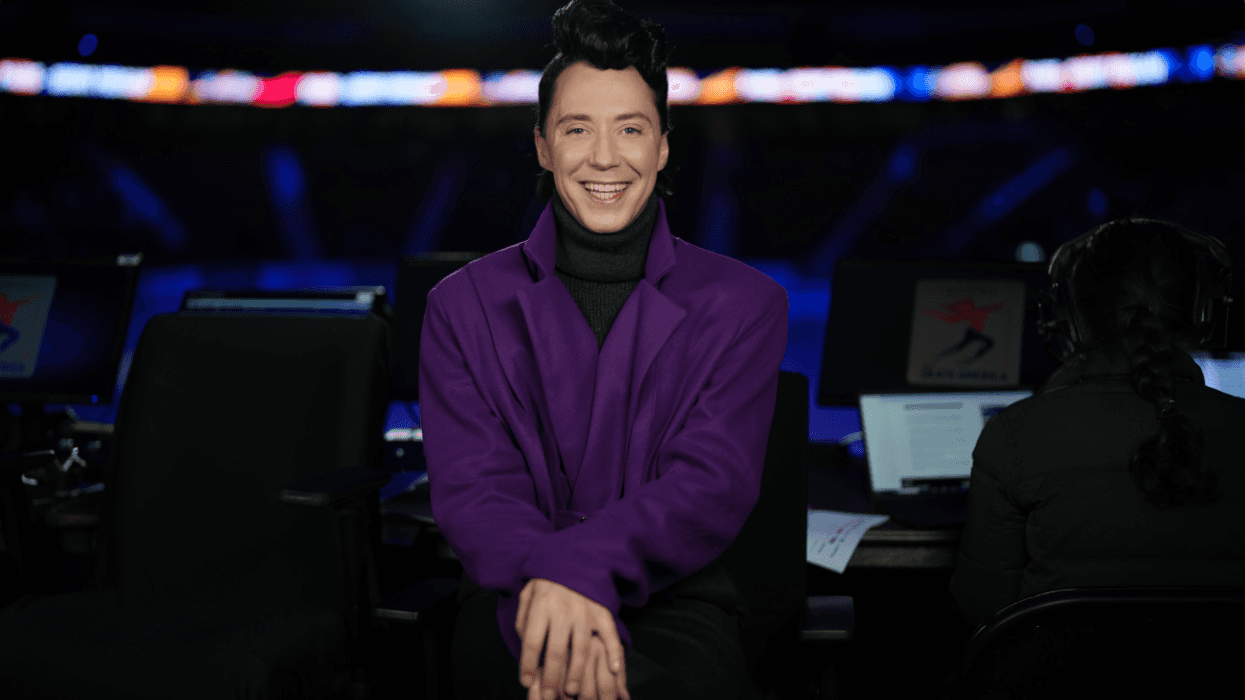
The Olympics is already a busy time for Johnny Weir, the gay figure skater who competed in the 2006 and 2010 Olympics and now serves as a commentator. It's a big cultural moment for Weir. Milano Cortina 2026 also overlaps with his run on Alan Cumming’s wildly popular reality competition, The Traitors. Weir answered the phone amid a busy day while in Milan for the 2026 Winter Olympics, which is coming to an end this Sunday.
Weir was not out when he competed during the Olympics, and it wasn’t until he published his autobiography in 2011, Welcome to My World, that he officially told the world that he’s gay. He retired from the sport in 2013 and has served as an official commentator for the games since the 2014 Sochi Olympics, alongside his best friend, fellow Olympian and Traitors contestant, Tara Lipinski. The two formed a close friendship over the years and became inseparable, so much so that Weir served as a “bridesman” in Lipinski’s wedding to sports producer Todd Kapostasy. It was a shock to many that their Traitors cohort didn’t know the extent of their friendship during the show, which was revealed by them in an explosive roundtable last week.
“We never just assume everyone knows who we are,” he says. “We've both, on the show and in real life, been very vocal about the fact that we understand that we are not the best at playing games like that. So we definitely felt in the most recent episode that we were both going out, and if I would be banished and then she would be murdered, or whatever the case may have been, we both felt it coming.”
In last week's episode, it seemed like their fate was written in stone, but somehow they were able to convince the other players to keep them around — and it was Stephen Colletti who got the boot. This gave way for the two Olympians to live their truth as close friends in the castle, though it’s still unclear how the two fare in the game with just a few episodes left.
“We're both very, very grateful that we had the opportunity to showcase our relationship and how close we are and how much we love one another, because that was all that mattered to us in the game,” the former Olympic figure skater says. “Of course, we wanted to win, and of course, we played a very good game, and you'll see how things turn out in later episodes.”
For now, Weir’s focus is on the Olympics, and there is undoubtedly enough drama going on at this year’s games, especially with the American competitors. One of the biggest upsets in figure skating history was Ilia Malinin’s disappointing performance, landing him in eighth place after being revered as “the quad god” and the frontrunner for the gold in the men’s free skate competition.
“Any athlete has been there and had a rough performance,” Weir says.“The thing that struck me is that he has been a little bit nervous, and he's been very vocal about how much pressure this all is.”
Weir goes on to say that figure skating is unique in the Olympics because it’s one of the few sports that’s judged; the other competitions are based on a stopwatch, scoring the most goals, throwing something the farthest, etc., so he understands the amount of pressure that these athletes are under.
“In my first Olympics, anyway, I was favored for a medal, and the pressure of that was absolutely crushing. I'd only been skating for nine years when I competed at my first Olympics, and I was mentally not ready for that kind of attention, and it broke me,” he explains. “I can’t say the same thing happened to Ilia because I’m not in his brain, but he just felt a little bit nervous.”
The pressure of a global audience is one thing, but Weir also knows that the judges don’t always get it right. “Believe me, Tara and I have both come for the judges a number of times on broadcast because they just completely get it wrong,” he says. So when it comes to the judging scandal regarding Madison Chock and Evan Bates not winning gold in the ice dancing competition, he can understand why people are upset with the French judge allegedly favoring the French duo, who ended up taking home the gold.
“The French team and Chuck and Bates were both marvelous,” Weir explains. “So while there is always going to be a little bit of favoritism based on personal taste in judging, I look at the panel, and I can't speak to anything that happened with the judging, but I think that both teams performed really well, and it just came down to a judge having a differing opinion. And that's a shame, but figure skating is like that.”
The precarious nature of the sport is something Weir understands much more deeply than most, which is why his commentary during the Olympics is essential. He's helping the average American who may be passively watching the sport "understand what they're watching, why certain things happen, why the skater wins, why that one doesn't, or why somebody falls," he says. He and the other commentators do not shy away from giving critiques and praise when the moment warrants it, but "our obligation is to our audience and also to be voices for the athletes" because they rarely have the chance to explain what happens, especially if they're not favored to win a medal.
Weir says he speaks to all the skaters and makes sure the commentators can be as much of a voice for them as possible, telling the world about them and turning them into people, not just great athletes.
The Games are a way to bring everyone together for some friendly sportsmanship, especially during a time when the world feels increasingly divided, he shares.
"The Olympics have always excited me because they give the opportunity for people to shine, and people to do the things they're passionate about, and for people to show the world who they are," Weir says. "I think that it's people love the Olympics because we can celebrate human achievement. We can celebrate our country, we can celebrate what should be a peacetime in the world as part of the Olympic charters that all should be peaceful during the Olympic Games."