


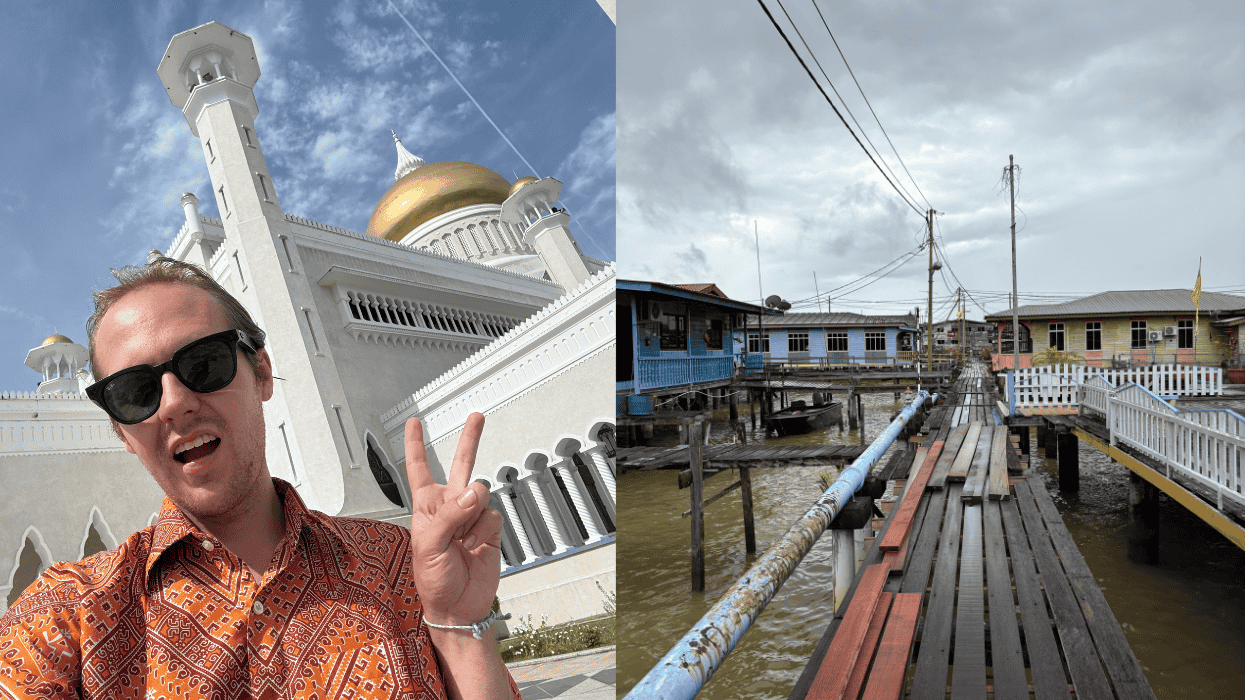

Few people visit the Southeast Asian nation of Brunei Darussalam. Especially travelers who are backpackers, Americans, or gay. I happen to be all three.
If you've heard of this tiny country on the northern coast of Borneo, it's probably not for good reasons. In 2014, Brunei made headlines when the Sultan announced plans to implement strict Sharia law, meaning acts like adultery or same-sex intimacy could be punishable by death by stoning. The backlash against this existential threat to the LGBTQ+ community was swift: celebrities called for boycotts, luxury hotels tied to the Sultan were blacklisted, and Brunei quietly slipped from the global travel map. In 2019, the Sultan declared a de facto moratorium on the death penalty, meaning executions are not to be carried out. However, the laws remain, and LGBTQ+ life is still underground and restricted.
Yet, as a gay man, I decided to go anyway.
It was not a rebellion, but a choice driven by powerful curiosity. I like visiting small, overlooked nations like Liechtenstein, Luxembourg, and Monaco. Brunei fits that category. A mysterious royal family piques my curiosity, too. I wanted to see what life actually looked like behind the headlines. What would it feel like to walk through a place that, at least on paper, doesn't want someone like me there? I wasn't walking in blind. Friends who had traveled there before assured me that, while the laws are strict and public transportation nonexistent, they had safe and enjoyable experiences. Their advice gave me some confidence that the trip was adventurous, not reckless.
The flight from Malaysia to Brunei began with a prayer and a video montage of the country's glittering mosques. It was a not-so-subtle reminder of where I was headed. By the time we landed in the capital, Bandar Seri Begawan, I was bracing for trouble. Would customs officers open my bag and discover "evidence" of my proclivities: a hot pink Speedo, sparkly earrings, gay romance paperbacks, and a bottle of PrEP? The fear melted away once I walked through visa-free with ease.
The city was safe but sparse. There is very little tourism and a small local population. I did not feel threatened as a gay man, but I felt vulnerable without a car. Gas is incredibly cheap, so everyone drives. Walking made me stand out, and I noticed every glance. Hyper-aware, I wondered: could they tell I'm gay, or are they just looking at me because I'm a fool without a car in this tropical climate? Would it matter if they could tell I was gay? Since I was traveling solo, I stayed quiet and avoided broadcasting any part of my identity.
I know I benefit from a particular privilege because my appearance, nationality, and ability to "pass" in public mean I can move through the streets unnoticed, except for the fact that I am a rare tourist. I also have the privilege of traveling to new countries out of curiosity alone. Others in the LGBTQ+ community, especially locals without that freedom or those facing financial difficulties due to who they are, face harsher realities.
Before the trip, I told myself I wasn't funding the Sultan or his life-threatening policies. I spent money at local eateries, stayed at a budget hotel, and paid taxi drivers directly in cash. The country also has no income or sales tax. My visit wasn't about supporting the government. It was about learning about this mysterious place myself. Honestly, it was also about seeing Brunei's unique wildlife: the strange Proboscis monkeys and their abnormal bulging noses.
While boycotts isolate, travel connects. That's the philosophy that got me on the plane.
In Brunei, homosexuality is outlawed, but daily life feels surprisingly ordinary. Locals were curious, polite, and welcoming. The population was diverse with a mix of Chinese, Indian, and Malay residents. People asked where I was from, and when I said the U.S., they said, "Wow! Welcome to Brunei!" The friendliness felt genuine because few foreigners visit for tourism. Taxi drivers proudly shared facts about their city.
There's a strange contrast in Brunei: enormous wealth alongside modest lives. The Sultan lives in the world's largest palace with a golden dome, owns thousands of luxury cars, and rules as one of the world's only remaining absolute monarchs. Yet just across the river from the palace is Kampong Ayer. In this traditional water village, wooden homes are built on stilts over crocodile-filled water. The houses are connected by rickety walkways where you have to be careful with each step. Children commute by boat to school. The disparity between the golden palace visible in the distance and the hazardous village below is impossible to ignore.
As a gay traveler, I've visited countries that celebrate Pride and others that outlaw it. In Brunei, I quieted myself, but I was not threatened. There's power in showing up anyway, in moving through a society that technically doesn't allow your existence and still taking your space. As a short-term visitor, I understood I couldn't demand the local culture shift for my benefit; my responsibility was to observe, not to preach. I learned that I do not necessarily have to be loud to be proud, because I know the outcome will not change because of my brief visit.
On my last morning, I visited one of Brunei's grand golden mosques. I was the only tourist there. The air was still and reverent. Standing alone under the golden dome, facing toward the Islamic holy city of Mecca, I reflected on how strange it is that a country infamous for intolerance could feel so peaceful and even a little boring. No one actively preached against the life I live, yet I remained aware of the laws on paper.
I don't believe visiting a country means endorsing it. If that were the case, nearly the whole world would be off limits to LGBTQ+ travelers. Brunei, like many places, carries contradictions: lavish palaces beside crumbling boardwalks, strict laws on paper beside quiet kindness in daily life. And, somehow, a fashionably dashing ruler of a country where someone like me could never love openly.
For me, as a queer traveler, it was a powerful act to go somewhere that, on paper, didn't want me, and to be there still anyway.
Cameron Cayer is a Rhode Island–born writer with a love for maps, history, and the quiet diplomacy of travel.
Opinion is dedicated to featuring a wide range of inspiring personal stories and impactful opinions from the LGBTQ+ community and its allies. Visit Out.com/submit to learn more about submission guidelines. We welcome your thoughts and feedback on any of our stories. Email us at voices@equalpride.com. Views expressed in Opinion stories are those of the guest writers, columnists, and editors, and do not directly represent the views of Out or our parent company, equalpride.


