

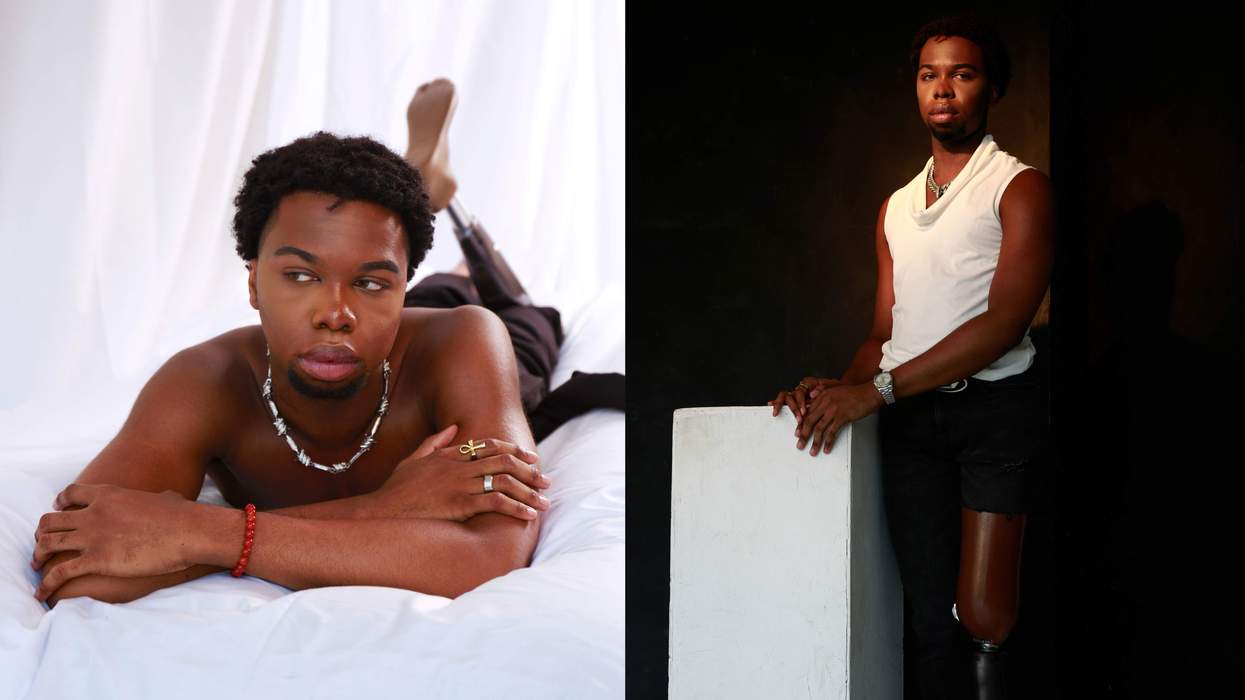

Going viral while still in middle school would be exciting enough for your average eighth grader, but for a Black queer amputee, it changed the trajectory of his whole life.
The schoolyard wasn’t always a welcoming place for Keith Parris, who was born with Tibial Hemimelia, a rare condition that led to his leg being amputated above the knee, so after a particularly rough day when he was a teen, he poured his hurt and anger into a memoir that he posted on the Wattpad publishing platform.
“I was the topic of discussion because a lot of people were just questioning my life, my sexuality, and just like who I am as a person,” Parris tells PRIDE. “And then there were a lot of misconceptions about me from people at school. So I was like, you know what? I'm tired of the rumors.”
That night in 2014, he went to bed after publishing a collection of essays about his experiences with an eating disorder, self-harm, and his disability, called Amputee Story, and woke up the next day to his friends blowing up the group chat because he was going viral.
“And my friend was like, ‘Hey, you're going viral.’ And I was like, ‘You're lying,’’’ Parris remembers. “I'm a regular person. It's like winning the lottery. It's like, you're just lying to me.”
His impromptu memoir ended up on the front page of Wattpad, where he started "getting millions of DMs” from people who thanked him for educating them about boys struggling with “eating disorders and mental health problems too,” and starting “a good conversation online.”
Being visibly disabled on the internet has also opened him up to a lot of judgment. Parris says he tries to block or ignore hateful comments, but because he lives at the intersection of three marginalized identities — being Black, queer, and disabled — people also make up wild stories about how he became an amputee.
“When it comes to race there's a lot of ignorant people online too,” Parris says. “They will say like, ‘Oh, I heard he was in a gang.’ They make these elaborate stories like, ‘Oh, he's a drug dealer, or he was in a gang and he was a snitch. And like they had to cut his leg off [to] teach him a lesson.”
But Parris, who goes by “The Icy Amputee Warrior” online, said the level of fame he reached while he was still in middle school has had a “domino effect” on his life. He is now a beauty influencer, model, author, and disability and mental health activist who gives talks at colleges across the country.
And this wasn’t the only time he’s gone viral. Parris was introduced to Rihanna’s millions of fans after the pop star’s social media team sent him some Fenty Beauty samples, and he made an Instagram post about them that the pop icon reposted. “I literally died,” Parris said of the surreal experience. “I was like, oh my god.”
Parris’ relationship to celebrity is complicated because although there were Black celebrities in the limelight when he was growing up, like Michael Jordan, Chris Rock, and Beyoncé, he never saw anyone with a disability like his.
“Even though they have the same skin tone as me, that we're the same gender, and they’re probably from the same place where I'm from, but still, I can't relate to them because they just don't look like me,” Parris said, continuing, “I didn't have anyone growing up looking like me. So I just wasn't connecting to these socialites that were these celebrities back in the day.”
Despite the judgment he faces online because of his disability and the homophobia he has struggled with from his family, Parris hides nothing about who he is now. He covers his Instagram account with photos of him wearing makeup, often sporting a jock strap, and showing off his prosthetic leg for everyone to see. He does this in large part because he wants to be the representation that he so desperately needed when he was growing up.
“I already know walking in any room that I might be the only disabled person, or even people's first time seeing someone with a disability too,” Parris says. Lateley he's even started wearing shorts in public for the first time and says that while he would have struggled to do that years ago, now “it's just a confidence booster for me.”
Being visibly queer and visibly disabled is an important part of his activism and advocacy work, and even though that can be challenging in such a conservative world, Parris won’t let the haters hold him back anymore.
“I think just for years I was always hiding myself,” he says. “I wasn't really proud of myself. I was always like, per se, in the closet. But then it was just like that one day, I just looked at myself. I was like, why am I dimming my light for society or for people? It's like, no, let me be proud of it. Let me be proud of who I am because I know god and the universe made me who I am.”