

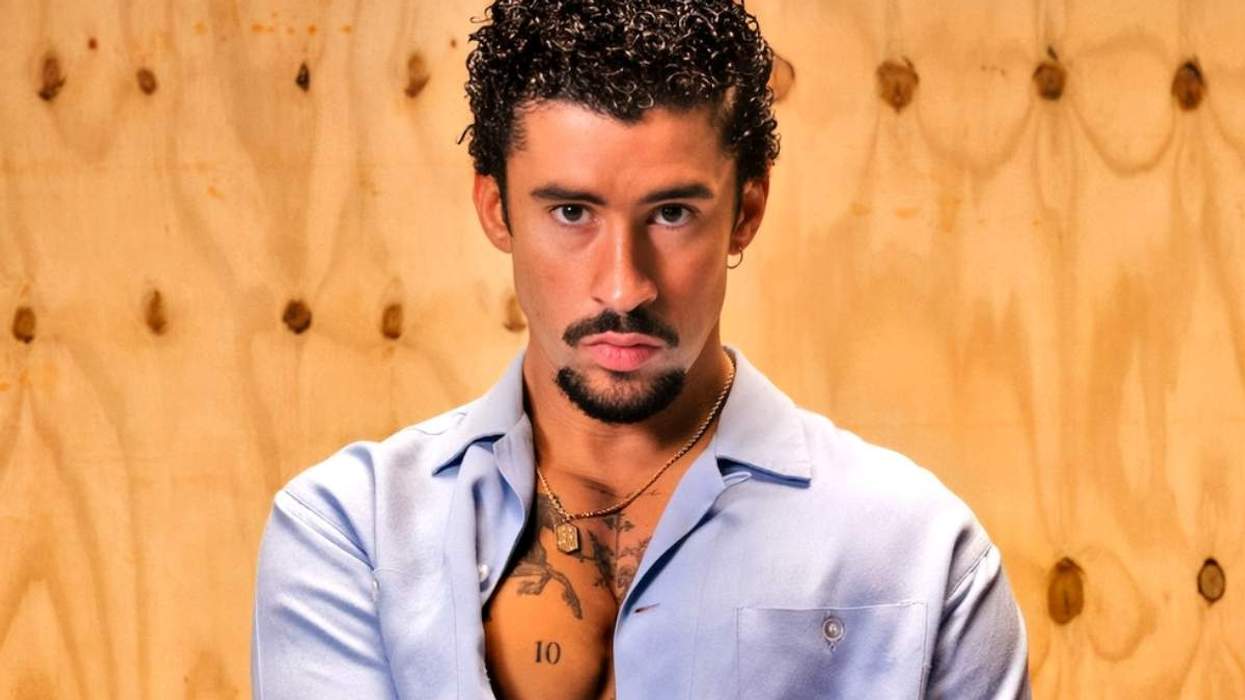

Bad Bunny, a daring Puerto Rican reggaetonero and certified global pop star, will deliver his headlining performance at the 2026 Super Bowl Halftime Show this Sunday, February 8, on NBC.
Throughout his career, Bad Bunny has been known to take big swings, advocate for those who can't fight for themselves, and always lead with kindness and positivity. The very few exceptions when the musician had a human moment — and responded to a certain situation with unfiltered feelings — are still weaponized by his haters and critics, even though his positive responses to criticism, as well as his overall advocacy for Puerto Rico, far outweigh anything negative he's said to bigots.
Born Benito Antonio Martínez Ocasio in Bayamón, Puerto Rico, U.S., Bad Bunny is the biggest male pop star of the 2020s — breaking records on music streaming services, winning accolades like the Grammy Award for Album of the Year with Debí Tirar Más Fotos, and solidifying himself as one of the most exciting touring performers through concerts (with sold-out dates) around the globe.
A month away from turning 32, Bad Bunny has a phenomenal discography with songs that may sound like any other reggaeton record from a Latine artist, but happen to explore deeper themes that feel refreshing, up-to-date, and still exciting.
Bad Bunny's six studio albums.
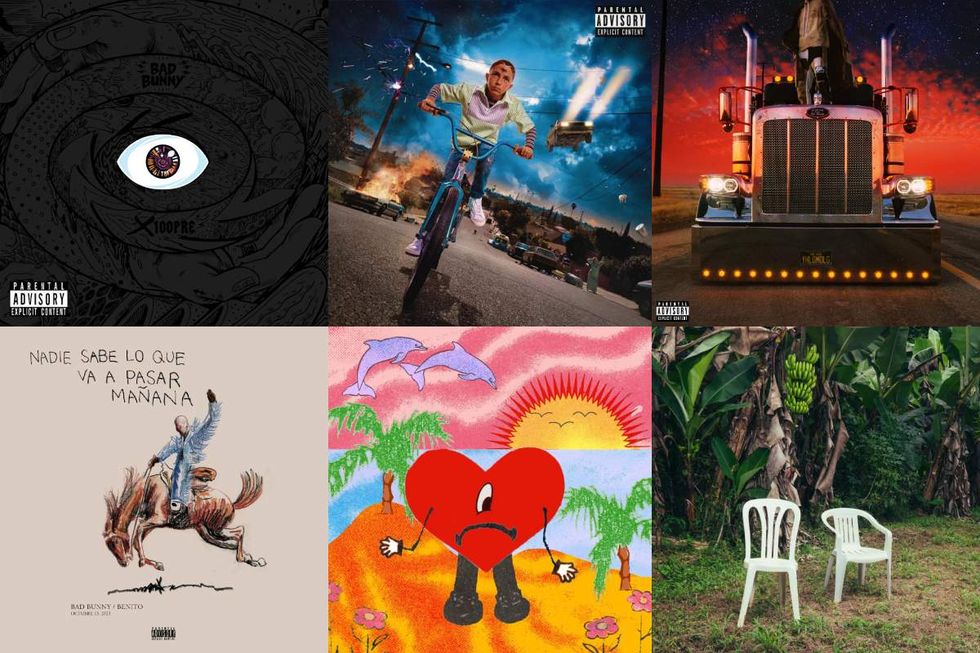
Bad Bunny's six studio albums released so far.
Rimas Entertainment
As of this writing, Bad Bunny has released six studio albums:
- X 100pre (2018)
- YHLQMDLG (2020)
- El Último Tour del Mundo (2020)
- Un Verano Sin Ti (2022)
- Nadie Sabe Lo Que Va a Pasar Mañana (2023)
- Debí Tirar Más Fotos (2025)
Bad Bunny's latest studio album, Debí Tirar Más Fotos, won him three trophies at the 2026 Grammy Awards, including the coveted Album of the Year.
Bad Bunny's collaborative album and mixtape.
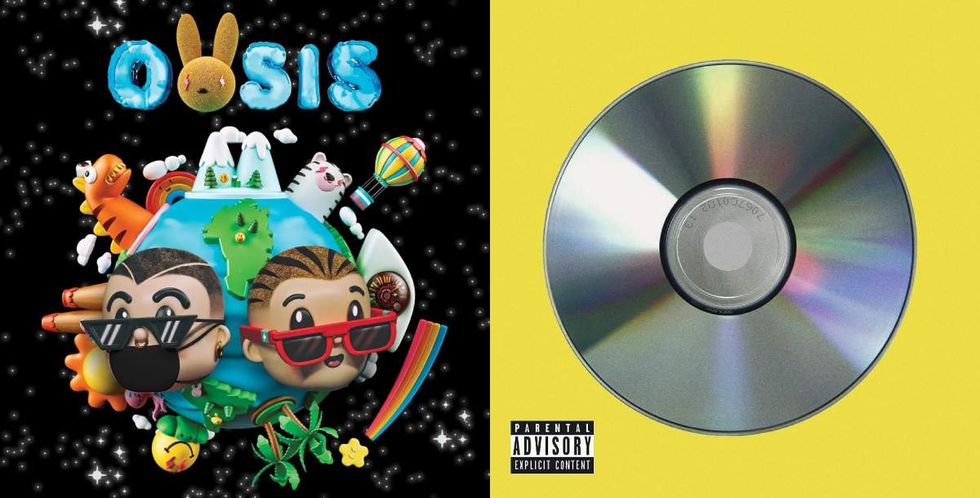
Bad Bunny's Oasis collaborative album with J Balvin; Bad Bunny's Las Que No Iban a Salir mixtape.
Universal Latino; Rimas Entertainment
Besides the six studio albums he's released so far, Bad Bunny has dropped a collaborative album with J Balvin and a mixtape released in 2020.
First and foremost, Bad Bunny and J Balvin released a collab album titled Oasis in 2019. The LP with Balvin came out shortly after X 100pr, Bad Bunny's debut studio album. In 2020, Bad Bunny also released a mixtape titled Las Que No Iban a Salir that followed his second studio album, YHLQMDLG.
The best Bad Bunny songs for beginners.
 Bad Bunny in official poster for the Super Bowl LX Halftime Show.NFL/Apple Music
While conservatives have relentlessly criticized Bad Bunny for headlining the 2026 Super Bowl Halftime Show, it's fair to say that many people in the U.S. aren't fluent in Spanish and don't mean any malice when expressing that they aren't familiar with Bad Bunny's work. Yet, many of those people are open to learning more about his impact and discography.
RELATED: Bad Bunny: 56 iconic and hot moments that broke the internet
So, if you're new to Bad Bunny and want to familiarize yourself with his artistic sensibilities, lyricism, and sound, we're here to help. From signature features in crossover hits with Cardi B and J Balvin, to fighting against toxic masculinity, to releasing maximalist music videos, consider this the start of your journey into the Bad Bunny rabbit hole.
'I Like It' (with Cardi B and J Balvin)
"I Like It" is exactly what it seems: A radio-ready, pop-perfect collaboration between three talented artists combining their individual strengths to craft what eventually becomes a No. 1 song on the Billboard Hot 100.
It follows Cardi B's meteoric rise in popularity after "Bodak Yellow," showcases J Balvin's gains in cultural cache that had Pharrell rapping in Spanish for "Safari," and feels like Bad Bunny's grand entrance to the music biz as a pop star in the making.
'Caro'
Bad Bunny has been fighting to break down toxic masculinity since the very beginning of his career. For instance, one of his first controversies (which generated conservative backlash) regarded his interest in getting bright, intricate, and artistic manicures regularly.
In July 2018, Bad Bunny called out a nail salon in Asturias, Spain for refusing him service due to being a man, as reported by Remezcla. That since-deleted tweet (now X post) prompted intense homophobic discourse from users questioning his sexuality for feeling that passionate about manicures and the refusal of service. Bad Bunny eventually deleted his Twitter (now X) account as a result of that controversy… but not because he bullied into quitting social media.
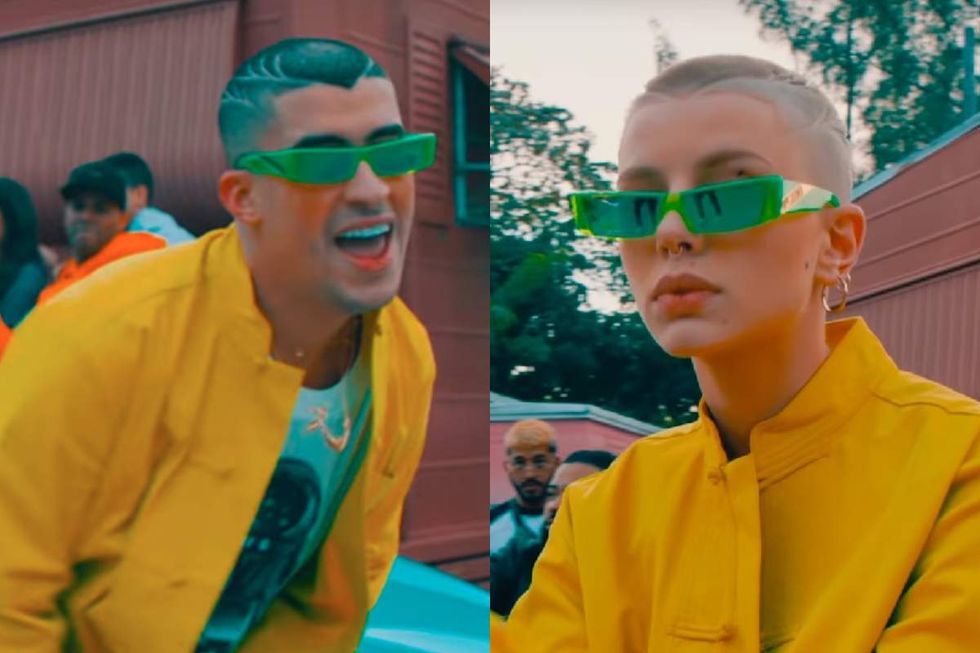
Bad Bunny; Jazmyne Joy in 'Caro' music video.
Rimas/OVO/Warner Records
Like most great artists, Bad Bunny put down his Twitter fingers and responded to that controversy with artistry. In about six months, he dropped a music video for "Caro," which starts at a nail salon and shows the reggaetonero getting his nails done. It is then established that model Jazmyne Joy stands in as a Bad Bunny alter-ego and lip syncs the song throughout the music video.
Ultimately, the "Caro" video demonstrates not only that men can get manicures, but that women can also be at the center of a reggaeton music video spitting the exact same bars that Bad Bunny would've.
'Yo Perreo Sola'
Skirt-wearing and in-drag versions of Bad Bunny are central to the music video of "Yo Perreo Sola," which — to this day — causes audiences to question his sexuality and/or wildly assume that he's a drag artist.
This music video communicates that women do not want to get hit on just because they went out to a club, which is (unfortunately) still an uncomfortable topic for many women in Latin America to express confidently, prompting Bad Bunny to challenge his own peers to stop perpetuating such narratives. Just like with everything else, though, Bad Bunny sends message while having fun, dancing, and putting his own neck out to advocate for those who wouldn't be heard otherwise.
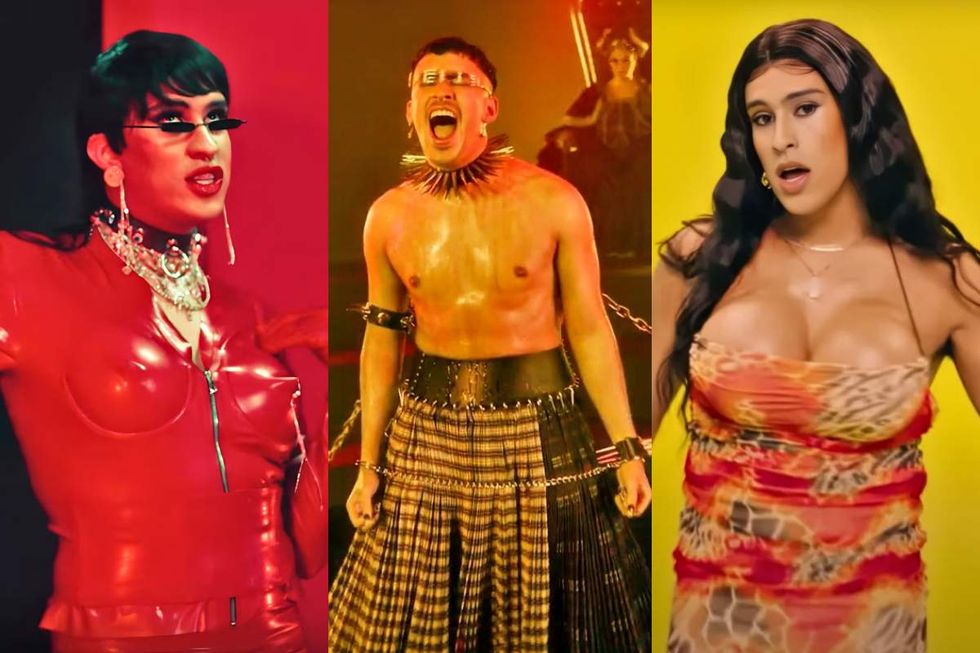
Bad Bunny dressed in and out of drag during the 'Yo Perreo Sola' music video.
Rimas
Women are not inviting men to hit on them because of the clothes they're wearing or the sheer fact that they went out.
The title, "Yo Perreo Sola," translates to "I twerk by myself." In the video, Bad Bunny is seen in a rabid state as if he's unable to control himself from his urges and must be chained up for people to be safe. Bad Bunny also gets in full drag to support the main point of the song: That a woman can get all done up, and go out, and twerk, all without automatically inviting men to join in.
'Tití Me Preguntó'
A universal experience across different countries, cultures, and creeds: Relatives who fixate on your love life and don't miss out on any opportunity to ask (again, again, and again) if you're dating anyone. In "Tití Me Preguntó," Bad Bunny has fun reminiscing on an auntie (a tití) who keeps asking him about girlfriends. In an attempt to dodge disclosing specific details — which many queer people can certainly relate to — Bad Bunny jokes (translating to English), "Today I have one, tomorrow I'll have another."
That's a fun answer, and it works! However, it perpetuates the stereotype that Latinos are supposed to be womanizers, and Bad Bunny despises being reduced to a cliché. This brings us to his cultural-reset performance of "Tití Me Preguntó" at the 2022 MTV Video Music Awards, in which he kissed a male dancer while performing on live television.
At the time, discourse surrounding queerbaiting had reached new heights, prompting viewers to immediately assign the label to Bad Bunny. Except, that's not at all what he was doing.
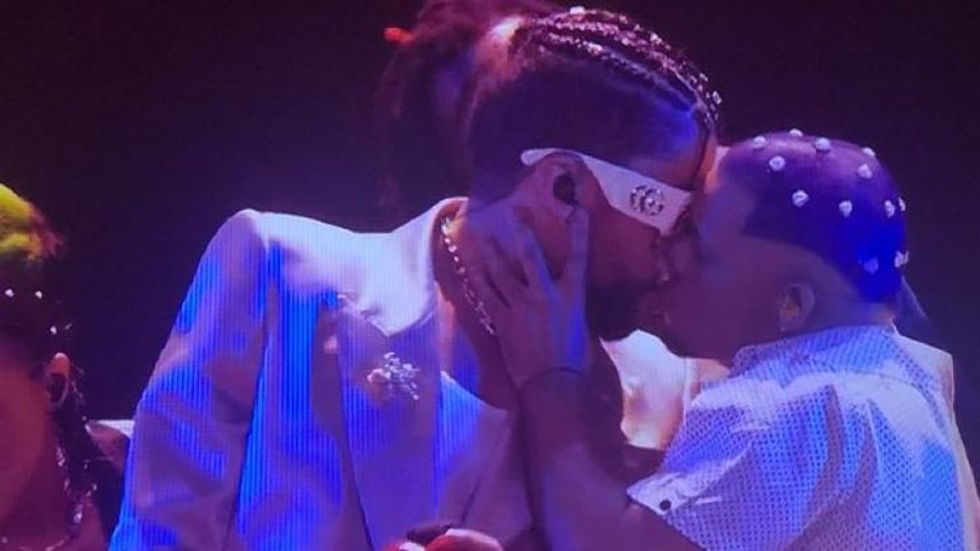
Bad Bunny performing 'Tití Me Preguntó' at the 2022 MTV Video Music Awards
MTV
"Bunny's entire history with the LGBTQ+ community has been about breaking down the macho stereotype that has been set over the course of so many years by male reggaeton stars in Latin America," this writer argued on Out in response to that viral performance from 2022. "The speculation or definitive conclusion of whether Bad Bunny is fluid, bi, gay, or queer has never been the point, and has never been his point, either."
Between getting his nails done, dressing up in full drag, and kissing a male dancer at the VMAs, Bad Bunny continues to prove that a male artist — particularly in genres dominated by toxic masculinity — can be the biggest musician in the world without being misogynistic, homophobic, and/or transphobic. And if, or when, that does happen, a path to apologize and reconsider past choices is available to anyone who means well.
'Where She Goes'
"Where She Goes" is an exhilarating Jersey club song with a stunning music video shot in an expansive desert. Celebrity cameos from Frank Ocean, Dominic Fike, Juliana Nalú, Julian Consuegra, Sabrina Zada, and Ronaldinho are all seen in the video, too.
This is an EDM banger from Bad Bunny that's actually titled in English, includes a few English words, and will generally sound familiar to pop music fans.
'Dákiti' (with Jhay Cortez)
"Dákiti" is one of the most popular songs of all time in Bad Bunny's discography. Once again aided by an electronic sound that is easily digested by mainstream audiences, this song was pretty inescapable if you live anywhere in the U.S. with a significant population of Latinos and went out to a bar.
This hypnotic track also has an immersive music video that transports fans to this gorgeous location, once again honoring the beauty of Puerto Rico and its natural sights.
'NUEVAYoL'
As Bad Bunny continued to make progress in his career and was afforded many more opportunities to perhaps even move to the U.S. and become an English-speaking musician who'd sell out arenas across the country, "NUEVAYoL" is a song that navigates that what-if scenario. Though this sentiment is very clear in the lyrics, it is even more pronounced in the music video, which shows the singer failing to assimilate in a different culture and not finding any actual happiness being away from Puerto Rico.
New York City — and the idea of feeling cold — are the two main plot devices used by Bad Bunny to communicate that no matter how fancy his life becomes, and the community he very well could find elsewhere, his heart belongs to La Isla del Encanto.
'Debí Tirar Más Fotos'
The title track of Bad Bunny's Grammy Award-winning studio album Debí Tirar Más Fotos was expanded upon with a short film that captures the essence of the song — exploring the loss, the regret, and the nostalgia of returning to a time when someone you really loved is no longer around.
The other, underlying meaning of the song relates to Puerto Rico as a whole, with Bad Bunny commenting in several tracks how he feels about the island being either ignored to the point of abandonment or taken over for financial reasons that lead to its full and complete gentrification. Two outcomes that are painful and unfortunate, but also real.