

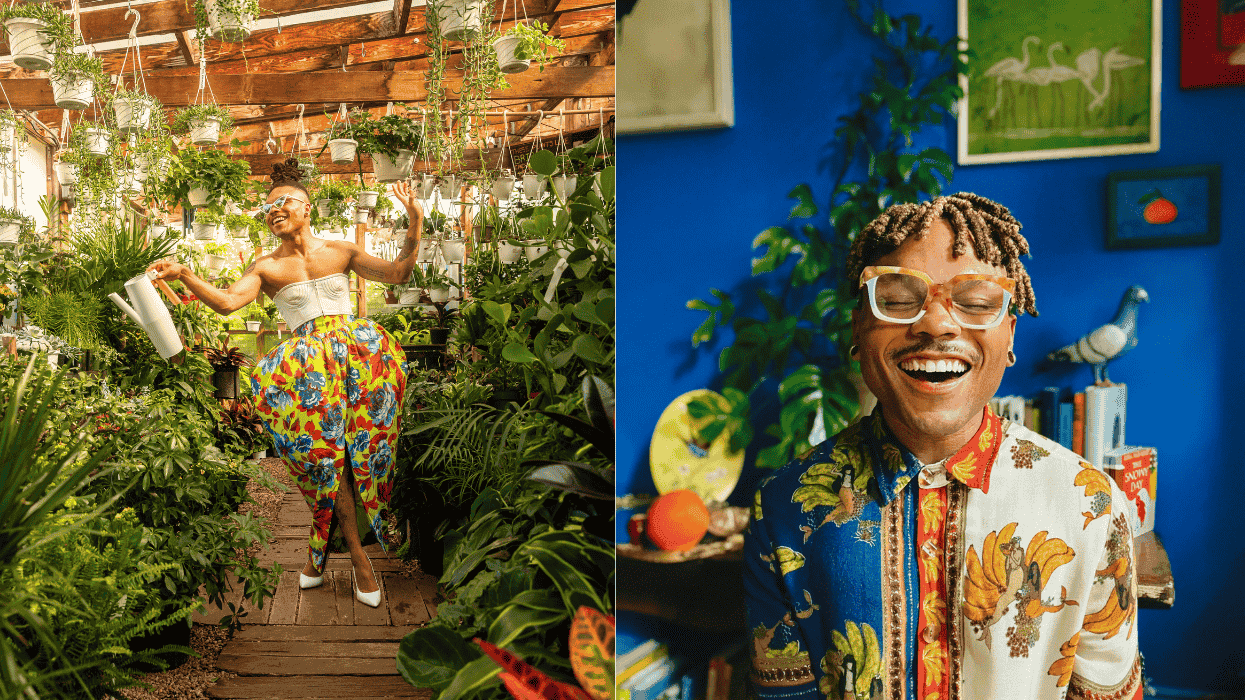

Step into the world of Christopher Griffin, better known as Plant Kween, and you won't just find houseplants. There's an entire ecosystem humming with intention. As the Plant Kween, Christopher has turned greenery into a living language, one that speaks of tenderness, identity, and radical care. What began as a simple curiosity about plant care has since blossomed into something far bigger. After our chat, I realized that Christopher has curated a brand where growth is both botanical and personal, where sunlight feels like affirmation, and where joy is cultivated as deliberately as a Monstera.
Marie-Adélina de la Ferrière: For those who don't know or follow you, tell our readers a bit about yourself.
Christopher Griffin: I'm Plant Kween — Christopher Griffin — a Black queer non-binary storyteller who uses plants as a doorway into something bigger: tenderness, identity, humor, healing, and belonging. I'm West Philly born and raised, and I live in Brooklyn now, where my apartment has basically become a little green world in the middle of the city.
Professionally, my background is in education and storytelling — I have a Master's in Higher Education, and I've spent years learning how to make people feel seen, cared for, and invited in. What started as "I love greenery" pretty quickly turned into "wait… I love what greenery does to us." Plants slowed me down when life felt loud and a little too fast. They taught me to pay attention to what I'm feeling, what I need, and what's actually working.
And over time, plants became this language I could speak out loud, publicly — about care, about community, and about what it looks like to take up space beautifully, exactly as you are.
Who inspired your green thumb?
The Black women in my life. Full stop.
My grandmother, Andrell Griffin, especially. She had that kind of magic where you walk into the yard, and you can feel that someone is loved here. Her garden wasn't just pretty; it was a world. As a kid in West Philly, I watched her tend to things with patience and pride, and I didn't realize until I got older that I was watching a philosophy: nurture what nurtures you. She didn't just teach me how to grow plants — she taught me how to grow myself.
Where do you live now, and how does that space further inspire your gardening ethos?
I live in Brooklyn now, and my home is basically a living, breathing greenhouse with a heartbeat. I've built a little ecosystem in the middle of the city — sunlight, leaves, shelves, corners that feel like small sanctuaries.
Living here makes my gardening ethos very clear: I'm not waiting for the "perfect" life or a "big backyard" to feel grounded. I'm building softness where I am. I'm proof that you can make a home feel alive — even in an apartment, even in the middle of concrete, even when life is moving fast.
Is there a plant in your collection that feels like it holds a story or lesson for you?
Yes, my 30-year-old Monstera deliciosa. I bought it from a fellow gardener at a little pop-up shop I used to love — I went quite frequently that summer of 2022. It wasn't a big flashy moment, but it's one of those purchases that stays with you because it felt like being handed a living piece of someone else's care.
And that's the lesson it keeps teaching me: what's mature and thriving didn't get there overnight. That plant has lived through years of change — different hands, different homes, different light — and it's still reaching. It reminds me that growth can be slow and still be spectacular. That consistency counts. And that sometimes the most beautiful things in your life are the ones you choose on an ordinary day, and then keep choosing, again and again.
What moment made you decide to share your love of plants publicly, and did you imagine it would resonate and expand into various topics the way it has?
At first, I was just sharing what I genuinely loved. It started in the summer of 2015, right after I bought my very first plant. I'm naturally curious, so once plants entered my life, I fell into this steady rhythm of learning — paying attention, trying things, noticing what worked.
As I started sharing that journey, friends began asking me so many plant questions that I eventually made a separate "plant page" — partly to document what I was learning, and partly to have a home for all those conversations.
And then it became something else: community. The page opened up this whole world where I started connecting with plant shop owners, growers, and people who loved nature as much as I did. I'd pop into shops, learn from the folks behind the counter, trade tips, swap stories — and suddenly plants weren't just helping me feel grounded, they were helping me feel connected.
I didn't imagine it would expand the way it has — into fashion, wellness, travel, identity, joy, grief, the whole thing. But in hindsight, it makes perfect sense: plants are never just plants. They're patience. They're desire. They're hope. They're a mirror. Once you start speaking that language, it touches everything.
In addition to sharing your life and gardening experiences, I LOVE and eagerly anticipate your weekly inspirational quotes. Can you tell us more about how and why you started doing that?
Thank you, that means a lot!
The quotes started because I needed them myself. I was moving through seasons where I wanted something honest, something that didn't feel like toxic positivity — more like a friend pulling you close and telling you the truth with love. Over time, it became a practice: taking what I'm learning in real time (about boundaries, rest, becoming, softness) and turning it into language people can carry with them.
They're little offerings. Little lanterns. And I take them seriously because words have saved me before
Black queer and trans communities are facing increasing attacks across the country. Why is Black queer joy not just important, but essential in moments like these?
Because joy isn't a distraction. It's resistance. When the world is trying to shrink us, erase us, or scare us into silence, Black queer joy becomes evidence. Evidence that we're still here. That we're still whole. That we're not only surviving — we're creating, laughing, loving, building, dancing, resting, and dreaming on purpose.
Joy protects the spirit. It keeps the heart from hardening. It reminds us we are more than the attacks, more than the legislation, more than the headlines that try to reduce our lives to a debate.
And it's not something we have to "earn." It's a birthright. In moments like these, choosing joy — openly, unapologetically — is choosing dignity. It's saying: you don't get to define my life by fear.
And is there a message or quote you'd like to leave with our readers?
"We survive by staying connected, not by staying quiet."
Not the kind of connected that's just hearts on a screen — the real kind. The kind that asks, how are you… really? The kind that shares what you know, names what you see, and refuses to let people disappear in plain sight.
Because isolation is how fear spreads. Connection is how we fight back without losing ourselves. It's how we turn panic into a plan, grief into care, and overwhelm into "okay, I'm not carrying this alone."
So reach out. Start the group chat. Knock on a door. Share the resource. Tell the truth with love. Let your voice be a bridge. Let your presence be a shelter. We don't get through this by being polite. We get through this by being together.