

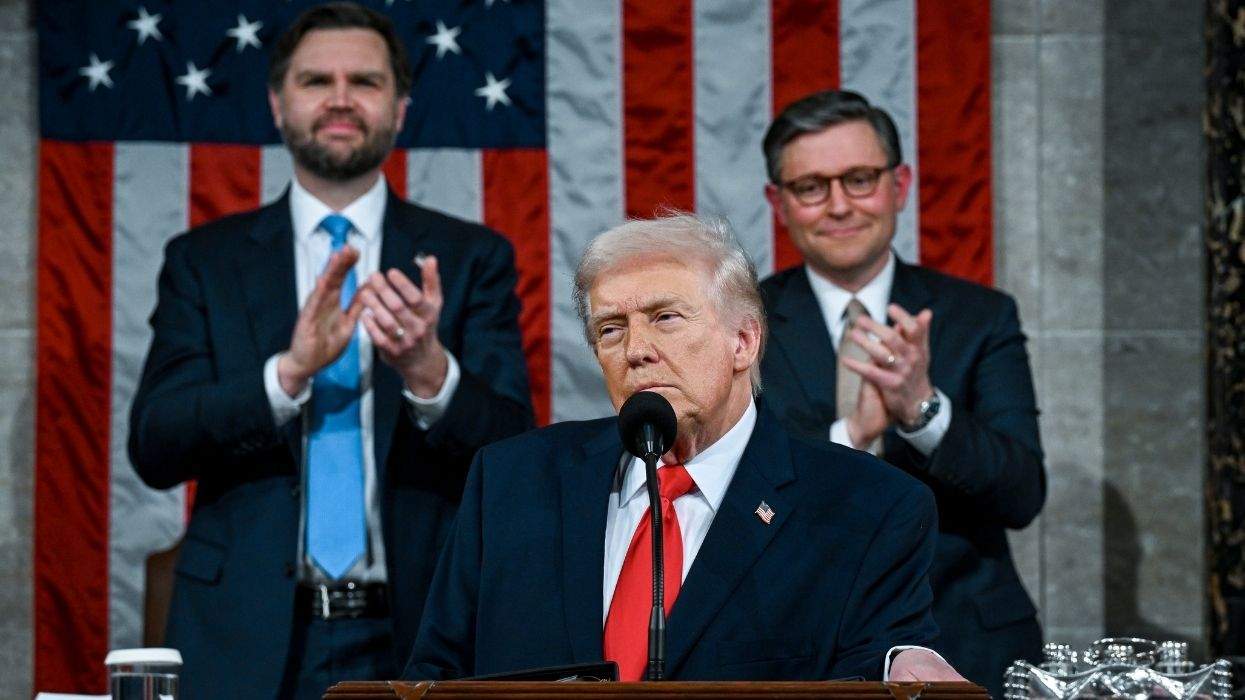

President Donald Trump used Tuesday night’s State of the Union address to single out a teenage girl’s story and, in doing so, cast the broader transgender community as a political target, turning the nation’s most-watched annual speech into a familiar culture war flashpoint.
Keep up with the latest in LGBTQ+ news and politics. Sign up for The Advocate's email newsletter.
At a moment when Americans are still grappling with high health care costs, struggling with economic uncertainty over affordability, and a contentious debate over immigration enforcement, the president instead trained his fire on transgender youth, a population whose size and medical care, researchers say, are routinely misrepresented in political debate.
During a speech filled with falsehoods and bravado, Trump began by claiming that before he took office again in January 2025, the U.S. was a “dead country” that it is now the “hottest” in the world, before boasting, “we ended DEI in America."
The White House invited a Virginia teenager, Sage Blair, and her mother, Michele Blair, to sit in the House gallery.
Trump spoke about “Sage’s harrowing story,” accusing Virginia school officials of secretly “socially transition[ing] her to a new gender” without her parents’ knowledge. Blair’s family claims that school officials affirmed her gender identity without notifying her parents. The Blair family alleges in ongoing litigation that she ran away from home and was subsequently trafficked for sex and that the school’s actions led to her traumatization.
Trump used the anecdote to argue for national action, telling Congress that “no state can be allowed to rip children from their parents’ arms and transition them to a new gender against the parents’ will,” adding, “We must ban it, and we must ban it immediately."
The family has been central to repeated efforts in the Virginia legislature to pass so-called “Sage’s Law,” a proposal that would require schools to notify parents if a student discloses that they’re transgender and restrict even socially affirming practices like using their preferred name or pronouns without parental consent.
Civil rights groups have described the bill as a “forced outing” measure that would endanger vulnerable students and erode the civil rights of transgender and nonbinary youth.
When only Republicans stood in agreement with Trump’s words, he let his anger show. "Nobody stands up," Trump said, pointing at Democratic lawmakers. “These people are crazy. I’m telling you, they’re crazy. Boy oh boy. We’re lucky we have a country with people like this. Democrats are destroying our country, but we’ve stopped it just in the nick of time.”
According to data collected by UCLA Law School’s Williams Institute, about 2.8 million people, or 1 percent of the population in the U.S., identify as transgender, with 3.3 percent of U.S. youth ages 13 to 17, roughly 724,000 teenagers, identifying as transgender, an August 2025 report found.
Related: Over 80 House Democrats demand Trump rescind gender-affirming care ban: 'We want trans kids to live'
Related: He voted for Trump. Now he’s worried his trans son will lose gender-affirming care
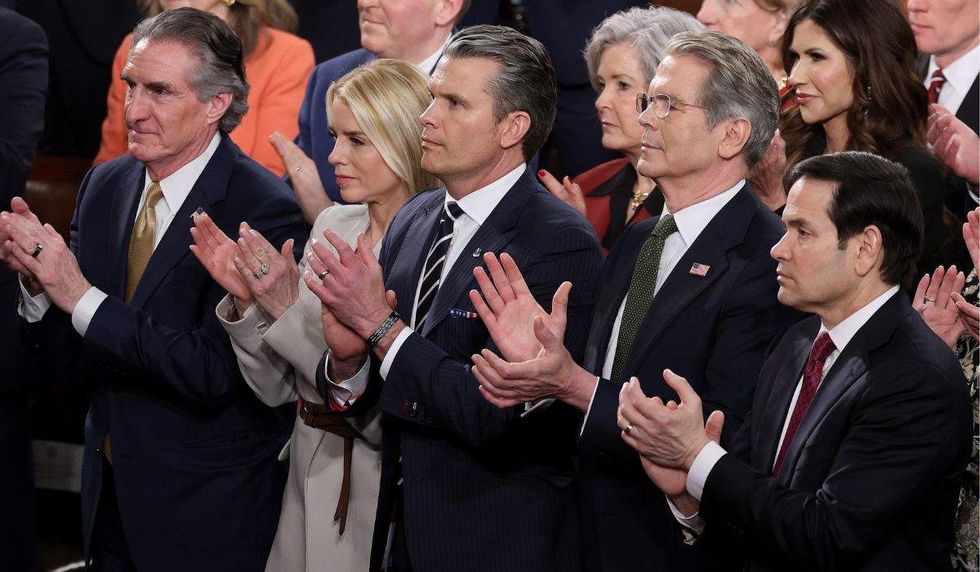 Cabinet members (L to R) Secretary of the Interior Doug Burgum, Attorney General Pam Bondi, Secretary of War Pete Hegseth, Treasury Secretary Scott Bessent, and Secretary of State Marco Rubio applaud during President Donald Trump’s State of the Union address during a Joint Session of Congress at the U.S. Capitol on February 24, 2026, in Washington, DC. Win McNamee/Getty Images
Equality Virginia, the state’s most influential LGBTQ+ advocacy organization, said Trump was “weaponizing” the family’s story to advance a nationwide ban. “Tonight, the President is choosing to double down on efforts to disrupt access to evidence-based, lifesaving care,” the group said in a statement. “Rather than allowing families and doctors to navigate deeply personal medical decisions free from federal interference — or allowing schools to respond with nuance and compassion without putting marginalized children at risk — the President is instead advocating for reckless, one-size-fits-all political control.”
Related: Donald Trump delivers presidential address filled with anti-LGBTQ+ lies and transphobic rhetoric
“At a time when Virginians are worried about rising costs, economic uncertainty, and aggressive immigration enforcement actions disrupting communities and families,” the statement continued, “attacking transgender young people is a blatant political distraction from the real challenges facing our nation.”
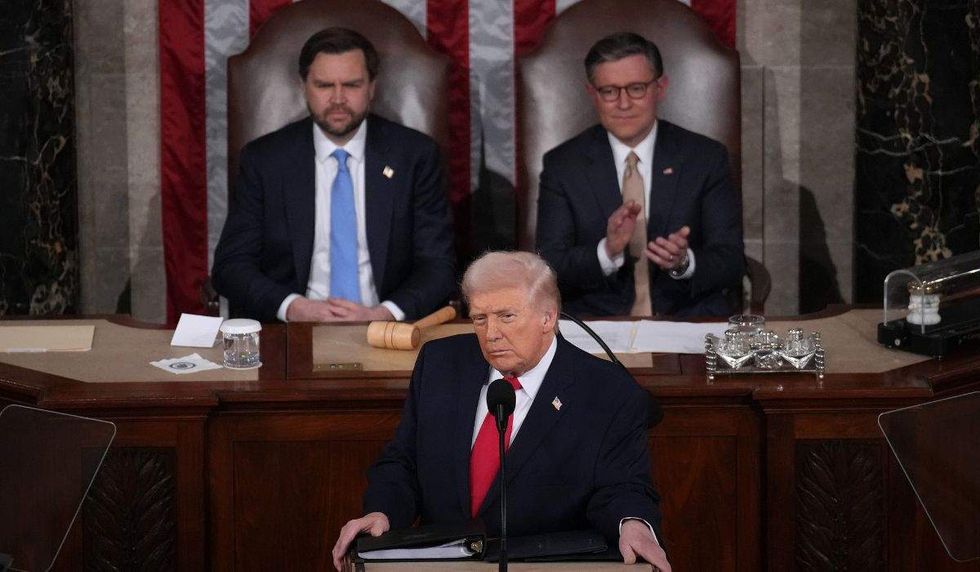 U.S. President Donald Trump, with Vice President JD Vance and Speaker of the House Mike Johnson (R-LA) looking on, delivers his State of the Union address during a Joint Session of Congress at the U.S. Capitol on February 24, 2026, in Washington, DC. Andrew Harnik/Getty Images
Related: Trump HHS posts ‘so-called report’ pushing conversion therapy for trans kids
Trump’s remarks fit into a broader federal push to restrict access to gender-affirming care. After the U.S. Supreme Court ruled last summer that Tennessee’s ban on gender-affirming care for minors is constitutional, conservative-led legislatures have tried to curtail access to this care for those who live outside that state.
In December, the Centers for Medicare & Medicaid Services proposed a series of rules that, taken together, would allow the federal government to withhold Medicare and Medicaid funding from hospitals that provide such care to minors. The Human Rights Campaign said it collected nearly 36,000 public comments opposing the proposals, warning that they would chill hospitals’ willingness to provide medically necessary care far beyond the narrow procedures targeted in political speeches.
On Capitol Hill, Republicans have pursued a parallel strategy. Over the past year, the House of Representatives advanced multiple bills focused on transgender health care and participation in schools, including proposals that would have classified best-practice care as a felony, exposing parents and doctors to criminal penalties for following established medical guidance.
HRC President Kelley Robinson sharply criticized Trump’s speech. “Whether it’s incoherent lies about his agenda, dangerously racist rhetoric about American communities, rambling grievances about past elections, or absurd and obsessive outbursts about transgender people, nobody knows what this President is talking about,” Robinson said in a statement. “The real state of our union is Trump-fueled chaos, division, and crisis. We’ve had enough – and he’ll hear that loud and clear in November.”