

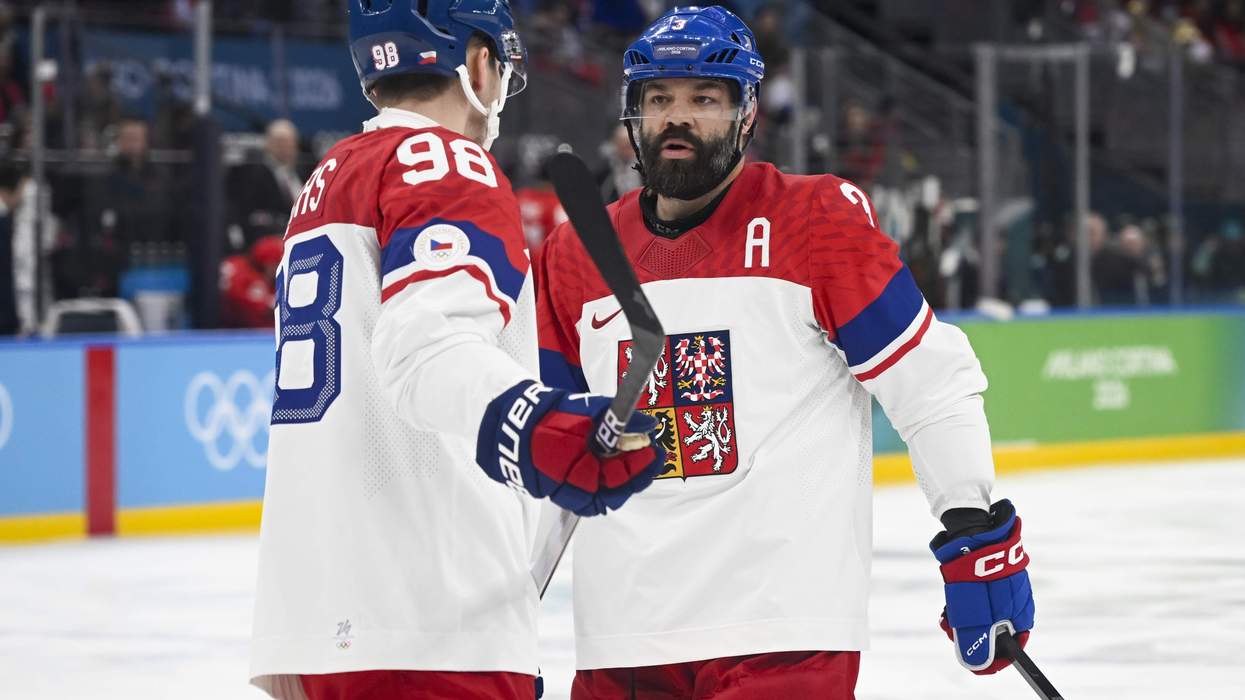

During last week’s quarterfinal game between Canada and Czechia at the 2026 Milan Cortina Winter Olympics, a player from the National Hockey League shouted a homophobic slur, seemingly toward a referee.
Keep up with the latest in LGBTQ+ news and politics. Sign up for The Advocate's email newsletter.
Radko Gudas plays defense for the Anaheim Ducks and represented his home country, Czechia, at the men’s hockey tournament at the Winter Olympics. But during a heated exchange last week, he shouted that someone, seemingly a referee, was a “f***ing c**k sucker,” as seen in videos of the incident shared to social media.
Related: Inside the undiscovered queer life of U.S. hockey’s first superstar, Hobey Baker
Related: Lesbian hockey players will live out 'Heated Rivalry' at the upcoming Olympics
Related: 'Heated Rivalry's Harrison Browne says new anti-trans hockey policy is 'crazy' and blames Trump
Related: Hockey player's viral coming-out was 'overwhelming' in 'the best way possible'
Gudas shouted the term while arguing with the referee over a two-minute penalty he received in the second period for unnecessary roughness against Brandon Hagel, a player for Canada’s Olympic team and left winger for the NHL’s Tampa Bay Lightning. During the game, Gudas also injured Canada’s team captain, Sidney Crosby, who was forced to sit out for the rest of the game. Czechia went on to lose the game 4-3, eliminating the country from medal contention.
Related: There are no out NHL players. Could 'Heated Rivalry' change that?
Related: How a gay hockey star is fighting homophobia when not in the rink
Canada ultimately faced the United States in the Olympic final, where the U.S. earned its first gold medal in men’s hockey since the so-called “miracle on ice” in 1980, when it defeated the Soviet Union.
According to the Code of Ethics for the International Olympic Committee, which oversees Olympic programming, athletes cannot engage in discrimination “on any grounds,” including sex and sexual orientation. Gudas did not address his usage of the term in interviews after the quarterfinal game.
This article was written as part of the Future of Queer Media fellowship program at The Advocate, which is underwritten by a generous gift from Morrison Media Group. The program helps support the next generation of LGBTQ+ journalists.