

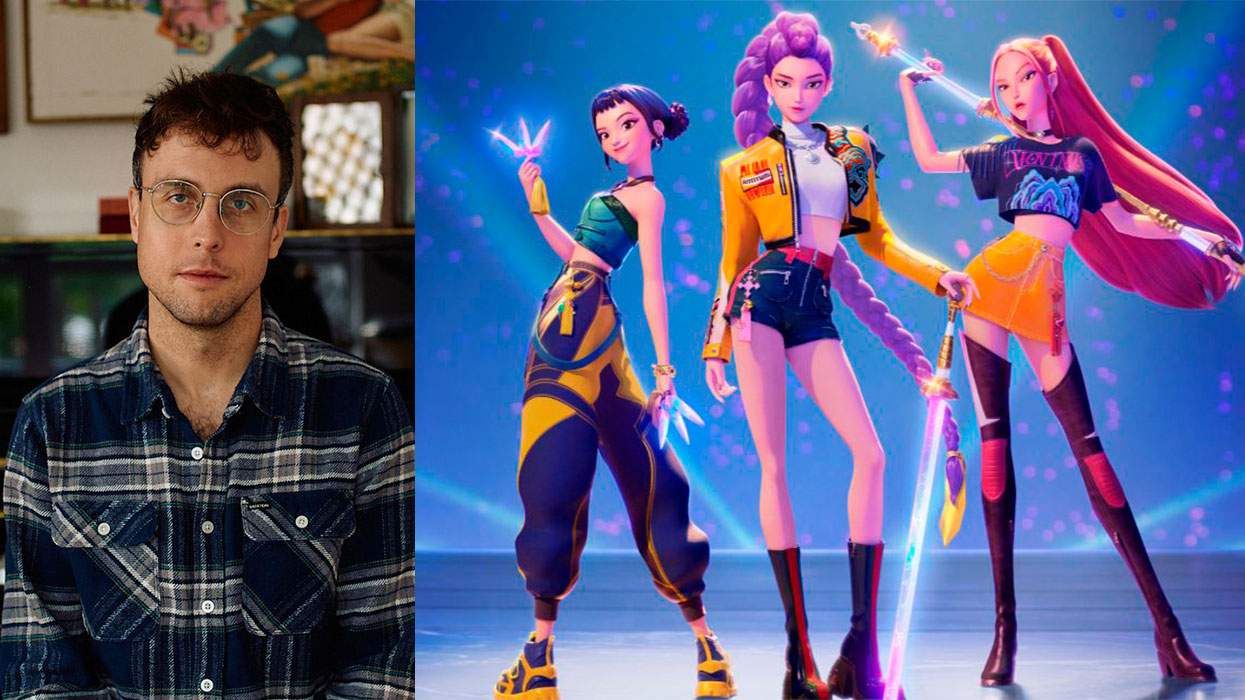
The queer allegory in Netflix's hit animated film KPop Demon Hunters is more than just subtext – it's actually built into its foundations.
Did you know that 2025 Out100 artist Mark Sonnenblick, who previously worked on Theater Camp and Lyle Lyle Crocodile, cowrote every song in Kpop Demon Hunters besides "Take Down" and "Soda Pop," alongside the breakout voice of the film, Ejae? He worked with a superstar group of K-Pop writers, including The Black Label (led by Teddy Park) and the breakout voice of the film Ejae. (Ejae voices Rumi, the lead singer of the K-pop girl group Huntr/x, which uses their hit music to fight demons.)
"We were able to write these songs that standalone as pop songs," Sonnenblick tells Out in an exclusive interview, "which makes sense because in the movie, they're supposed to be the biggest pop stars in the world."
Before all of the success, the team worked together from opposite corners of the world. "Ejae and I, 1 a.m., she'd be in Korea and I'd be in New York. We'd be on a Zoom just like, 'If we can pull this off, it'd be something really, really cool.'"
Sonnenblick reveals some behind-the-scenes facts about the songs: "What It Sounds Like" (which he wrote with Stephen Kirk and Jenna Andrews) took over a year to write and had over 100 different versions. "How It's Done" was originally storyboarded to another song entirely. And "Golden," the number-one song in the country for eight consecutive weeks, wasn't completed until December 2024.
"'Golden' was the last song written and the last one to be put in the movie," Sonnenblick shares. "It came together quickly because by then, we had already tried six other versions of the song." In one version, "the pre-chorus was less yearning, a little bit less about trying to show who you really are, and about perfection: 'Endless shine and dying light, that's who I'm born to be.'"
The songwriting was an intimate back-and-forth between him, Ejae, The Black Label (who produced Golden’s instrumental track), and the film's directors. They asked if the lyric could "'be a little bit more about wanting to be honest and wanting to be who you truly are?'"
"You hear it outside of the movie, it's this big empowering anthem, which it totally is," but lyrically, the meaning holds something much deeper. "There's a whole other layer to the meanings of these songs that are really specifically woven into the story," Sonnenblick says. "The irony in the movie, where the emotion comes from, is Rumi hiding who she is as she's singing, 'No more hiding.'"
Those hidden meanings give the film an edge. Take "Your Idol," the Saja Boys anthem at the movie's climax, where the demon boy band reveals that they're stealing their fans' souls. "Your Idol" refers to themselves as K-pop figures, but also plays with the Christian sin of idolatry. The group donned rosary beads while singing about "preaching to the choir," and the story connects Rumi's shame about her scars and hiding who she is to the sin that damned the band's frontman Jinu to hell.
"How the Saja Boys were dressed is really rooted in deep, older Korean culture, the demon designs are too. So it's not specifically religious, but there is a lot of Christianity in Korea, and it's part of Ejae's background too. And I'm half Jewish, half Christian," Sonnenblick shares.
Sonnenblick credits his co-writers with the hook idea ("Ejae came up with that") and the initial cathedral vibes of the instrumental track (“That was Ian Eisendrath, our executive music producer, and The Black Label”). "The double meaning we were interested in is not only this idea of K-pop idol, but also just in a relationship too. A kind of toxic thing, like, 'Hey, baby, it's all right. Just turn to me. I got you.' But then being able to make that musical with, they're literally stealing your souls with how they make you feel. 'Anytime it hurts, play another verse.'" That's how it can feel to play music. In the case of Huntr/x, it's a place of salvation.
This core difference was held dear to Sonnenblick and the filmmakers while writing all of the songs.
"Huntr/x connects people through music, and the Saja Boys isolate you through music. It's you with your headphones on. It's you watching them. It's not you turning to the people next to you and embracing everybody in the room. It's the demon in your ear saying that you're not good enough. It's saying, listen to this song and tune out the people around you. And these are both sides of what music can do."
How these pieces came together is what's made KPop Demon Hunters the most-watched Netflix original film of all time, which is still shocking to Sonnenblick. And while Ejae was originally a songwriter who submitted ear-catching demos, she eventually became the voice of the film's star, Rumi.
"You work on so many things, you have no idea what the response is going to be," he says. Some might see a straight-to-streaming animated film as a death sentence, but in retrospect (with the streaming numbers and the Hot100 number-one spot), it was the perfect route for the film.
"When this first dropped on Netflix, there wasn't a lot of fanfare around it. Part of what was so powerful was how it was embraced by the fans," he says. Word of mouth is really where this came from."
For his next act? Sonnenblick is working on a stage production for Andrew Haigh's classic 2011 queer film, Weekend. "It takes place in Brooklyn," Sonnenblick confirms, tight-lipped about the details of a production still in its very early stages. He was able to confirm to Out that Weekend currently features elements of movement, dance, and music — though they're still figuring out the balance of the modern reinterpretation.
"Everyone working on it is brilliant, and just operating at the top of their game. Every time we get to go back in the room with it, it's great. Hopefully, sometime in the next two years, we'll be able to share it and hopefully do justice to Andrew's film."
Sonnenblick hopes they're able to get "at the heart of Andrew's beautiful movie."