



Let’s have a baby together. It’ll only set you back $250,000.
To become a gay dad with a biological child, you’ll first need some eggs (human ones). You can buy some from an egg bank or try to find a donor who will cycle just for you. If doing the latter, it’s good to have contracts, so you’ll need a lawyer too.
Then you need to get your eggs to a fertility clinic. If you have a donor, you’ll be paying for their travel and appointments. If you’ve got the eggs, a freezer truck transportation service will do. Embryologists at the clinic do their thing with the eggs and your sperm, and voilà — you have embryos on ice. If embryologists sound expensive, it’s because they are.
We’re done with the “less hard” part. Now you need to find a surrogate, the uterus-bearing person who will carry your baby. You’ll either pay a surrogacy agency, which can be pricey, or find a surrogate of your own, which “sounds hard because it is,” says Janene Oleaga, attorney and founder of Oleaga Law, a family formation law firm. “Then there’s the actual embryo transfer, which may or may not be covered by insurance. You’ve also been paying this whole time to keep the embryos cryogenically preserved,” Oleaga says.
Feeling the cash crunch yet? There’s another cost to consider. The stigma against gay parenthood runs deeper than rhetoric alone. It’s woven into the very fabric of our health care system.
As LGBTQ+ acceptance makes hard-fought progress, today’s young people are coming out earlier than previous generations. In a 2018 survey conducted by the Family Planning Council, respondents over the age of 60 said they came out at an average age of 37; for respondents in their 30s, the average age was 21, and for respondents ages 18 to 24, the average age was 17.
When Obergefell v. Hodges granted federal marriage equality protections in 2015, LGBTQ+ interest in family planning spiked, with solutions like assisted reproductive technology (ART), foster parenthood, and private adoption leading the way. Nearly half of LGBTQ+ millennials are actively planning to grow their families, a difference of just 7 percentage points from non-LGBTQ+ millennials, and a marked difference from previous generations.
If queer intended parents (IPs) take the ART route, financial challenges loom. The average cost of in vitro fertilization (IVF) hovers around $12,400 per cycle, according to the American Society for Reproductive Medicine. But the chances of success are less than 50 percent, according to ART data from the CDC, adding considerably to the financial pressure. Subsequently, an entire boutique industry has emerged to help intended parents navigate the medical, legal, and emotional terrain of the process.
“To be very frank and honest with you, a lot of this is a mega, mega business,” says Harout Cracchiolo, who together with his husband became a first-time father last year. “We went with a friend who donated her eggs and paid for all her treatments. Then we went with a family member who ended up carrying the baby for us and got a separate surrogacy insurance for her. We still had to pay all the hospital bills, anesthesia, and doctor’s visits [out of pocket], because insurance wouldn’t cover it. We ended up at around $175,000.”
Cracchiolo says he and his husband were lucky, “because we did our IVF and got pregnant the first time.” He partially attributed this success to the care he and his husband received from their chosen fertility center, and he called some agencies “a scam.”
“One quote included a $60,000 agency fee,” Cracchiolo says. “Then it’s about another 20 or 30 grand for the egg donor, another 70 or 80 grand for the surrogate, and all the attorney’s fees.” Cracchiolo also says he and his husband calculated another quote’s projected total cost to be over $250,000, with the agency wanting most of that money in escrow upfront.
Family planning professionals said the $60,000 agency fee figure sounded high and noted that every industry has its bad actors. For many intended parents, finding and working with a good agency to mitigate the risks of surrogacy will be worth the investment. “There are a number of reputable agencies protecting both intended parents and surrogates alike,” Oleaga says in a follow-up email. “An ethical, knowledgeable agency provides valuable guidance and support throughout the surrogacy journey.”
Oleaga adds that many lawyers offer to review agency agreements with both intended parents and surrogates to ensure individuals understand what they are agreeing to, along with what services the agency will and will not provide.
Nevertheless, for gay male couples, the fertility financial benefits that come with health insurance are often stunted, since they may only apply when policy holders themselves are the ones who are pregnant. “The majority of gay men,” says Oleaga, “should expect a six-figure bill.”

The unpredictable costs of fertility have led some intended parents to seek out agencies whose financial safeguards help keep their family planning hopes alive, says Taylor Frey, who with his husband Kyle Dean Massey opened Elevate, an egg donation and surrogacy agency, after their own decade-long fatherhood journey.
“When Kyle and I went through the process, we were both working in Broadway shows, and we started a savings account to create embryos with an egg donor,” Frey says. “I was 25 at the time. We created embryos, then put them on ice for eight years so we could replenish funds.”
Frey and Massey say they founded Elevate to innovate on industry setback and cancellation policies. “If you do not end up with what you need to transfer to a surrogate, your recycle fees are on us,” says Frey, referring to fertility fees incurred when eggs turn out to be unviable.
“The reason why [surrogacy] is so expensive is that, from deciding you want to be a parent to having a baby, hundreds of people will touch your case,” Massey says. “All the attorneys, and psychologists, and counselors, and lab technicians, and nurses, and physicians, and monitoring clinics, and labs — it’s a lot of people.”
Oleaga agreed with the idea of meeting with several prospective fertility service providers as a best practice. “I always advise intended parents and potential surrogates to meet with multiple agencies and review their agency agreements before signing on,” she says.
For female same-sex couples, the dynamics are different, albeit no less demeaning.
“We knew we wanted to have kids. My only stipulation was that we be married first because we’re gay,” says Samantha Davis, who with her wife Leni had their son via intrauterine insemination (IUI) on their second attempt in 2019. “I just didn’t want the government to feel like we weren’t both equally the parent.”
If heterosexual couples have unexplained infertility, they need to have been trying to conceive for at least a year (or six months if over the age of 35) before a doctor will make the diagnosis official, a declaration that unlocks health insurance benefits for some fertility services. But for same-sex couples, the waiting period is waived. “Because we’re gay, I wanted to make sure that I was automatically considered infertile [from the start] so that the insurance would cover some of the stuff we would be going through,” Samantha says.
The couple’s infertile status unlocked an allowance of $16,000. “That’s not per child, or per year,” Leni says. “That’s for life.” The Davises’ expenses included storage for sperm and paying to have embryos created and tested, all of which quickly burned through the stipend. They also say they had to pay out of pocket for psychiatric evaluations and blood work.
“The first time, we weren’t in a great financial place,” Samantha says. “We were scraping every time we needed to pay for something.” Samantha touched her belly. She’s pregnant again, this time through IVF.
“After our son, I really wanted to have a girl,” she says. The couple decided to do IVF to produce a female embryo, but after two attempts, the only remaining healthy embryos were males. “We could have tried again to see if we could get that girl, but financially it wasn’t feasible.”
The path to biological parenthood shouldn’t be this expensive for anyone. For LGBTQ+ people, however, the journey remains especially taxing as we navigate systems ill-suited to our family planning interests.
“A lot of LGBTQ+ people don’t have children, so it’s not such a big movement,” Cracchiolo notes. “But it needs to be. You want to feel included. You’re having a baby — you don’t want to feel strange when you go to the hospital.”
Horror stories aside, the parents agree their journey was worth every step.
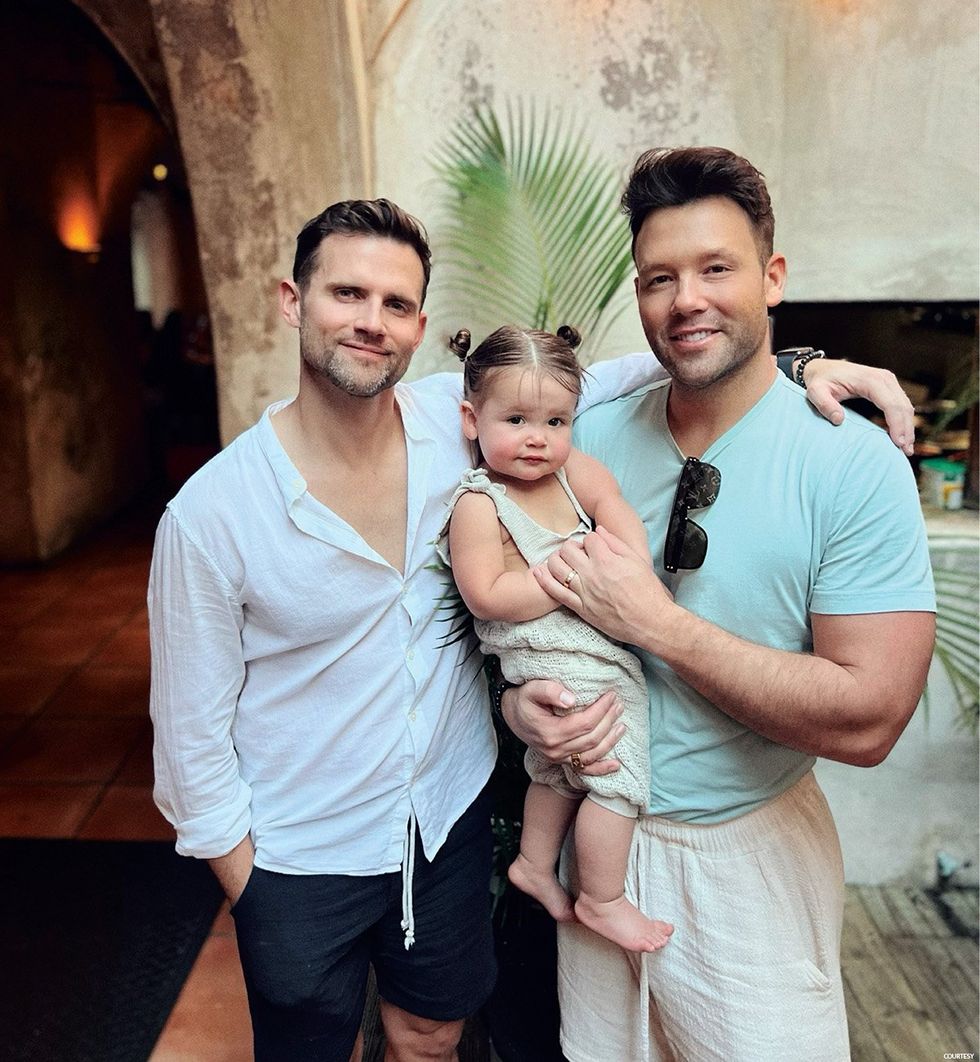
“It’s the coolest thing to wake up and know that every day you’re working towards making this child’s life something you didn’t have,” Cracchiolo says. “It’s just the best thing ever.”
The Davises echo this sentiment. “It’s rewarding in so many ways,” Samantha says. “I think I’ve learned so much about myself, my upbringing, things that I hope to do differently.”
Queer people deserve to become biological parents regardless of socioeconomic status. But reform is needed to make LGBTQ+ parenthood more financially accessible. In the interim, anticipating the future cost of parenthood might influence how you spend and save your money today.
Oh, and if people start to give you shit for tightening the budget to fund your legacy — “Fuck ‘em,” Samantha says. “Don’t worry about what anyone says. Find what works for you and your family.”
Leni laughs. “You can quote her on that.”
Nick Wolny is a journalist, speaker, and entrepreneur. He writes about the intersection of LGBTQ+ life and personal finance, and has previously contributed to CNET, Entrepreneur, and Business Insider. Join his newsletter at NickWolny.com.
This article is part of the Out May/June issue, available on newsstands May 30. Support queer media and subscribe -- or download the issue through Amazon, Kindle, Nook, or Apple News.