

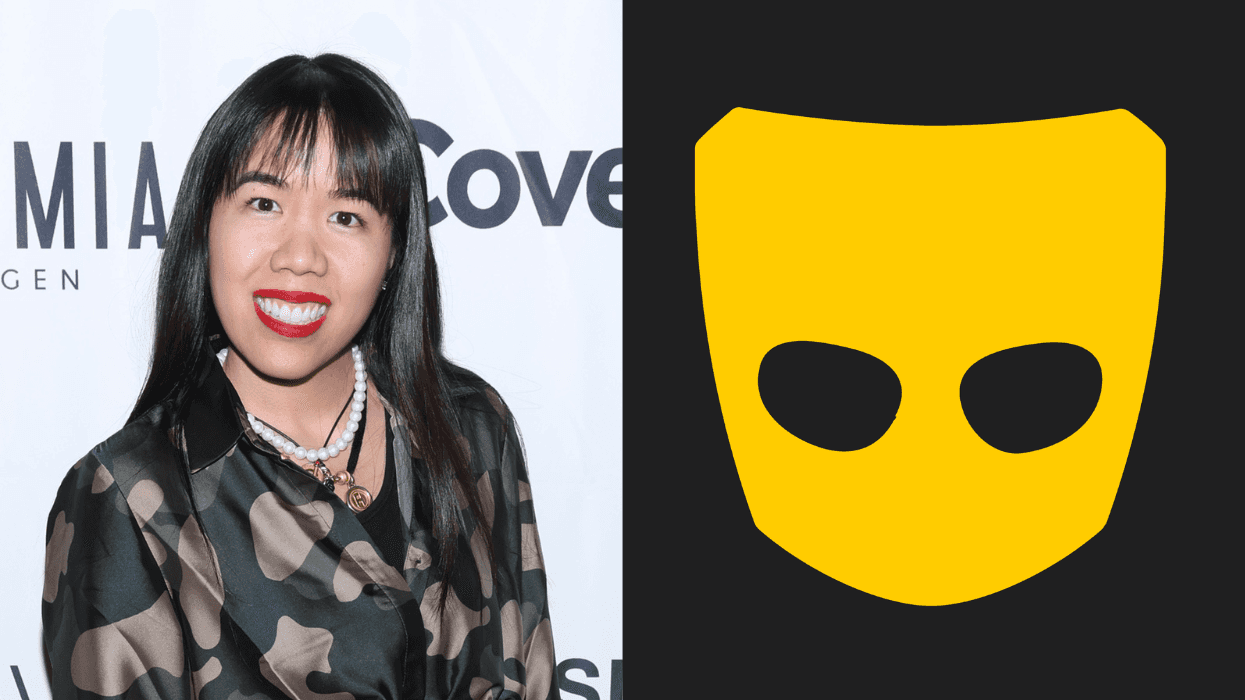
A few days after my essay about being a straight woman on Grindr was published, a friend called to say he had read it four times and cried. Midway through, he started crying again. So, technically, my Grindr article made him cry five times.
He screenshot the line that got him and texted it to me. It was the last sentence: “Everything that made the friendship matter happened afterward.”
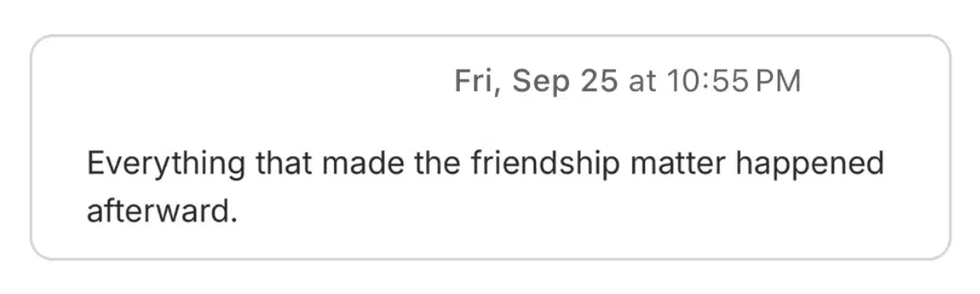 A friend shared the line from J’Net Nguyen’s original Out essay that moved him.Courtesy
I was touched, and a little amused. I thought I had written a funny, occasionally raunchy story about the objectively ridiculous fact that I have spent years on Grindr, a fact made funnier by the position on my profile: Vers Top. I hadn’t expected anyone to find it heartfelt. I certainly hadn’t expected another “afterward.”
The essay went viral, and the response was overwhelmingly supportive. People called it fascinating, “boots-on-the-ground journalism,” and the ethnographic study they didn’t know they needed. Gay men I had never met wrote from around the world. Many wanted to be friends, and a few invited me to stay in their homes. One man in Europe said the whole thing was almost impossible for him to imagine. What stopped him were the private albums: gay men sharing explicit photos with a straight female friend without it turning sexual or awkward. He came from a country that wasn’t particularly gay-friendly, where even mentioning Grindr could feel taboo.
His note reminded me how much geography shapes what counts as normal. West Hollywood is its own strange little universe, full of people who came here to live outside whatever “normal” meant back home. In my bubble, I am pretty impossible to shock. There’s an unspoken understanding: you’re safe, you get it, this isn’t weird. What felt ordinary in my world carried an entirely different weight in his.
Then I did something even more questionable than joining Grindr: I posted the essay on LinkedIn. Next came messages from people I’d never met, including several at major companies. One lesbian senior executive told me seeing someone post so openly about Grindr made LinkedIn feel safer for her. That same week, a polished press release was being prepared announcing my appointment to a global council. In one corner of my life: official titles and professional headshots. In another: Grindr, gay men, sex, headless torsos, and strangers discussing me on the internet. Both women were me.
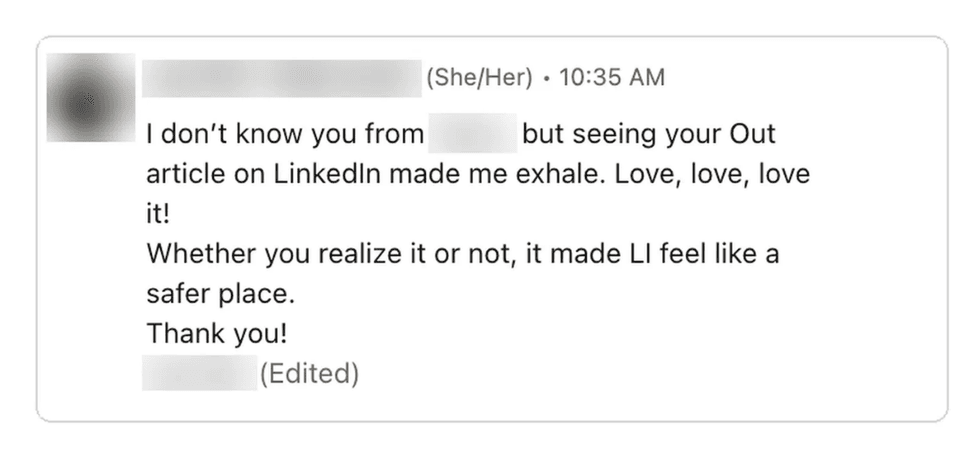 A LinkedIn user shares how Nguyen’s openness about Grindr made the professional platform feel more welcoming.Courtesy
A small minority disagreed, and some of their questions were interesting. One man made his case thoughtfully. Grindr, he argued, is a place where gay and bisexual men can be open about their desires and bodies. There are plenty of other places for a straight woman to show allyship. This one should be theirs. His description also left out the trans and queer users already on the platform, which makes “who gets to decide?” harder to answer.
I understood where he was coming from, though I didn’t entirely agree with where he drew the line. There is Grindr the platform and Grindr the piece of gay culture. They overlap, but they aren’t identical. The platform lets me identify as a cis woman and lists “Friends” and “Networking” among the things I can look for. A company can tell me I’m welcome while an individual man can sincerely feel that my presence changes something about a space he considers his. Gay people fought hard to build places where they could be safe, sexual, social, and fully themselves, and many of those physical places are disappearing. When something hard-won becomes scarce, people guard it.
I also believe gay men need spaces of their own. I’ve told my friends they should never feel obligated to invite me anywhere just because we’re friends. If you want a night that’s just the boys, have it. I have a robust social calendar. Sometimes I’ve been invited to gay male gatherings, gone happily for a couple of hours, and left early on purpose. Nobody asked me to. I just knew. Respecting a space isn’t only about whether you’re allowed through the door. It’s knowing when to leave.
But it gets more interesting. Gay men have told me they walked into a party, immediately wanted to turn around, and then saw me. So they stayed. They knew I would pull them into a conversation, introduce them to someone, or make the room less awkward until they found their footing. For some of them, the woman in the gay space was the person who made the gay space easier to enter.
That doesn’t give me an exemption from boundaries. It does complicate the idea that insider and outsider are always as obvious as they look on paper. There are gay platforms I don’t use precisely because I don’t think they’re for me. Sniffies is built around cruising. Goose calls itself “for the boys.” Message received. If Grindr announced tomorrow that it was exclusively for LGBTQ+ people, I would leave. But that isn’t what Grindr says, and it isn’t what the gay men in my life have asked of me. I ended up there because they welcomed me. If I disappear for a while, they notice: “Girl, I haven’t seen you on Grindr. What’s up with that?”
 J’Net Nguyen’s Grindr profile, where she has spent years connecting with gay friends.Courtesy
That is the difference between being welcomed into a space and believing you’re entitled to it. I don’t think gay spaces belong to me, or that most straight women need Grindr or would enjoy it. Readers compared me to the heroine of Josh Silver’s novel Fruit Fly, a straight woman who lands on Grindr. There’s one difference. She went looking for material. I went looking for my friends.
As the essay went viral, one of those friends, whom I’ll call Grant, told me he had my back. Then he widened it: “We always have your back.” He meant the boys. He didn’t say what he’d seen online, and I didn’t ask. Some friendships are built well enough that you can hear what isn’t being said.
The criticism didn’t hurt me. I slept damn well. I’ve Googled myself. I’m human. But I don’t go hunting for every opinion. What got me was realizing my friends were worried something might, and were quietly trying to shield me from it. A few gay men online were fiercely protective of Grindr from someone like me, while gay men who actually knew me were fiercely protective of me. And if you stand for anything, somebody will disagree. Sometimes they’ll be thoughtful. Sometimes they’ll be an asshole. Welcome to the internet.
A friend asked one more question I can’t shake. If I were a straight man doing exactly what I’m doing, using Grindr mainly to talk to gay friends who wanted me there, would the reaction have been the same? If your instinct says it would be different, it’s worth asking yourself why.
I don’t have a perfect answer for where every boundary belongs, and I’m not sure there should be one. A few gay men thought I didn’t belong on Grindr. Far more, friends and strangers alike, wanted me to know I did. I can hold both.
I read that screenshot line differently now: “Everything that made the friendship matter happened afterward.” The original essay was about how people find one another. Then strangers wrote to say I was welcome, while a few questioned whether I belonged at all. Through all the debate, the people who knew me continued to do what they’ve always done. They made room. I’ve always understood that being welcomed into a space also means knowing when to give others theirs. Sometimes the kindest thing I can do, even when someone has made room for me, is know when to step aside. Maybe all we can do is pay attention to who is opening the door, respect the rooms that aren’t ours, and take care of the people we find once we’re inside.
Everything that makes a relationship matter still happens afterward.
J’Net Nguyen is the founder of FriendsHAUS, a social venture helping gay men build meaningful friendships and a lasting social foundation. Based in Los Angeles and raised in a family with six gay uncles, she has spent years creating social and philanthropic initiatives within the LGBTQ+ community and serves on the Board of Directors of the Assistance League of Los Angeles and as an Executive Advisor to the World NGO Day Global Council.
Opinion is dedicated to featuring a wide range of inspiring personal stories and impactful opinions from the LGBTQ+ community and its allies. Visit Out.com/submit to learn more about submission guidelines. We welcome your thoughts and feedback on any of our stories. Email us at voices@equalpride.com. Views expressed in Opinion stories are those of the guest writers, columnists, and editors, and do not directly represent the views of Out or our parent company, equalpride.