

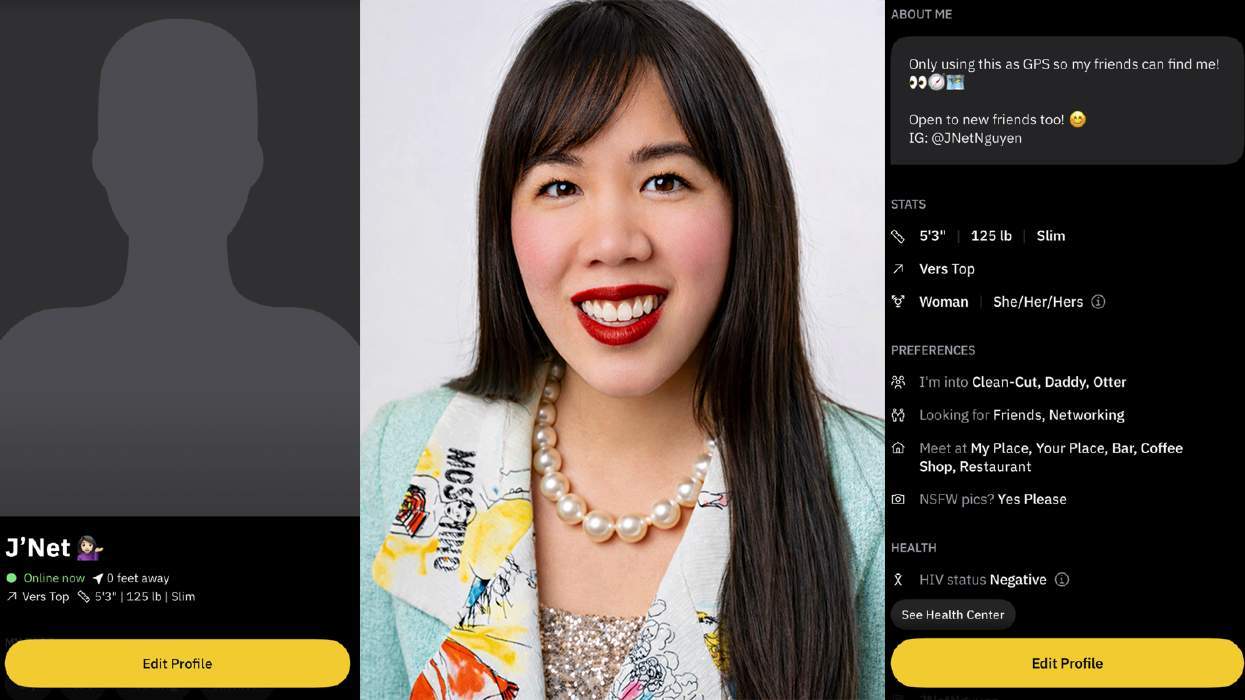
I have Grindr. I've actually had Grindr for years, which is a slightly strange thing to say considering I'm a straight woman.
And no, I'm not catfishing anyone. My profile doesn't even have a photo. It just says J'Net, pronounced Jeanette, because honestly, if you know me, you know me. There are not exactly a lot of people running around with a name spelled J-apostrophe-N-E-T.
I've also always been conscious that I'm a guest on Grindr. It's a space that wasn't created for me, and I'm not trying to get men's attention.
So why am I there? I grew up with six guncles, so gay men have always been part of my life. As an adult in Los Angeles, that expanded into hundreds of gay friends and acquaintances. If a huge number of your friends are all on the same platform, eventually that platform becomes useful to you too. People go where their people are.
For years, I've basically been using Grindr as a gay-friend GPS.
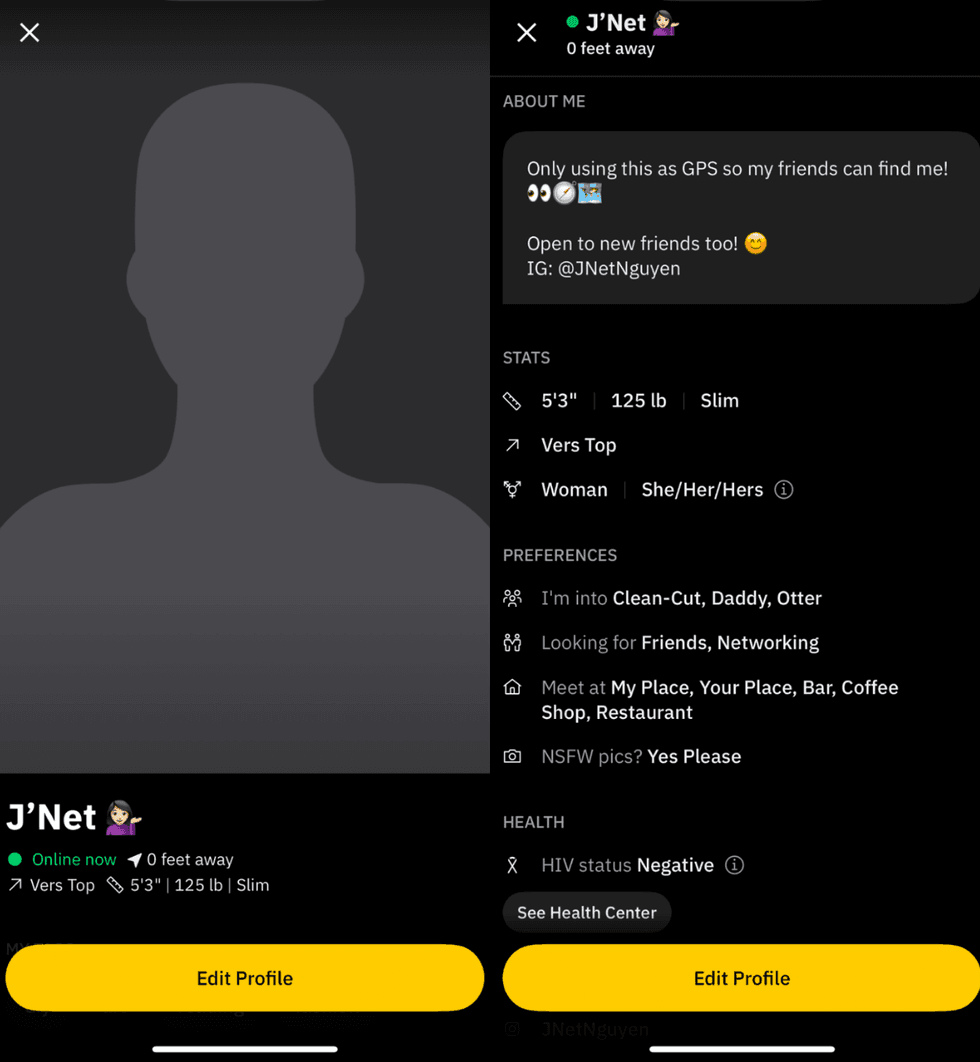 J’Net Nguyen’s Grindr profile explains that she uses the app as a “GPS” so her friends can find her.Courtesy J’Net Nguyen
My gym in Los Angeles is a 75,000-square-foot private members club spread across five floors, so I could be working out on the third floor while a friend is at the rooftop pool, and neither of us would have any idea. Grindr has resulted in plenty of, "Wait, you're here? I'll come say hi" messages. And if I haven't opened the app in a while, some of the boys will actually call me out on it because they can't see where I am.
A friend of mine named Ian once told me that women are so unusual on Grindr that when he does see one, his first assumption is that she's probably there to sell drugs. I have no idea how statistically accurate Ian's assessment is, but I got a kick out of learning that this was apparently my competition. Meanwhile, I'm just trying to figure out whether one of my friends is upstairs in the yoga room.
On one trip to Mexico, I opened the app and discovered that someone I met through mutual friends was suddenly nearby. Neither of us had known the other was traveling there. Grindr knew before we did. We were friendly but not particularly close. We spent time together there and became closer afterward. It was one of the first times I realized my ridiculous little gay-friend GPS was doing more than locating people.
One friendship in particular started in a way that still makes me laugh. We'll call him Matt.
Matt and I met while swimming at a rooftop pool. Grindr somehow came up, and he got a kick out of the fact that the straight woman he had just met had an account, so naturally we both pulled out our phones. He sent me a tap. I tapped him back, added him to my favorites, and then he unlocked his private album.
I opened it and, yes, there were nudes. There was also a pretty raunchy video of Matt with his ex-husband, who, at the time, was actually his boyfriend again.
I remember looking at everything this man I'd just met at a swimming pool had entrusted me with and thinking, Oh, we're going to be good friends.
And I was right.
Years later, Matt and I are genuinely close. He happens to be an Ivy League professor, which makes our origin story even funnier to me. I've guest lectured for his graduate courses many times, and when I traveled to the East Coast, he offered me his amazing apartment because he was going to Provincetown. Rooftop pool, to Grindr tap, to private album, to teaching his graduate students and having the keys to his apartment. There are probably more conventional friendship origin stories, but I happen to love ours.
I knew what Matt looked like without clothes before I knew much about him at all, but there was no field on his profile that said: Ivy League professor, future close friend.
When a gay friend shares a private album with me, I don't read it sexually. I read it as vulnerability and trust. But I've watched men trade private albums and later run into each other at the gym and completely ignore one another. There is something objectively funny about two people standing 10 feet apart pretending they don't know each other when they have already seen considerably more of one another than most acquaintances ever will.
Grindr can make sexual intimacy happen before social familiarity. You can have seen something incredibly private and still have no idea whether you're supposed to say hello when you see him at a charity fundraiser. There isn't really a social script for that.
I have a strange vantage point here, because I don't have any romantic or sexual stake in Grindr. I'm basically watching the ecosystem without needing anything from it, which may be why I notice what happens between people after they find each other.
At a dinner party, mahjong, or HYROX, you usually encounter each other as people first. On Grindr, the opening context is often attraction and sexual availability. There's nothing wrong with that. But whether you want to sleep with someone and whether you would actually enjoy having that person in your life are very different questions.
It's easy to forget how radical Grindr was. Finding one another once depended on gay bars, cruising spaces, coded signals and local knowledge, and getting that calculation wrong could carry consequences far more serious than embarrassment. Grindr made gay proximity visible on a screen. That is an extraordinary piece of social infrastructure, even if it became most famous for hookups.
What interests me more is the gap between access and relationship. Open Grindr in West Hollywood, and you'll see an almost absurd number of men within a very small radius. But being surrounded by potential connections isn't the same as having people you can call on a random Tuesday night, or people who notice when you disappear for a while.
Finding people and finding your people are not the same thing.
Grindr itself seems to be moving toward a broader version of what I'd been doing informally. Its "Global Gayborhood in Your Pocket" vision puts maps at the center, surfacing gay bars, gyms and other local places alongside people. Apparently my use of Grindr wasn't such a misuse after all. Maybe I was just early.
I don't want Grindr to stop being Grindr, and I don't need it to become LinkedIn with torsos. But gay life includes sex and also friendship, travel, nightlife, chosen family, and all of the mundane things that eventually make somewhere feel like home.
What happens after people find one another is the question I've become most interested in, and it's why I founded FriendsHAUS. I help gay men in L.A. build meaningful friendships through personalized guidance and careful introductions. I actually get to know what someone's looking for in friendship, then match them with people they'll click with. Grindr answers: Who is around me? My work asks: Who actually becomes part of my life?
An introduction by itself isn't a friendship. Friendship requires context, repetition, vulnerability, and small investments so ordinary we rarely notice them. You see someone again. You remember what he told you last time. You meet each other's friends. Eventually that person stops being someone you recognize and becomes someone you actually know.
Technology can create the possibility for a relationship. It can't manufacture the history.
Which brings me back to Matt.
Grindr didn't make us friends. It couldn't have predicted the guest lectures or the apartment keys. It simply gave two people who had met at a rooftop pool another way to recognize each other.
Everything that made the friendship matter happened afterward.
J'Net Nguyen is the founder of FriendsHAUS, a private social advisory helping gay men in LA build meaningful friendships and a lasting social foundation through personalized guidance and intentional introductions. A USC alum raised in a family with six guncles, she serves on the Board of Directors of the Assistance League of Los Angeles and as an Executive Advisor to the World NGO Day Global Council.
Opinion is dedicated to featuring a wide range of inspiring personal stories and impactful opinions from the LGBTQ+ community and its allies. Visit Out.com/submit to learn more about submission guidelines. We welcome your thoughts and feedback on any of our stories. Email us at voices@equalpride.com. Views expressed in Opinion stories are those of the guest writers, columnists, and editors, and do not directly represent the views of Out or our parent company, equalpride.