


Got a question that would scandalize your group chat? That’s what this column is for. Go Ask Alex is an anonymous space for queer readers to ask the questions they’re afraid to ask anyone else — about sex, love, life, and everything in between. It’s judgment-free and completely anonymous.
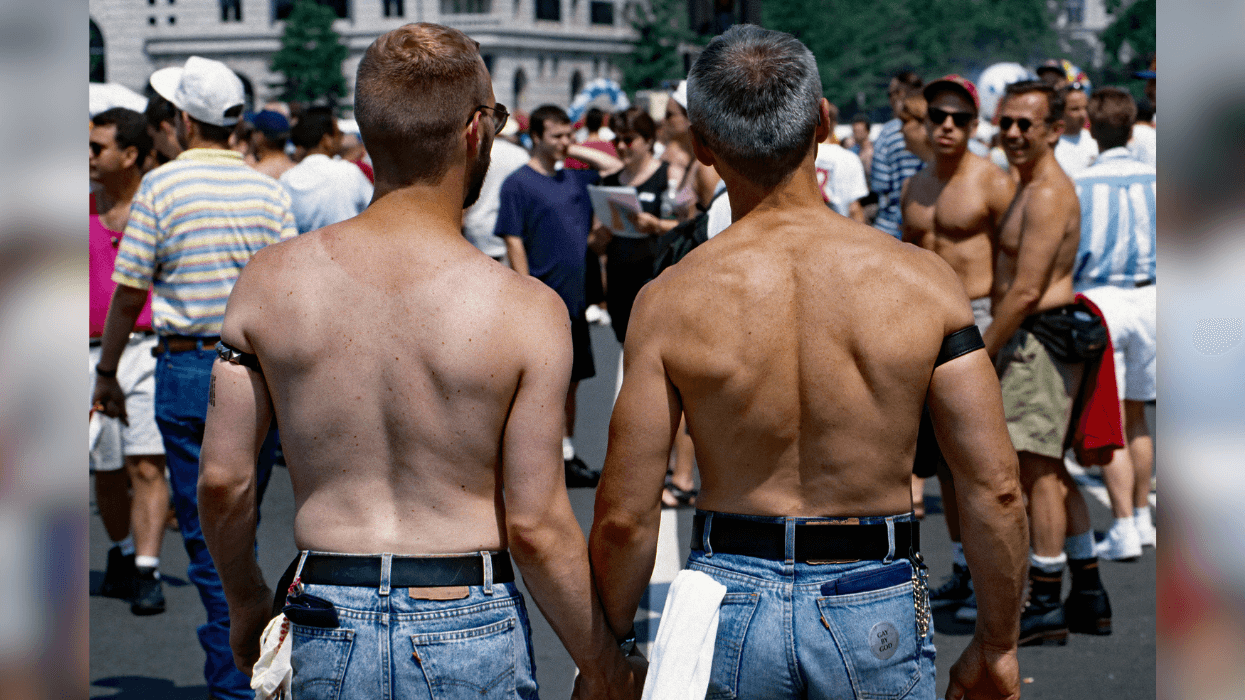
Do you think that monogamy is a relic of heteronormative pressures from the AIDS epidemic? I hear stories from older gays (the ones who survived) who share stories about what gay bars used to be like. It sounds like they used to just basically be orgies, for lack of a better term. Guys might go to the bar with their boyfriend, but it was normal to make your way around the room, flirting, sucking, fucking, touching, etc. Maybe this is just exaggeration from those sharing, but what have you learned about gay culture before the AIDS epidemic?
Hey friend,
It’s nice to dream about what gay life was like in yesteryear. I’ve spent the better part of my adulthood alternately wishing I could have lived during its hedonism and being grateful I didn’t, because surely I would have been one of the more than 59,000 gay and bisexual men who died of AIDS in the United States between 1981 and 1990, most of them way too young.
I think we have to be careful with these imaginings. The older I get, the less I fantasize about gay life in the past, because I can never know what it really was like. Thanks in large part to AIDS itself, many records, data, and accounts of the pre-AIDS years are simply, sadly, lost. I think it’s impossible for any of us, even gay and queer historians and experts, to say if AIDS made gay men more monogamous.
Gay culture was never one thing. Neither was AIDS. There were monogamous gay men before AIDS, during it, and after, and there were nonmonogamous ones in each one of those times, too. AIDS affected many communities besides gay and queer men, and the way it affected them varied widely depending on where in the world they lived.
AIDS cannot be simplified to a kind of single, monolithic event that unfolded in a clear way to a specific set of people and resulted in discernible cultural changes. To say that AIDS changed how we date is almost moot; AIDS changed everything. It’s still changing everything.
I wince at the idea of “after AIDS.” UNAIDS estimates that 570,000 people died of AIDS-related illness in 2025, about one person per minute. International HIV funding fell from $8.8 billion in 2024 to $7.3 billion in 2025, the lowest level in nearly two decades, largely because of the U.S. government and cruel decisions made by Donald Trump and his administration.
Since the ‘80s, yes, we’ve curbed the epidemic with good medicine. Even so, huge numbers of people in poorer countries, without health care, stable housing, or doctors who understand them, still can’t access medication. AIDS happened, and it’s still happening.
AIDS changed how the world saw gay and queer people, and perhaps more profoundly, it changed how we saw ourselves. We used new media. We created new language. We galvanized public support with new technology and presented, arguably for the first time in history, the idea of a unified LGBTQ community to a hetero world. We went public. I think it’s probably more accurate to say that AIDS created a modern gay identity that generations since have had to reckon with, to accept or reject.
I do think a post-AIDS sex phobia existed and still exists among survivors. You can see it in plenty of men who lived through it. I am friends with many such men. Talk to them. Ask them how their views of sex and monogamy have changed over time. This is just my own personal, anecdotal observation, but many of them simply adapted in the darkest years of the plague and swore off sex, then took years to overcome this fear of sex, then rediscovered joyful (and decidedly nonmonogamous) sex lives later in life. But that’s just the men I know, and I won’t assume that story arc for all.
Michael Weinstein is president of the AIDS Healthcare Foundation and a legendary and successful AIDS activist in his own right. In 1986, he and Chris Brownlie started the Stop AIDS Quarantine Committee to fight Proposition 64, a ballot initiative to quarantine people with AIDS, which, thanks to their activism, California voters defeated. Even so, in 2014, he told the Associated Press that Truvada, the PrEP pill to prevent HIV, is “a party drug.” In 2015, his organization put up billboards in Los Angeles with “Grindr” on one man’s face and “gonorrhea” on another’s. He's a slut-shamer who we still, nevertheless, owe a debt to for his earlier activism.
Larry Kramer was a notorious prude, and he got started before AIDS: his 1978 novel Faggots, which should be read a bit satirically, nevertheless sincerely concludes that no relationship can survive a culture of promiscuity. I hope it’s clear that I disagree. During AIDS, he was one of our greatest and loudest voices. Some of the greatest AIDS activists had to become monogamy-preaching, sexphobic people because of the nature of the crisis: they were essentially screaming at everyone to just stop having sex.
Kramer’s 1983 essay “1,112 and Counting” told gay men to give up “careless” sex (his exact word) until the epidemic passed. And besides these legends, the fear of sex lingered in the minds of countless gay and queer men for decades because they’d seen emaciated men dying on the news.
Fear of sex and a preference for monogamy are not the same thing, and that’s kind of my point. They shouldn’t be conflated. We can observe a pretty clear and rampant sexphobia that ignited in both the gay and queer community and outside of it in the wake of AIDS, but that doesn’t mean that gay men were more inclined to open relationships and lax rules around dating before AIDS or that this changed during and after, and I’d be wary of anyone who made that claim with any certainty.
In 1983, two men with AIDS, Richard Berkowitz and Michael Callen, wrote the booklet How to Have Sex in an Epidemic, one of the founding documents of safer sex. (They were not the first. The year before, the Sisters of Perpetual Indulgence handed out 16,000 copies of Play Fair!, the first safer-sex pamphlet for gay men, at San Francisco’s Freedom Day Parade.) Instead of the monogamy and partner reduction that health professionals and gay leaders urged at the time, Berkowitz and Callen proposed condoms and other precautions. So even then, gay men were pioneering safer promiscuity and ethical sluthood.
I don’t think anyone can say whether there are more or fewer monogamous gay couples now than there used to be. Existing studies disagree and rely on self-reporting. A 2010 San Francisco study of more than 550 couples found that 47 percent of them had open or “monogamish” (Dan Savage’s famous term) relationships while 45 percent were strictly monogamous. But that’s San Francisco. A 2016 survey of 576 men ages 18 to 39 found that 85 percent of single men were looking for monogamy. Do I believe all 85 percent of them will be monogamous in their future relationships? No.
None of these studies can speak for all gay men. A perfect poll of every gay man in America, if we could do one (we can’t), would be useless. Is a man truly monogamous or just saying he is? Is his an idealized, aspired-for monogamy? Does one have to be in a currently monogamous relationship to be monogamous? Some men start monogamous, then change. Some guys are wild and slutty in their 20s and start monogamous relationships later. Monogamy is just a way to date, one I think most people, regardless of their sexual orientation, will try, and I think they’ll try it because, regardless of AIDS, monogamy is still, largely thanks to religion, the general global standard of how to date.
No, I don’t think the kind of sexphobia and awkwardness that various studies show Gen Z exhibiting (the kids are, by many metrics, not as sexually inclined as their forebears) is a result of AIDS history. Many of them don’t even know much about this history. To a 22-year-old, AIDS is some distant thing that happened long ago and that they think doesn’t affect them. Maybe they’ll learn otherwise, but maybe not, and that’s OK, too. It is heartening that there are generations now who will grow up without having to make decisions around sex from the fear of dying from it.
Want my advice? (You’re writing in, so I’ll assume you do.) I’ll repeat a simple line, a simple view of the world, that was given to me by one of my gay elders, because it was given to him by one of his. Bruce Mailman, a legend of wild, gay New York nightlife in the ‘80s, founder and owner of both The Saint (considered by many to be the greatest gay disco that ever existed) and the New St. Marks Baths, told his younger gay cousin, who at one point was my boss, his view of life, one I have done my best to adopt for myself: “Never look back, only forward.”
Hey there! I’m Alexander Cheves. I’m a sex writer and former sex worker—I worked in the business for over 12 years. You can read my sex-and-culture column Last Call in Out and my book My Love Is a Beast: Confessions, from Unbound Edition Press. But be warned: Kirkus Reviews says the book is "not for squeamish readers.”
Here, I’m offering sex and relationship advice to Out’s readers. Send your question to askbeastly@gmail.com