


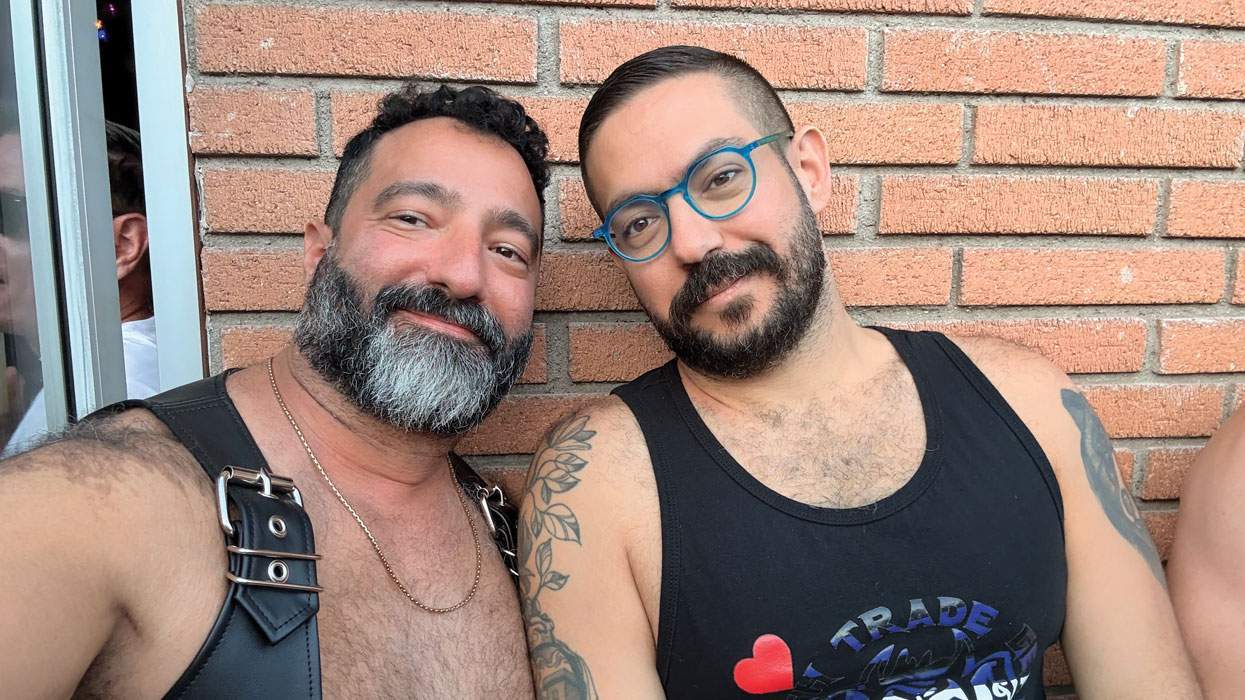

Everyone hates Grindr. This, at least, is what Calum Bowden and I agree on when we call to talk about his new gay hookup app Meetmarket, a Berlin-built platform promising end-to-end encryption and no ads, ever. In June, it blew past its crowdfunding goal, raising €161,456 (roughly $184,334) in one month and gaining 1,300 founding members.
The money, Bowden says, will fund a year of development for an app that he hopes will be available on Apple’s App Store.
Bowden is a handsome, beefy tech nerd. Seemingly just for fun, he built a prototype of the app last March entirely himself, then advertised it on his thirst-trap-heavy Instagram. It got 15,000 users in 24 hours, 24,000 in three days.
The response proved, in his mind, a real need.
“I want to dethrone Grindr,” he says. It sounds like a long shot, but he’s not the only one. Goose, a new “anti-algorithm” sex and dating app from out model Derek Chadwick that promises human-screened applicants, launched in June. Hank Social, a platform for men into kink and fetish that’s “as discreet as you want it,” built by two Palm Springs gay friends, is also planning an app launch — though, like Meetmarket, there’s no set launch date. The focus of all these new, small-time contenders is privacy and keeping the tech in the hands of the communities they serve, not large corporate entities.
“We’re part of this community ourselves, so we get how sensitive this stuff is,” says Hank Social cofounder Eido Gat. “Nothing ever leaves our servers.”
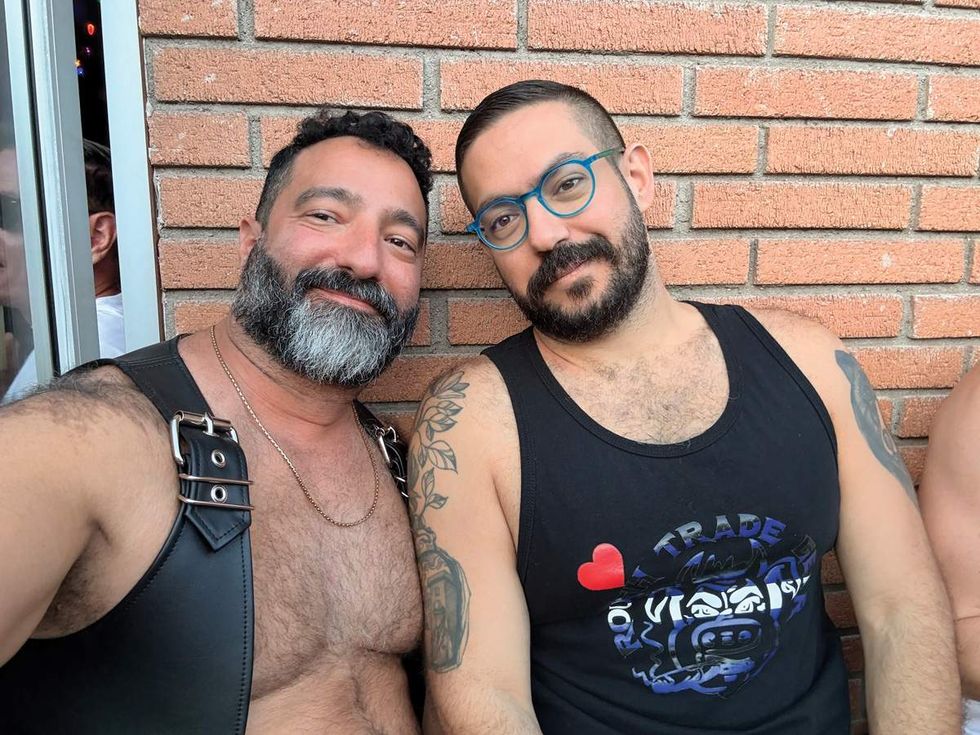 Eido Gat and Ido Barbibaycourtesy Hank Social
It’s a similar promise as the others, but can it be kept? Why all this big focus on privacy anyway?
Because Grindr’s track record is terrible. In 2018, the company admitted it was sharing users’ HIV statuses with third parties; in 2021, Norway’s data protection authority fined Grindr nearly $6 million for sharing this data with advertisers without users’ express consent, a decision Grindr fought and lost in 2024. That same year, 670 Grindr users filed a class action in London alleging the app shared their HIV information and other sensitive data with advertisers.
On top of all this, Grindr has seemingly struggled, over years, to prevent its geolocation sex app from being used to harm queer men. Between 2014 and 2015, Stephen Port, dubbed “the Grindr Killer,” drugged and murdered four men in London whom he’d met on various dating apps. In Toronto, Bruce McArthur murdered eight men, most met via Grindr and other popular apps, between 2010 and 2017. In 2016, a Daily Beast writer used Grindr in the Rio Olympic Village and published enough details to out athletes, some of them from homophobic countries, before the article was retracted. And police from Egypt to Russia have created fake profiles on Grindr to entrap and arrest queer men.
Even with all this, it boasts 15 million monthly active users, by far the largest of any app used by the LGBTQ+ community across the globe.
These ambitious newcomers to the now-crowded gay dating app business may not be entirely pure protests and may not be fully convincing as real contenders against Grindr. But they do feel like heartening grassroots campaigns by tech-savvy queer folks to take control of online gathering places, which have become, for people all over the world, their only access point to community and queer culture.
“There was no friendly place to learn what I was into, just sketchy Telegram channels,” says Gat, who’s into leather and watersports (piss play). “Hank is the app I wish I had back then.”
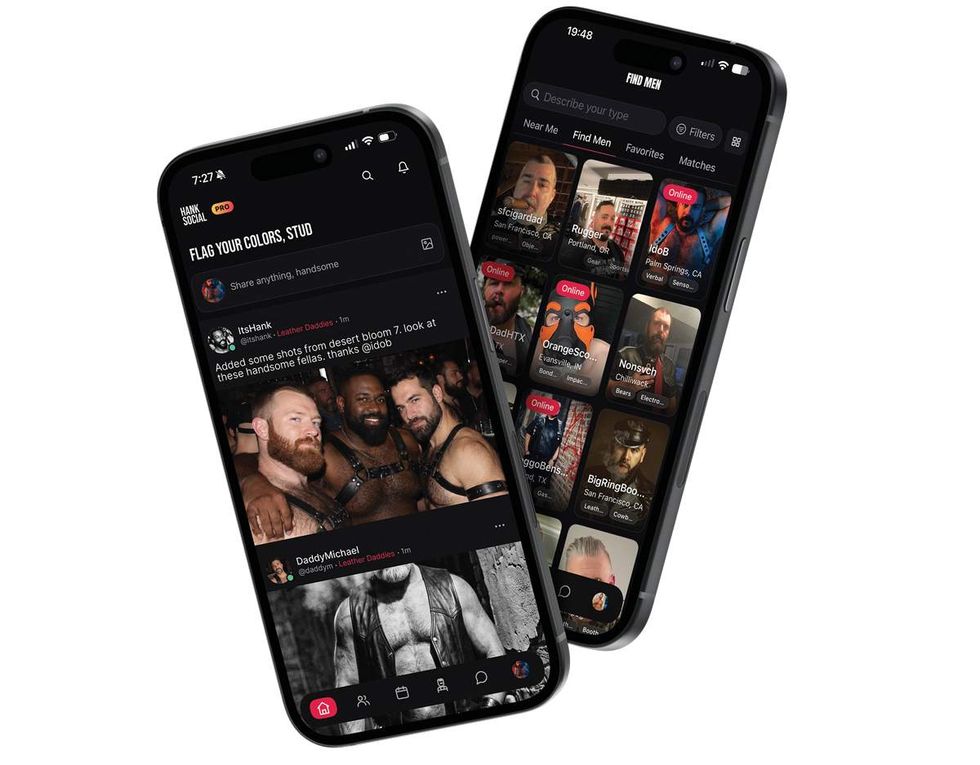 Hank Social appcourtesy Hank Social
Monetizing the needs of queer people, a minority populace that faces disproportionately high rates of loneliness and depression, is particularly heinous to him. I tell him I’d call it nothing less than evil.
“Our need for intimacy and connection is a human right,” he says. “They are using our need for connection and intimacy and profiting off it. Now we’re socializing in these private, walled gardens owned by corporations, whether it’s Meta or Grindr.”
I tell him I’ve written about sex, and the ways men like us seek it, online and in person, for years, but this is the first time I’ve wanted to look under the hood and grasp better how app tech works; more often, I examine the social aspects of apps. I admit the tech is all a little confusing, and I feel like a troglodyte when Bowden explains what actually happens when I message a guy on Grindr (and all major apps). Grindr, like most platforms, is centralized, so all messages, pictures, and shared information go to the company’s servers and are stored there, where they can be bought, sold, and subpoenaed.
“They keep data of all interactions,” Bowden says. “What profile you clicked on, how long you viewed that profile, what you clicked on next, what you did after that. All this metadata of behavior is tracked.”
The purpose is not for our benefit. “The experience is designed like slot machines. They use the same delayed dopamine reward mechanics as casinos. They give you just enough reward at the right moment so you stay hooked on the app.”
Why? To sell subscriptions and share user data with ad-tech partners for profit.
 Christy Frink is a queer, Baltimore-based tech transparency and security researcher.courtesy Christy Frink
With Meetmarket, Bowden pledges that messages will be end-to-end encrypted, and the app will run on what he calls a “decentralized identity” system “that doesn’t have a list of email addresses and passwords somewhere, but rather gives users ownership of their information on their own device.” But all this is aspirational. Meetmarket isn’t out yet, and Goose has already faced controversy: The app was accused of using AI-generated Instagram profiles in promotion, an odd look for an anti-algorithm app. For better or worse, we still live in Grindr’s world.
Still, it’s worth understanding what “end-to-end encryption” means. It may best be explained as a puzzle. Messages (data) are puzzles that can be read. When an app is E2E encrypted, only app users have the keys to decipher their own puzzles, their own messages, not the company, or the government that subpoenas the company for them. The messenger app Signal works this way, as do WhatsApp and iMessage. Grindr does not.
The downside of E2E is that message content can’t be moderated. Signal has explicitly avowed that, even with the likelihood that some use the app to send abusive and harmful content, it will not soften its encryption; indeed, it has publicly stated that it would pull out of the United Kingdom and Sweden entirely rather than let government access its users’ messages. Can Meetmarket do the same? No, Bowden says, and though the reasons aren’t fully clear to me, it seems to have something to do with the App Store’s requirements for dating and hookup apps: If a user reports abuse, messages must somehow be decrypted by moderators, and public images will need to be scanned for illegal content, per law.
Hank Social does the same: “We run human moderation so that illegal content never touches the platform,” Gat says.
Meetmarket, at least, will be open source, Bowden says. To help clarify what that means and why it’s so important, I speak with Christy Frink, a queer, Baltimore-based tech product manager for over 15 years who is now a tech transparency and security researcher. She’s worked with multiple grassroots organizations and networks, but doesn’t disclose their names (her public website does list a few).
 Meetmarket founder Calum Bowdencourtesy Meetmarket
“Open source means you can pull up the code of the platform you’re using and see what integrations they have with other products, how your data is being captured, and where it’s going,” she says. Most people still can’t make sense of code, but “open source” means a level of security and trust; the platform is willfully being “accountable to a large community of people who can go in and see what they’re doing.” Of course, she says, corporate companies don’t want to be open-source, and few are. “It gives up trade secrets,” she says. “It gives up the game of whatever they’ve developed and lets competitors see their code.”
At the end of the day, Frink says, encryption and open source are little more than promises platforms make to users, and promises can be broken. Projects can start with good intentions before selling out. As an example of this, Bowden tells me that last April, Sniffies, the beloved gay cruising platform (one I’ve written about in Out before), which positioned itself as a queer-run, community-first sex platform, took a $100 million minority investment from Match Group, the dating conglomerate behind Tinder, Hinge, and OkCupid.
“I honestly gasped,” Bowden says. ““Sniffies was cool. Then they chose to sell out to potentially the worst possible company.”
Why so bad? “No money is free,“ he says. “The fact that it’s a $100 million minority stake means they will want to get over $100 million in return. Match Group buys a stake in something before fully acquiring it.” (He’s right: Match first invested in Hinge in 2017 and completed the full acquisition in 2019.)
Match CEO Spencer Rascoff, appointed in 2025, formerly sat on the board of Palantir, the data-analytics firm that sells surveillance software to police departments and ICE, which have used it to find and deport undocumented people in the U.S. In March, OkCupid, another Match property, settled with the Federal Trade Commission over accusations that it gave an AI facial-recognition company access to nearly three million user photos, plus their location data, despite its privacy promises. “The minute Sniffies took this money, their incentives realigned from doing something for the community to doing something to increase shareholder value for Match,” Bowden says.
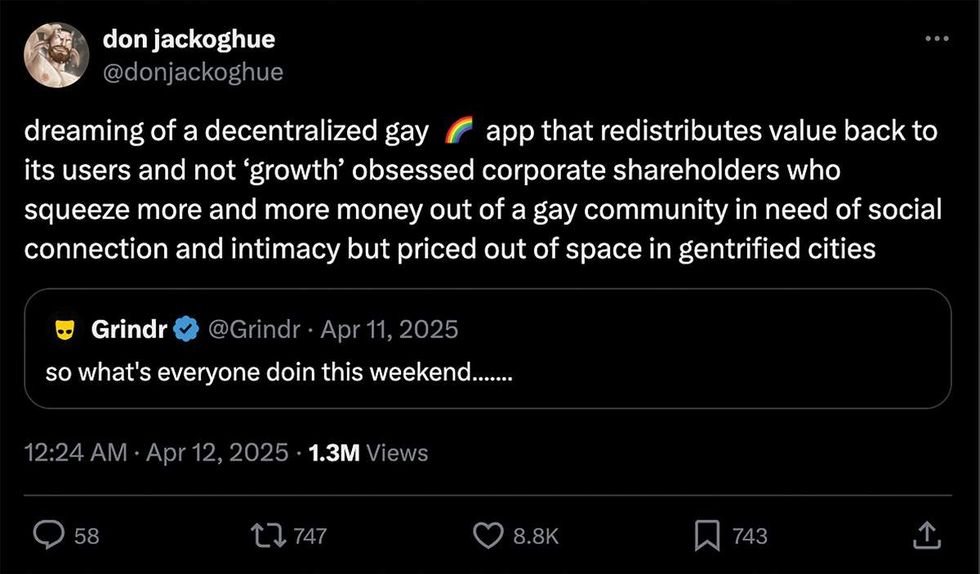 Calum Bowden, aka Don Jackoghue, posts about Meetmarket.courtesy Meetmarket
But all this misses the point, Frink tells me. Getting focused on one app or one platform is not where the real danger is. It’s when data from multiple platforms is combined, which has become a lot easier with AI.
Maps data, purchases, the contents of an inbox, and even the biometric data collected by fitness rings and watches: all may be harmless alone but devastating when combined. She points to health data collected by wearables: “If a trans woman is on hormone replacement therapy, that is going to leave a specific biosignature in the health stuff that is tracked by these rings.” The idea of a U.S. state with transphobic legislation buying its citizens’ user data and using it to find out who is trans and where they live is now a dark possibility, says Frink.
She says we are increasingly facing a future where data from multiple apps can be leaked or sold and pieced together by AI to make full, complete pictures of people’s personal identities and political beliefs, as well as their physical location data, by hostile entities.
One of the biggest customers for user data in the United States is the American government. A declassified report from the Office of the Director of National Intelligence confirms that U.S. intelligence agencies buy vast amounts of commercially available data on American citizens, including smartphone and web data, without warrants.
“You don’t need a warrant,” Frink says. “You can just buy it and sift through it later.” Europe, she notes, has more protection. Europe’s General Data Protection Regulation, or GDPR, gives residents legal rights over their data: Companies must get consent to collect it, and anyone can demand theirs be fully deleted. “In Europe,” she says, “if I want the app I’m using to delete all the data ever collected on me, I can do that under GDPR. The United States has no similar protection.”
She also points out the real danger posed by data that could change with new laws. “What I’m doing now in my private life may be legal, but in five years it might not be,” she says. “Then the data that I gave up five years ago is still going to be on somebody’s server somewhere and can be used against me.”
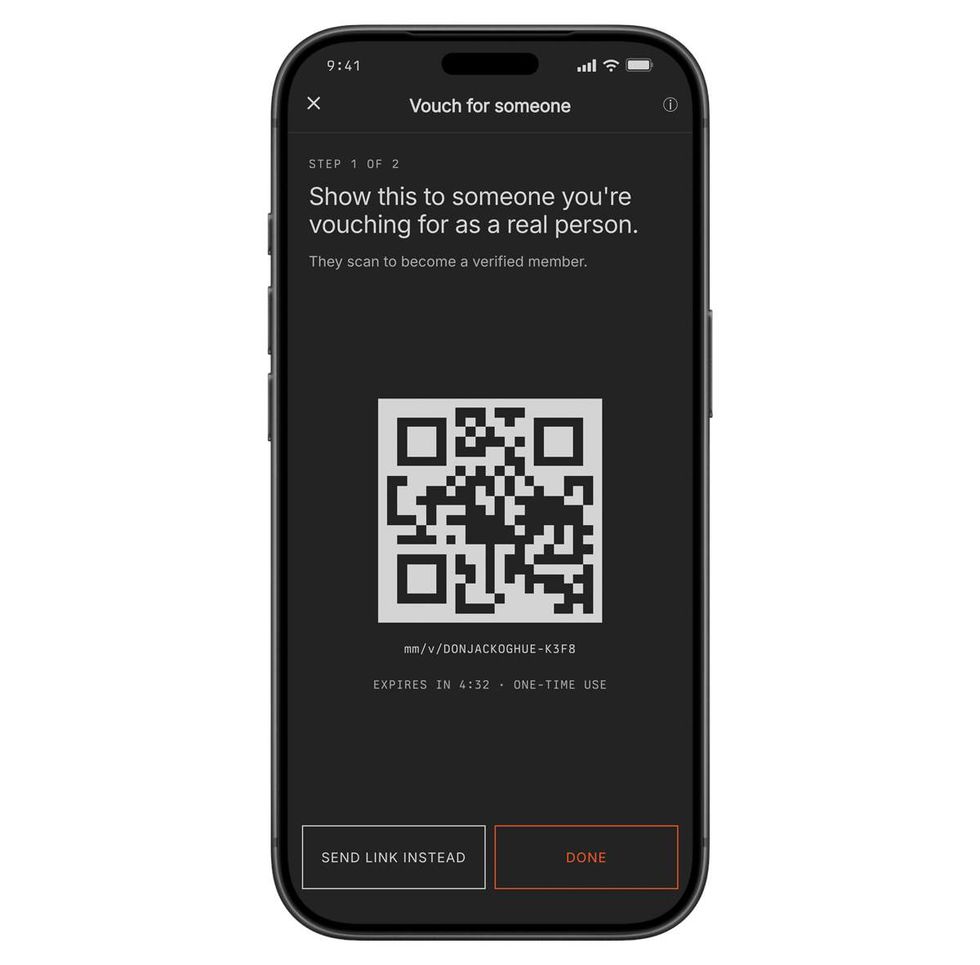 Meetmarket app mock-upcourtesy Meetmarket
This is not hypothetical. In 2021, a Catholic group used commercially obtained Grindr location data to identify a priest, Monsignor Jeffrey Burrill, and out him, ending his career. “If somebody took just the location of my phone and tracked it for a week,“ Frink says, “you could see where I sleep at night and easily derive who I am.”
But this isn’t new. What makes it scary now is that AI can sift through enormous amounts of data that has been leaked, hacked, or sold, and generate lists of names (of, for example, people who’ve made pro-Palestine statements online, or people who’ve visited gay porn sites) for hostile parties. “Vacuuming up a bunch of social media and using AI to go through it is what ICE is doing now,” she says. “They’ve talked about it openly.”
A recent New York Magazine piece argued that after 20 years of living on a data-storing web, everything we have ever typed is one catastrophic, AI-assisted leak away from going public. For years, a leaked database was a haystack no human could sift through, but AI can.
“The government’s always been vacuuming up our tweets,” Frink says, “but it’s impractical for a person or even a group of people to go sift through all that stuff. It’s huge data. But now, companies like Palantir, using AI, can go through it in minutes and get names and addresses.”
AI has accelerated her own work. She works with programs that scan security software for holes and weaknesses. Since they started using AI, they have surfaced, by her estimate, a hundredfold increase in vulnerabilities.
“This is good, because it means they’re catching stuff before hackers do. But it’s not enough. Hackers also have this technology.” She believes it’s just a matter of time before hostile parties acquire data and use it, with AI help, to target a group. And by “hostile parties” she means “regular, nefarious people or nations.”
Bowden, for his part, resists the apocalypse talk.
“AI companies love these narratives,” he says. “It gives them power. They position AI as an existential crisis, then position it as how to solve that crisis.”
I raise what feels like the bigger problem, one I’m admittedly facing myself: All this stuff is complicated. Does one need a tech degree to know enough to protect themselves? It sure seems that way.
Frink acknowledges this and blames it partly on media coverage. “Tech publications get it right in ways that traditional outlets do not,“ she says. “But tech reporting stays in the tech bubble.”
I tell her that’s why I’m writing this: because I cannot, in the end, be anti-app. Queer people in isolated places need them to find each other, find sex, find love. However naïvely, startups like Meetmarket give me hope.
Luckily, Frink offers basic things everyone can do to be smarter online. The Electronic Frontier Foundation has a plain-language guide on digital hygiene. And: “Just change your browser.” Swap Safari or Chrome for Firefox or Brave, use an ad blocker, and use a reputable VPN (“Proton is a really good one for free.”). Use a password manager. And when chatting with guys on Grindr, move sensitive conversations and photos to an encrypted messaging app.
And if a bar in the neighborhood begins scanning faces at the door, as some gay bars in San Francisco have started doing for alleged security reasons, “do not patronize those businesses,” she says.
Bowden has a more general rule: “Don’t share anything that you’re not ready to be taken out of the context in which you shared it. You can’t trust these platforms at all.”
Bowden seems ready for the fight: “There’s a rich history of mutual aid in the queer community,” he says, “but it seems to have skipped over digital tech. We’ve been given the most extractive, financialized forms of technology and just accepted them.” Not anymore.
Alexander Cheves is a writer, sex educator, and author of My Love Is a Beast: Confessions from Unbound Edition Press. @badalexcheves
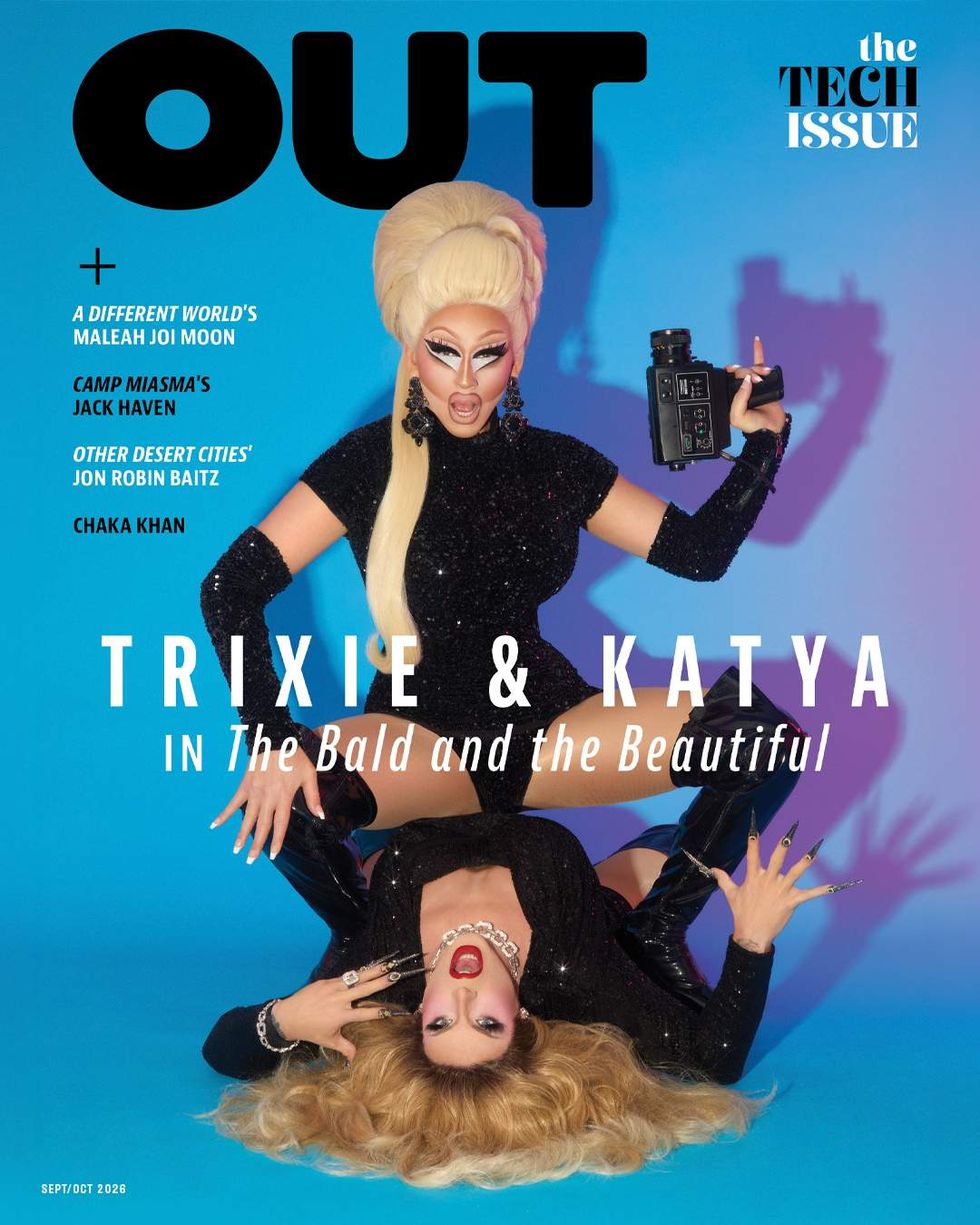 Out September/October 2026 cover with cover stars Trixie Mattel and Katya Zamolodchikova Albert Sanchez and Pedro Zalba
This article is part of OUT’s Sept-Oct 2026 print issue, on newsstands September 1. Support queer media and subscribe — or download the issue now through Apple News+, Zinio, Nook, or PressReader starting August 20.