


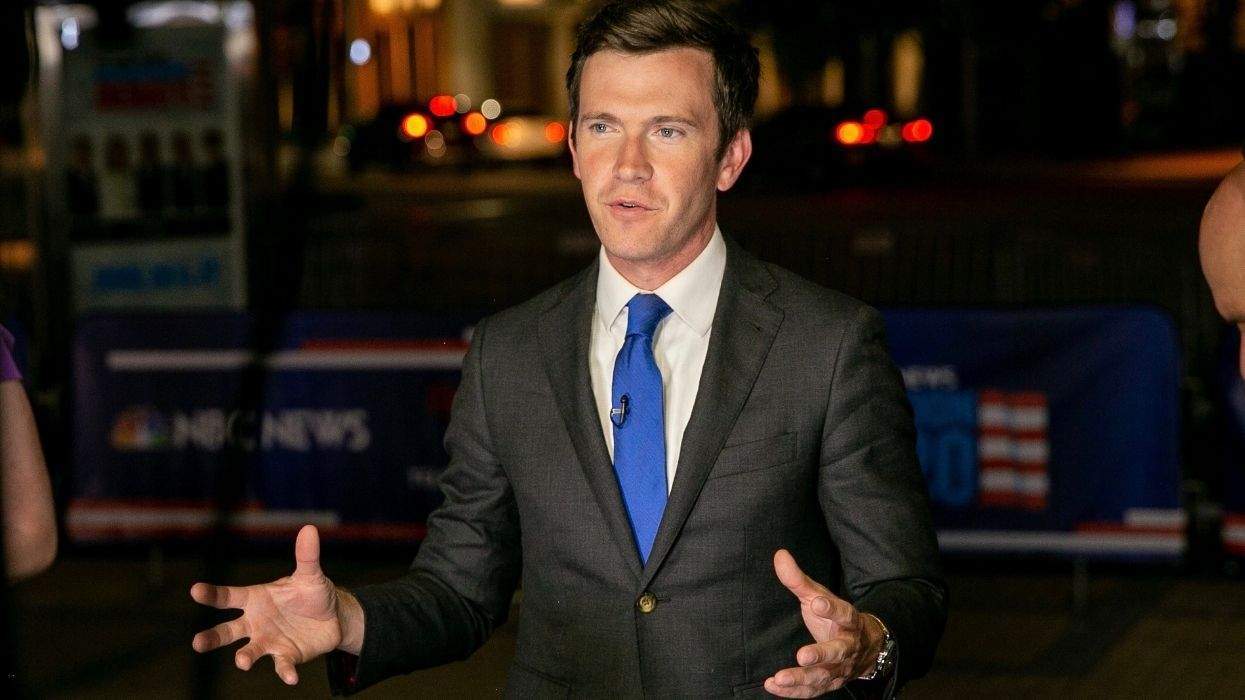
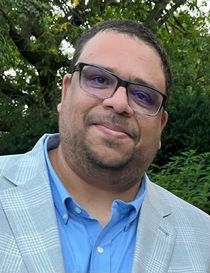
Vaughn Hillyard stepped outside for an interview with The Advocate so the baby would not wake. “I just had a son born on Saturday out here in the desert,” MS NOW’s senior White House reporter said, beaming with pride.
It was an early April morning in Arizona, the sky just beginning to burn gold at its edges. Inside, his son, less than a week old, was asleep. Hillyard moved in the careful hush of someone recalibrating entirely, adjusting to a new gravity that has nothing to do with White House briefing rooms, criminal trials, or the velocity of American politics that he’s used to.
Life with a newborn
The next day, after the pediatrician visit, his voice sounded steadier. “Everybody is thriving,” he said.
For now, he is on parental leave. He expects to return to Washington soon, stepping back into the White House beat almost as quickly as he stepped away.
For more than a decade, Hillyard has lived at the pace of breaking news, filing from rally floors and courthouse steps, from campaign tarmacs and the tight quarters of the White House press pool. Now 35, he has spent most of his adult life covering Donald Trump and the MAGA movement that reshaped American politics. The work began at NBC News and continues at MS NOW.
 Vaughn Hillyard has spent more than 10 years reporting on Donald Trump and the MAGA movement.MS NOW
Related: Rachel Maddow on standing up to government lies and her Walter Cronkite Award
“It’s like news,” he said of the early days of parenthood. “You wake up, and you just go.”
His son’s name came years before the child was born.
In 2021, Hillyard and his then-boyfriend, Devan Cayea, were hiking through Runyon Canyon when the conversation turned to a future that still felt more imagined than real. They landed on a name almost offhandedly. It stayed with them through moves from Arizona to Los Angeles to New York City, through train rides along the Hudson River toward Cayea’s upstate roots, until it stopped feeling hypothetical and started feeling certain.
On April 4, 2026, Hudson Hillyard-Cayea was born.
The path to fatherhood took nearly two years and required a different kind of discipline than the one Hillyard brings to daily reporting. It required patience without a deadline. He and Cayea, who is the managing director for the chair and CEO of Accenture, worked with the New York Surrogacy Center and were eventually matched with a gestational carrier named Laura, a mother of two who lives in Arizona. Not just anywhere in Arizona, but close to where Hillyard was raised. “So literally she lives about 20 minutes from where I grew up,” he said.
Proud son of Arizona
Hillyard is a third-generation Arizonan. His father went to Arizona State University. His grandfather did too. Growing up there, he watched his home state processed into political shorthand on national television, flattened into a handful of familiar names and reliable narratives. The place’s complexity was often lost for the convenience of the broadcast.
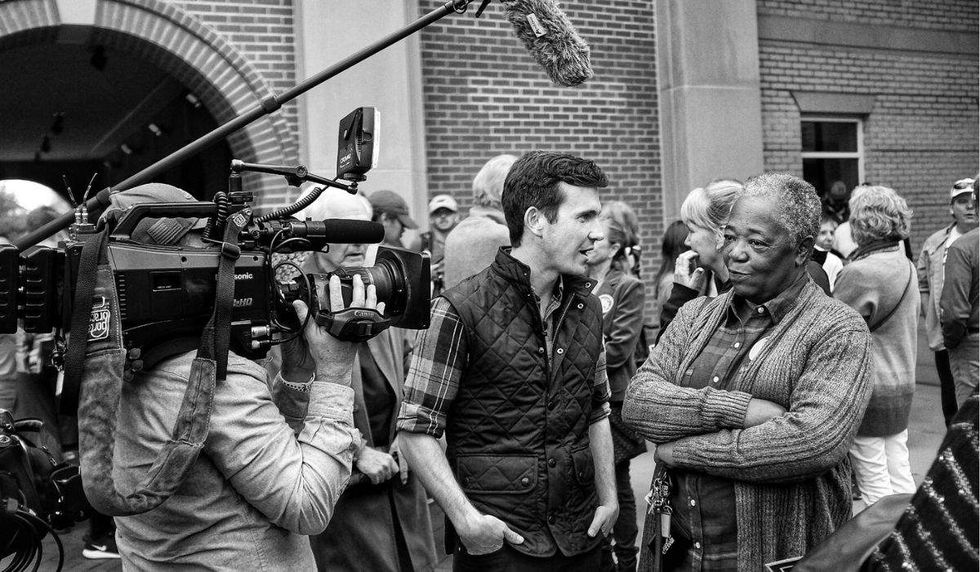 Vaughn Hillyard says he likes to tell stories of people in hyper-local situations.MS NOW
Years ago, he said, Arizona’s national identity was often reduced to figures like former Maricopa County Sheriff Joe Arpaio, later pardoned by Trump, and then-Gov. Jan Brewer, a Republican. “I knew that my community, my city, my state were so much more complex and diverse than that,” Hillyard said. That refusal of oversimplification became the engine of his journalism.
Related: From NBC’s peacock carpet to MS NOW: ‘The Weekend’ hosts step into a new era in cable television
In third grade, a teacher named Donna Hicks told him he had a strong writing voice. By sixth grade, he was filming everything he could with a camcorder, less interested in being on camera than in documenting what was happening around him.
“I had decided that I would be going to Arizona State Journalism School someday,” he said.
He did. From there, he moved directly into the national press corps, landing in Washington as a Tim Russert fellow at NBC News.
At NBC, he built the foundation of the career he has now. He covered three presidential elections, traveled across all 50 states and more than 20 countries, and embedded himself in the daily realities of American political life. He reported live from Trump’s criminal trial, extensively covered Vice President Mike Pence, and interviewed key figures across the political landscape.
The work required endurance. It also shaped how he sees the country, not as a collection of headlines, but as a set of communities that must be understood on their own terms.
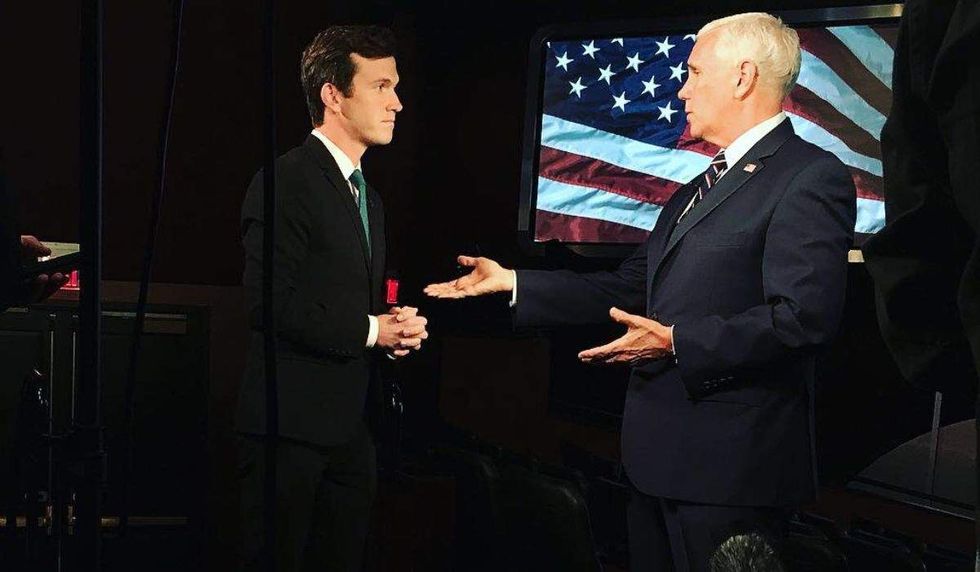 Vaughn Hillyard has been covering the MAGA movement since 2015.MS NOW
Figuring out his own story
However, there were parts of his life that did not move at that same pace.
Hillyard came out as gay in 2017, years into a career spent largely on the road, telling other people’s stories while setting aside parts of his own. “I had effectively pushed aside that part of my life up until then,” he said. The work gave him purpose. It also gave him distance. “While I found myself so often telling people’s stories, I was also in real time figuring out my own,” he said.
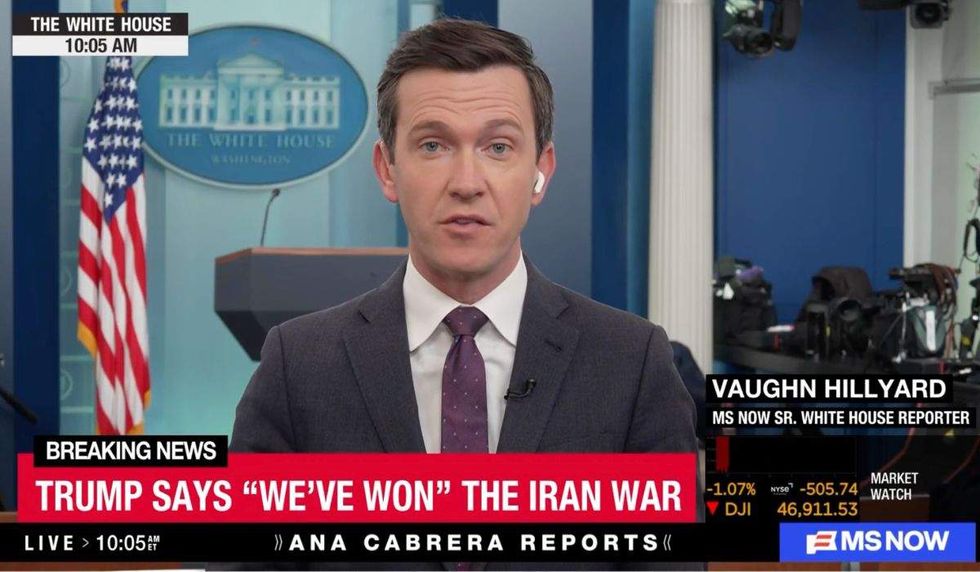 Vaughn Hillyard reports on Donald Trump's declaration that the U.S. "won" the Iran war.MS NOW
Related: MSNBC revamps weekend morning show with two prominent Black gay men as cohosts
He met Cayea in early 2020, just before the pandemic. Their relationship formed in isolation, without the usual layers of social life. “We really got to know each other before we got to know each other’s friends and family,” he said.
They married in 2023. A week later, he was back at a Trump rally.
Asking the tough questions
If there is a defining trait in Hillyard’s reporting, it is persistence. He has spent 11 years covering Trump, watching the movement evolve, contract, and consolidate. “It’s ever evolving, and it’s complex,” he said. That work has meant asking questions that do not always make him welcome. In 2023, aboard Trump’s private plane, he pressed a line of questioning that cut the exchange short and cost him access for a time.
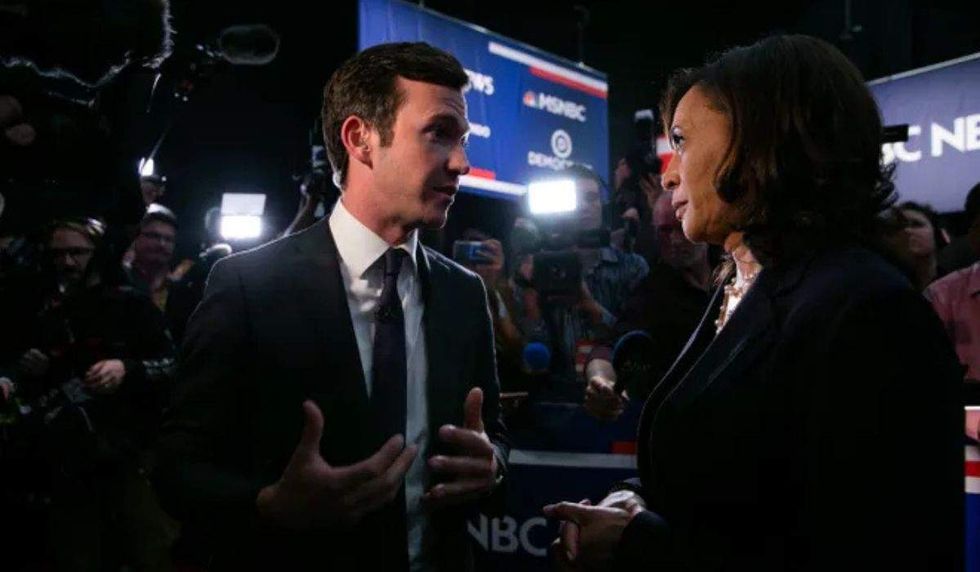 Vaughn Hillyard has interviewed many of the country's most prominent political leaders.MS NOW
“I have never ever steered away from asking the questions that I think are pertinent,” he said. “Our job is to ensure that they have been asked every question that we have the ability to ask.”
Related: MSNBC fires back at disinformation — and makes history — with fearless new show
At MS NOW, he said, that approach is supported, not just tolerated. He describes a newsroom where leadership has made clear that his reporting and his identity are not separate considerations. Covering Trump has also meant navigating a political environment where reporters are often singled out or dismissed. Hillyard does not dwell on those moments. Instead, he considers them part of the job.
A life story in two minutes
Although he has a front-row seat to history, there are moments that stay with him, even amid the churn of daily reporting.
He recalls an elderly lesbian couple in Arizona he interviewed during the pandemic, separated in a senior living facility and forced to speak over FaceTime as they waited for vaccines that might allow them to be together again.
Reporting from the campus, Hillyard narrated as one partner watched the other receive her first dose. “The miracle has happened. First step. First step,” she said, her voice breaking as the shot was administered.
Related: Jonathan Capehart on being seen, coming out, and ‘chosen family’ with Michelle Obama
For Hillyard, it was a rare moment when the scale of a national crisis narrowed to something intimate and immediate, a relationship measured not by policy but by time apart and the possibility of reunion. “You felt like you were sharing a life story caught in two minutes of time,” he said.
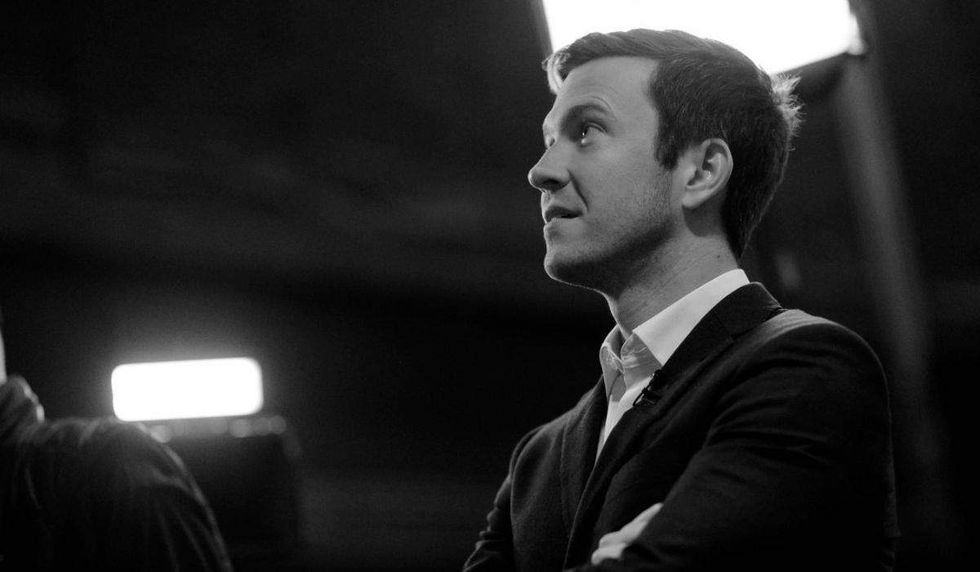 Vaughn Hillyard married his husband, Devan Cayea, in 2023.MS NOW
Hundreds of thousands of miles
Outside of work, he looks for ways to slow down, even if it does not come easily. He drives long distances, often without a destination, usually in his mid-size Volvo. “I love putting literally hundreds of thousands of miles on the vehicle,” he said.
He runs a couple of miles when he can. And he watches baseball. He is a Diamondbacks fan in Arizona, a Nationals fan in Washington, and was a Mets fan when he lived in New York. “I think it’s important that you embrace whatever team is in the town where you live,” he said.
In another life, he said, he might have been a baseball announcer.
He still thinks about the players he never had the chance to interview, especially those from an earlier era. Hank Aaron. Ted Williams. Figures whose careers overlapped with moments in American history that were not fully understood in real time.
“I wish I could go back and interview some old baseball players from back in the day about what was happening in society,” he said.
It’s beginning
He will be back in Washington this week, stepping into the role for the White House Correspondents’ Dinner, an annual ritual of proximity and performance.
He knows that world. He is very good at it. But for now, the story is smaller.
Hillyard lingers outside a moment longer in the early light, then heads back in, to Hudson, to Devan, to a life that suddenly feels fuller, louder, and entirely new.
For once, the story he’s living isn’t breaking. It’s beginning.