
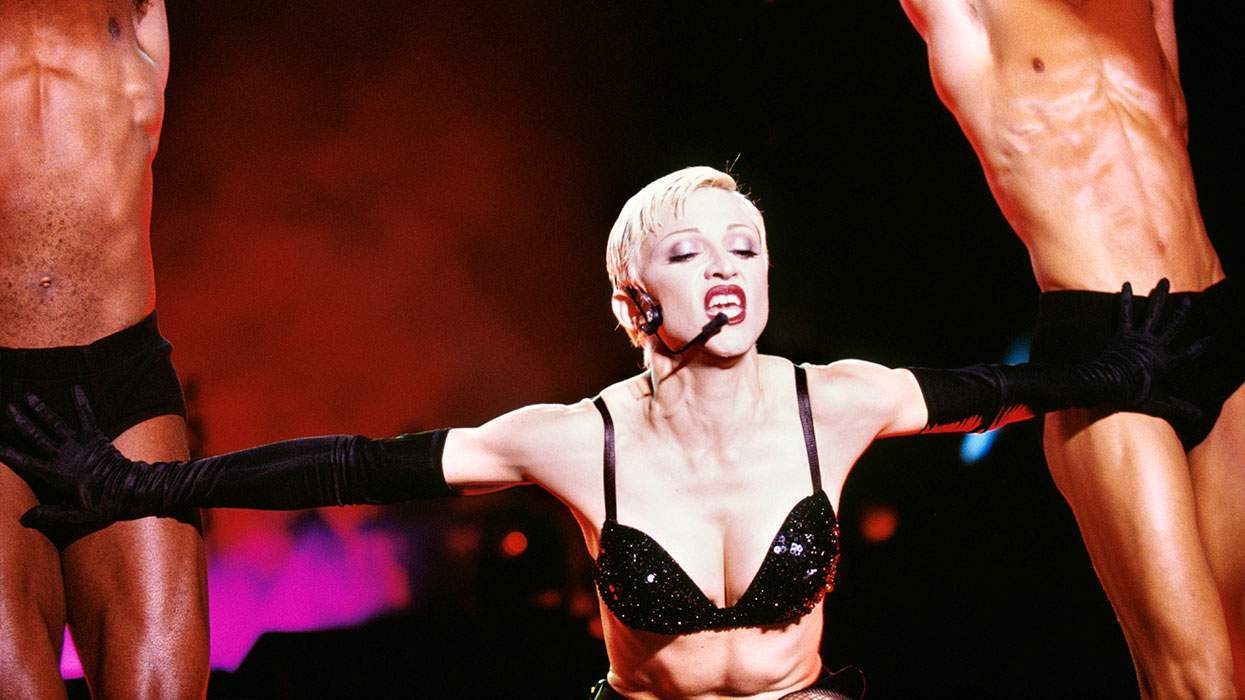
To celebrate America's 250th Anniversary on July Fourth this year, the MAGA clown car parade will try to forever rebrand America as a fascist sweatshop where the American worker should be grateful to its new overlords for supplying us with ample fireworks, artificial intelligence, cryptocurrency, endless wars in the middle east, untested supplements, “the markets”, plastic surgery, unaffordable housing, the Supreme Court, and let’s never forget white supremacy. The rest of us will celebrate freedom and love on the dance floor with Madonna. It’s no mistake that Madonna chose July 3 as the release date for her new album. It’s like five middle fingers on one hand pointed straight at the people profiting off everyone else’s misery. So, while the now very splintery basket of deplorables tries to stitch together whatever psychotic patch quilt of military grade weapons, Botox and apple pie to wrap America in this July Fourth, we can ignore it and celebrate one of the greatest living artists of our time, Madonna.
And before anyone jumps in and says something about Madonna not being political, let me remind you that politics is best practiced through actions, not by screaming to your friends and high school enemies online about the same topic du jour until everyone moves onto the next even more upsetting outrage panic cycle. While people infight online, Madonna is releasing a wildly anticipated album the night before the most dreaded spectacle on Earth is set to take place.
I was a snobby little queerpunk in the 8th grade. I had long hair parted down the middle and in it I wore a kiddie beret, I wrote “poetry”, sported a nose ring and a ton of other “jewelry” that I either stole from Claire’s or bought at a hardware store. My two friends at school were equally as abrasive. Winnie was a goth Navajo girl who loved weed and only spoke when she had something really cutting to say, and Stacy was a very promiscuous 8th grader who loved Kurt Cobain and also loved to start physical fights with preppy girls. We all worshiped Courtney Love’s rock band Hole and TLC, but since we kind of hated each other, we fought over which band had the best songs. The one thing we unequivocally agreed on was Madonna. Winnie and I knew every word on the Erotica album, and we would use the lyrics as our own secret language in class, so the other kids would have no idea what we were talking about. The other kids in school did not like Madonna. This was Garth Brooks territory. Madonna was the first person any of us ever saw completely rebel against the boring and the judgmental and gave us permission to do the same.
In 1990, Madonna appeared on Nightline to defend her then very controversial #1 hit, “Justify My Love.” MTV had banned the video because America apparently had no issue with violence, misogyny or war, but drew the line at bisexuality, kink, pleasure and women openly expressing sexual agency. Stacy recorded the interview onto VHS, so naturally we watched it over and over until we had the whole thing memorized. Madonna was satellited in, because she was too famous and too untouchable to physically appear in the studio with everybody else.
What’s so striking watching it now is not that Madonna seemed shocking. It was that all the adults questioning her seemed profoundly unequipped for the conversation they themselves insisted on having. Madonna never once dodged a question. She answered every single one directly, calmly, and intelligently while Forrest Sawyer kept circling back around to the same exhausted “where do you draw the line?” panic that conservatives have been using to dumb down every conversation about sex, queerness and censorship for my entire lifetime.
When Sawyer asks her what happens when a 10-year-old sees the video and gets “confused,” Madonna immediately cuts through the performance of concern and says, “Good, then let them get confused and let them go ask their parents about it.” Which was honestly one of the most radical things imaginable to hear as a queer kid growing up in the middle of nowhere in the 1990s. Because confusion was treated like a moral failure back then. Curiosity was treated like sin and silence was the ultimate virtue.
And then Madonna says the thing that basically nobody in mainstream American culture wanted to admit out loud during the AIDS crisis: Teenagers were already having sex. Gay people existed. Sexuality existed. The danger was never knowledge. The danger was shame, silence and adults refusing to do their jobs.
What’s even more revealing and kind of pathetic is how badly many critics misunderstood her in real time. The New York Times described Madonna as “shockingly inarticulate” because she used phrases like “you know” and “I mean.” Pretty embarrassing, NYT. Which honestly says far more about the critic than it does about Madonna. She wasn’t inarticulate at all. She was direct, conversational and completely in control of the discussion. If anything, Sawyer was the one who seemed unable to process that she had already answered his questions. More than once he simply repeated himself after she had very clearly explained her position.
Madonna’s clarity made her dangerous, not her obscenity.
Fast forward to today, and you’ll undoubtedly find a sea of people lining up to crucify Madonna for her age and for her looks. The same culture that once accused her of being too sexual, too opinionated, too ambitious, and too shameless now treats the reality of her aging and refusal to simply just go away as some kind of moral collapse. And of course, Madonna herself already explained this entire process almost a decade ago when she accepted Billboard’s Woman of the Year Award in 2016. Unlike the Nightline interview, where she still seemed amused by America’s pearl-clutching and eager to intellectually spar with it, the Billboard speech feels completely different. She’s a mix of furious, heartbroken and crystal clear. It’s the cumulative psychological toll of surviving inside a culture that has spent 40 years simultaneously consuming a woman while punishing her for existing.
The speech is often reduced online to cherry-picked quotes or oversimplified into another meaningless “Madonna controversy,” but watching the full thing now feels less like an acceptance speech and more like somebody finally deciding to publicly document the emotional math of survival. She isn’t trying to be charming, and she's definitely not trying to smooth herself out for the comfort of others. At multiple points she sounds genuinely hurt. And she should. By that point she had spent over three decades being turned into a projection screen for virtually every American anxiety surrounding women, sex, religion, queerness, power, aging and celebrity itself.
One of the most striking things about the speech is how directly Madonna ties her creative life to violence, grief and catastrophe. Younger people who only know Madonna as a pop-culture abstraction often forget that she arrived in New York at the tail end of the 1970s into a city that was fun and alive because it was dangerous. The New York she describes in the speech is not the sanitized luxury mall version sold back to tourists now. It was economically devastated, violent, and saturated in death by the time AIDS ripped through entire artistic communities. Madonna talks openly about being raped at knifepoint on a rooftop, being robbed repeatedly, and then watching nearly everyone around her die from AIDS, drugs, or gun violence. She very matter of factly explains that there was no safety.
That context matters enormously because people often discuss Madonna as though she simply materialized into existence fully formed as some kind of fame-obsessed provocateur. But what made Madonna revolutionary was not merely that she embraced sexuality. It was that she insisted upon authorship over it at a time when women were still expected to function primarily as decorative recipients of male fantasy. There is a massive difference between being sexualized and controlling the terms of your own sexuality, and American culture still intentionally confuses the two because the confusion itself helps maintain power. Madonna understood that instinctively, decades before most mainstream institutions were even capable of articulating it.
What makes the Billboard speech so devastating is that Madonna openly admits the punishment only intensified with age. When she says, “There are no rules if you’re a boy. If you’re a girl, you have to play the game,” she isn’t speaking metaphorically. She then calmly lays out the terms of that game with brutal precision: Women are allowed to be pretty, sexy and desirable, but not too intelligent, not too confrontational, not too autonomous and absolutely not visibly ambitious outside the boundaries approved by both men and other women. You are allowed to perform sexuality so long as it remains commercially useful to everyone except yourself. The second a woman claims ownership over her own desire, her own image, or her own fantasy life, the culture immediately begins trying to degrade her back into compliance.
That was exactly what happened during the Erotica era, around her fifth album released in 1992. The reaction to her 1992 coffee table book Sex and that album was not merely criticism. It was a full-blown cultural exorcism. Madonna became a repository for national panic about pornography, AIDS, feminism, queerness, and female autonomy all at once. She mentions during the speech that newspapers compared her to Satan, which sounds absurd now until you remember how genuinely hysterical the discourse surrounding female sexuality became in the early 1990s. Cock rockers like Poison and Motley Crue could wear heels, lingerie, and fishnets while remaining culturally framed as dangerous in a glamorous, masculine way. Madonna doing similar things was treated like civilizational rot. And she understood exactly what was happening in real time: women were simply not permitted the same freedoms as men.
Madonna, refusing to disappear, continues to deeply disturb people because her continued existence shows how fraudulent these systems are. When she says, “People say I’m controversial. But I think the most controversial thing I have ever done is to stick around,” it resonates deeply because it’s true.
As America turns 250 under the most openly corrupt, bigoted, and authoritarian administration many of us have seen in our lifetimes, we need Madonna now more than ever. While the newest generation of queerpunks, degenerates, outsiders and other mixed nuts might not hold the same reverence for Madonna that my generation does, the ground she continues to break for women aging visibly, defiantly, and unapologetically in public is still dangerous terrain. Because Madonna’s real offense was never sex. It was survival. It was refusing to disappear, which is inherently radical.
And maybe that’s exactly why releasing a Madonna album the night before America’s giant nationalist birthday spectacle feels so perfect. While the country wraps itself in the dangerous air of nostalgia, surveillance, weapons, forced conformity, and billionaire worship, Madonna will once again be standing somewhere in the distance reminding everybody there are still people alive who remember freedom differently.
Josh Ackley is a political strategist and the frontman of the queerpunk band The Dead Betties. @momdarkness
Opinion is dedicated to featuring a wide range of inspiring personal stories and impactful opinions from the LGBTQ+ community and its allies. Visit Out.com/submit to learn more about submission guidelines. We welcome your thoughts and feedback on any of our stories. Email us at voices@equalpride.com. Views expressed in Opinion stories are those of the guest writers, columnists, and editors, and do not directly represent the views of Out or our parent company, equalpride.