


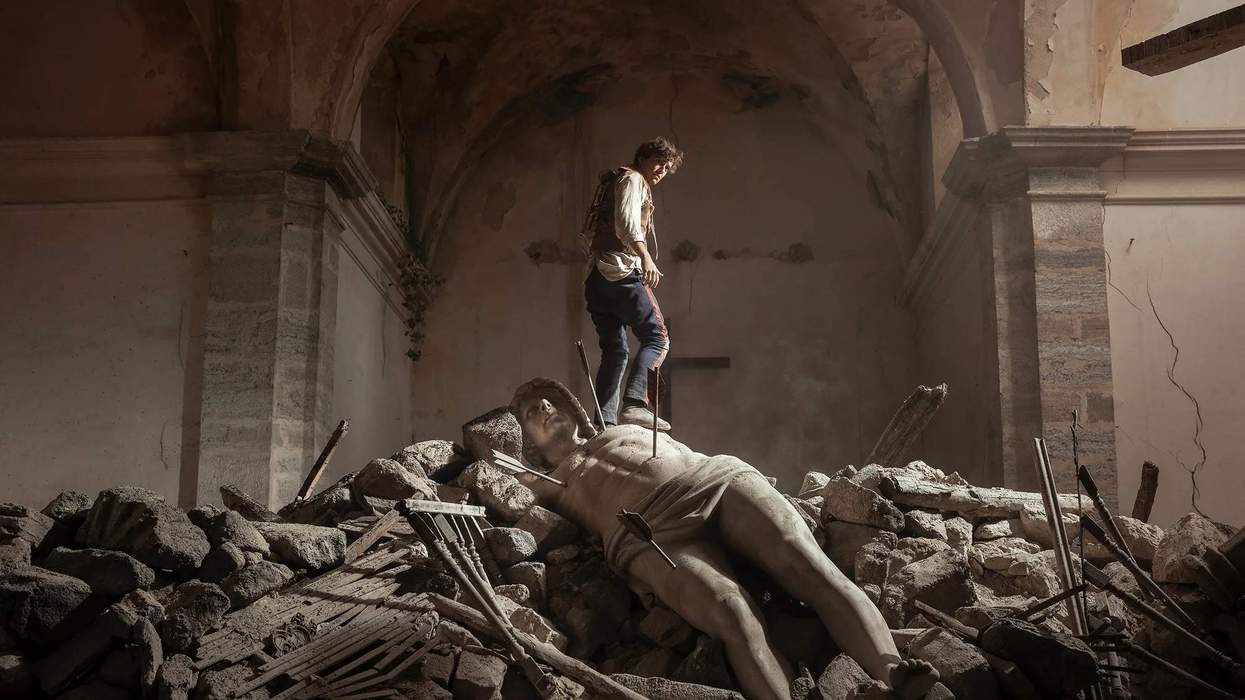

This essay originally appeared on Them, and contains spoilers for La Bola Negra.
In a review that has sent shockwaves through the corner of social media in which an Oscars race feels like it has existential consequences, New Yorker critic Justin Chang wrote that La Bola Negra filmmakers Javier Ambrossi and Javier Calvo “mean to erect a cinematic monument for the ages,” but instead produced “a film that insists, arrogantly and aggressively on its own monumentality.”
Elsewhere in his scathing critique, Chang writes that the Spanish awards season hopeful “wants to be a sweeping historical epic of gay longing,” grading it poorly against that high benchmark. Means to, insists, wants…. If you’re that, well, insistent on assigning metatextual agency to a film, you better be damn sure you’ve got a good read on its aims. Especially if you think it’s “arrogant.”
Of course, if you believe that a pair of directors have set out with a grandiose mission in mind, you’d be inclined to judge them harshly for it if you believe they failed. One isn’t supposed to want to make an epic, I suppose; at least if you’re not one of the handful of filmmakers we’ve already given collective permission to approach the three-hour runtime.
But as a critic with just as much access to Los Javis’ deepest intentions as Chang has — which is to say, none — I suspect he has dramatically misread the film’s ostensible “wants.” La Bola Negra is not trying and failing to be a “monument,” it is taking a core feeling and dragging it through history like a sponge through a spill until it is saturated. It is not a queer epic in the sense it is an epic with a queer narrative; rather, it is a queer epic in the sense that it interrogates what qualifies as “epic” in the first place.
La Bola Negra plays out against the sort of backdrops viewers might associate with the “epic” appellation: a country-consuming civil war, fascist repression, the tragic death of a renowned artist. But here, the phenomenology of desire itself takes precedence over the signatures of the epic form. It is somewhat baffling that Chang feels as though the “omniscient” film “too often crowds the smaller sculptural details out of the frame” when it spends so much screen time on the tension of a hand hovering over a resting shoulder.
Federico García Lorca, the assassinated gay playwright whose unfinished play serves as the thrust of the movie? His appearances are sparse, and restricted to flashback. The Spanish Civil War itself is more of a setting than subject matter. The resolutions of each of the three timelines — a forbidden love story between a soldier conscripted into a fascist army and a prisoner of war, an imagining of Lorca’s La Bola Negra, and a more contemporary 2017 storyline that ties them to each other — each shift their central narrative questions into fuzzier, emotional territory the longer the film goes on.
There is no Titanic-esque, phantasmagoric vision of the torn-apart lovers together in some alternate history, and certainly no conventional monumentalizing of their romance. Their story ends with a bullet, and generations of inherited shame, becoming painful dinner table talk decades later. What ultimately happens to the unfinished Lorca play, whose pages are found in the 2017 timeline? The film is more interested in a series of minor reconciliations, like the one between Alberto (Carlos González) and his boyfriend Juan Pablo (Julio Torres) than in many of the larger threads other epics might delight in tying up for a sense of completeness. Where Chang sees “lyrical bombast,” I hear a hundred queer notes, played pianissimo.
In a famous 1997 essay, queer scholar Eve Sedgwick reapplied psychologist Silvan Tomkins’ notion of “weak theory” to literary criticism. For Tomkins, the “strength” of a theory was determined by how much it could explain: “To the extent to which the theory can account only for ‘near’ phenomena,” he wrote, “it is a weak theory, little better than a description of the phenomena which it purports to explain. As it orders more and more remote phenomena to a single formulation, its power grows.” Scientific theories — along with the sort of paranoid literary readings Sedgwick criticized — want to be able to account for as much as possible, claiming everything for itself.
Chang’s criticism — itself perhaps a textbook example of paranoid reading — ironically accuses La Bola Negra of operating as a strong theory, even as his lingering questions reveal it does not. In one of the review’s most telling moments, he writes, “The complexities of human longing across the ages are not explored so much as solved, in the manner of a mathematical proof. But what, exactly, is being proved here? The universality of suffering? The magic of editing?” How can he be so sure that La Bola Negra is trying to “solve” anything if he’s not sure what’s being solved? Is directorial incompetence really a better explanation in this case than a misjudging of directorial intent? Perhaps that mystery should have given the critic some pause that the film’s objectives lie somewhere else than “proof.”
And if La Bola Negra were making a point about the universality of suffering, or the magic of editing, is that somehow less worthy than some grand, overarching thesis? Is it not enough for the film to simply be stunningly beautiful — for it to aestheticize the way in which every queer person feels both like they are completely alone and like they have invented something brand new, like being gay is at once a profound impossibility and a fountain of possibility? As Sedgwick might ask, “What makes pleasure and amelioration so ‘mere’?” Chang makes the mistake of assuming that La Bola Negra had some sweeping purpose it did not achieve when he’s the one grading a poem like a math test.
Indeed, the most striking effect of La Bola Negra — as I noted in my review for Them — is that it seems to shake loose deeply personal feelings for so many queer viewers. “I started crying and I didn’t even know why,” one Redditor wrote about their first time seeing the film in response to Chang’s review, adding, “I left the theater completely verklempt. I thought about my own family, my ancestors, every single person in my bloodline who wasn’t able to live authentically for one reason or another, how all of their struggles and heartbreaks and dreams and human errors led to me, to the ordinary and beautiful life I still have yet to live.”
I do not know this person, and yet my own experience was identical. I sobbed in my screening and then emerged full of inarticulable feelings about the difficulty of feeling itself: Can queer lineage even be accessed in a straight world? How many mistakes have I repeated because I have been cut off from an already staccato history of trans life? How many have I made just because I’m human?
It’s fine if Chang was not moved — or if he felt like the film was doing something else entirely, and fell on its face. That’s criticism, just as this essay is. But if we are going to make room for the queer epic, we might need to recalibrate our vocabulary for the queer instinct to place texture, narrative, sensation, and history on a more even plane.
Get the best of what’s queer. Sign up for Them’s newsletters.