

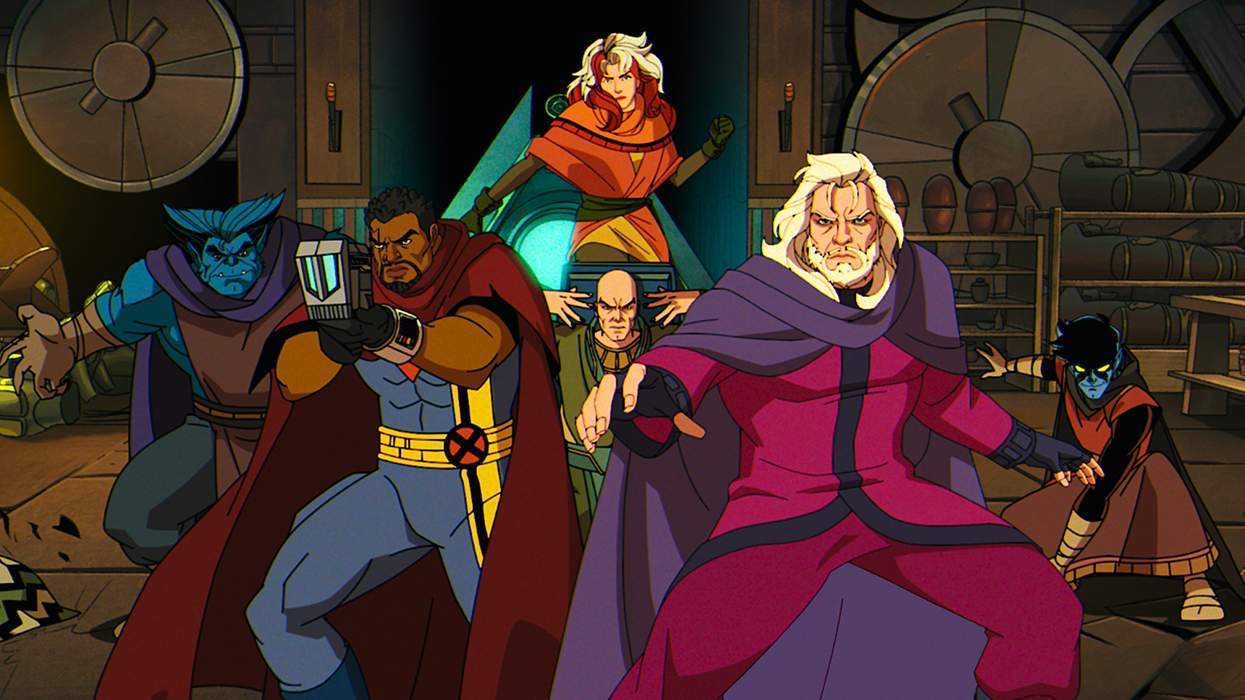
It’s a great time to be an X-Men fan. We have a new Wolverine video game clawing its way to PlayStation 5 this September. Original X-Men movie cast members like Patrick Stewart and Ian McKellen are making a comeback in Marvel Studios’ Avengers: Doomsday this December. And now, Marvel Animation’s Primetime Emmy-nominated revival X-Men ’97 is back with a second season.
Following a spectacular freshman run — which left its die-hard fanbase anxiously awaiting answers ever since 2024’s time-bending finale — the sophomore season is dropping its first three episodes on Disney+ on July 1. When we last saw our beloved mutants, they were divided and scattered across the timeline: some marooned in the ancient past, others in the present, and the rest transported to a far-flung future. For the actors who bring these legendary comic book characters to life, receiving the new scripts was just as mind-bending as the plot itself.
"Because we were working on Season 1 and 2 at the same time, and then 2 and 3 at the same — and out of order with different episodes... I've lost track!" laughs JP Karliak, the voice behind the shapeshifting Morph, as he teases the possibility of voicing cameos from the Marvel universe. "We're in different dimensions and time periods and all of this stuff. I'm sure I do voice some really cool characters, but I have no memory of who they are."
What they do remember, however, are the intense emotional wavelengths their characters are riding into. For Lenore Zann, who has voiced the powerhouse Southern belle Rogue since the original landmark X-Men: The Animated Series premiered in 1992, season 2 explores uncharted psychological depths. When the script finally landed on her lap, she knew her character was headed for a reckoning.
"I'll just say that I love where Rogue is going. I love her hero's journey," Zann teases. "She will continue to try and find justice for what has happened to Remy [Gambit] and for a whole genocide. And that will take her to some dark places."
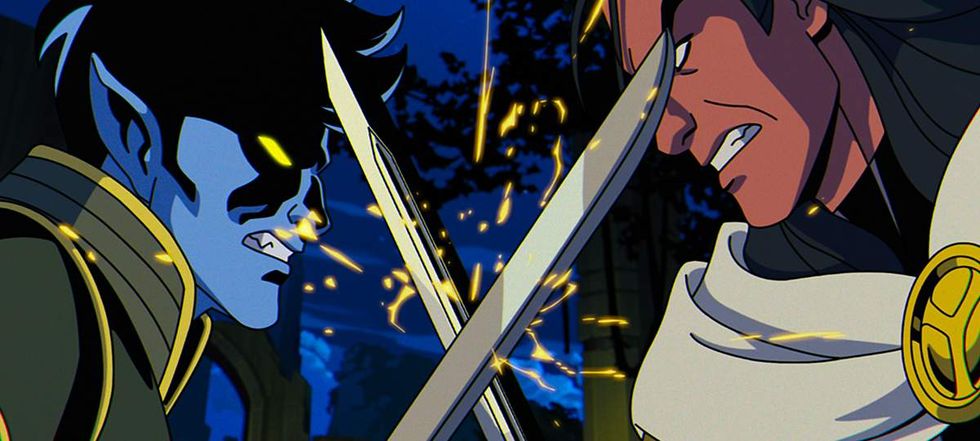 Morph (left)Marvel
The trauma of last season's devastating attack on the mutant sanctuary of Genosha still hangs heavily over the white-streak-haired mutant. Rogue didn't just lose a teammate; she watched the love of her life die in her arms. At the start of the second outing, those wounds are far from healed. Not only that, but there’s a massive moment in the season's fourth episode that could fundamentally rupture Rogue's already fragile state of mind.
"Rogue is dealing with a whole survivor's guilt already," Zann cautions gently, careful not to pierce Marvel’s veil of secrecy. "When you witness a genocide up close and personal, and you lose people that you love, obviously it's going to affect you deeply. I think that's something we have to keep in mind with Rogue. She's still grieving. And that is going to continue and it's going to intensify before it gets any better."
While Rogue navigates a storm of grief and vengeance, Morph is traversing a very different sort of internal journey. In the first season, fans watched the shapeshifter rely heavily on lightning-fast transformations to assist the team. But underneath the theatrical battle tactics and the comedic defense mechanisms lies a deeply fractured individual trying to reclaim their identity after years of trauma.
"At the end of the original series, Morph just rejoins the team at the very end," Karliak points out. "Morph has been away from the team for a while, going through a lot of PTSD and working through some issues. So the first season of our show was very much about Morph finding his bearings and getting a sense of where they fit in the team, using humor to push through any awkwardness."
But there’s a lot more to the shapeshifter beyond the signature quips. During the season 1 finale, Morph transformed into Jean Grey to confess his love for Wolverine — a standout scene that left X-Men fans in a tizzy. It was a vulnerable moment that signaled a profound shift in the character's emotional trajectory — one that will ripple into the new season.
"I think you're going to see some emotions Morph has yet to explore in this season," Karliak reveals. "More than just the ba-dum tss!"
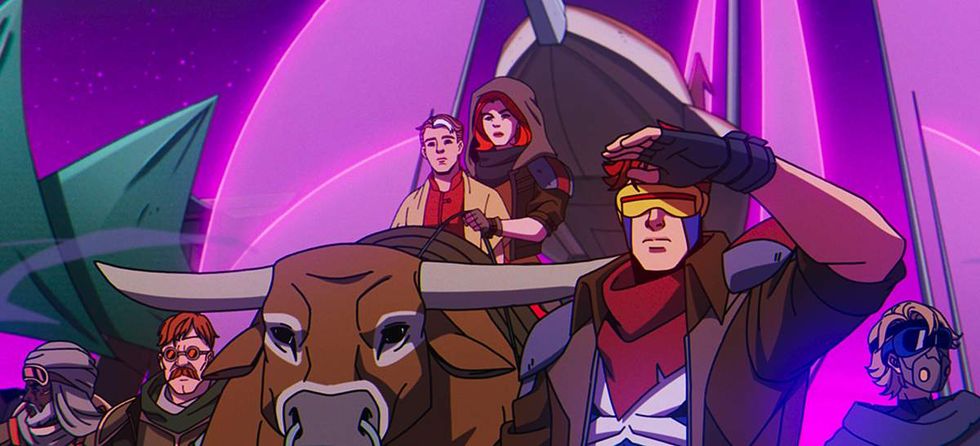 Season 2 of X-Men '97 sees the characters scattered across space and time.Marvel
Ever since Stan Lee and Jack Kirby first conceived of these characters in 1963, the X-Men have served as an enduring metaphor for marginalized communities. They are a band of individuals hated and feared by a world they are sworn to protect, finding solace not in societal acceptance, but in each other.
For the LGBTQ+ community, this metaphor has always hit close to home. The X-Men themselves represent the concept of the "chosen family" — the vital, life-saving networks of love and safety that queer people seek out when their biological circles or broader societies reject them.
When Zann and Karliak step away from the recording booth and out into the real world to attend comic conventions, it’s clear that all that subtext has resonated with the queer fanbase. For Karliak, the connection became even more real when Marvel announced that Morph would be identified as nonbinary in this new iteration of the franchise.
"Just from reading the scripts and knowing that Morph was going to be a nonbinary character, I knew that would have some impact," Karliak says. "I don’t think I really recognized how big that would be until we started doing conventions and meeting people."
What makes the portrayal so elegant is its absolute subtlety. The show never halts the narrative to deliver a heavy-handed lecture on gender identity. Instead, it allows Morph’s identity to simply exist as an unquestioned fact of life within the X-Mansion.
"Even though we never really talk about it in the show — other than Rogue using 'they' and 'them' pronouns for Morph at one point — we really don't address it too much," Karliak notes. "And of course, the 'will they, won't they' relationship with Wolverine, but it still hits on such a level... I certainly get trans and nonbinary people who feel so seen and feel so hopeful — during this exceedingly dark time — when they see a queer superhero like Morph."
For Karliak, the line between voice actor and character has been entirely blurred. "Morph is very personal to me because I feel like our identities are so linked together. We're so similar," he shares. "As you know, this is Morph's voice. I don't really do anything extra for it. I feel so deeply that when people say how they feel seen, I'm feeling it too. We're in the same boat of feeling that representation through Morph."
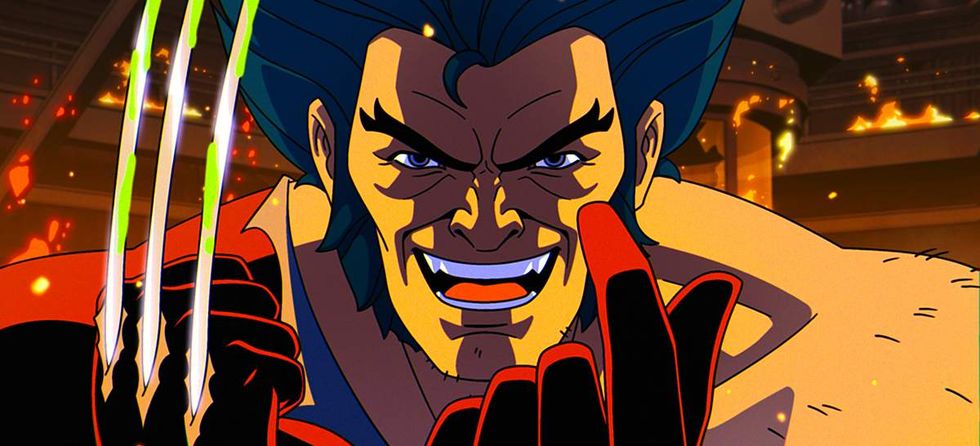 Wolverine in X-Men '97.Marvel
Zann has observed this same phenomenon through the lens of Rogue for over three decades. While Rogue might present as a cisgender woman, her specific mutant affliction — the inability to make skin-to-skin contact with another human being without absorbing their life force — serves as a potent allegory for the historical queer experience.
"First of all, it's been a real honor to play a character in a show that is really all about representation and the ability for a whole bunch of misfit kids to come together and learn to accept themselves for who they are and learn to accept each other without shame or blame," Zann says. "And to not only do that, but to also try and fight for the right to exist in a world that hates and fears us."
She continues, connecting Rogue's specific burden directly to her LGBTQ+ fans: "As Rogue, I'm often hearing from the LGBTQ community who come up to me that they relate so much to her because of her inability to be able to touch somebody that she loves. And her desire to look at people who are walking along the streets, holding hands, kissing in a park, whatever — all the things that ‘normal’ people can do. But the LGBTQ community felt that they were held back for many, many years. Then things started to get better. And now, things are going back the opposite direction again. And it's very, very sad."
"I feel like a really great degree of responsibility playing this role and being a spokesperson who can go out and tell people and tell kids it's OK to be different," she added. "It's OK to be who you are and that we're all in this together. And that, together, we can in fact build a better world for everybody."
Fans who have followed the series since its 1992 iteration have likely noticed an increasingly streamlined approach with X-Men ‘97: Season 1 ran for 10 episodes, while the incoming Season 2 clocks in at only nine — and, much to the fans’ dismay, there was a two-year gap between seasons. It is a stark departure from the broadcast television era of the 1990s, where some seasons contained up to 21 episodes. Yet, both actors are quick to defend the "less is more" approach of X-Men ‘97.
“These episodes that we're doing now are longer in length,” Zann explains. "When I watch them, it feels like I'm watching a movie... Our team works so hard on crafting these and getting them to the level that they are.... It takes a long time to get it to this level, which is why I'm sure we're doing fewer episodes."
Karliak, too, prefers the leaner and meaner approach of the revival series. "We're telling such rich and deep adult stories with this series that we don't really have room for the filler," he maintains. "Everything is action-packed and filled. And so I would so much rather there be quality over quantity."
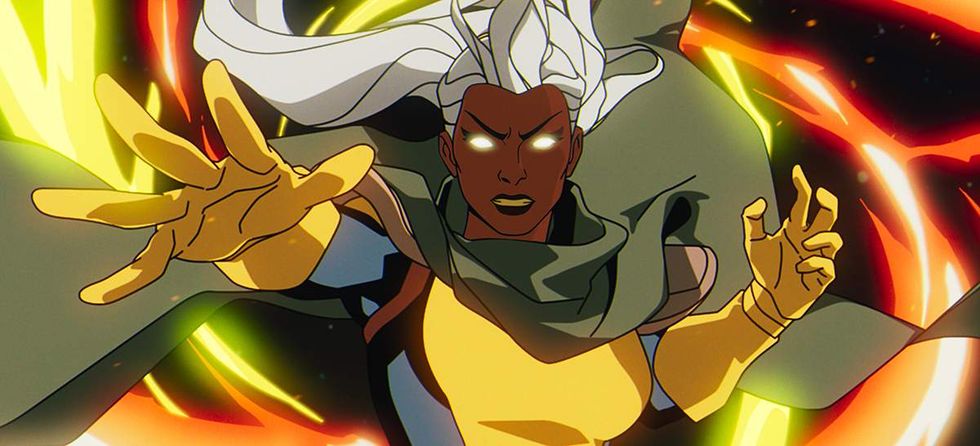 Storm in X-Men '97.Marvel
That being said, neither actor has any intention of hanging up their superhero suits anytime soon. As long as the fans clamor for more and the writers continue to pump out quality scripts, both Zann and Karliak express an enthusiastic willingness to sign on for the long haul.
"Absolutely," Zann declares without hesitation. "I mean, if Kevin Conroy can play Batman for 33 years...at this point, I think I've actually surpassed Mr. Conroy's record — sadly, he passed away a few years ago. And, I'm still here."
Karliak is totally game for a multi-decade run, provided the series maintains the rebellious edge that defines the franchise's core identity.
"As long as we are telling a story that's true to the property and to the spirit of the X-Men that we are a rowdy little group of kids that are the rebels — the island of misfit toys — and we are a safe space for the outsider then, yeah, of course," Karliak muses. "If we wanted to go for 12 seasons, I wouldn't mind."
Given the cinematic scale of the animation, Zann also loves the idea of a major, theatrically released animated feature film — something she’s even pushed for behind the scenes. "An animated feature film. I would love to do that, too," Zann reveals. "I did mention it to [Marvel Animation executive] Brad Winderbaum at our New York premiere a couple of weeks ago. I said an animated feature would be good. And he was like, 'Yes, I know.' I would love to do that. There doesn't seem to be anything in the works yet, but who knows?"
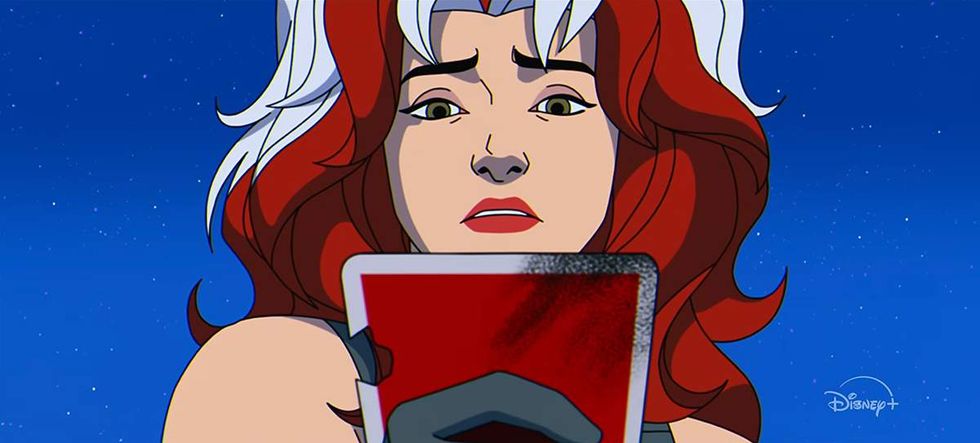 Lenore Zann voices Rogue in X-Men '97.Marvel
For now, their immediate future is locked in. While the fanbase prepares for the arrival of X-Men ‘97 season 2, Marvel has already greenlit the show through season 4. With the vast catalog of Marvel Comics lore at their disposal, both actors have wish lists for where the narrative could go next and which characters should make their debut.
"The first one is a joke answer because I've been saying this a lot. Doop! Where's Doop?" Karliak quips, referencing the oddball X-Men character, who is a green floating glob. "Such a weird character. I'd love to see Kitty with Lockheed because I just love a little purple dragon."
For Zann, it should be no surprise that her ideas for the show stem from romance between her character and Gambit. "I would love to see a spin-off series of Mr. and Mrs. X. Remy and Rogue LeBeau. Like in the comics. That would be so much fun."
Whether the series ultimately ventures toward standalone romance spinoffs or interdimensional space dragons, one thing remains absolutely certain: Karliak and Zann are confident that season 2 will deliver. As the countdown to July 1 reaches its final hours, Zann offers one final, exhilarating piece of advice for the audience.
"I think the fans are going to be beside themselves," she promises with a knowing grin. "But you better buckle up your seatbelts. Because we're in for a wild ride."
Season 2 of X-Men '97 is now available on Disney+.