



Connor Storrie’s starring turn as the host of the newest episode of Saturday Night Live went viral for his injured stripper bit and his Heated Rivalry co-star Hudson Williams showing up, but now people are also talking about a controversial faux PSA that didn’t make it onto the broadcast but was released online.
The sketch depicted canceled celebrities blaming their controversial actions on Tourette syndrome — in the wake of Tourette's campaigner John Davidson involuntarily shouting a racial slur while Sinners stars Michael B. Jordan and Delroy Lindo were presenting at the BAFTA Film Awards.
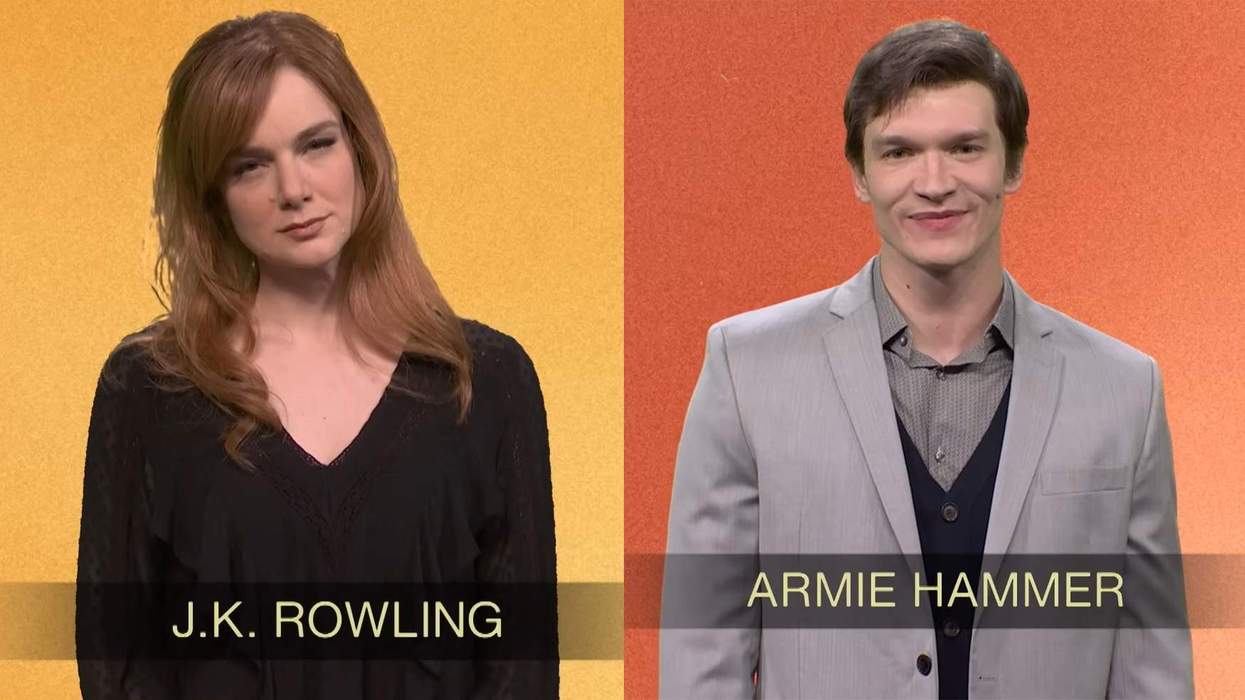
In the sketch, Storrie plays Armie Hammer, while other SNL comedians portray celebrities like J.K. Rowling, Mel Gibson, The Real Housewives of New York star Jill Zarin, Louis C.K., Bill Cosby, and Kanye West, who all claim that their poor behavior can be blamed on Tourette’s.
“Not many people know this, but one of the most common side effects of Tourette’s is cannibalism,” Storrie says while acting as Hammer, who faced massive backlash when leaked messages made public his alleged cannibalistic sexual fantasies.
SNL cast member Ashley Padilla played a fictional Rowling blaming her blatant transphobia on Tourette’s. “Tourette’s isn’t just blurting out an offensive word,” she said. “It can be years-long obsession with something like trans life and a deep anger that someone who was born with a wand in their pants would want that one removed and replaced with a Horcrux.”
While some people saw this skit — which didn’t air with the SNL episode on NBC, but was later posted on YouTube and the show's social media accounts — as a comedic way to poke fun at celebs who will use any excuse necessary to avoid accountability, disability activists felt it was damaging to an already marginalized group.
"We had hoped this would be a new week and we could move on but the release of further content online that has been designed to ridicule Tourette's and reduce our community to a punchline has only deepened that hurt,” CEO of Tourettes Action Emma McNally said in a statement Monday.
The SNL skit stemmed from Davidson swearing and saying a racial slur during the BAFTAs due to his Tourette syndrome, which for him causes tics and uncontrollable outbursts called coprolalia. Coprolalia is a medical term used to describe outbursts that often include “obscene words or socially inappropriate and derogatory remarks,” and for a small number of people, these outbursts can manifest as “racial or ethnic slurs in the company of the very people who would be most offended by such remarks,” according to the Tourette Association of America.
In a recent interview with Variety, Davidson explained how painful the experience at the BAFTAs was for him and how he’s experienced violence because of his tics in the past. “When socially unacceptable words come out, the guilt and shame on the part of the person with the condition is often unbearable and causes enormous distress,” he said. “I can’t begin to explain how upset and distraught I have been as the impact from Sunday sinks in.”
In her statement, McNally said making fun of someone with this condition is cruel. “Mocking a disability is never acceptable,” she wrote. “It would not be tolerated for any other condition, and it should not be tolerated by people with Tourette's."
She stressed that Tourette’s is a “debilitating” disability and shouldn’t be a way to slam celebrities for their bad behavior when what society really needs is “compassion, accurate information and above all, we need education.”
"Tourette’s is a complex neurological condition, of which there is no cure. It is not a joke,” McNally said. “It is not a personality trait. It is not a source of entertainment. It is a condition that can be extremely debilitating, causing pain isolation and huge amounts of discrimination.”


