
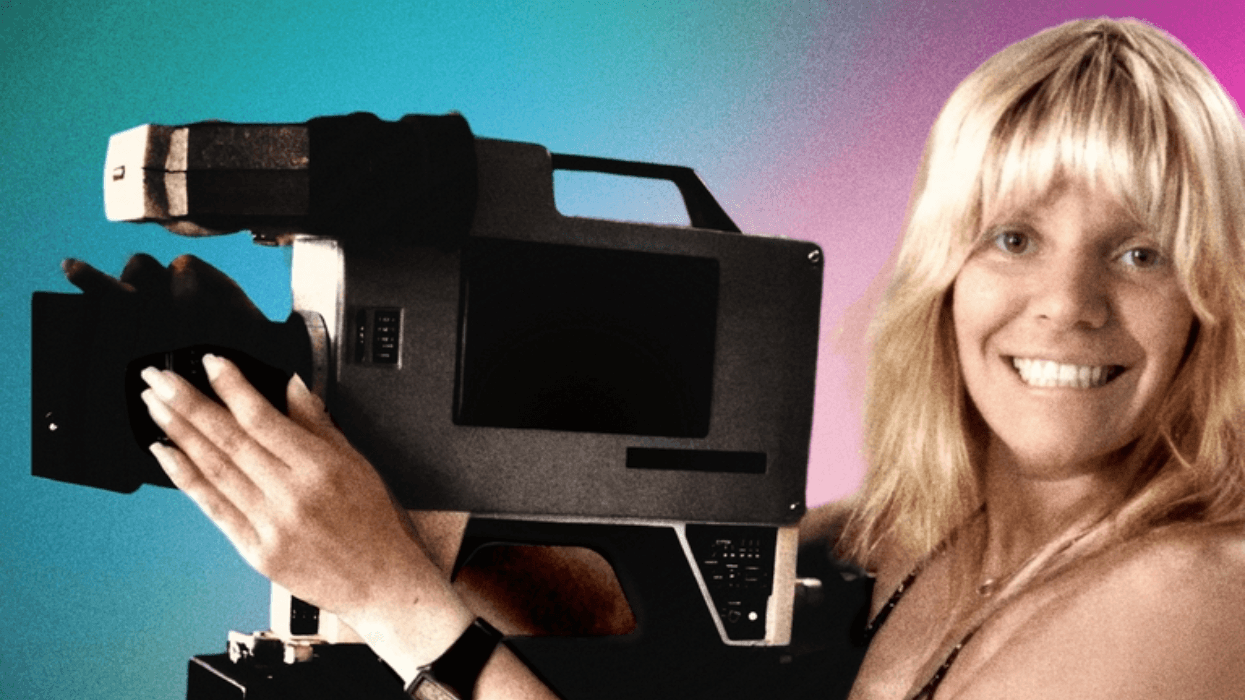
If the queer community of New York City had a fairy godmother, it would be Robin Byrd.
Sure, her crinoline ball gown was replaced by a black crochet string bikini, and her magic wand had a big plastic rubber at the end. But for decades, Byrd made people’s fantasies feel possible while fiercely protecting them from the forces that wanted queer sex, queer bodies, and queer pleasure pushed back into shame.
I first met her during one of my earliest trips to Fire Island about ten years ago. Not growing up in New York, I had no real reference point for who she was. But even before I understood the full mythology, I understood the reaction. She moved along the boardwalks like a minor deity: hair in a bun, body unmistakable, presence undeniable. When people referred to her, I could tell she was someone special.
Since then, I have become more than familiar with the legacy and lore surrounding her. For those who may not yet know, the new HBO documentary Bang My Box: The Robin Byrd Story, which premiered at the Tribeca Festival and arrives on HBO June 30, offers a long-overdue introduction to Byrd’s celebrity, her public-access empire, and the tireless advocacy work she did for the LGBTQ+ community during some of the most frightening and formative eras of our recent history.
“I am so happy that people get to see me for me,” Byrd, 71, tells Out of the documentary, “because everybody has their own conceived fantasy. Everybody thinks they know me.”
Directed by Jyllian Gunther and Stephanie Schwam, and produced by Sarah Jessica Parker’s Pretty Matches Productions, the film is not merely a nostalgia trip through late-night cable, vintage porn stars, and pre-Giuliani downtown debauchery. It is that, of course, and thank God. But it is also a portrait of a woman who understood something long before the mainstream caught up: that sex could be silly and sacred, that pleasure could be political without being programmatic, and that being seen — really seen — could be a form of survival.
‘Whatever your fantasy made me to be’
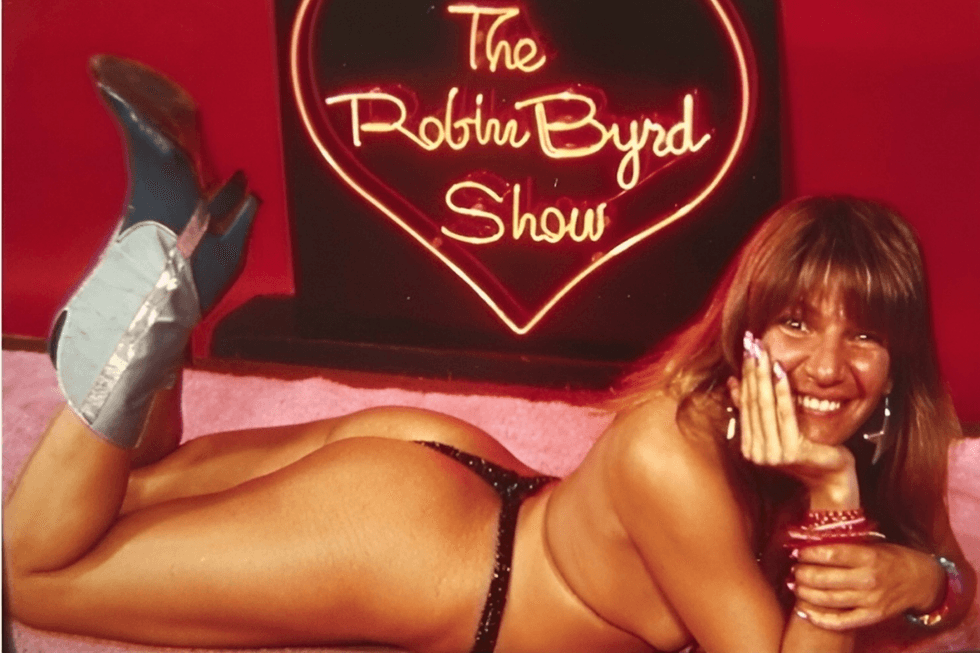
Robin Byrd poses in front of a neon sign for The Robin Byrd Show.
The Robin Byrd Show
From 1977 to 1998, The Robin Byrd Show turned Manhattan Cable Television’s Channel J into Byrd’s own glittering, low-budget, late-night universe. She interviewed adult film stars, strippers, escorts, downtown characters, nightlife fixtures, and queer people of every stripe. She took calls from viewers, whom she lovingly called her “Byrd Watchers.” She danced. She flirted. She asked questions with the curiosity of someone who never believed sex should be hidden behind euphemism or shame. It was, in spirit, the raunchiest and silliest podcast imaginable — decades before the word podcast even existed.
She preached condoms and safer sex with a big grin, not a wagging finger. And she did it all in the uniform that became her iconography: the crochet bikini, the blonde hair, the body offered not as perfection but as permission.
“I am whatever your fantasy made me to be,” Byrd says. “Some people thought, ‘Oh, that porn channel.’ Even people that never saw the show had perceived visions of what I was. And now the doc really tells them what I am and who I am, which is not any different than who I was in front of the camera.”
Then, because she is Robin Byrd, she undercuts the sentiment with a laugh and a wink.
“I’m not any different in person than I was on the show,” she says. “Except — no, I’m not even less bossy. I’m just as bossy when I need to be.”
For the filmmakers, making the documentary meant peeling back those fantasies and discovering the depth beneath the persona. Gunther remembers growing up in New York and seeing Byrd on a black-and-white television as a child, registering her mostly as “a sexy funny lady.” What neither filmmaker fully understood at the beginning was the gravity of Byrd’s impact.
“We didn’t know she went to the Supreme Court and fought for First Amendment rights,” Gunther says. “We didn’t know she was a feminist. We didn’t think about any of those things. The whole thing was like she was an onion that we were unpeeling as we made the film.”
That process of discovery becomes part of what makes Bang My Box feel so alive. The film does not retrofit Byrd into a tidy activist narrative. It does not pretend she was walking around downtown with a manifesto tucked into her bikini bottom. In fact, the filmmakers are careful to let her remain as unruly and unclassifiable as she has always been.
“She did her own thing,” Schwam says. “She didn’t have a manifesto. She wasn’t political. She just did what she did with her intuition and her heart.”
That distinction matters. Byrd’s work was political precisely because it was not packaged as politics. She was not translating queerness, sex work, desire, kink, bisexuality, or gender nonconformity for polite society. She was not asking permission to humanize the people who came through her studio. She simply treated them as already human, already interesting, already worthy of airtime.
The show also belonged to a very specific late-night economy: the era of phone-sex lines, 1-900 numbers, and public-access ads that promised fantasy, intimacy, and escape for a few dollars a minute. Before apps, DMs, OnlyFans, or even the internet as most people know it, these numbers were a kind of analog portal — part hustle, part performance, part lifeline. At first, Byrd’s line catered mostly to straight men, but as she quickly amassed a devoted gay following, she expanded the enterprise to include gay men and transgender performers, diversifying the platform while creating lucrative opportunities for queer people working in the sex industry.
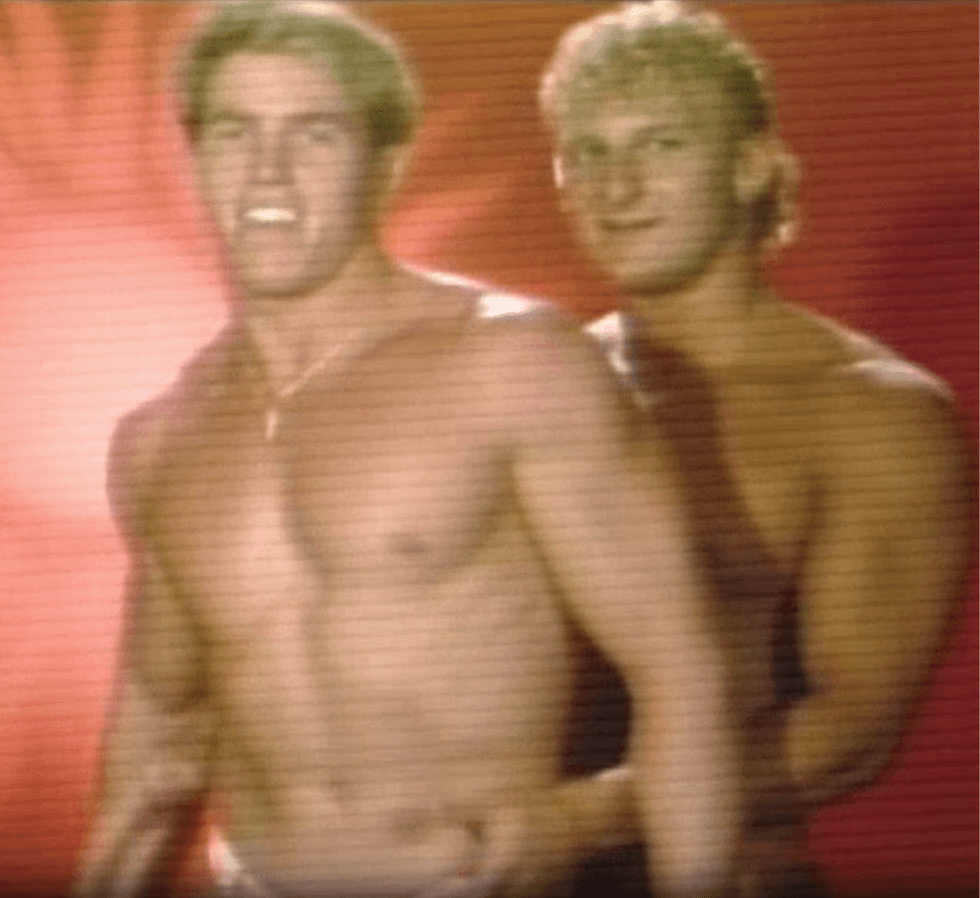
Two performers appear in a segment from The Robin Byrd Show, which featured a mix of adult entertainment, live calls, and performances.
The Robin Byrd Show
“For Robin, the everyday was political,” Schwam says. “But again, it was without this sort of intention of politics. She wasn’t performing activism. She wasn’t performing feminism. She was a feminist.”
“She was sex-positive and body-positive,” Schwam adds. “The idea of a ‘queer safe space’ didn’t exist in the language. She just did her thing, and then language and boxes and definitions came to meet her.”
Byrd’s own explanation for why she did the show is simpler, and far more devastating.
“I didn’t like what I watched on television late at night,” she says. “It was basically news. I felt that there was a need for some sort of love to turn you on and tuck you in and have some sweet dreams.”
“At that time, even in the seventies, AIDS was starting,” she adds. “There were people dying. Nobody had a loved one, or they lost their loved one, or they were afraid of having a loved one. And I was there for them. I wanted to be that person. I wanted to let them know that I’m here for you. If you don’t have a loved one, you always have me.”
Then she reveals the wound beneath the mission.
“I meant it because I never got that love,” Byrd says. “I was never given that warm hug.”
Byrd, who was adopted at a young age and lost her adoptive father when she was very young, carries that origin story inside the woman she became: someone who went looking for love and decided, somewhere along the way, that she would become the love so many others had been denied.
“I just didn’t like what I watched on television,” she says. “I wanted to change it.”
Where is Robin Byrd now?
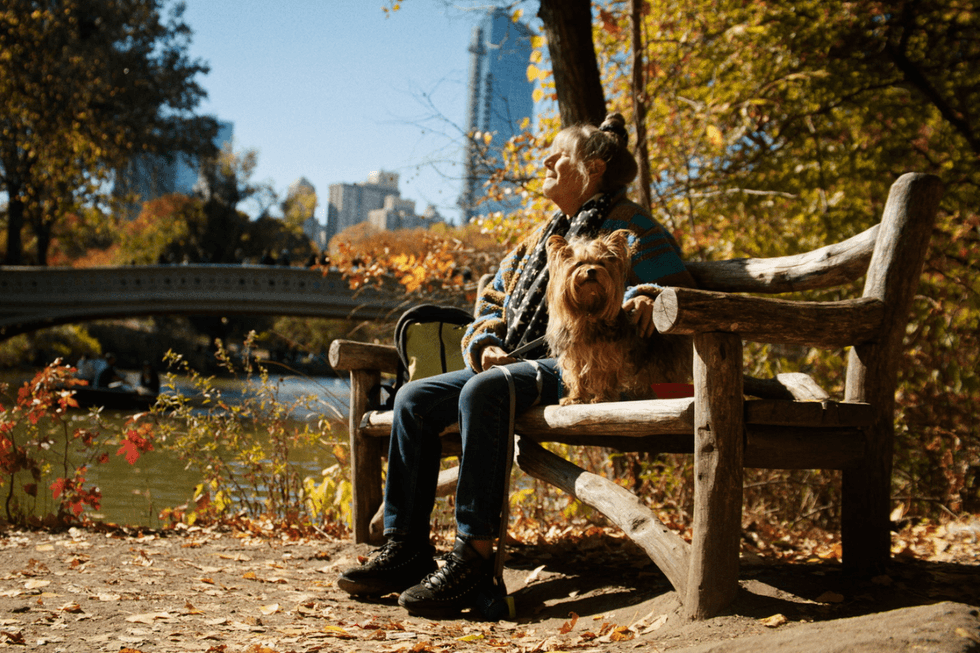
Robin Byrd sits with her dog in New York City's Central Park.
HBO Documentary Films
One of the reasons the documentary works is that it resists one of the laziest traps in films about sexual figures from earlier eras: the lurid “Where are they now?” gaze. There are no traditional talking heads staring into the camera, no parade of aging former performers treated like cautionary tales. Instead, the filmmakers use voices, archival material, and the strange intimacy of people calling in — an intentional choice that feels connected to the world Byrd created.
“We really decided to pull back and let the footage and Robin speak for itself whenever possible,” Schwam says. “Taking the talking heads out wasn’t just for the sake of it. It was a natural decision, a hat tip to the Byrd Watchers calling in.”
The filmmakers wanted to avoid the rubbernecking impulse that so often attaches itself to former porn stars, sex workers, nightlife people, and anyone who once lived publicly through their body.
“There’s an element of being distracted by the way somebody looks now,” Gunther says. “We’ve already gotten to see them. Let’s hear them now.”
The result is a documentary that trusts its subject and its archive. It lets Byrd be funny, bossy, tender, evasive, commanding, and emotionally available — sometimes all within the same scene.
The film’s emotional center, however, is not only Byrd’s career. It is her relationship with her husband, Shelly. Their decades-long love story gives Bang My Box an unexpected tenderness, especially as the film observes Byrd caring for him amid his dementia. What could have felt like a secondary plot becomes one of the documentary’s most moving threads: the sex-positive public-access queen now living a quieter life defined by devotion, routine, and care.
Byrd is clear about what that part of the film reveals.
“It shows the love, totally, that I have for him,” she says.
People, she says, are always asking what she is doing now.
“I always answer: I’m enjoying the life I built,” Byrd says. “When you’re working, you have your job. When you’re retired, you don’t have that anymore. I have another purpose: to take care of him.”
The filmmakers saw that love too. In their interview, they describe their first in-person meeting with Byrd and Shelly as “basically a double date.” Shelly, they say, was magic. Their timing together was immediate and revealing. When Byrd would describe something she had done, Shelly would chime in to say he had the tapes, that he had filmed it.
At first, Byrd was protective of him and his routine, cautious about the filmmakers’ presence. But over time, as trust developed, she allowed them to see more.
“In the end, I think she saw that we loved him so much,” Schwam says. “She let us embrace him.”
Gunther adds that showing Byrd’s life now meant showing her caring for “the person who took care of her this whole time.” It allowed the film to celebrate Shelly as more than a supporting character in the Robin Byrd mythology. He was not just the man behind the camera, or as the film puts it, her “head gopher.” He was part of the foundation.
That love story also complicates any simplistic reading of Byrd as merely a sexual provocateur. The film is full of pleasure, but it is also full of commitment. It understands that sexual freedom and long-term devotion are not contradictions. In Byrd’s life, they appear to grow from the same source: a refusal to let other people define what intimacy should look like.
Two New York icons, one story
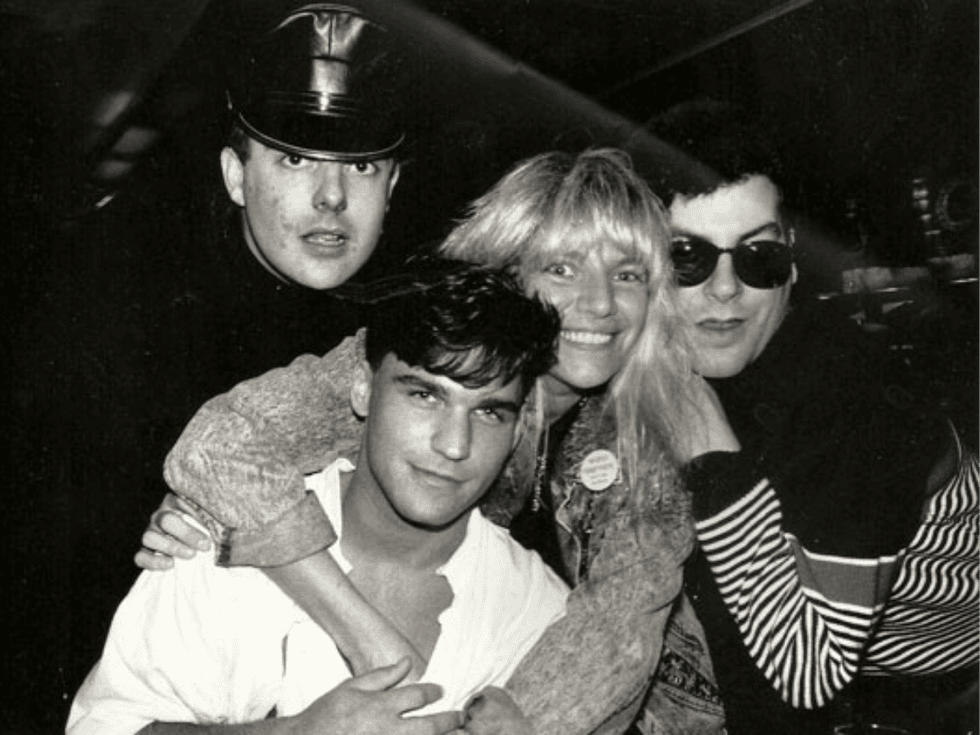
Robin Byrd poses with friends in New York City's LGBTQ+ nightlife scene.
The film arrives with an especially fitting New York connection through Sarah Jessica Parker, who serves as one of its producers. For the filmmakers, Parker’s connection to Byrd made cultural sense beyond celebrity attachment.
“I think Sarah Jessica really understands that Robin is a precursor to her television show,” Schwam says. “She’s really more of the Candace Bushnell era.”
That lineage feels right. Before Sex and the City turned female sexual candor into glossy HBO prestige, Byrd was doing something stranger, scrappier, and more radical on public access.
“I moved to New York City on January 1, 1977,” Parker told HBO on the red carpet. “Not terribly long after that, I became a young adult, lived on my own, had a cable box, and discovered this singular, extraordinary, almost mystifying person. I had never seen somebody who talked like that, who was having the kinds of conversations nobody else was having. She was beautiful and smart and caring and irreverent, completely in possession of herself.”
But what Byrd became when it was necessary, Parker added, is an essential part of understanding her.
“She was a fierce advocate, a champion of free speech,” Parker said. “But in the queer community, at the most urgent and necessary time during the AIDS crisis, she had no problem screaming and yelling about what was needed and what was being ignored.”
It is a story that is long overdue. Parker said she had not heard from so many friends in anticipation of a project in quite some time. That excitement makes sense. For many New Yorkers, Byrd is not just a media figure. She is part of the city’s erotic, queer and messy subconcious.
‘It’s the pioneers that get the arrows’
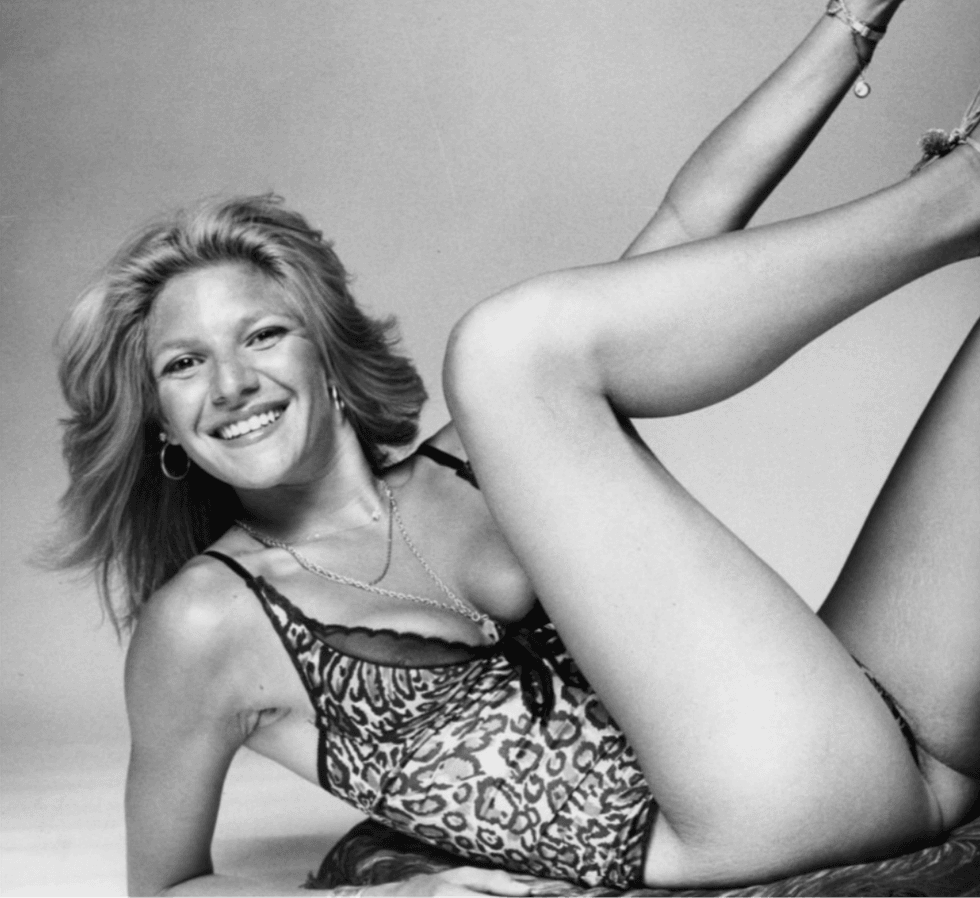
Robin Byrd during the early years of The Robin Byrd Show.
But Byrd is less interested in being canonized than in making sure people understand the road they are walking on. In its final stretch, the documentary finds Byrd confronting aging and her own naked body at 70, the age she was during filming. The sequence becomes one of the film’s most powerful statements: that visibility is not only about youth, sex, or spectacle, but about refusing to disappear.
“What kind of hypocrite am I telling everybody to love your body?” Byrd says. “Here I am a little woollier than I was when I was younger. And I’m like, wait a minute, it’s not embarrassing to me. I’m just giving you the reality of aging and being 70. I’m not a hypocrite. I set by example.”
That example extends beyond body acceptance. Byrd wants younger LGBTQ+ people to know that the freedoms many now inherit were not inevitable. They were fought for by people who came before.
“What I want people to know is where they came from,” she says. “How it got there. How you are able to be okay with being gay and out of the closet.”
“I wanted people to know that I was the pioneer,” Byrd adds. “I’m the one that took the arrows for the roads that you are settled into. It’s the settlers that get the land, but it’s the pioneers that get the arrows.”
It is a devastatingly accurate description of queer history. The people who make the world more livable rarely get to enjoy the fullest version of what they made possible. They take the arrows. Others arrive later and call the land home.
Byrd took arrows from censors, moralists, corporations, people who reduced her to smut, people who watched without understanding, and a culture that has always been happy to consume sexual labor while refusing to honor sexual laborers as thinkers, caretakers, and artists. Yet she kept showing up in her bikini with a condom and a smile, telling people to protect themselves, enjoy themselves, and love themselves above all else.
The filmmakers say they hope audiences leave the film loving themselves the way Byrd has been teaching people to.
“We want people to love themselves the way Robin is teaching us all to,” Schwam says. “No matter how hard that is.”
They also joke: “I hope you leave feeling horny.”
Honestly, that works too. Because in Robin Byrd’s world, horny was never just horny. Horny was alive. Horny was curious. Horny was connected. Horny was a reason to pick up the phone, ask a question, use a condom, dance awkwardly, watch a stranger, recognize yourself, and maybe feel a little less alone before going to sleep.
When I tell Byrd that seeing her old safer-sex clips now feels revolutionary — the way she talked about rubbers without stigma, with humor, urgency, and ease — she does not seem surprised.
“I’ve always been ahead of my time, Alex,” she says.
She has. But Bang My Box makes clear that perhaps the rest of us are finally catching up.
Bang My Box: The Robin Byrd Story premieres June 30 on HBO and will be available to stream on Max.
Want more Robin? Out's Stephen Walker caught up with the legendary TV pioneer at the International Provincetown Film Festival ahead of her documentary's premiere. Watch their conversation below.

Robin Byrd with Stephen Walker in Ptown. Filmed by Stuart Sox.