


This story originally appeared on Them.
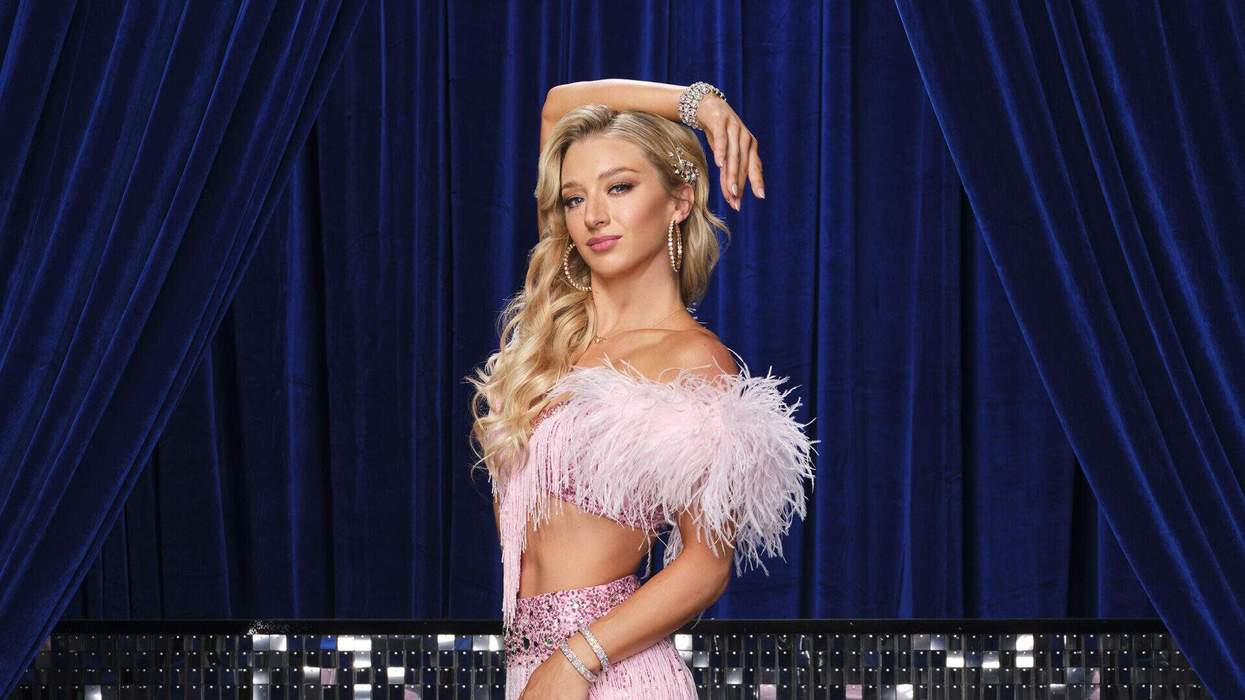
Out100 honoree Amber Glenn made history in 2024 as the first out queer woman to win a U.S. figure skating title, proudly draping herself in a Progress Pride flag during her victory lap on the ice. Now, after winning Olympic gold earlier this year, Glenn is turning to her queerness as a source of inspiration as she vies for a new honor: the coveted Dancing with the Stars Mirrorball Trophy.
“I’m really having the time of my life,” she tells Them over a video call, a rare moment of calm in her busy training and filming schedule for the series. “I’m really happy to be myself — a strong woman — in these spaces, on these huge platforms.”
Already in week six of the dance competition show, Glenn has stunned audiences and proved to be a true competitor. Never one to hide her identity as an openly queer athlete, Glenn has injected her full into every performance, including the show stopping, now-viral tango during week 2 inspired by the gay hockey romance Heated Rivalry.
In the tense opening scene of the dance, Glenn grips her professional dance partner Pasha Pashkov, briefly locking eyes with him before her gaze turns elsewhere, revealing her true passion. As “All The Things She Said” — the background track to an infamous scene in Heated Rivalry — continues to play, Glenn reaches out to a woman who walks by with her arm outstretched, desperate to grab hold of her hand. As the woman walks away, leaving Glenn in despair, she and Pashkov begin to dance. Both on the DWTS stage and in Heated Rivalry, the song represents a moment of undeniable queer yearning powerful enough to pull on anyone’s heartstrings.
“It was really cool to have Pasha really try and understand the story, where I was coming from, how I felt about it — and the way he was able to choreograph it was fantastic,” Glenn says.
Being openly queer on a global stage isn’t always easy. At the 2026 Winter Olympics, Glenn skatied her way into our hearts alongside her teammates on Team USA, known affectionately as “The Blade Angels.” Her performances along with her teammates, alternative darling Alysa Liu and Isabeau Levito, quickly went viral. Despite all that love, Glenn received a number of “scary” threats for supporting LGBTQ+ rights, and just being herself.
But much like her approach to her athletic craft, Glenn isn’t backing down. She sees representing queer people, whether it be on the ice rink or one of the most-watched dance floors on earth, to be an honor and a responsibility.
“I’m really lucky that I’m able to do things like this,” she says. “It just amplifies my voice even more, which I feel like is a responsibility and a duty that I have as part of the community — and [as] someone who speaks out about queer rights and about mental health and about the things that are really close to my heart.”
Below, Glenn speaks with Them about her experience on Dancing with the Stars so far, the queer athletes who inspire her, and representing LGBTQ+ people on the global stage.
How does training for Dancing with the Stars compare to training for the Olympics?
It’s been a lot of fun, first and foremost. I’m used to training solo for what I’m doing alone, versus now I am training with someone and that someone is my coach, my choreographer, and my partner. It’s definitely different for me. Not to mention every single week is something new, whereas I’m used to perfecting the same routine for months on end, competing the same routine multiple times. There’s a lot of differences for sure,but it’s been such a great experience.
It’s been really amazing seeing you killing it on stage. Have you had a favorite performance so far?
I’d have to say the week two tango and then this week five samba have been a lot of fun.
Totally. I feel like the week two tango was everywhere. Everyone was talking about it. What was the creative process behind it? I know that you had filmed a video for HBO that was a similar, Heated Rivalry-inspired concept.
[The HBO video] was such a great opportunity and I was so grateful to have worked with them on that. I really got to cinematically show this kind of story, but [the Dancing with the Stars performance] was just pure dance. It was really cool to have Pasha really try and understand the story, where I was coming from, how I felt about it — and the way he was able to choreograph it was fantastic.
What has some of the feedback that you’ve gotten for that performance been like?
Incredible. People have been so supportive. Everything from the costume to the choreography, to the kind of attitude I had towards it — it was all really great and really encouraging, and I think it really boosted my confidence in this competition.
I was reading your Team USA essay about the meaning of Pride. I thought it was so beautiful. There’s a point where you write that there really wasn’t robust representation for queer women in sports when you were growing up. How does it feel to be the representation that you didn’t see?
Luckily as I got older, that started to shift and change. As I got into my teenage years, I felt way more comfortable with myself, because I saw myself represented, but not necessarily in my sport. But in many others, I saw these trailblazers who were just so courageous and so inspiring to me. I was lucky enough to be in a position where I felt safe and comfortable to be myself, even in the face of any sort of negativity or consequences, which at that point meant way less to me than being who I am.
I was very lucky to be able to do that and be myself and still be safe and be happy and find success in what I do.
Tell me about how being that representation has felt as an Olympian, because I know that isn’t always easy.
Of course there’s some pressure that comes with it because you want to represent your community as best as you can, and not everyone is gonna be perfect all of the time. We’re gonna have tough days. We’re not always going to do the right things or say the right things. There’s definitely been an extra bit of pressure to really think before I do things or before I speak, which I think has honestly been probably best for me, because it has let me portray myself the way that I truly am, rather than how I am moment to moment.
I have really taken on this duty of being a representative of the community and taking it with everything I do, because I know that it’s really important and that people are watching. I want to do right by them because a lot of people can’t be themselves in their everyday lives. It’s not possible, it’s not safe, and I want to make the world a place where they feel like they can be.
Recently there’s been a renaissance of mainstream representation and visibility for women’s sports, yourself included. Are there any queer women that you are inspired by who are athletes?
Of course, Megan Rapinoe. I had the opportunity to be on her podcast recently and it was just such an honor to have that conversation and to speak to such a leader in the space. I remember seeing her and just thinking, “She is authentically herself and stands for what she believes in.”
This interview has been edited and condensed for clarity.
Dancing with the Stars airs Tuesdays at 8 p.m. EST on ABC and Disney+.
Get the best of what’s queer. Sign up for Them’s newsletters.