
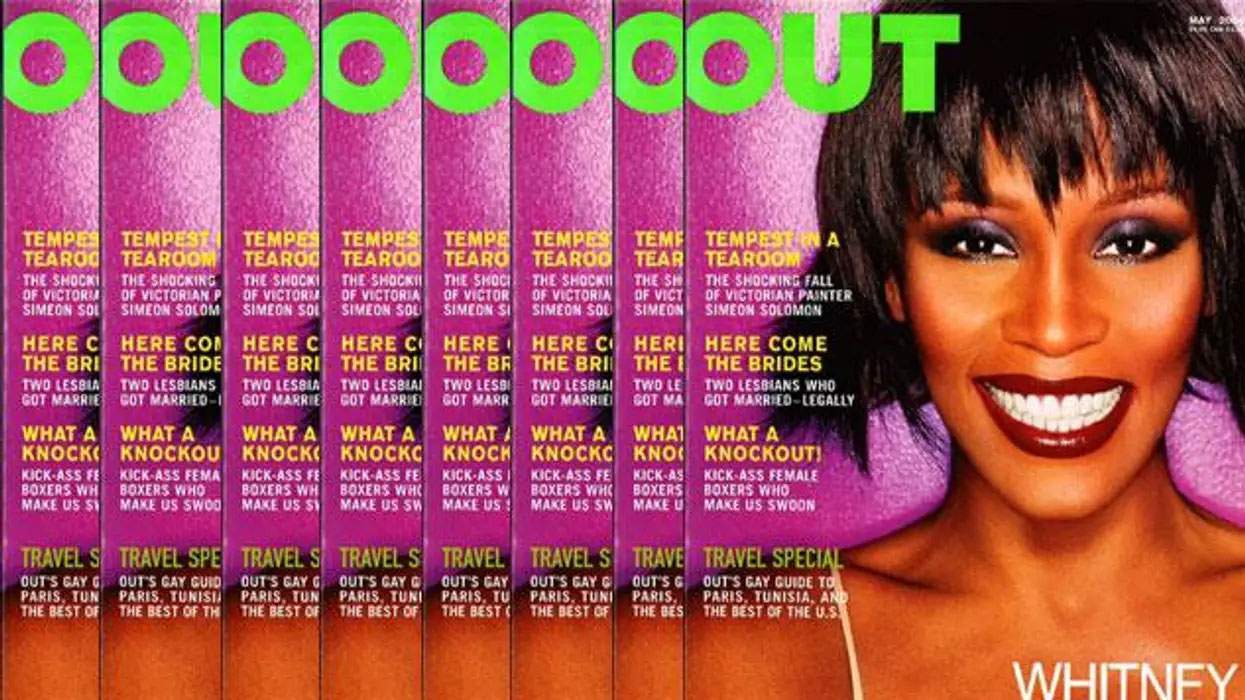
The following is an excerpt from Mighty Real: A History of LGBTQ Music 1969-2000, a book from former Out contributor Barry Walters, who interviewed Whitney Houston for a 2000 cover story — the first and last time the late icon spoke with the LGBTQ+ press. But first, an author's note:
"I ain’t suckin’ no dick,” Whitney Houston blurted at me during our 2000 Out cover story, her first and last major interview with the LGBTQ+ press. That was her way of explaining why some believed our beloved diva was lesbian. But for our adversaries, the mere hint of gayness was insulting – a means to demonize an otherwise bulletproof Black superstar.
My book Mighty Real: A History of LGBTQ Music 1969-2000, which Viking publishes May 12, isn’t about who is and who isn’t queer in the music world. Instead, it focuses on the art our heroes made in the late 20th century, and the culture listeners create through communal interpretation. It deals with how musicians speak in codes to get past the gatekeepers, appease the mainstream, and reveal deeper truths to us.
From Metallica to Madonna, I’ve interviewed all sorts of talent: straight, lesbian, gay, bi, trans, queer-adjacent, out-of-the-closet, and deeply within it. Whitney was the latter. The extent to which she and those around her lied to guard this secret proved lethal.
Yet nearly every closeted LGBTQ+ artist I’ve spoken to over the last 40-plus years has made some kind of reveal in which they come clean by letting me know privately what they’re not yet able to make public. Melissa Etheridge, for example, confided in 1992 that she sensed what I wanted to ask, that she wasn’t quite ready to answer it, and that she’d get back to me when she could. (She did – the very next year!)
Whitney didn’t hold on long enough to do that with her words. Instead, she did it through her actions.
I’m not going to give away here what happened immediately after I turned off my recorder: You’ll need to read Mighty Real to learn that.
The following excerpt of our infamous interview zeroes in on Whitney’s duplicity as well as her pain. –Barry Walters
______
“‘Who is this African American kid coming in here and singing pop music like Barbra Streisand?’” Whitney lampooned. “‘We have to inspect this girl. We have to pick her apart!’ Barbra had her day too, you know, as an American Jew. So did Diahann Carroll, Lena Horne. They had real tough issues to deal with—grinning onstage with the white people and then coming home and having to deal with civil rights issues. They picked me apart ’cause I surpassed the so-called rules. I beat the Beatles and the Elvises.”
Black superstars at that time rarely discussed racism with white journalists so forthrightly. Whitney regarded me as James Baldwin might have, as one queer person does with another. She knew I knew about discrimination firsthand. But what I didn’t understand then was that she couldn’t be honest with me about her sexual difference and thus spoke of her racial difference so I could still feel her struggle. Almost certainly, she sensed what I was about to ask, and that she’d need to lie, and, therefore, she wanted me to sit with her in the analogously harrowing truth she could discuss. Maybe this was subterfuge, but maybe that’s what all minorities and women must do. We’re all forced to translate our pain into something else because the world isn’t ready for it straight-up.
Whatever was going on, it hit me hard. Part of me wanted to hug her. Part of me didn’t want to go further. But I knew I was getting to the crux of who she was and that she’d likely never again trust a reporter to go this deep.
It didn’t take long at the start of her career before the apparent vacuum of her personal life was filled with a persistent rumor: The diva is a dyke. How did that get started?
“Mmmmm,” Whitney hesitated. “I suppose it comes from knowing people… who are. I don’t care who you sleep with. If I’m your friend, I’m your friend. I have friends who are in the community. And I’m sure that in my days of bein’ out, hanging with my friends, having nothing but females around me, something’s gotta be wrong with that. I ain’t suckin’ no dick. I ain’t gettin’ on my knees. I can’t just really sing. I can’t just be a really talented, gifted person. She’s gotta be gay.”
With every query, she grew more animated. “Listen, I took a lot of grief for shit that wasn’t me, okay, ’cause I had friends, ’cause I was close to people.” Her hands waved, her eyes blazed. “But that ain’t me. I know what I am. I’m a mother. I’m a woman. I’m heterosexual. Period.”
You can be a mother and still be gay, I heard my inner voice say. You can be a lesbian and still be a woman, I wanted to remind her. But what was that going to achieve? I knew — just as I knew when Bobby Brown verbally gay-bashed me earlier in the interview—that if I said what I was thinking, the interview might be terminated. For the bulk of her professional career, reporters had tried to expose her as gay to bring her down. Yet here she was with a fellow LGBTQ person who wanted her to leave the closet so I could help lift her up. I can’t imagine her anguish in that moment.
“But I love everybody,” she continued. “If I was gay, I would be proud to tell you, ’cause I ain’t that kind of girl to say, ‘Naw, that ain’t me.’ The thing that hurt me most was that they tried to pin something on me that I was not. My mother raised me to never, ever be ashamed of what I am. But I’m not a lesbian, darling. I’m not.”
“I am a mother, thank you,” Whitney repeated. “I love to hear my child call me Mommy. That’s what I am — not lesbian, not gay, not all the bullshit… Sometimes I swear to you, it feels like nothing is going my way. Then I look at my little girl and know that she needs me for me and not anything else. That makes me wanna live on so much harder, ’cause I can’t stand to think the world would teach her something I wouldn’t teach her. That makes me live, baby.”
She actually said that. Three years after her mother’s death, Whitney’s daughter, Bobbi Kristina Brown, was found unconscious in a bathtub, much like Whitney had been. Bobbi died six months later at age twenty-two.
Excerpted from Mighty Real: A History of LGBTQ Music 1969-2000 with permission from the author and Penguin Random House.
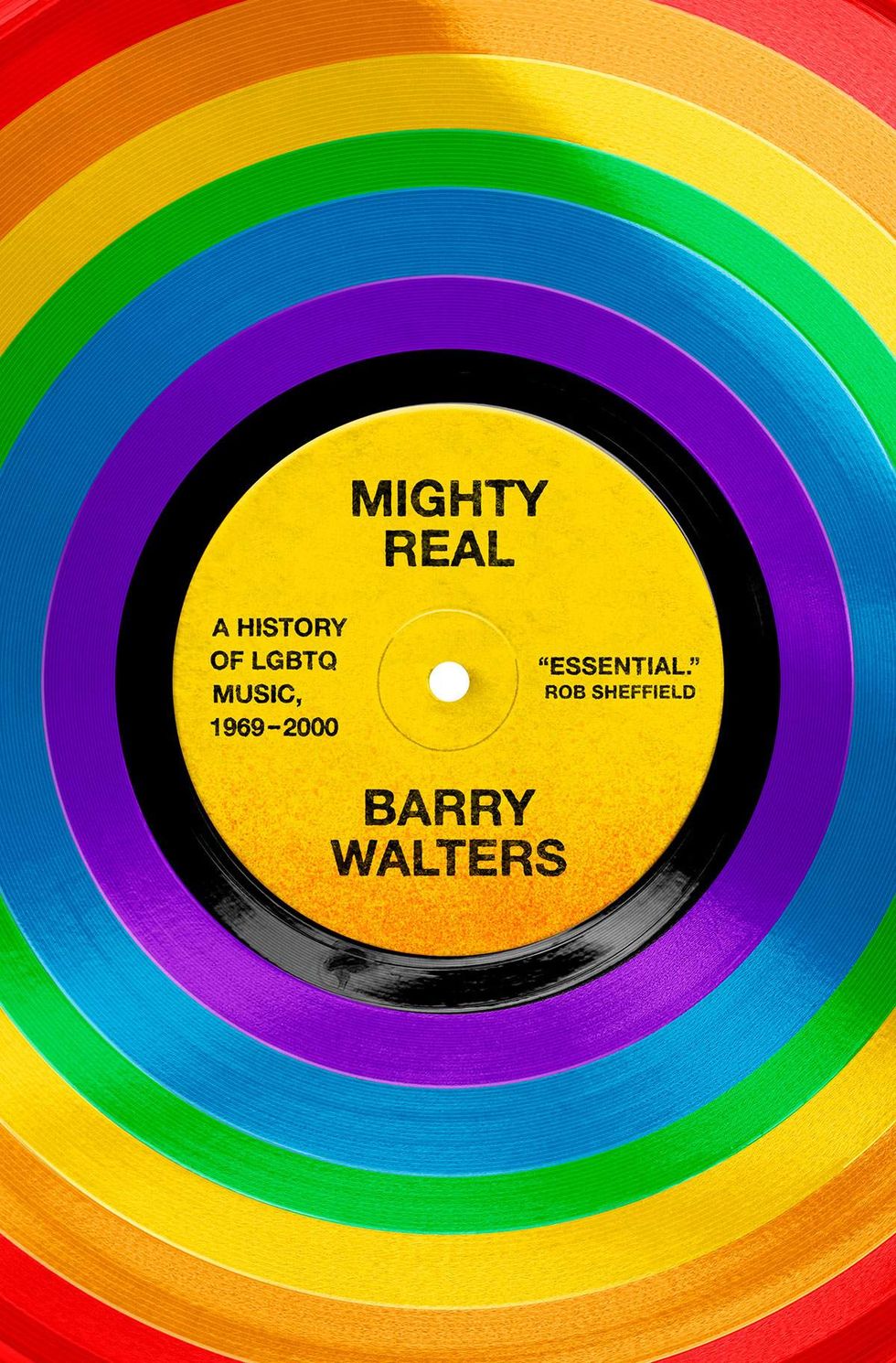 'Mighty Real' book coverPenguin Random House