


I didn’t grow up thinking there was space for me inside Black masculinity. Not fully. Not comfortably. Not without adjusting something first.
There were always expectations, some spoken, most not. Ways of moving, speaking, existing that felt understood before they were ever explained. And even when you learned how to navigate them, there was still a quiet awareness that you were performing something, of holding parts of yourself just outside of reach.
For a long time, masculinity felt less like something to inhabit and more like something to get right. Watching Waves, that feeling surfaced almost immediately. Not because the film names queerness — it doesn’t. But because it makes space for it.
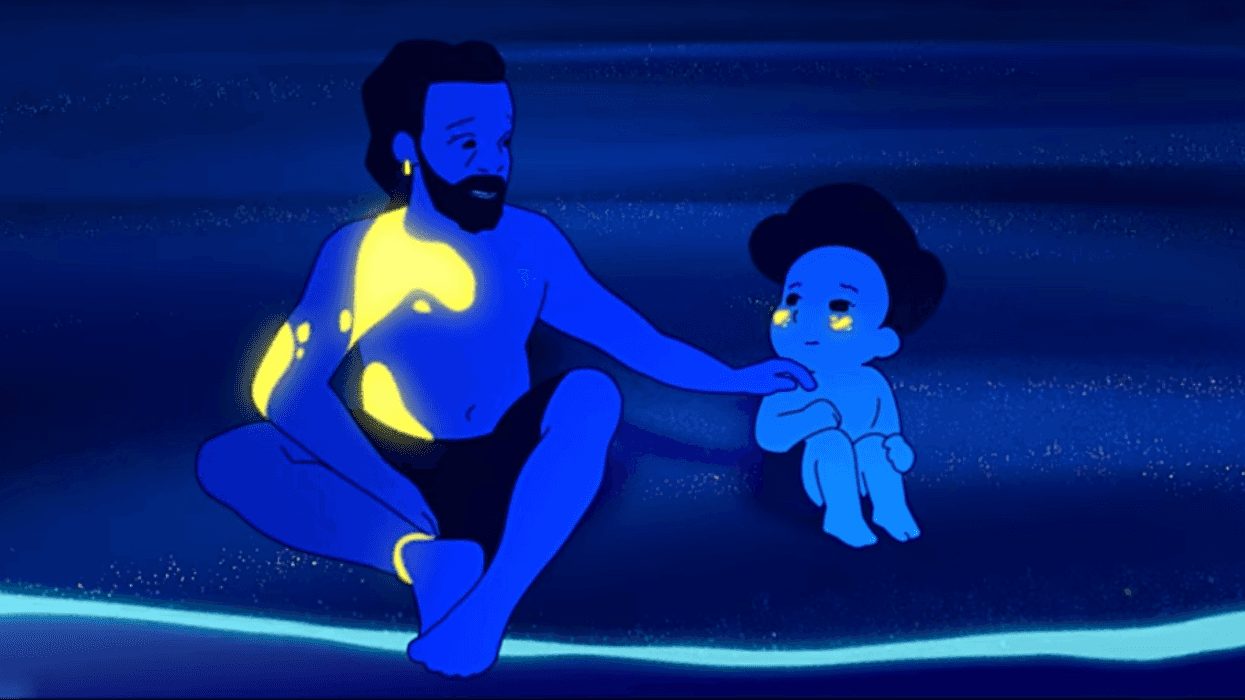
The film, a hand-drawn animated short by filmmaker Jason Raymond, follows a young Black boy in conversation with his father at the edge of the ocean, circling questions of identity, belonging, and self-definition. It’s only four minutes long, but it carries the weight of something much larger, something both deeply personal and quietly expansive.
It opens with the boy alone, staring into his reflection. He rubs water across his face, as if trying to wash something away. Moments later, he’s engulfed, pulled under by waves, sinking into an abyss of his own making.
Then, a hand reaches in. His father. “You’re in here too deep to be out here alone,” he says. Calm. Patient. Certain.
There’s a steadiness in his voice that feels unfamiliar, almost disorienting in its softness. Not because it’s unrealistic, but because it’s rare. The kind of care that doesn’t brace itself for impact. The kind that doesn’t assume the world needs to be explained through warning or correction.
For those who learned early how to read a room, how to adjust tone, posture, and presence depending on where they were, that softness can feel out of reach — or at the very least, conditional.
There’s a particular awareness that comes with that. An attention to self that isn’t always about expression, but about calibration: what to reveal, what to soften, what to hold back entirely. That awareness doesn’t always come through direct correction. Sometimes it’s quieter than that — a look, a pause, a shift in energy that lets you know when you’ve moved too far outside what’s expected.
You learn how to adjust. Or at least, how to appear as if you have. Waves moves in the opposite direction.
The father, voiced by Brandon McGee, doesn’t rush to correct the boy or harden the moment. Instead, he meets him where he is, offering reassurance in a tone that feels intentional, even practiced. Reflecting on the role, McGee described the film to me as “a beautiful story about just embracing who you are, and finding self-love,” noting how deeply the message resonated during recording. Watching the finished film, he admitted, “The first one or two times I watched it, I got teary-eyed. I got chills in certain spots.” That emotional weight isn’t accidental.
The version of masculinity Waves presents isn’t defined by distance or discipline; it’s defined by presence, by patience, by a willingness to say what often goes unsaid. It feels less like instruction and more like permission. And that permission matters.
Because for many of us, masculinity isn’t just something you inherit — it’s something you navigate. Something you move through carefully, aware of how you’re being read at all times. The boundaries aren’t always clearly defined, but they’re felt. And when you exist outside of them, even slightly, you learn quickly what’s acceptable and what isn’t.
Softness, in that context, can feel like a risk — not just emotionally, but socially, culturally. It becomes something you regulate.
In reflecting on the film, Raymond has spoken about wanting to reimagine the relationship between a Black father and son. “I wanted to show a positive relationship between a Black father and son,” he explained. “I wanted him to get a point across without hitting him, without telling him to just tough it out.”
That intention is felt in every frame. But what makes Waves resonate isn’t just what it shows, it’s what it allows.
There’s a moment, brief enough to miss if you’re not looking, where the film gestures toward something larger. A glimpse of movement, of expression, of a world where Blackness and queerness aren’t positioned as separate ideas, but as something that can exist together.
It’s subtle. Almost fleeting. But that subtlety feels intentional. The boy is never explicitly defined as queer, but the film creates space for him to imagine that queerness could be a part of who he is. That kind of space isn’t always offered. In fact, it’s often resisted.
Recently, Pete Docter, Pixar’s chief creative officer, defended the decision to remove LGBTQ+ elements from the film Elio, explaining that the studio was “making a movie, not therapy.” The comment speaks to a broader tension in how queer stories are treated, framed not as essential, but as excessive.
But films have never just been entertainment. They’ve always been sites of reflection, places where people make sense of themselves, where possibilities are imagined before they’re lived.
So when queerness is positioned as something optional, something that risks making a story too specific or too heavy, it raises a different question: Who gets to exist at the center of a narrative without explanation?
There are countless films where desire follows a familiar arc, where getting the girl is the goal, the resolution, the reward. Those stories are rarely questioned for being too narrow or too pointed.
But when queerness enters the frame, it’s often treated as something extra, something that needs to be justified. Waves doesn’t ask for that permission. It simply creates space.
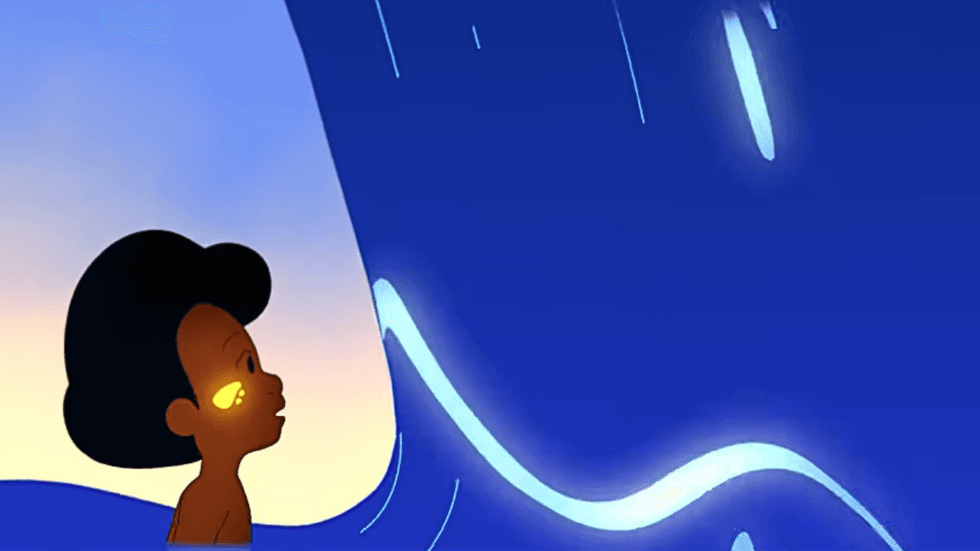 A still from the hand-drawn short film ‘WAVES.’Courtesy of Jason Raymond
There’s a word that comes to mind when thinking about the film: amorphous. Not fixed. Not easily defined. Not confined to a single shape.
It’s a way of thinking about identity that resists being locked into place, something fluid, something self-determined rather than imposed. And for Blackness, that kind of freedom isn’t always guaranteed. We are often defined before we are understood, given meaning before we have the chance to create it for ourselves. Waves imagines what it looks like to have that space anyway.
For Raymond, that openness is intentional. “Everyone has this idea of being Black,” he says. “But there’s also a lot of freedom in being Black.”
That freedom isn’t always visible. But here, it is.
Water, as it appears in the film, carries that idea forward — fluid, shifting, resistant to containment. It holds memory without fixing it in place. It allows for change without demanding resolution.
As Raymond put it, “Water for Black people… it knows so many stories.”
Standing at its edge, the boy isn’t being told who to become. He isn’t corrected or redirected. He’s given space.
Space to exist without performance. Space to feel without consequence. Space to imagine a version of himself that hasn’t already been decided for him. And that distinction matters.
Because becoming isn’t just about growth — it’s about unlearning. Letting go of the versions of yourself shaped by expectation rather than truth, making room for something softer, something more honest, something that doesn’t require constant adjustment. That kind of space doesn’t come easily. And it doesn’t come often.
At a time when artificial intelligence continues to reshape creative industries, Waves serves as a reminder of what intention looks like. Every frame is drawn by hand. Every line was carefully delivered. The film’s existence feels tied to time, to care, to a kind of attention that resists automation.
As Raymond put it plainly, “AI will never replace humanity. It’s never gonna tell you about real human experiences.” That humanity is what makes the film land.
Not just as a story, but as an experience — one that lingers not because it answers anything definitively, but because it opens something up: a question, a possibility, a different way of understanding what it means to be seen.
By the time the film ends, the image of the boy at the water remains. Still uncertain. Still becoming. But no longer alone in that process.
Maybe that’s what stays with you.
Not just the softness of the father’s voice, but what it makes room for — the idea that identity doesn’t have to be decided before you understand it. That it can remain open. That it can shift. That it can hold contradiction and still be whole.
Like water.
And for those who have spent time navigating the space between expectation and self, that openness feels less like uncertainty and more like freedom.
Not the kind that demands definition, but the kind that allows you to discover it for yourself.
Aaron Brokenbough is a Philadelphia-based filmmaker and writer exploring identity, storytelling, and community through a queer Black lens. His work makes space for reflection, softness, and self-definition. Learn more at ambrokenbough.com
Opinion is dedicated to featuring a wide range of inspiring personal stories and impactful opinions from the LGBTQ+ community and its allies. Visit Out.com/submit to learn more about submission guidelines. We welcome your thoughts and feedback on any of our stories. Email us at voices@equalpride.com. Views expressed in Opinion stories are those of the guest writers, columnists, and editors, and do not directly represent the views of Out or our parent company, equalpride.
Watch 'Waves' by Jason Raymond.