
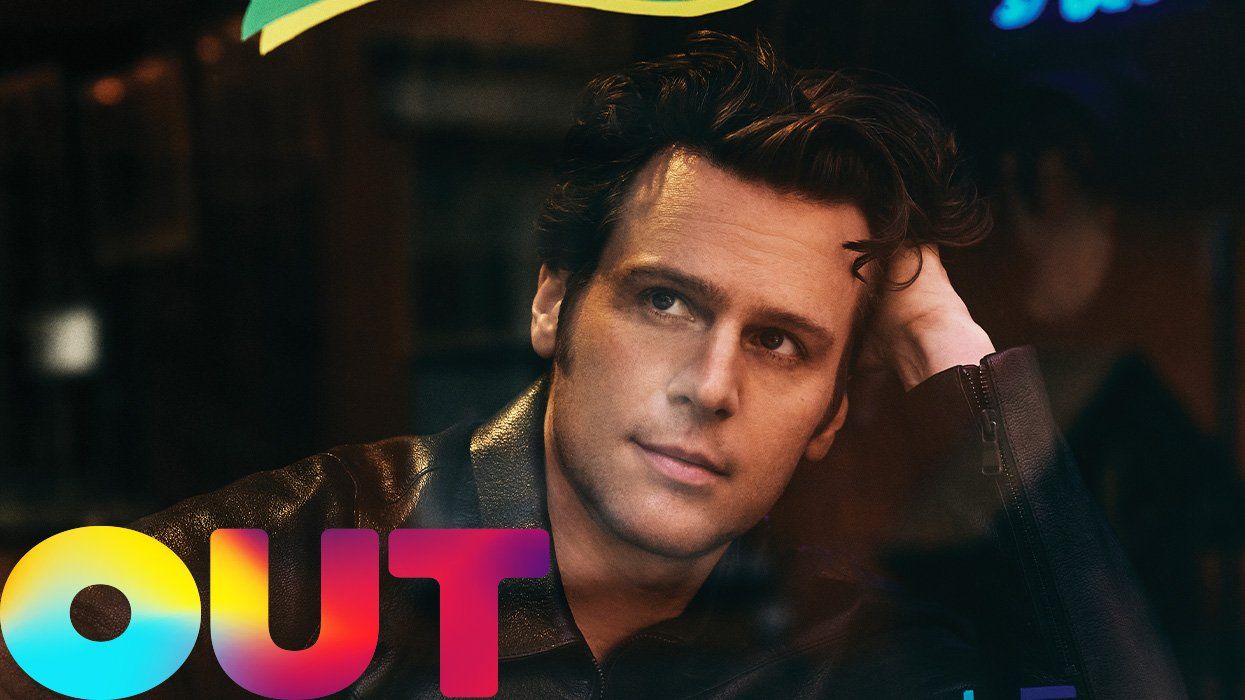
When the audience of Broadway’s Merrily We Roll Along first meets Frank Shepard (Jonathan Groff), the character has all the trappings of a beautiful life: He’s hosting a glamorous party at his Los Angeles home as a producer of hit commercial films.
Others might call this scene a certain kind of hell. At the fete, he flirts with a younger woman who is not his wife. It’s revealed that he missed his son’s graduation. One of his longtime best friends, the writer and theater critic Mary Flynn (Lindsay Mendez), effectively ends the gathering with a drunken dressing-down, in which she mourns Frank’s squandered artistry as a once-promising composer. At one point, Frank tells his wife, “I’ve made only one mistake in my life. But I made it over and over. That was saying ‘yes’ when I meant ‘no.’”
When Jonathon Groff first encountered Merrily, “that line went boom,” the actor recalls. “It went through my body. And I thought that I have to play this part, because this is a mistake that I have made often in my life.”
“I think everyone that was closeted at some point can relate to a version of that, of saying ‘yes,’ when I meant ‘no,’” he reflects. “This thing of presenting something that’s different than what’s happening inside felt super personal to me.”
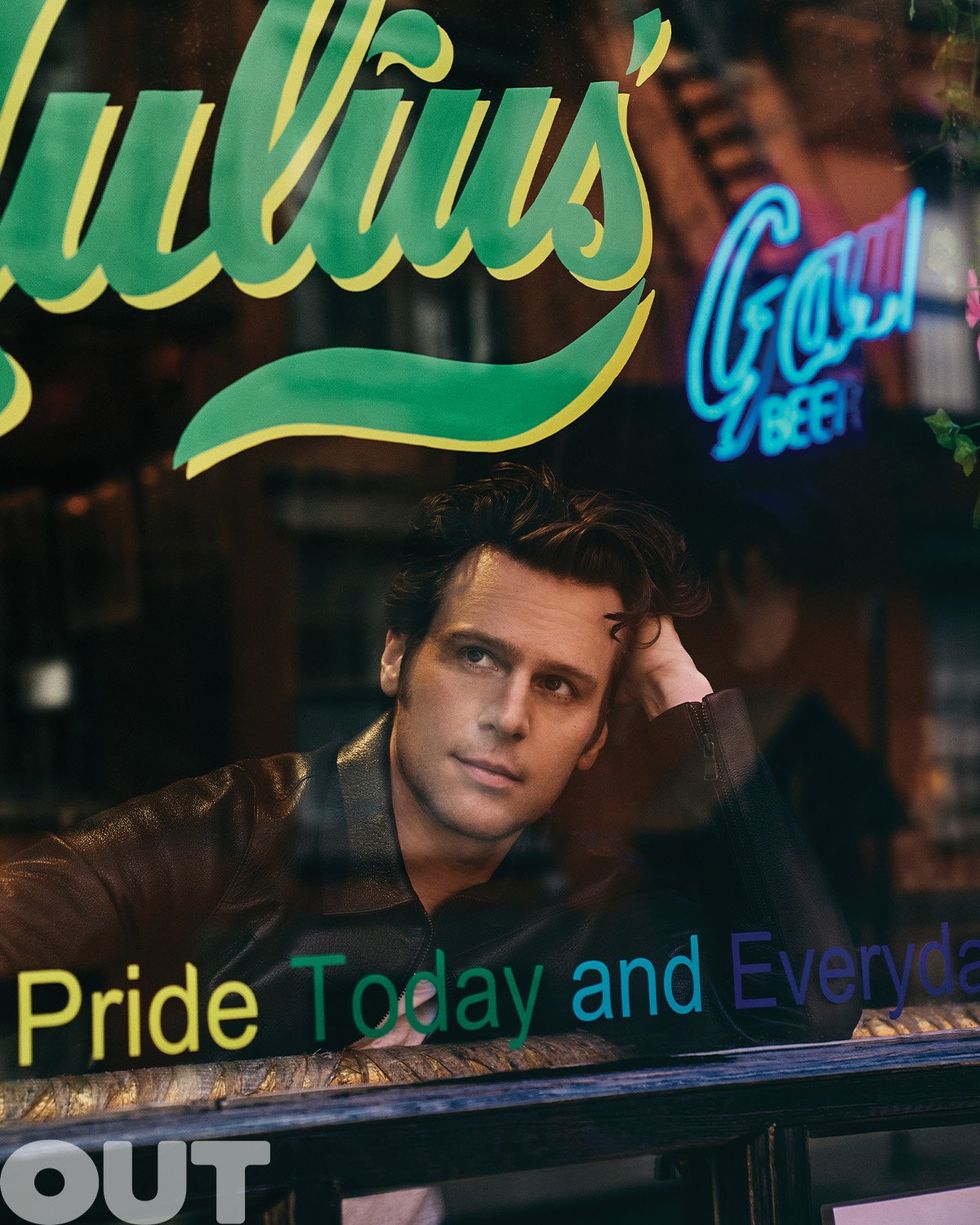 NILI LOTAN Black Leather Jacket and Grey Flannel Trousers; 9TH ST VINTAGE Vintage T-Shirt; ADIDAS Black Samba OG Shoes; Location JULIUS'
The character Frank is not gay. But two gay men were behind the creation of the musical, which boasts music and lyrics by Stephen Sondheim and a book by George Furth; both passed before the show’s Broadway revival began last year. An autobiographical air is steeped into this story of three creatives whose friendship unravels over 20 years (Daniel Radcliffe plays the lyricist and playwright Charley Kringas who collaborates with Frank). First released in 1981 to negative reviews, Merrily was adapted from a 1934 play of the same name. Both productions warn of the price fame takes on relationships and souls. And its scenes unfold in reverse chronological order (1976 to 1956 in the Sondheim version), ending in a finale that is also an ironic beginning of youthful hope for the future.
It’s a personal story for Groff, who relates to Frank’s interior life and how others (don’t) respond to his struggles. For example, his showbiz peers suggest he take a vacation in response to a tearful breakdown. “No one wants to really make space for Frank’s darkness or his pain…that feels so familiar to me,” Groff says. “It feels very gay. And then there’s also something about it that feels quite American of like, just…take a little trip, and then you’ll come back, and you work, and everything will be fine. But there’s not a real investigation of sadness or despair.”
Merrily is personal by design — for actors and audience members alike. Groff quotes the musical’s producer, Sonia Friedman (and sister to Merrily’s director, Maria Friedman): “There are certain shows that are beyond theater, and this is one of them where you want the audience to follow the characters’ stories. But you want them to also reflect on their own lives as well as this, because [the show] keeps saying, how did you get to be here?”
It’s a question that Groff contemplates as he journeys backward in time each night at the Hudson Theatre. Like Frank, the 39-year-old has two decades of career and adulthood to reflect upon. He marvels how the teen reading a Sondheim biography in front of his high school science fair project went on to garner three Tony nominations (for Merrily this year, Melchior in Spring Awakening in 2007, and King George III in Hamilton in 2016), voice Kristoff and Sven in Disney’s hit Frozen films, and lead the groundbreaking HBO dramedy Looking as Patrick.
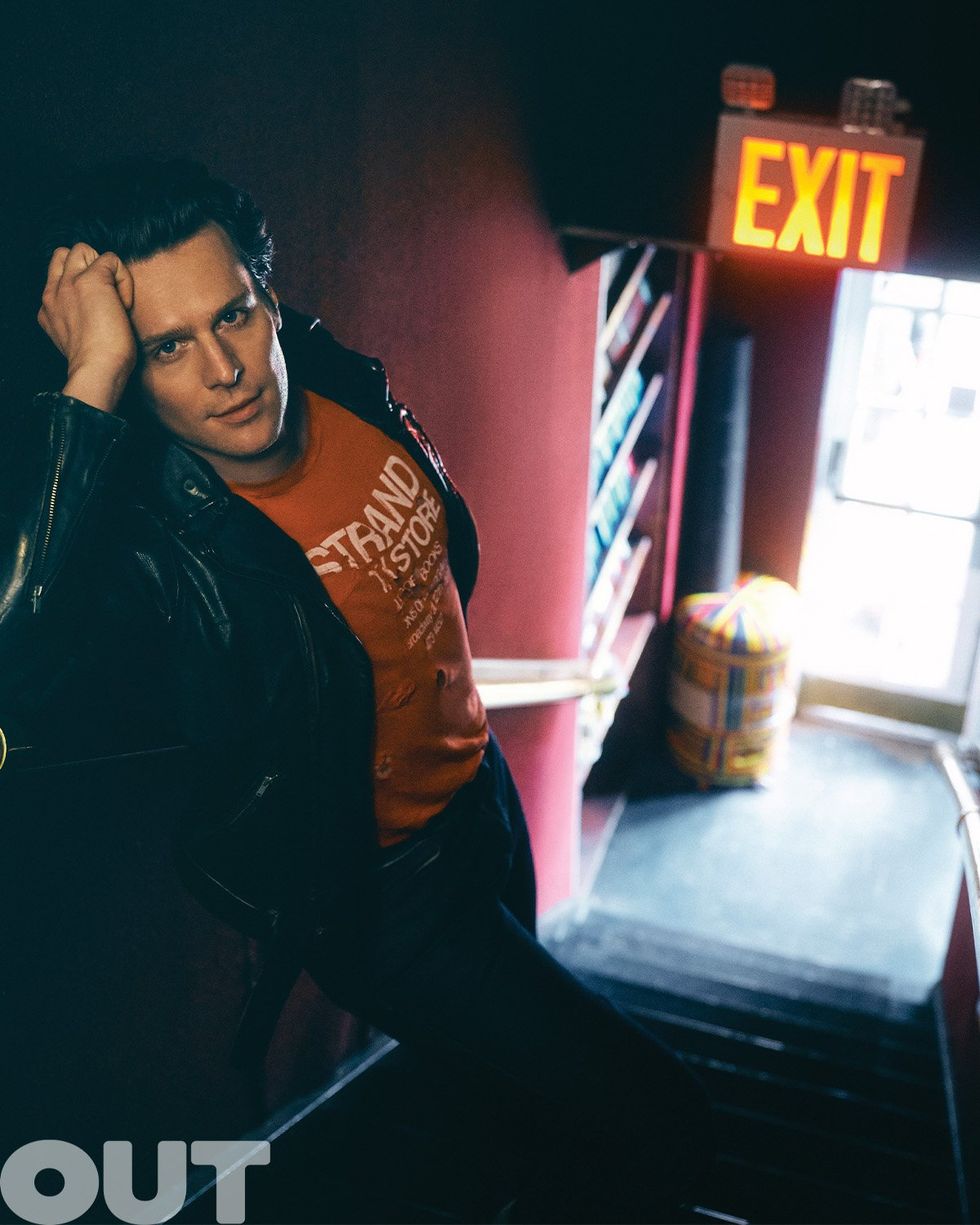 9TH ST VINTAGE Vintage Motorcycle Jacket; Vintage Strand T-Shirt; KING & TUCKFIELD Denim Jeans; DR. MARTENS Vintage Boots; Location THE DUPLEX
Outside the spheres of musical films and theater, Groff has broken ground as a gay actor by starring in the Netflix crime thriller Mindhunter as Holden Ford and in The Matrix Resurrections as Smith. He was also a lead in M. Night Shyamalan’s Knock at the Cabin last year and will appear in the new season of Doctor Who — starring Ncuti Gatwa as the first Black queer star of the long-running British sci-fi series. “He’s a supernova of talent,” Groff sings of Gatwa; an It’s a Sin fan, he also jumped at the chance to work with Russell T Davies after the showrunner personally invited him to join the season.
This enviable acting career is not what Groff envisioned when he came out publicly in 2009 in an interview with Broadway.com. “I would rather be myself and be in a relationship and not have that compromised by this career thing,” he recalls reasoning at the time — effectively choosing to be himself openly over the possibility of becoming a leading man.
“I felt like I was opting out of that [star] trajectory because of coming out,” he says. “And so everything that’s happened to me with the success of film and television has been a complete surprise to me because I thought…by coming out that that was impossible.”
Groff credits his coming out with saving him from becoming a Frank, who makes a devil’s bargain for material gain. In fact, by appearances, Groff is an anti-Frank. To wit, he arrives via bicycle to his Out photo shoot at the Duplex gay bar in the West Village. He says he even favors riding a bike to the theater each day over an offered car service. Later at Julius’ around the corner, he takes a bite (and then finishes) a burger prepared for a photo op, and then thanks the owner and chef by name. So not the stereotypical fame monster.
“Being gay has allowed me to forge my own path,” he attests. “I don’t feel at the mercy of the traditional Hollywood machine because I never really felt like I fit in there. That equation wasn’t where I lived. And so I’ve just been sort of over here following my artistic heart, which was a choice I made long, long ago. I sort of credit that for not buying into the stuff that Frank in the show kind of buys into.”
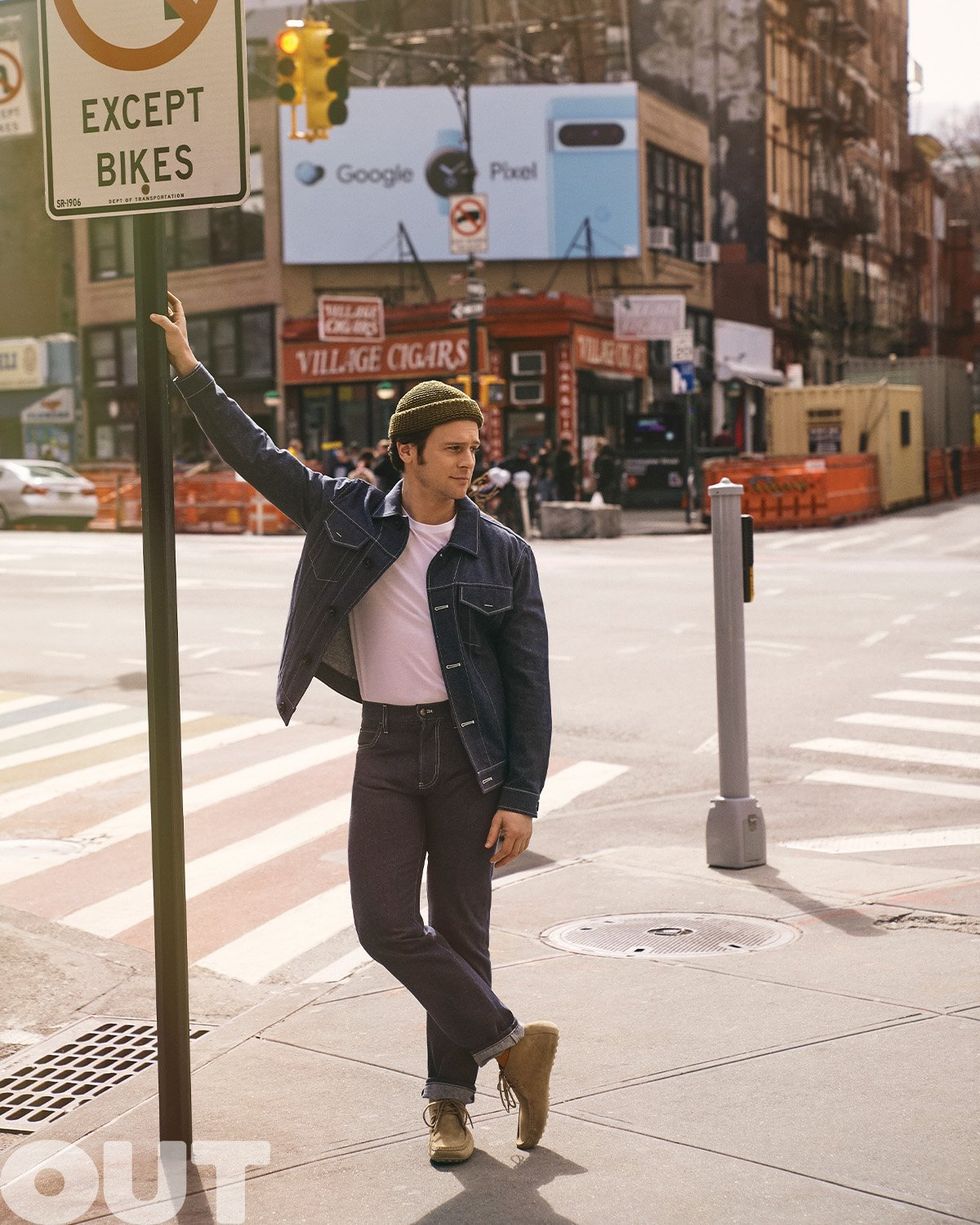 LORO PIANA Denim Jacket and Pants, Beanie, and Shoes; UNIQLO Socks; GIORGIO ARMANI White Crewneck T Shirt
Groff calls his success in the entertainment industry “a lucky gift of timing,” noting how he came of age at a turning point for gay acceptance in America — and after the worst of the AIDS crisis in NYC. His speech following each Merrily performance helps raise funds for Broadway Cares/Equity Fights AIDS, and it “means so much” to him because he is mindful of “all of the gays that came from small towns to move to New York to do theater and how many of them died.” Groff was born in Lancaster, Pa., and was raised amid Amish communities before pursuing his Broadway dreams in the Big Apple.
As a working out actor, “I feel so lucky and I feel some sense of responsibility, of really breathing it in and taking it in,” he confesses. “Even 10 years ago, I don’t know if I would have been cast in this role of Frank, ’cause even in theater, it’s such a straight character.… There’s also something that feels like a shift in the times that’s allowing me to play this role right now as well.”
His casting in such a diversity of roles on stage and screen “feels a part of this wave of progress of people being not only accepting of actors being out, but of actors being able to play multiple different things and not get so pigeonholed…. I’m so grateful to be living in this time.”
Of course, Groff was no passive spectator in the fight for LGBTQ+ representation. In addition to coming out, his lead role on Looking, which celebrates its 10-year anniversary this year, marked a watershed moment as the first HBO series centered on gay men. Although tragically short-lived — Looking ran for two seasons and had a film finale — the dramedy created by Michael Lannan has a lasting influence and remains a prescient portrayal of queer friendship as advances in tech and HIV-prevention tools like PrEP transformed the dating and cultural landscape.
“We’re still so proud of that show,” says Groff. Looking’s legacy also lives on through the success of Groff and the other creatives who gave it life: Murray Bartlett, who played Patrick’s friend Dom, won an Emmy in 2021 for his work in The White Lotus; Russell Tovey, who played Patrick’s boss and on-again-off-again lover Kevin, is now a regular in Ryan Murphy productions like American Horror Story: NYC and Feud: Capote vs. the Swans; and director/producer Andrew Haigh’s latest film, All of Us Strangers, is a veritable new queer classic. The cast remains close. Last year, Groff officiated the wedding of Raúl Castillo, who portrayed Patrick’s love interest, Richie.
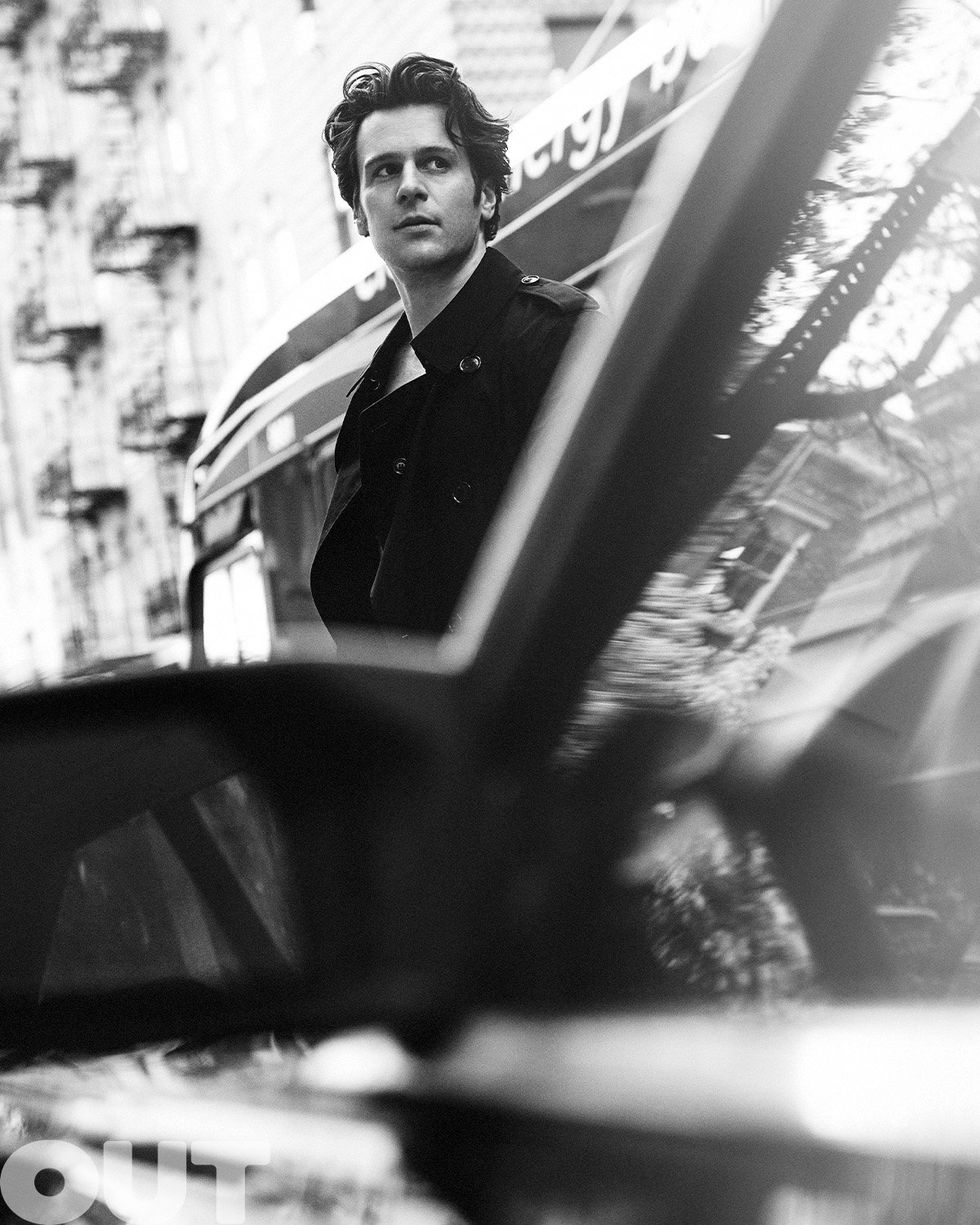 BURBERRY Black Trench Coat; POLO RALPH LAUREN White Tank Top; LEVI’S Denim Jeans; JIMMY CHOO Black Motorcycle Boots
Groff still feels Looking’s impact through his professional relationships. He recalls signing a blown-up cover of Out tied to Looking’s release for Casey Bloys, an ardent advocate of the show who is now chairman and CEO of HBO and Max content. (Bloys also greenlit 2022’s Spring Awakening: Those You’ve Known, a 15-year reunion doc of that musical’s cast.) Recently, the director of Groff’s new film, A Nice Indian Boy, Roshan Sethi, revealed Looking helped him come out, which is not uncommon feedback for Groff.
“I’m just so proud that it’s still there, and it’s still a beacon for some people,” Groff says. “And it’s like a forever beacon for all of us that worked on it.”
Looking played a pivotal role in Groff’s journey. “I didn’t truly accept myself until I had the opportunity to do that show, and play that character, and be with those guys, and every day be talking about what it meant for us to be gay, and what we were scared of, and what we were excited about,” he says. “That was such a life-altering experience in so many ways.”
Groff sees Patrick’s growth (and his own) over the course of Looking as one “from boyhood to manhood.” By the conclusion of 2016’s Looking: The Movie, the character undergoes “an important evolution” of “being able to be a good partner, a good friend, and a good person in the world.” This growth was seen visually in an emotional look that Patrick exchanges with Richie in the film’s final scene, signaling that they would try to make a life together. So does Groff believe that Patrick and Richie would still be a couple today?
“They’re always going to be together forever cosmically,” he says. “And either that’s an actual relationship that lasted forever or a friendship that lasted forever. I don’t know what happened in their actual relationship. But I definitely feel like they were taking care of each other’s hearts from that point on.”
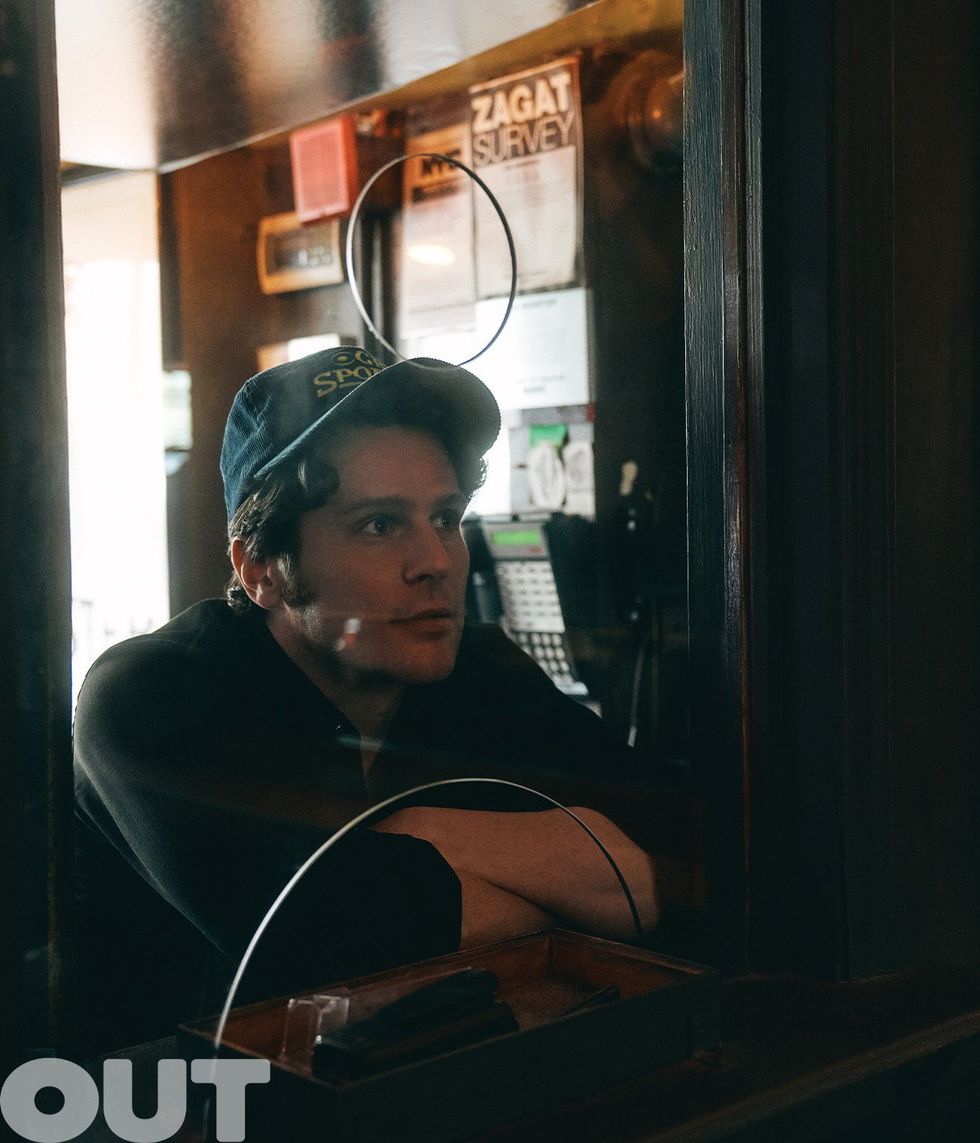 9TH ST VINTAGE Vintage Western Shirt; LEVI’S Black Denim Jeans; JIMMY CHOO Black Motorcycle Boots; HAT Vintage; Location MONSTER NYC
Like Patrick, Groff feels like he’s ready for love, in part because Merrily sparks “reflection and embracing an ownership of the past to cross through into the future.” By chance, the same night this writer saw Merrily in April, Groff’s first boyfriend, celebrating a birthday, was also in the audience.
Groff recalls how, at 3.5 years, this relationship remains his longest to date — and one that occurred at a crucial period in his career. Groff dated him from ages 19 to 23 when they were still closeted yet lived as roommates in midtown Manhattan. His ex, who he did not name, is a dancer who helped teach him the choreography for Fame at Crunch Fitness; Groff played Nick Piazza in a regional production at North Shore Music Theatre in Massachusetts. “I was so slow at picking up choreography,” he confesses. But the fancy footwork made a lasting impact. Fame led to Groff being signed by an agent, his membership in the Actors’ Equity Association, and his Broadway debut as an understudy for the lead role in 2005’s In My Life. A year later, he was appearing in Spring Awakening.
“There was something about having him at the show last night,” says Groff, calling it a “full-circle moment.” He adds, “I’ve been single now for a couple of years and I’m feeling…ready and open for anything. If that’s continuing with that, if that’s a relationship, I’m cool with that.”
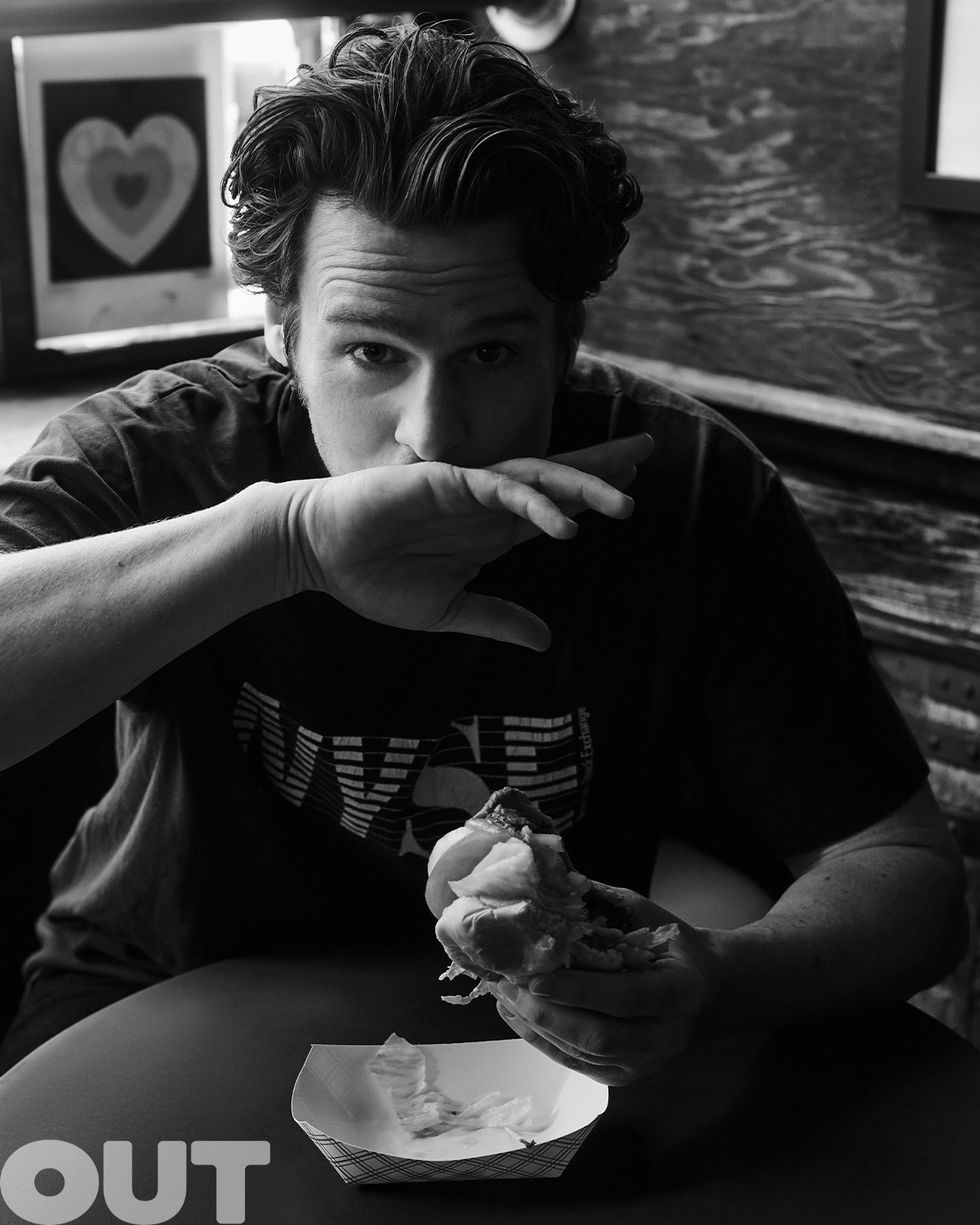 9TH ST VINTAGE Vintage NYSE T-Shirt; NILI LOTAN Grey Flannel Trousers; ADIDAS Black Samba OG Shoes; Location JULIUS’
In addition to the occurrence of a rare NYC earthquake, the day of this Out interview marked another fateful event: the 63rd anniversary of Barbra Streisand making her TV debut on The Tonight Show. Groff appeared on The Tonight Show Starring Jimmy Fallon to commemorate the occasion. But his Barbra standom doesn’t end there. The actor wants to one day buy a Village restaurant called & Son Steakeasy, which used to be the site of the Lion, a gay bar where Streisand first sang publicly during a singing contest (according to a plaque there, at least). His goal is “turning it back into a gay bar and calling it BARbra.” A neon “BARbra” sign even hangs in his Merrily dressing room as a reminder of this dream.
Other dreams are poised to come true as well. Merrily’s revival is one of the biggest hits on Broadway right now, boasting sold-out shows and one of the Great White Way’s highest ticket prices. It also received seven Tony nominations this year, among them nods for Groff, Radcliffe, and Mendez.
Groff has been Tony-nominated twice before, but the theater world’s highest honor has lost some of its luster from the days when, post-high school, he taught a class on the Tony Awards at a theater camp. (He’d show clips to his pupils and have them vote for Best Actress. Wicked and Avenue Q were contenders that year.)
“When I was a kid, the marker of success was like an Oscar or a Tony or like whatever the award was,” he says. “Now I understand 20 years later that that’s a fun part of the game of it all. But it’s not what makes your artistic heart sing.”
The eschewing of awards recognition is also very anti-Frank. However, Groff also recognizes the importance of a good speech, like the “beautiful and touching and inspirational” words for the LGBTQ+ community that Hamilton’s Lin-Manuel Miranda gave at the Tonys after the Pulse nightclub shooting. If he has the opportunity to give his own remarks onstage, “I’ll attempt to honor whatever is happening in that moment,” he promises.
For now, Groff feels like his character at the end of Merrily, as three starry-eyed young friends look to the skies and imagine what dreams may come. “We gotta be the luckiest people who ever lived,” he quotes.
“I feel that. I really like to be living in this time and working in this way,” he says. “It’s more than I ever could have dreamt of. And so I just wanna soak it in, take it in, and keep going.”
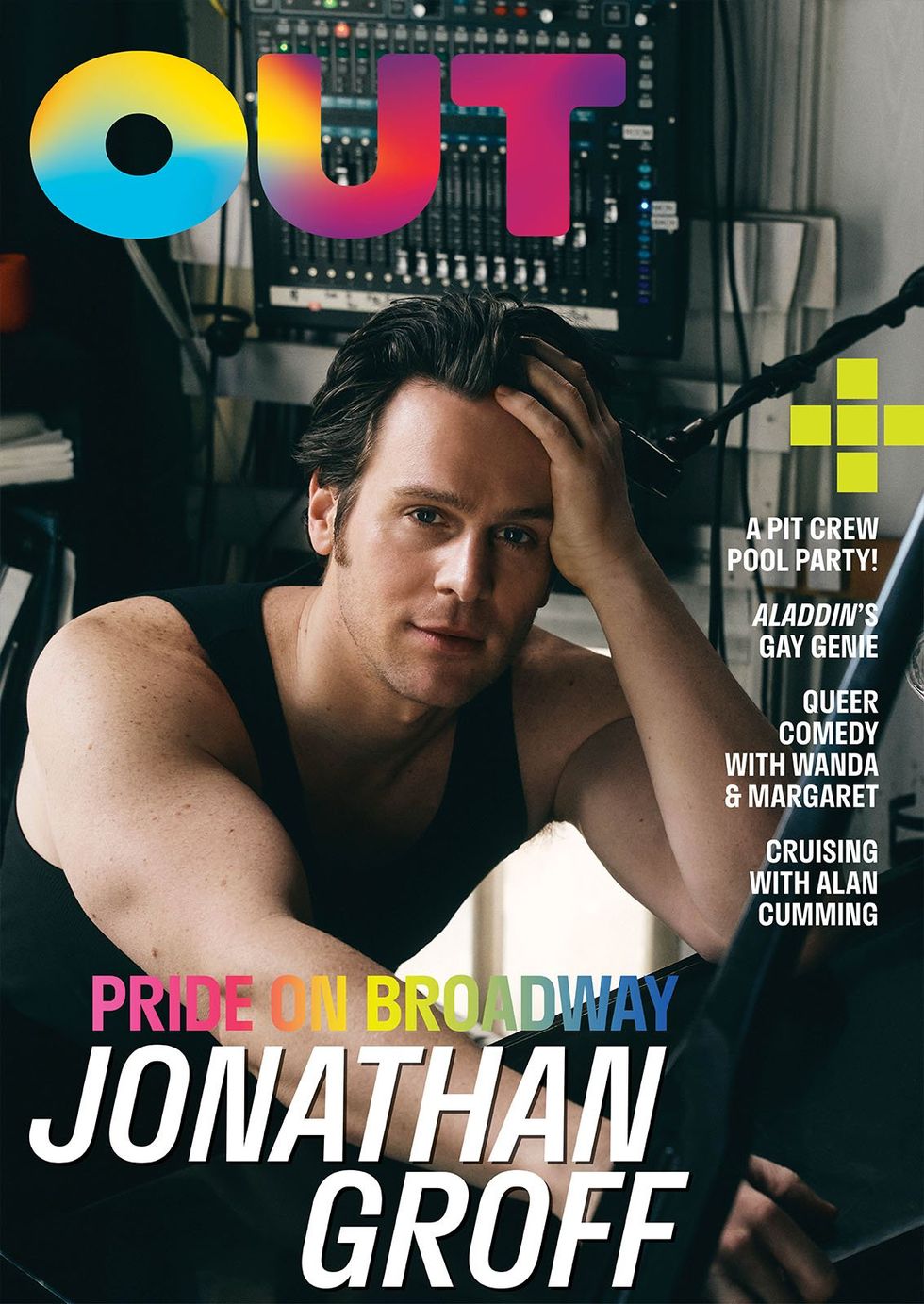 SAINT LAURENT BLACK VELVET Suit, Tank, Belt, Boots; Location THE DUPLEX
Talent: JONATHAN GROFF
Photographer: DEAN ISIDRO @deanisidro with DE FACTO @defactoinc
Digital tech: ALEX KALB @_kalby_
Photographer’s assistant: CASEY WEIS @caseynotkacey
Stylist: ERICA CLOUD @ecduzit with THE WALL GROUP @thewallgroup
Stylist’s assistant: MIA NAVARRO
Glam: AMY KOMOROWSKI @akgroomer with THE WALL GROUP @thewallgroup
Digital producer: DASHA BROOK @dasha_brook
Special thanks to the iconic West Village gay bars THE DUPLEX @theduplex_nyc, JULIUS’ @juliusbarnyc, & MONSTER @monsterbarnyc for hosting and being featured in this photo shoot.
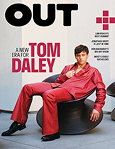
This cover story is part of the Out May/June issue, which hits newsstands on May 28. Support queer media and subscribe — or download the issue through Apple News, Zinio, Nook, or PressReader starting May 14.

OPENING THE OUT100 VAULT
In 2017 Jonathan Groff was a cover star of the Out100, Out magazine’s annual list of LGBTQ+ luminaries changing the world. That year, Groff was making waves as the lead of Netflix’s crime thriller Mindhunter, a milestone part for an out actor.
This year marks the list’s 30th anniversary, and in celebration, we’re launching a dedicated platform for all things Out100. Our new digital hub will include an interactive tour through 30 years of history in the Out100 Vault, as we revisit past cover stars like Groff and share fresh insights on their contributions to queer culture. And readers can get exclusive access to past Out100 honorees, in their own words, in our new Out100 Voices section.
Plus, Out readers will have the biggest opportunity yet to choose who makes the 2024 Out100 list. We’re expanding our reader’s choice category, so get ready to tell us all about your faves! It’s all coming together just in time for Pride month. Don’t miss the launch – sign up for our free email newsletter to stay in the know! Go to out.com/signup today.