

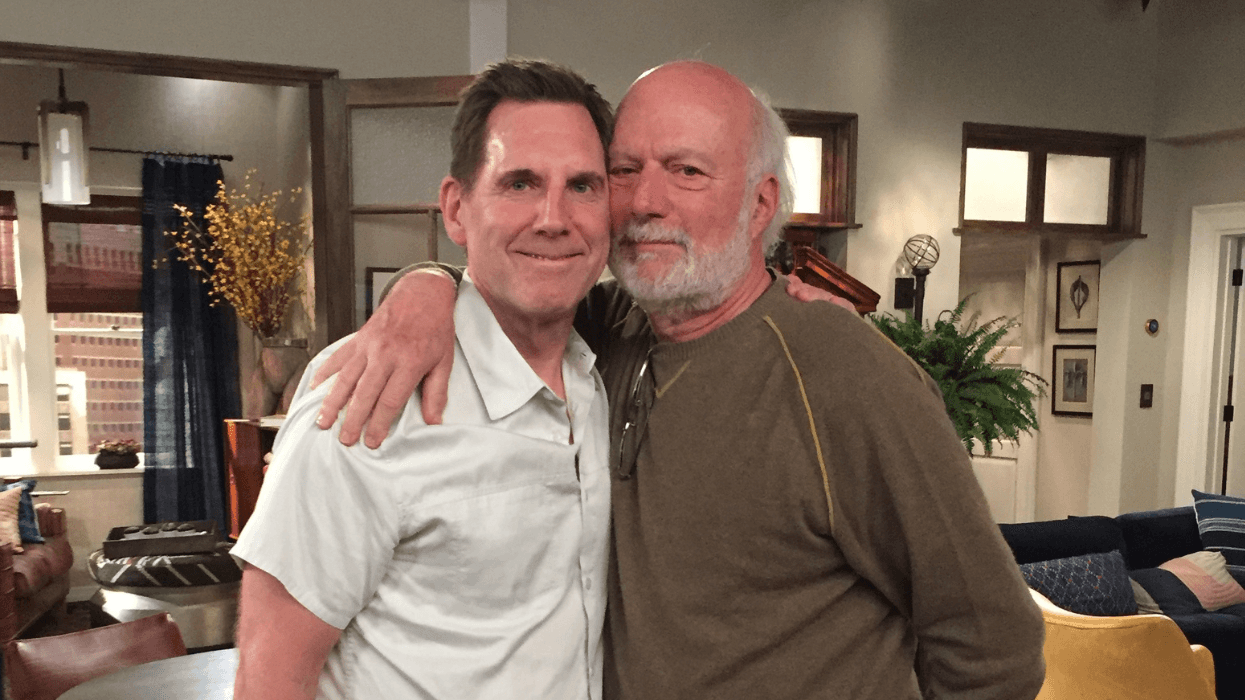
James Burrows, the most influential sitcom director in television history, died Friday at age 85. He leaves behind an incredible body of work that includes iconic TV shows Taxi, Cheers, Frasier, Friends, and Will & Grace.
Burrows famously used the multi-camera sitcom, one of America's most risk-averse art forms, to make gay people visible, sympathetic, and funny long before Hollywood considered that safe.
That instinct showed up early. In January 1983, Cheers, in its first season, aired "The Boys in the Bar," in which Sam Malone's old Red Sox teammate comes out as gay while promoting his autobiography.
Sam, frightened of what his regulars will think, stands by him anyway. The episode won a GLAAD Media Award, a remarkable feat for 1983, and was directed by Burrows, who cocreated the show.
Related: When George Wendt’s Norm taught us gay stereotypes are the real joke in one of Cheers’ most seminal episodes
Burrows kept writing gay, fluid, or queer-coded characters into the biggest comedies on television over the following decades. He always portrayed them as human beings. He shaped some of Friends's most pointed moments, including one of network television's earliest same-sex weddings, and brought warmth to queer-adjacent storylines on Frasier.
Most consequentially, he directed every single episode of Will & Grace, more than 240 of them, at a time when a show built around a gay lead was still a network gamble.
He kept going almost to the end, directing for Hulu's gay sitcom Mid-Century Modern in his final years. His last onscreen work was a recurring role in the third season of HBO's The Comeback, where he played a fictionalized version of himself directing a sitcom pilot.
Few people watched James Burrows work as closely, or for as long, as the out actor Tim Bagley. Bagley's history with Burrows stretches back more than 40 years, to when Bagley took a job as an NBC page fresh out of college and spent his shifts in the bleachers watching Burrows direct Cheers.
Related: Tim Bagley is an unsung hero in the history of Hollywood's LGBTQ+ representation
Later, Bagley would work directly for Burrows as a recurring cast member on Will & Grace, playing one half of a gay couple, and again, most recently, on The Comeback. Bagley also recalls Burrows quietly mentoring a fellow page, Pete Chakos, into a decades-long career as his editor. Chakos would go on to win multiple Emmys for his work.
It was a small, well-known kindness Bagley says was entirely consistent with who Burrows was.
That apprenticeship in the bleachers paid off. By the time Bagley joined Will & Grace as a cast member, he understood Burrows's rhythms well enough to leave him alone unless given a note, and when Burrows did give one, Bagley trusted it completely, even when he didn't understand why it worked until he heard the audience laugh.
“He knew everything that was going on,” Bagley told Out of watching Burrows on set, recalling how the director would stop a rehearsal mid-scene to nudge a wastebasket a few inches, or crouch down and shift a camera with his foot. “It was fascinating to watch.”
Bagley says that instinct extended to actors too. Burrows wanted people to simply do the job, not ask for hand-holding. “If he needs something from you, he’ll give you that note,” Bagley said, describing the lesson he absorbed just from watching. “I learned all that from just standing there, watching him so intensely.”
Bagley is direct about why he believes Burrows insisted on directing every episode of Will & Grace, a workload almost no other sitcom director would take on. The show launched not long after Ellen DeGeneres came out on her own sitcom and was canceled soon after, a moment that showed how unready much of the industry still was for openly gay leads.
“He really wanted to get it right,” Bagley recalled. “He had a real understanding and empathy for LGBTQ people. He was definitely an ally.”
Bagley’s own characters, Larry, half of a gay couple raising an adopted child with his onscreen partner Joe, existed, in Bagley’s view, to show “the normalcy of a gay couple,” he said, as "people who play games, have fights like every other couple." Bagley believes that was the entire point. “There was nothing to fear in seeing gay people together. They were just like you and me.”
That same instinct, Bagley says, carried Burrows decades later through Mid-Century Modern, the Hulu comedy about three gay friends in their later years. Burrows told Bagley he believed the show was canceled because of where the country is right now. “The world just didn’t want to hear about it,” Bagley recalled Burrows saying. “It made him sad.”
Related: Fans react to 'Mid-Century Modern' canceled after one season
Despite decades of proximity to Burrows, Bagley shared one of his most vivid memories of Burrows.. It was during his initial table read before his first appearance on Will & Grace. Bagley was nervous, so Burrows turned to him and said, “You do what you do, and nobody else can do what you do, Tim.”
The compliment landed so hard, coming from someone Bagley had quietly studied since his page days, that he froze and looked down at the table. “It hit me very hard,” Bagley warmly remembered. “I didn’t know what to say.”
It took his castmate Sean Hayes kicking him under the table before Bagley managed a delayed thank-you. Afterward, Hayes asked what had happened. “I just was overwhelmed,” Bagley replied. “I didn’t know how to respond.”
Bagley insisted it wasn’t false modesty. Burrows simply didn’t hand out praise like that often. “He just didn’t say stuff like that very often,” Bagley said. “I was kind of caught off guard. It was so humbling for me.”
The most recent chapter of their relationship came on The Comeback, where Burrows played a fictionalized director, “Jimmy,” opposite Lisa Kudrow. Bagley says Burrows was visibly more fragile than he remembered. “I could see that he was shaking,” Bagley said. Burrows mentioned, vaguely, that he was dealing with health issues.
“He casually told me that he was going to see a doctor,” Bagley recalled, but didn’t elaborate, and Bagley didn’t push because Burrows was an intensely private man. What struck Bagley most was how badly Burrows wanted to be there. “He didn’t have to do that,” Bagley said. “But he wanted to do it.”
Burrows’ final episodes centered on a monologue, since widely shared online, in which his character quits directing an AI-written sitcom pilot. Bagley remembered Burrows describing different writer “personalities” in the speech, “the gay writer, the chubby overweight guy, the angry girl,” as Bagley put it, building to the line that AI couldn’t replicate any of it.
Bagley offered to help him run lines. Burrows waved him off. “My wife does all that with me,” he told Bagley. “I’m good. I’m fine.”
Bagley said that scene captures who Burrows actually was. “That’s really who he was,” Bagley said. “He was there for the writers. He loved writers. He loved actors. That’s why he was so loved.”
Through Bagley’s account, a clear pattern emerges. Burrows was a director who used warmth and laughter to make television a safer, more human place for gay people before it was fashionable, expected, or easy.
“He was a very sweet, generous, kind man,” Bagley said, “and he was definitely an ally who really walked the walk.”