



You may never have heard of anal fissures before, but they are actually a common medical condition that can seriously impact your sex life.
Most straight folks are getting them from constipation or pregnancy, but queer men are likely to experience them if they love to bottom — especially if your partner is large, you don’t prep well first, or don’t use enough lube.
Anal fissures are incredibly painful and can be tricky to heal, but there are dietary changes, medical interventions, and sexual techniques that can help you heal up and prevent them from happening again in the future.
So if you’re a size queen who bit off more than you could chew, or your partner was a little too enthusiastic when he drilled you through the mattress, and now your backside is paying the consequence, fear not, because there are plenty of things you can do to get back in the saddle…so to speak.
What are anal fissures? What are the symptoms?
Man holding his butt.
Pixel-Shot/Shutterstock
Not to be confused with hemorrhoids, anal fissures are tears in the lining of the anal canal and are usually accompanied by sharp or burning pain during bowel movements and bright red blood.
“They can happen from increased pressure due to anything from constipation to sitting too long on the toilet to, of course, any kind of anal play. They are fucking painful, and common symptoms include irritation, swelling, and bleeding,” says Dr. Evan Goldstein, the leading anal health expert in the United States who founded Future Method, a sexual wellness brand dedicated to revolutionizing anal sex prep.
Pain will be the first symptom to tip you off that something is wrong, and that you likely need medical intervention, according to Dr. Carmen Fong, a colorectal surgeon and the chief medical officer at Bummed, a telehealth platform that makes prescription creams to treat hemorrhoids and anal fissures.
“The pain feels sharp, like a paper cut, and chronic fissures can be associated with knifelike pain that lasts hours after a bowel movement. Pain with bowel movements is often the first symptom people notice, but for those engaging in receptive anal sex, discomfort during or after intercourse can be the earliest sign.”
Are they common for gay men who like to bottom?
Two gay men in bed.
Lopolo/Shutterstock
In Goldstein’s private practice, Bespoke Surgical, anal fissures caused by receptive anal intercourse (aka bottoming) are the most common reason gay men seek out his medical advice.
“It is all about pressure with sex,” he says. “Am I able to relax and open the muscles? Can the skin expand and not only accommodate, but also withstand the forceful nature of anal sex? Prepping correctly, using anal dilators as the pre-game, and adding tons of lube during dilation and sex itself are also key practices to implement any time we engage in anal intercourse — and even just playing with toys and fingers.”
Kiara DeWitt, who is the founder and CEO of the progressive, gender-affirming med spa Injectco, says that gay men who like to bottom are more prone to anal fissures, which is why it’s so important to know what to do if you get one.
“Gay males who participate in receptive anal intercourse regularly experience fissures at greater rates than non-anal penetrating partners,” she explains. “Studies show that the risk of anal fissures increases linearly with greater lifetime receptive anal intercourse exposure.”
Luckily, Fong says that most anal fissures from bottoming are usually superficial and easier to heal because they don’t cause the anal sphincter muscle to spasm, which decreases blood flow and prevents healing. “Superficial tears, more common with external trauma like bottoming or douching or toy use without proper lubrication or warm ups, may not involve this spasm and often heal more quickly,” she says.
What treatment options are available for anal fissures?
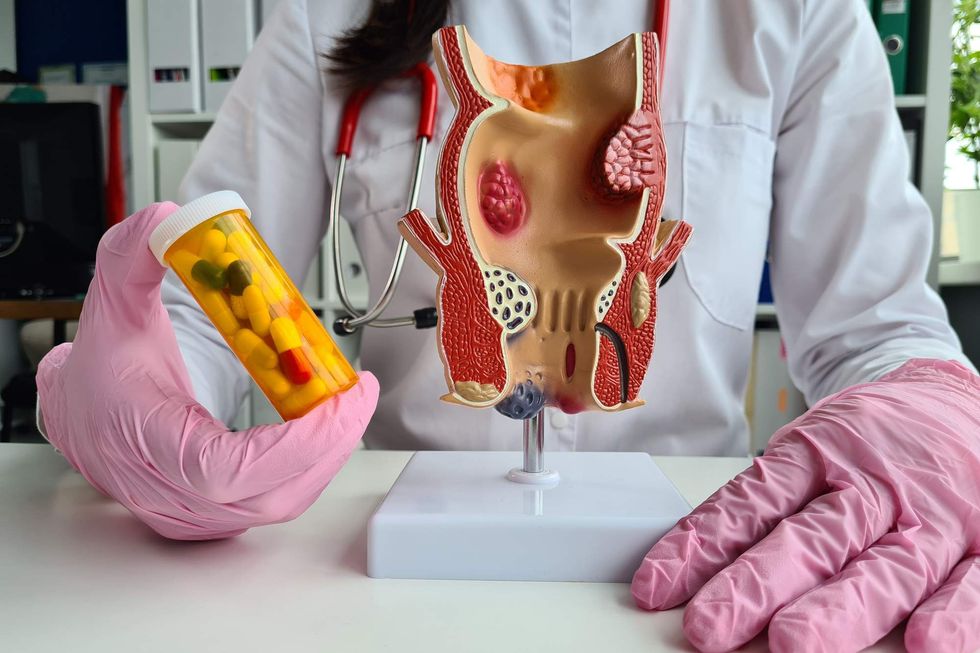
Doctor holds model of unhealthy lower rectum with inflamed vascular structures and medication pills.
NMK-Studio/Shutterstock
If you think you have an anal fissure, Goldstein says you can start out with at-home treatments before bringing in the big guns. This can include over-the-counter creams, warm Epsom salt baths, stool softeners, ibuprofen for pain control (though you need to be careful because it can increase bleeding), and a prescription compound containing lidocaine, steroids, and a blood pressure medication. He also says you should avoid sitting on the toilet for too long and stop using wet wipes, as they can alter the skin’s microbiome and prevent healing.
“I recommend people use suppositories and a special compound medicine that decreases the anal muscle pressure, as well as making sure your poops are soft and easy (which might mean using a stool softener),” Goldstein says. “If this isn't helping after about a week to 10 days, then it’s time to see a doctor to help guide the healing process further.”
If these methods aren’t enough, anal Botox to relax the internal sphincter and allow a fissure to heal is the next step before moving on to surgical interventions.
“For fissures that fail medical therapy, a surgical procedure called lateral internal sphincterotomy (LIS) is the gold standard, with high healing rates, though it carries a small risk of incontinence,” Fong says. “Even still, Botox is so successful these days (about 85 percent heal) that we rarely have to do LIS anymore.”
To give yourself the best chance of healing your anal fissure properly and reduce your risk of recurrence, you're going to need to make some changes to your diet too. Just be careful not to overdo it on the fiber or protein because they can cause constipation if you’re not careful.
“Your goal for fiber intake should be between 25 and 35 grams per day,” DeWitt recommends. “Fiber supplements such as psyllium husk, chia seeds, ground flaxseed, spinach, blueberries, and oatmeal are your friends. Water should be increased to at least 2 to 3 liters per day. Stool softeners like docusate sodium 100 mg twice daily can assist with smoothing things out while healing is active. Dial back on dairy products, processed foods, caffeinated beverages, and spicy foods as they can cause irritation to inflamed tissue during bowel movements.”
While you’re healing, can you still bottom?

A man holding a peach.
AJR-Photo/Shutterstock
If you want your anal fissure to heal, you’re going to have to take a break from bottoming. But this is just a good excuse to get more creative in the bedroom!
“I recommend taking 4 to 8 weeks off bottoming,” Fong says. “Sorry guys, but it helps your bottoming longevity to have these heal all the way instead of just partially, resulting in new fissures down the line.”
According to Goldstein, you’ll get the best results if you take a two-week break while you use medications to heal, then once you’re done with the medications, take a week-long break to make sure you don’t experience any more pain or bleeding, before testing the waters.
“Then, I usually have people do a test run with the Future Method anal dilators (or something similar) to make sure the scar is fully healed and ready for primetime,” he says. “But it can be a four-week process to get you back in the saddle. If at any point you feel like it’s just not progressing correctly, go see someone. Early intervention is key, especially if you can't bottom because of it anyway.”
Do you need to change the way you have sex?

Two men kissing in bed.
AJR_Photo/Shutterstock
“To be blunt, you better,” DeWitt says.
The key things you need to keep in mind are only douching with soft enema tips and warm water, using way more lube than you may think is necessary, and warming up the area with stretches using fingers or toys instead of diving right in.
“Get a high-quality silicone-based lube. They don't dry out like water-based lubes,” she says. “And you'll need to liberally apply it every five to 10 minutes during sex. Warm up with your fingers or a smaller toy for five to 10 minutes. Your anus will ‘relax’ into penetration after that because your body has a reflex for it. Do not use one of those numbing lubes. They prevent you from knowing when you are about to rip a new one. Size does matter when it comes to anal tears.”
Goldstein says you might also want to try new positions to help keep you from getting another fissure — in fact, he even wrote a book on anal sex titled Butt Seriously: The Definitive Guide to Anal Health, Pleasure, and Everything In Between, which walks you through the best positions.
“For example: make sure the bottom is on top and facing each other,” he recommends. “This allows the bottom to be in control of depth and speed, as well as provide direct and constant communication.”
He also suggests using anal dilators before you “slowly progress over time back to bottoming. Slow and steady with lots of lube, patience, and tops who are patient. Constant communication is key and always reevaluating with yourself and your partners.”
Sources cited:
Dr. Evan Goldstein is the leading anal health expert in the United States who founded Future Method, a sexual wellness brand dedicated to revolutionizing anal sex prep.
Dr. Carmen Fong is a colorectal surgeon and the chief medical officer at Bummed, a telehealth platform that makes prescription creams to treat hemorrhoids and anal fissures.
Kiara DeWitt is the founder and CEO of the progressive, gender-affirming med spa Injectco.