

This story originally appeared on Them.
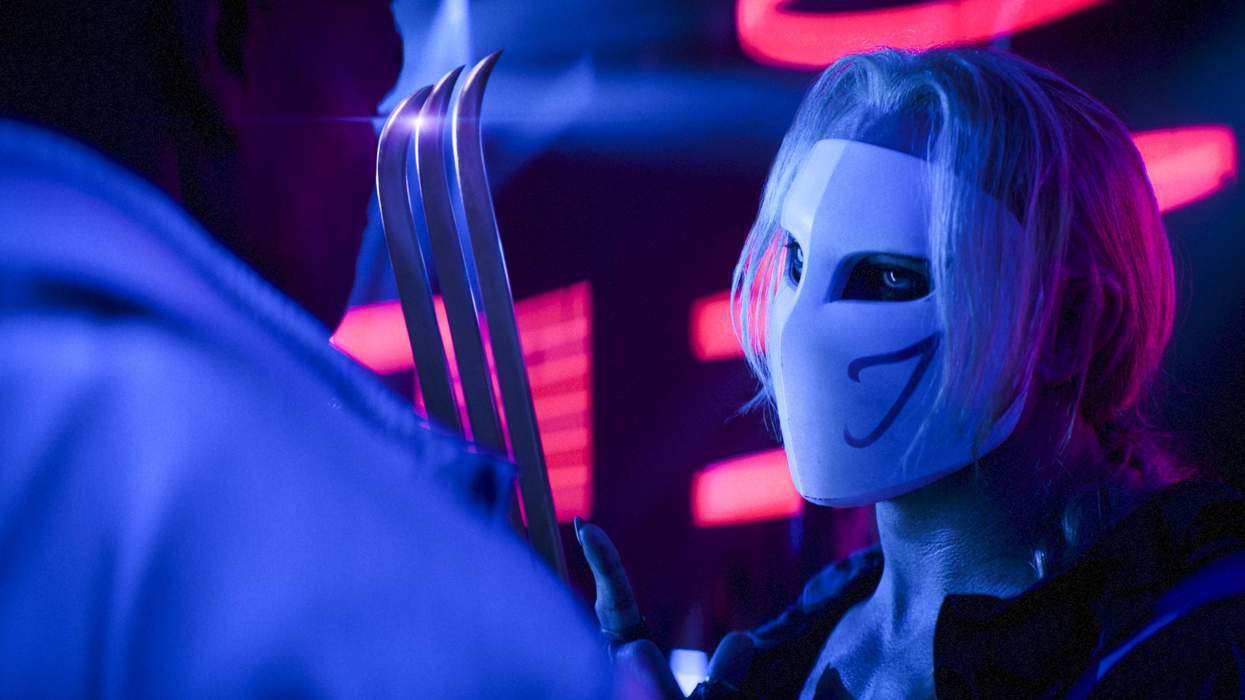
Country star Orville Peck has made a name for himself not just as an artist, but as an advocate for gay rights. But during his feature film acting debut as Vega in the adaptation of beloved video game Street Fighter, the masked singer gets the chance to represent gay wrongs.
Peck tells Them that he grew up playing the iconic 1987 fighting game with his older brothers. That’s why, when he got the call to trade in his usual tasseled black mask for a porcelain white one to play the queer-coded Vega, it felt surreal.
“I always played Vega or Chun-Li,” he laughs. “That’s the rules as a gay boy, I think.”
Directed by Kitau Sakurai, Peck joins an ensemble cast of talented actors, including Noah Centineo, Andrew Koji, Callina Liang, 50 Cent, and Jason Momoa. While the plot of Street Fighter focuses on natural-born fighter Ryu and his brother Ken Masters as they join other competitors in the World Warrior tournament, the pivotal role that Vega plays as the martial arts film’s gay villain is undeniable.
We’re introduced to Peck’s golden-locked Vega the night before the big tournament, when the all-AmericanGuile calls him a “freak” who should become “a family man.” (For those of us familiar with defense secretary Pete Hegseth and his transphobic, “high-T” agenda, Guile’s vibe might not feel entirely unfamiliar.) In a moment of brilliant retaliation, Vega skillfully eviscerates Guile, with queer flair. Unfortunately, as we later learn in the film, Vega’s principles may not be as honorable as they seem… Filled with kicks, jumps, and moments of homoerotic tension, Peck portrays Vega as self-absorbed, and beautifully evil.
Ahead of the film’s theatrical release, Peck sat down with Them to talk about learning to fight, becoming besties with Chun-Li, and which fictional wrongdoer inspired his performance in Street Fighter.
Prior to landing the role, did Street Fighter mean anything to you?
I played it all the time with my brothers. I was a big console gamer when I was little up until we finally got a PC when I was [around] 12 and then switched over to PC games. I always played games my whole life, and still play video games.
In the movie, there are obviously a ton of fight scenes. I’m curious if you had to train for the role.
I sure did. We all did. It was sort of an option in a way: Everybody has an incredible stunt double that was on set. These stunt performers — they should have an Oscars category to themselves because of the unsung work that these people are doing. They will, like, tear a ligament and go to the hospital and be back the next day doing stunts. It’s actually insane. They are insane people in the best way possible.
But on the cast, everybody wanted the chance to also fight because I mean, look, this is Street Fighter and I didn’t come to “street,” you know what I mean? It was almost six months in total, through pre-production and then in production, of fight training for me — and it was a blast. I’m a dancer, my background is in dancing, and so it was just like getting to be a dancer again and do choreography. I loved it. And it’s now brought a passion back for me.
Speaking of fighting, I know there’s a moment in the beginning where Guile calls Vega a “freak,” and to me, I read that as a thinly veiled moment of homophobia. I’m curious, when you were filming that fight, if you had any homophobe in mind when you were doing your kicks and your flips and stunts.
It’s so interesting because yeah, Vega is this queer-coded character. I remember even as a kid, people thought he was a girl because he had long hair and they couldn’t understand it and he’s effeminate in a way. The production team wanted to honor that — that is part of Vega and so the queer-codedness is in there.
Then, it was actually Cody Rhodes’ idea that Vega confused him: this all-American hero has fought in a million battles and he’s this machismo, meathead-ish type, Army guy — and then he sees this beautiful, elegant Spanish man and he’s suddenly confused because something’s awakening in him. The fact that that was added in by someone like Cody Rhodes, I think it really speaks to the heart and the humanity that we wanted to have in this film.
That’s so interesting you picked up on that. I’ve actually never thought of that, but it’s really interesting because that could be Guile’s insecurity about how he saw me earlier in the fight. There’s layers to this stuff. At the end of the day, Street Fighter and fighting games — I think the beautiful thing that draws queer people into those kinds of games is you can choose your character that speaks to you. Everyone has a different main who is, for whatever reason, impulsively you. We wanted to keep true to that. This movie is filled with unique, diverse — not just characters — but performers. There’s no other way in the world that the 12 of us would ever have been in the same room for any reason. It was such a cool experience.
Growing up playing the game, was there a specific character that you gravitated towards?
I always played Vega or Chun. That’s the rules as a gay boy, I think. My older brothers played as Dhalsim and Guile. I would always play as Vega.
I love that, and now you’re here playing Vega literally onscreen, so full-circle moment.
I’m best friends with Chun-Li (Callina Liang). That’s what I wanted as a kid. I wanted to be Chun-Li’s friend and I manifested — and that’s powerful.
From the beginning, Vega has just this queer flair about him, and he brings that into his villain arc. Did any famous gay villains inspire your performance?
I love that question. I really went animal with it. To me, he’s sort of got this cat feel to him, where everything is superior and if somebody wants to talk to him, it’s like, “Oh God, do I have to turn and look at you?” Everything’s such an effort because he’s so superior, so self-involved. Everything for me came from this elegant, cat feel. If anything, maybe like a Catwoman thing?
Obviously, your music has inspired so many queer folks and you’ve really used your platform over the years just to speak up for gay rights. I’m curious how it felt to play a character who kind of embodies gay wrongs.
Honestly, yeah, it was a trip. It’s funny, I just got off playing the MC in Cabaret on Broadway, which is also like this character that makes a switch into just inhumane, unthinkable evil, right? So it was interesting. I’ve played a few villains now, but I like playing villains because I think the challenge is finding the way to not play them as a parody or caricature. That is a weird place to go to because you have to decide if this person wakes up and has dreams and hopes and an endgame in mind. It can’t just be, “I want to be evil today.”
I think with Vega, the especially hard thing is he’s a psychopath, so really my thought was that in every interaction he has in the movie, the thought process for me was, “How does this benefit me? How will this get me further in the tournament? Where will this take Vega?” That’s why I feel like he works with M. Bison. It’s actually for his own goals. He just wants to be elevated up to this superiority. There’s some gays like that. I’ve met them. I’ve dated them.
This conversation has been edited and condensed for clarity.
Street Fighter is in theaters October 16.
Get the best of what’s queer. Sign up for Them’s newsletters.