

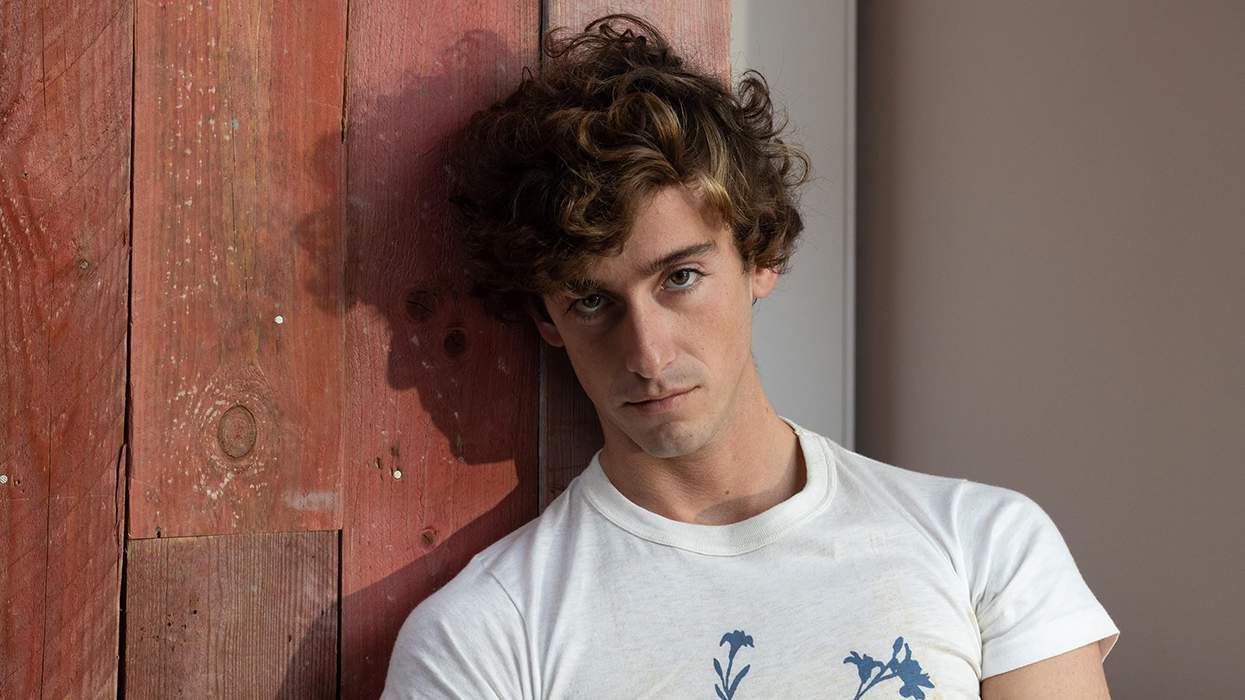

Watching La Bola Negra, any viewer would argue that Guitarricadelfuente disappears into the role of Sebastián, the gentle trumpeter-turned-soldier, who is swept up into the Spanish Civil War after his village is attacked and its inhabitants slain. It can be hard to separate the two, not only because they are both gentle, wide-eyed and musically inclined, but also because their conflation was by design. Sebastián and Guitarrica exist in a sort of symbiosis between character and actor, orchestrated by directing duo Los Javis, who were partly inspired to adapt aspects of the character to fit the actor who inhabited the role.
“They work from everybody’s uniqueness,” Guitarricadelafuente told Out. “I remember telling them, ‘If I was born in that time, in that context, in that small village in northern Spain, I really think that that would actually have been me.'”
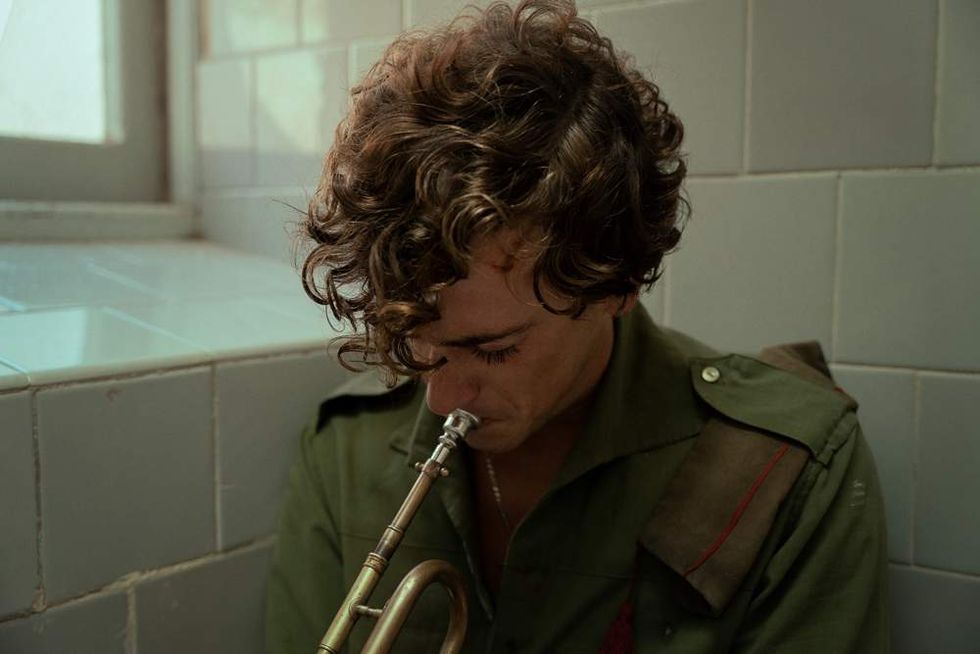 Guitarricadelafuente in 'La Bola Negra'Netflix
Poised as one of this year’s breakout acting talents, and with tons of Oscar buzz and critical praise already following him for his role in the Spanish queer war epic, Guitarricadelafuente admits that he wasn’t always keen on making his acting debut. The Spanish singer-songwriter remembers sitting on a beach the summer he first received the script, asking a friend out loud whether such a career transition — he’s already a lauded indie singer-songwriter who has released two studio albums, been nominated for a Latin Grammy, and collaborated with Troye Sivan — made sense.
“I wasn’t sure at all,” he said while visiting Brooklyn, New York, to attend a viewing of the film. He wasn’t even sure why Los Javis approached him at first. “I was like, ‘You’ve never seen me act! How do you know I’m capable of doing this?’”
The answer was contained in his music videos. In fact, his music career wasn’t a deterrent from Los Javis being able to see him on the silver screen. Quite the opposite. The duo, who won the Best Director award at the 2026 Cannes Film Festival for La Bola Negra, saw echoes of the character they were writing in Guitarricadelfuente’s visuals.
Those visuals ended up being a major reason that the script resonated with the “Full Time Papi” singer. Los Javis’s writing reminded him of his own songcraft.
“I try to create images and words that can act like catalysts that trigger a reminiscence of your past or put an image in your mind,” he said. “When I was reading the script, it was so visual and so clear.”
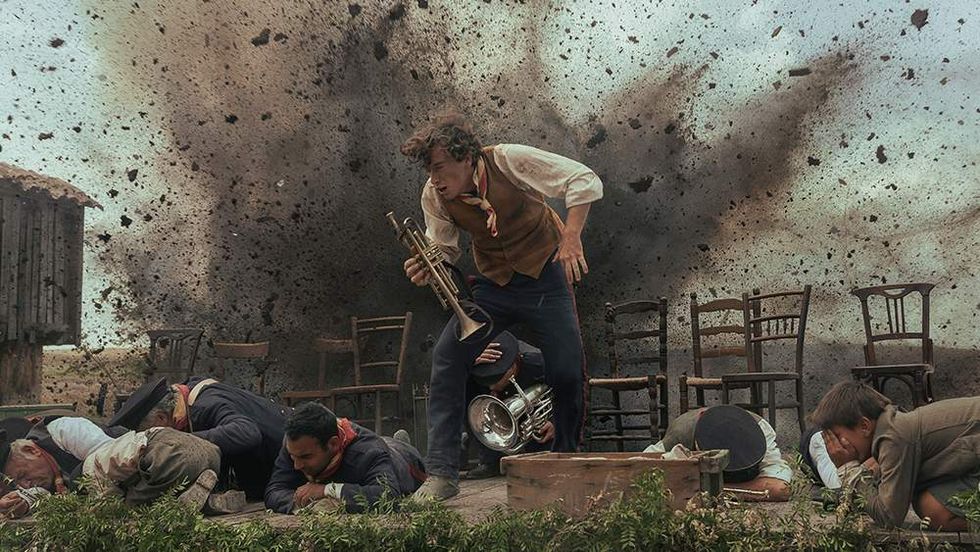 Guitarricadelafuente in 'La Bola Negra'Netflix
Part of those visuals include some beautiful tensions inherent in the film: the lush pastoral Spanish vistas, the harsh brutality of war, and the tender, gentle capturing of nascent queer romance between two people caught up in a war. Sebastián’s tender naïveté against the harsh backdrop of the conflict is one of the film’s many great tensions and one that drew Guitarricadelafuente to the role, despite his initial hesitation.
“Sebastián has a very complex mind and inner world,” he said. “It’s very easy to be empathetic with him, as someone who’s been dragged from his village and put in this war hospital, with the vigorous masculinity that is expected from him.”
Sebastián’s reserved and delicate nature makes sense, especially given that he is a young queer person at a time when there was, in Guitarricadelfuente’s own words, “no chance of questioning yourself, who you are.”
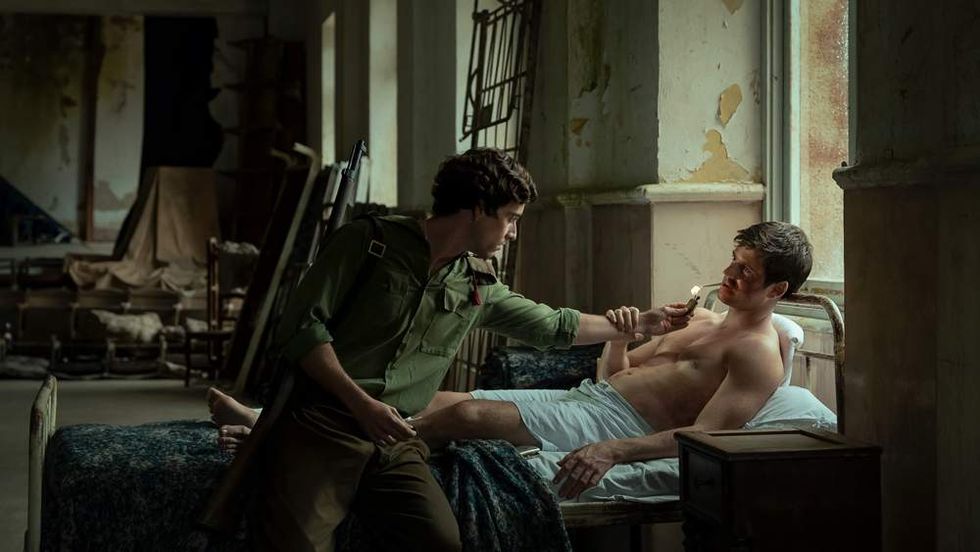 Guitarricadelafuente and Miguel Bernardeau in 'La Bola Negra'Netflix
While La Bola Negra is a war epic, it’s also the story of Sebastián meeting two people who will ultimately change the trajectory of his life. One is Rafael, based on the real Spanish actor Rafael Rodríguez Rapún, and the other is Nené Romero, a singer and actress played by Penélope Cruz, who widens Sebastián’s worldview and tells him that there’s a world outside his small village.
“It’s the first time you see Sebastián smile in the film,” Guitarricadelafuente noted. “He sees hope in her, someone is telling him, ‘You young boy, there’s a world waiting for you in Madrid, and I will wait for you there.'”
As his real life mirrors that of Sebastián, so too did his relationship with Cruz mirror the characters’ relationship on screen. He described Cruz as “so generous, so caring.”
“It was like discovering she’s actually ‘mother,’” he says, laughing. “She’s taking him by his hand and showing him the way. That was also the way I felt Penélope was as a human.”
He continued, “And yeah, she’s a total mother.”
 Penelope Cruz in 'La Bola Negra'Netflix
Just as Nené widens Sebastián’s worldview, so too does La Bola Negra ask us to rethink the queerness of our shared history. That most likely comes from its source material: it’s based on an unfinished work by gay Spanish poet Federico García Lorca, a person whose poetry is known by every Spaniard. However, his queerness, much less so.
“When we learned Lorca in school, they separated his private life and his art, when actually his soul and his way of desiring was so linked to his art,” Guitarricadelafuente said. That de-queering of Lorca is a lesson that ultimately gives La Bola Negra its oomph: a call for us to reexamine our shared queer lineages.
“I believe that this was a way of paying homage to all of those love stories or those lives that weren’t able to live,” Guitarricadelafuente said. “To have a queer war epic film, for everybody to see it and for younger generations to not take freedom for granted at all.”
La Bola Negra is out in select theaters this weekend. It will begin streaming December 2 on Netflix.