
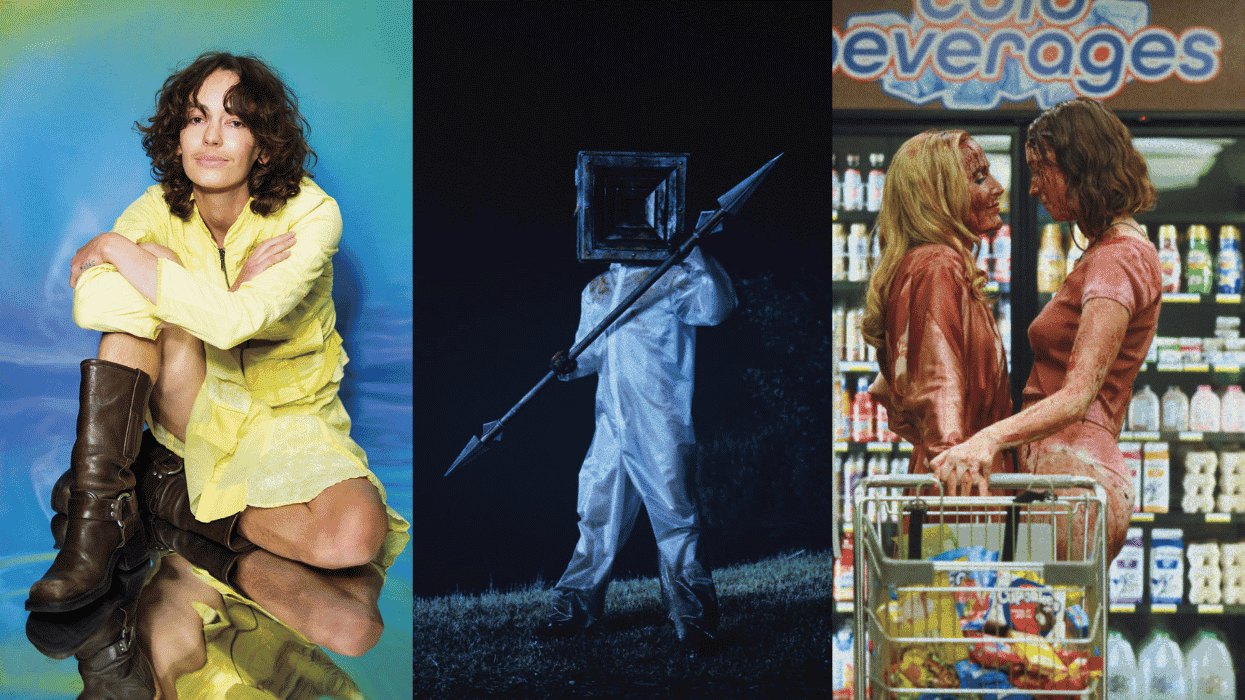

Hannah Einbinder and Gillian Anderson are rightfully getting a lot of attention for their blood-and-hormone-soaked roles in Jane Schoenbrun’s new movie, Teenage Sex and Death at Camp Miasma. Einbinder plays a young, queer director hired to remake a dying slasher franchise, while Anderson plays the older, reclusive star of its first entry. But the film hinges on a third performance: nonbinary star Jack Haven’s turn as the not-so-subtly named Little Death, a problematic and trope-filled masked trans killer who bridges the real world and movie world.
In one of Camp Miasma’s most memorable scenes, Haven embodies Little Death as he goes on a murder spree set to the smooth 1996 alt-rock ballad “A Long December” by Counting Crows.
 Jack Haven of 'I Saw the TV Glow' stars in Jane Schoenbrun's latest horror film, 'Teenage Sex and Death at Camp Miasma.'Mettie Ostrowski/NewFest
Haven, who was born two years before the 1996 song was released, laughs when I ask if they were familiar with the track before Schoenbrun brought it to them. They say they usually tune in to listener-supported freeform New Jersey radio station WFMU and the Weather Warlock (“it’s just a synthesizer that reacts to the weather. It’s in a field in Acra, New York,” they tell me).
In the end, it’s the wide scope of references Haven and Schoenbrun brought together — including Michael Myers, The Terminator, a lot of Angela from Sleepaway Camp, and some Kate Bush music videos – that makes Haven’s dialogueless performance so fluidly unique.
“Jane is a multidimensional artist and thinker,” Haven, who also starred in their last film, I Saw the TV Glow, says. “And that’s where I like to be, is multidimensionality. That’s sort of my obsession, is learning about higher dimensions and learning to communicate with multidimensional beings and knowing that they’re here with us.”
“I think when I’m able to work in Jane’s movies, I feel like I get to travel to those places,” they continue. “And I feel like Jane is a very caring guide as we move together outside of what we know as human beings…. Jane has such a confident manner of pirating the ship away from the familiar.”
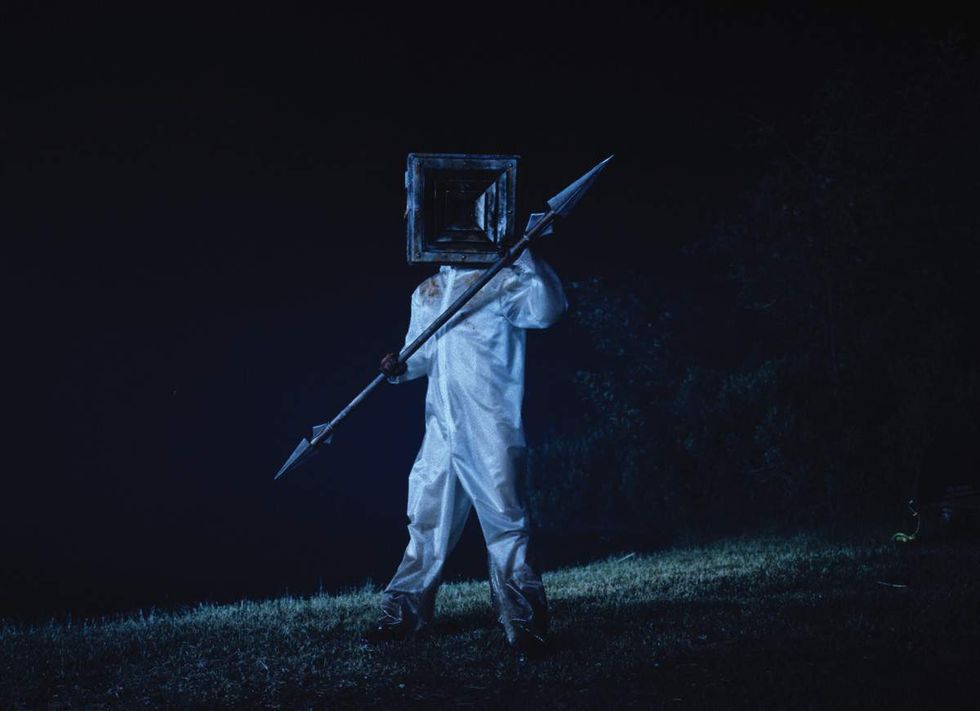 Haven plays a character called 'Little Death' in the new Jane Schoenbrun slasher.©MUBI
One way that guidance manifests is in a nonverbal form of communication between the actor and director, based on a “deep knowledge of this unavoidable pain and the beauty in that pain,” which they explored in both TV Glow and this film, with scenes shot from Little Death’s perspective.
Haven says Schoenbrun is “always down” to “play as creatures” rather than a “defined idea of a character,” and wanted Little Death to have a “perverse raw sexual energy.”
Little Death follows in the footsteps of gender-bending horror icons like Psycho’s Norman Bates, Silence of the Lambs’s Buffalo Bill, and Texas Chainsaw Massacre’s Leatherface. Usually, audiences only get to see them as one-dimensional killers and crossdressers. In Camp Miasma, the audience gets to see a more human side to Little Death.
While studying the horror genre to prepare for the role, Haven says they developed “such fondness for the trans slasher.”
“Leatherface is one of my dearest characters of all time, just because I really relate to that character,” they say. “I feel really liberated by the sort of slobbering overwhelm of a character like Leatherface; it just makes me feel more comfortable in the world living, because she’s out there protecting her family.”
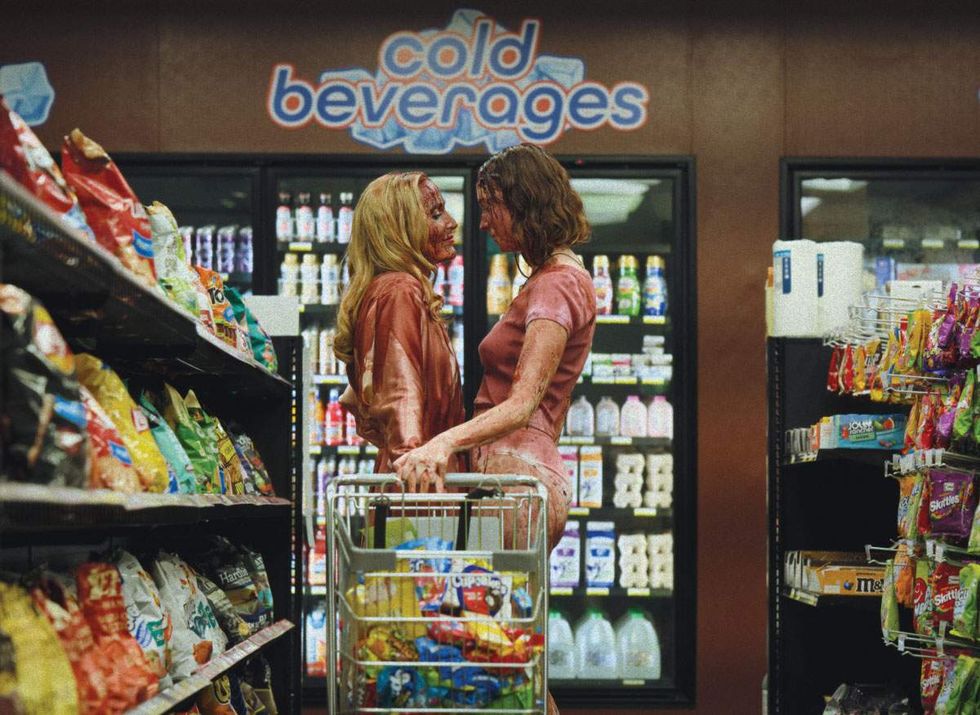 Gillian Anderson and Hannah Einbinder get cozy while covered in blood in a scene from 'Teenage Sex and Death at Camp Miasma.'©MUBI
While Haven has a love for these characters, they also know that politically and socially, the right is using these same tropes to paint real-life trans people as mentally ill predators. Haven isn’t bothered, and in fact feels some “relief” in playing a trans character that isn’t easily marketable.
“For a while they were selling us transness as they thought they could brand it, and they thought they could take it from us,” Haven notes. “Transness is essentially dangerous because it’s in between, and we live in a world that is so delicately balanced on opposites. We know as trans people that opposites are not real, that we move fluidly through binaries. And so I think I feel proud to represent the fear of what this fluidity embodies in us, which is truly resistance — resistance to being sold and being sold to.”
This type of resistance and resilience is central to the type of moviemaking Haven reveres. They say that while it’s getting harder for trans filmmakers to get funding from studios to make films like Camp Miasma, it’s “getting easier to, in general, make movies.”
“My scope of the world is mostly trans film and trans filmmakers, and I think that we are understanding that we don’t need [mainstream Hollywood], and that we have our own industry and ideas that are based on collaboration and mutual respect,” they say. “So, I think we ask for money when we need to ask for money, and we make sacrifices to ask for money, but I don’t think that it’s the primary motivator in filmmaking.”
In addition to Schoenbrun, Haven mentions the work of trans filmmakers and distributors like The M. Sisters, Castration Movie creator Louise Weard, Elizabeth Purchell’s Muscle Distribution, and Avalon Fast as work that excites them for the future of the industry.
They’re also hard at work writing a movie called The Unmiserables, which they’re shooting at the end of the summer.
“I make my movies with a small group of people that we really have no money at all,” Haven says. “So it’s like pure imagination, and it’s for us now.”
Next up, Haven has Peter Collins Campbell’s film Grind, which stars Janeane Garofalo. Haven plays Ricky, a hustle-culture-obsessed delivery driver trying to make enough money for rent in one Manhattan night.
“Of course, he goes down into the depths of hell. It’s very Greek, this movie,” Haven says. “It’s really funny, it’s so fucked up, it’s brutal.”
Apart from that, they’re traveling, painting, and always willing to talk about multidimensional beings.
“We’re really at an odd time,” they say. “I just have to let reality break down, you know? We have to surprise ourselves. We have to stop making sense.”
Teenage Sex and Death at Camp Miasma is out now in theaters via Mubi.
This article is part of OUT’s Sept-Oct 2026 print issue, on newsstands September 1. Support queer media and subscribe — or download the issue now through Apple News+, Zinio, Nook, or PressReader starting August 20.