

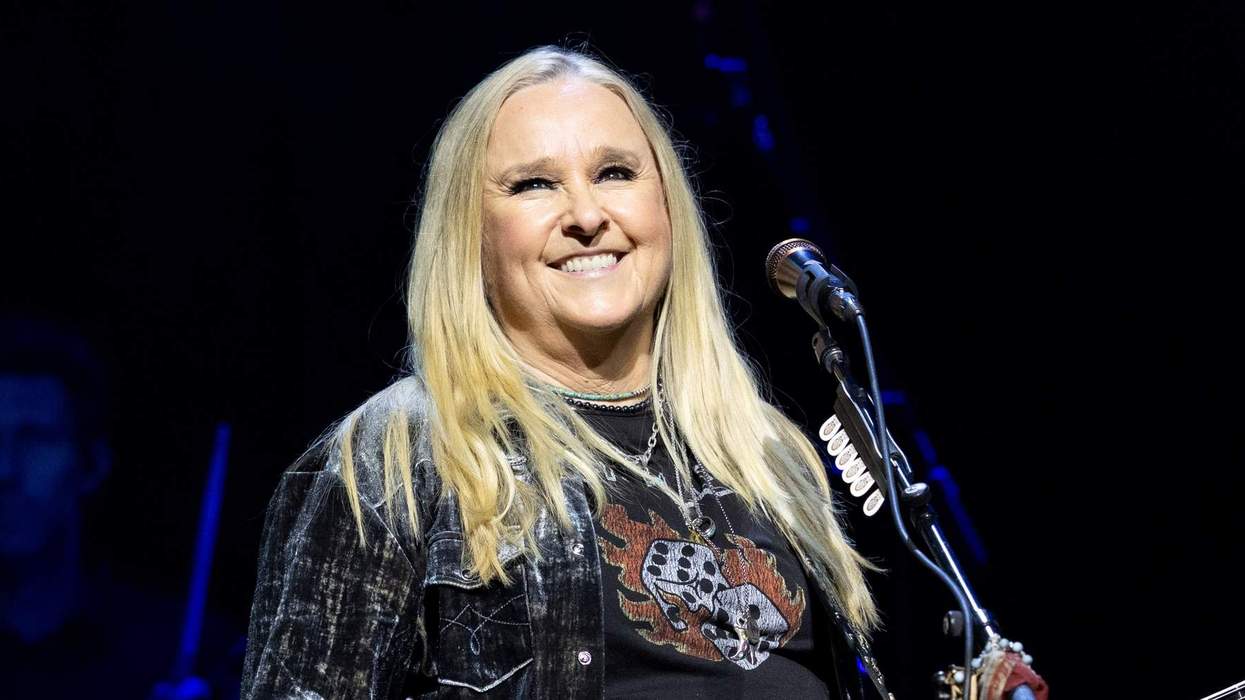
In May 1992, Melissa Etheridge graced the cover of Music Express — a now-defunct, free Canadian magazine that had previously featured the likes of Keith Richards of the Rolling Stones, Janet Jackson, Tom Petty and Boy George. Next to a sexy photo of Etheridge wearing a low-cut white top, her guitar slung over her shoulder, the headline under her name read, "The Naked Truth."
However, as Etheridge recalled this week in an interview with Joel Madden on his podcast, Artist Friendly, the truth is that the man who wrote that article told many lies about who she was, much to the singer's shock.
"I was on the cover of Music Express, and he changed every pronoun that I used," she said. "He changed it to my 'boyfriend,' and it horrified me."
- YouTube youtu.be
It was 1992, Etheridge was 31 and she had released three albums without publicly declaring her orientation. Yet her sapphic fans seemed to sense what she was hiding.
"My first, you know, two rows would be women losing their minds, right? And I'm like, 'I don't know. You know. What's this?'" she said.
Following the release of her third album, Never Enough, the mainstreaming of grunge provided an opportunity to consider at least coming out with her wardrobe: "Hey, I can wear flannel," she told Madden. "I've been wearing flannel for a long time, you know, and I hear 'alternative,' and I'm like, 'This is the time," said Etheridge.
The gender-swapping of her reference of her "girlfriend" to "boyfriend," and changing all the pronouns, accelerated her desire to publicly declare she was a lesbian. "The gay community was really strong, but it was underground," she said. "I’m like, 'Oh my god, they’re going to think that I did this.'"
So instead of her original plan — to come out in September 1993 on The Arsenio Hall Show to promote the release of her fourth album, Yes I Am — Etheridge made an impulsive announcement. Forty seconds into her speech at the Jan. 20th, 1993 Triangle Ball, a celebration of President Clinton’s inauguration, the rocker wowed the crowd of "powerful gay leaders," including the woman she called her "sister," k.d lang.
“I’m very proud to say right here, I’m very proud to have been a lesbian all my life,” Etheridge told the crowd, to huge cheers. Lang leaped into the air and hugged Etheridge tightly. That inspiring moment was captured on video.
Looking back at that speech more than three decades later, Etheridge told Madden: “I’m grateful that I had the opportunity to be truthful to myself and speak about it," she said. "It comes back to me constantly."
Interestingly, this is actually the second time in almost a year that Etheridge, 64, has spoken about the article that propelled her to come out of the closet. She discussed it an interview posted to her official Facebook page in June 2025. "I was misquoted so horribly in a music magazine once," she said. "They had changed everything to me saying 'My Boyfriend', and I was like 'I can't do this'."
In 1995, Etheridge released her biggest hit song, I'm the Only One. It peaked at No. 8 on the Billboard Hot 100 that year, with the iconic lyrics that made clear, once and for all, this is a woman who loves women, even when they don't love her back.
Tonight you told me
That you ache for somethin' new
'Cause some other woman is lookin' like something
That might be good for you
Go on and hold her 'til the screaming is gone
Go on believe her when she tells you
Nothing's wrong
But I'm the only one
Who'll walk across the fire for you
And I'm the only one
Who'll drown in my desire for you
It's only fear that makes you run
The demons that you're hiding from
When all your promises are gone
I'm the only one