

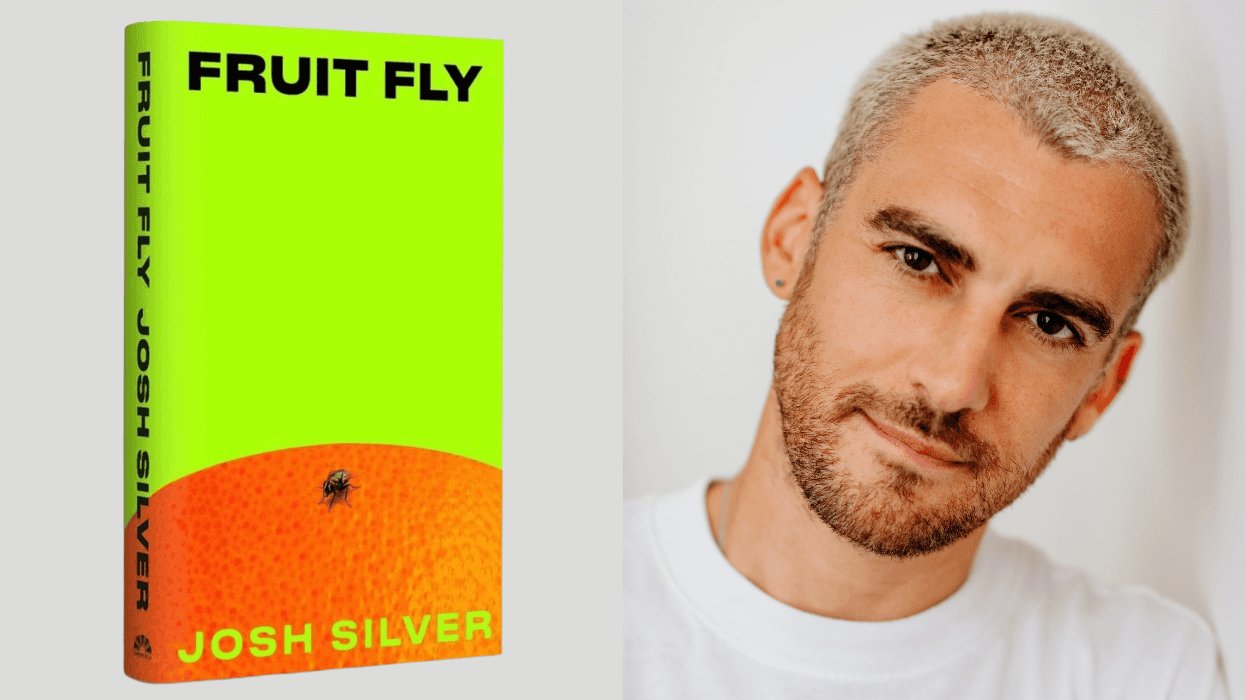
Despite the long-storied tradition of the special relationship between gay men and straight women, few books have plumbed the intricacies of this type of dyad like Fruit Fly. Though there are plenty of laughs to be had, this is no Will & Grace. Instead, Josh Silver’s darkly comic debut adult novel follows Mallory Maddox, an author and therapist floundering with writer’s block, who becomes obsessed with a young gay addict named Leo. She takes his story, slaps a new name — Liam — on him and gives it a provocative title: Slay.
Both Mallory and Leo are deeply flawed but endearing. And their story has been one that has captured the attention of not only readers, but Hollywood as well. In July, A24 announced that it had optioned Fruit Fly and planned to turn it into a television series. The person behind the popular book is Josh Silver, an author and mental health nurse who previously wrote two dystopian YA books.
Silver first got the idea to explore the novel’s themes while studying to be an actor at the Royal Academy of Drama. In the years between when he was in school and started auditioning, he saw his queer identity change from something to hide that something the industry wanted to commodify. It was there that he started to wrestle with some of the same questions that Fruit Fly picks up, including what it means to tell an authentic story and how people perform their own trauma.
In an interview with Out, Silver spoke about the parallels between himself and his characters, how he got special insight into Mallory, and why he doesn’t want to write likable people.
Read Out’s full conversation with Josh Silver ahead.
When did you get the earliest idea for Fruit Fly?
I used to be an actor. I went to the Royal Academy of Drama, which is an objectively good drama school. I went into the acting world as a closeted gay guy in 2012. I found there was a pretty strong narrative back then that you shouldn't let anyone know that you're gay, and it's not gonna be useful for your career. It just started me off in a place of confusion. I was trying to figure out my identity as someone who had come from the north of England in a fairly religious context to drama school, which should have been this liberating experience. And it was in many ways, but outwardly, I was performing and pretending to be straight.
About six, seven, eight years later, there was this cultural shift where diversity became a hot topic, especially in the acting industry. We needed more diversity across the board, and that was in all aspects of cultural difference. And I remember having a call with my agent, and she said, “Oh, you can tell them you're gay, by the way.” And I was like, “Oh, I can do that now.” She was like, “Yeah, go on, tell them, be as gay as you can be. They're only casting gay people for this part.” The whole thing was really difficult because I felt like the pain and difficulty of the previous eight years had just been eradicated all of a sudden. I found it really difficult, and then I just saw that being queer started having currency, and it had a usefulness, and it gave you — not an advantage, but all of a sudden, it was important to have diverse casting.
I just questioned it all. I questioned whether they believed that, whether they believed the importance of diversity, or whether it was tied to economic gain, and the people at the top just saw it as another opportunity. I see it with Pride, too, these corporations that wrap bars of soap in the rainbow flag and sell them. I have a lot of anger and frustration towards this whole thing, and I wanted to write about it.
People want to draw a parallel between you and Leo, but I’m really interested in how you identify with your other protagonist, Mallory.
I love that you're asking that, because I shared this book with my twin brother, and he was like, “You are both of these characters,” and that's true. I really relate to her desire to be validated externally and be seen as successful. That's a journey I've been on myself as an actor and as a creative, wanting to feel like everything's in order by having a home that looks fantastic; for people to look at her and envy her, but being on the inside, still in an incredible amount of pain, but not really knowing where the pain's coming from; feeling like the only way to end the pain is by external approval. She lies, she creates narratives of herself, she says that she's read books she hasn't, and she wants to be seen as this slightly brilliant, slightly melancholic, but wealthy author. And it's all a facade. She's desperately unhappy, and she's in a relationship that is toxic. The reason she stays is part of her own inability to look at herself. I don’t relate to a relationship like that one, but I do relate to the idea of not looking at yourself in order to see where her past and her wounds are affecting her choices.
Reading Mallory, I was reminded of the long tradition of gay male writers writing about themselves as women. But that's also changing a lot now that we can have gay male protagonists in books.
People will ask me, “You do know that you're doing what you're satirizing?” As in, you’re writing from the point of view of someone you are not and I was like, “Yes, that is the point.” I believe in creative freedom, and I believe we should start in a place of creative freedom. I've been asked a lot about whether I think that only gay actors should play any gay roles or whether only gay people should write gay stories. I don't believe that to be true. I think that what I'm questioning with the book is intention, using parts of someone else's story that involve trauma or pain that is very specific to that demographic. If you're gonna use that, I want to know why.
Creativity should be open and broad. I love writing from the female perspective of Mallory, and I would have lots of help with it. I have some great female friends who would read after me. The book is dedicated to a girl called Leah, and she's a Northern friend of mine. Northern people are known for being quite straight talking and funny, and she would call me and be like, “Fucking hell, Josh, she would never do that!” And I'd have people who would guide me with the more practical and emotional side. I was surprised at a lot of the similarities beneath the surface that I think as a gay man, I share with women. And I think that that bond is unique and special for a reason.
When I was reading the book, I was thinking a lot about the particular relationship between gay men and straight women. There’s always discourse about straight women in gay men's spaces, but there is this relationship that we have that is not always reflected in literature.
It’s always been a place of safety where I feel like I can be myself 100 percent and not feel threatened. I think we share a space of safety between ourselves because there's no threat between us. I think Mallory and Leo are reaching for each other, searching for each other. It’s this strange dynamic where they're using each other, but actually it's coming from a very sweet place.
The book is also to me very straightforward about areas of life where there is a disconnect or subcultures that don’t translate. You have scenes involving chemsex or Grindr, where Mallory is sort of an interloper. What was it like to write things that you know from your own experience, but then also write them from an outsider perspective?
Very fun to do that. She seems very naive at points, but that's part of the satire. The actual reality of how gay men interact is — there's a voyeuristic nature from people who are not in our community, they're like fascinated by it. Like, “Oh my God, you do this,” and, “You do that, and you don't feel guilty?” And, “You're able to just sleep with those people?” There’s this intrigue and this awe of like, “Oh my God, you guys operate in such a different way.” She puts herself in the middle of it and sees the realities of what that can bring. But she's like, “Oh no, I just want to watch. I don't want to be in it.” She keeps getting drawn back to Leo's chaos, but wants to remain a voyeur.
A couple of interviews that you've done have touched on the trauma porn aspect of the novel, but I think the book is also interested in how Leo and Mallory are creating their own trauma porn, making themselves the subject of it, almost performing trauma.
Oh, yeah, 100 percent. And this was really important to me, because the headline of the book is that Mallory's stealing someone's story. But what she's actually doing is stealing the story of someone who is lying and fabricating his own life because he has learned how using trauma gets him what he needs. He gets empathy, money, drugs, sex, whatever he needs from his trauma, and he is manipulating the whole situation. He is no victim, and it was really important for me to do this because Mallory is not to blame. We're all part of this problem.
When I was in active addiction — I'm sober now — it may have been subconscious, some of it was probably conscious, but all I had was my story and my ability to use it to get what I needed. Moving through all that as a sober person, looking back on it and reflecting on how manipulative that can be, and how it's unhelpful for the narrative that we as queer people put out there. I'm not saying that's our fault. We do things when we're in survival mode a lot of the time. It’s dangerous because we're not being fully honest, and Leo is not being fully honest about who he is. When he reads the manuscripts at the end and is surprised by what he sees. I'm like, “Well, are you? Because that is the narrative you wanted to put out there, that you were headed to that end.” They both have this moment of seeing reality, and for me, that was really important for him to see it written down because he's like, “Holy shit, is that how you see me?” And she's like, “That's what you said!” I know she's fabricated a lot of it, but the basis of it is his lies.
I was reading some reviews of Fruit Fly and someone wrote, “Oh, you'll love it, everyone in the book is awful!” I even have a friend who's a therapist who read it and was wincing at how Mallory as a therapist is acting with her client. What is appealing about characters who make immoral decisions on the page?
In terms of likable and unlikable characters, I really don't use those words as much as other people maybe anymore. When I was growing up, I thought the point of life is to make everyone like you. It was exhausting and I couldn't do it. I will never try to make my characters likable or unlikable. What I will try and do is make you understand their motives and where that's coming from within them, their history and why they're making the choices they're making. I want you to almost watch through your hands because you're like, “I know he's gonna do something horrible,” because you know him and the kind of person he is. I have no desire to make you like my characters. You think all my characters are awful, I don't mind at all. If you were to come and say I don't understand why they're making these choices, I don't think I've done my job.
Josh Silver’s Fruit Fly is available now wherever books are sold.