


The new David Geffen Galleries at the Los Angeles County Museum of Art (LACMA) have transformed the city's skyline and the way we experience art. Since opening in April, the striking elevated structure has invited visitors to abandon the traditional chronological route and instead explore thousands of works arranged around four bodies of water — the Atlantic Ocean, Mediterranean Sea, Indian Ocean, and Pacific Ocean.
As you wander freely between continents, cultures, and centuries, unexpected connections emerge, making it an ideal setting for a queer tour of the collection. Hidden in plain sight are portraits of queer figures, ancient sculptures that challenge binary ideas of gender, homoerotic mythological scenes, and masterpieces whose gay subtext becomes unmistakable once you know where to look.
I have selected 20 highlights that illustrate how queer lives, desires, and identities have always been an integral part of art history. So, put on comfortable shoes, resist getting distracted by the spectacular views of Los Angeles, and prepare to experience LACMA through an entirely different lens.
David Hockney's 'Mulholland Drive'
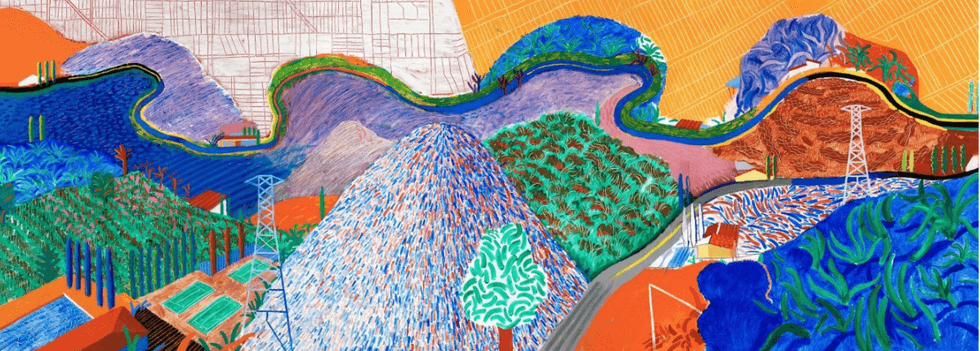
David Hockney, Mulholland Drive: The Road to the Studio, 1980
Los Angeles County Museum of Art, Purchased with funds provided by the F. Patrick Burns Bequest
Begin your journey on the top floor of the Broad Contemporary Art Museum building (BCAM). Step into the Modern Art galleries and make a beeline for the largest canvas ever created by one of the most important queer artists, David Hockney (1937-2026).
Mulholland Drive: The Road to the Studio (1980) is his love letter to the city that allowed him to imagine an entirely new future. Tracing the daily trip between his home and his West Hollywood studio, Hockney transforms winding roads into ribbons of electric color. Hillside homes, swimming pools, and tennis courts tumble across the canvas, drawing the viewer into the exhilarating ride.
Just around the corner, we find Beauford Delaney's (1901-1979) Portrait of Claude McKay (1944). Delaney’s expressive brushwork matches the intensity of McKay's writings on the injustices of Black life in America. The result is a joint endeavor from two queer Black pioneers who shaped the Harlem Renaissance.
Close by is Frida Kahlo’s Weeping Coconuts (1951), one of her many works alluding to the pain she suffered through her life. This biographical fact has unfairly hijacked her narrative, obscuring how Frida defied social norms and engaged with love, gender, national identity, disability, and political struggle — themes that have turned her into a queer icon.
Frida’s bisexuality was never hidden. Her on-and-off partner, Diego Rivera, encouraged her relationships with women, and the museum's decision to place Georgia O'Keeffe's (1887-1986) Horse's Skull with Pink Rose (1931) nearby creates an irresistible dialogue between these unconventional female artists.
Frida met O’Keeffe at Rivera's New York MoMA show in 1931. Diego bragged that his wife flirted with O'Keeffe, which seems to be the case. In 1933, Frida wrote a friend saying, "O'Keeffe was in the hospital for three months, she went to Bermuda for a rest. She didn’t made [sic] love to me that time, I think on account of her weakness. Too bad.”
The final gallery offers a reminder that queerness doesn't always announce itself through explicit subject matter. Ellsworth Kelly's (1923-2015) Blue Curve II (1972) exemplifies how abstraction became part of a new visual language forged by openly gay artists.
Ay-O's 'Rainbow Heart'
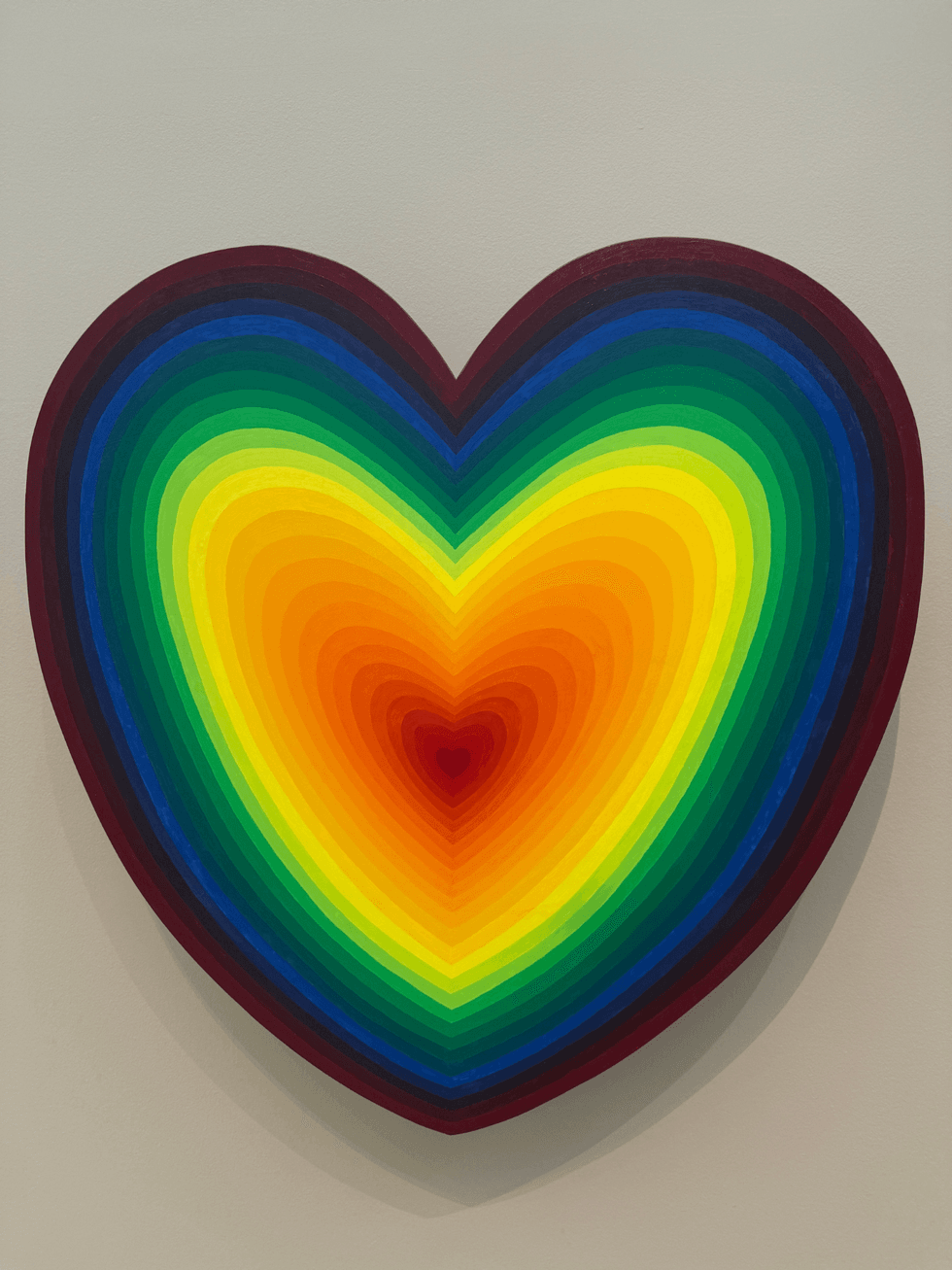
Ay-O, Rainbow Heart, 1965-1967
Gift of Riko Mizuno
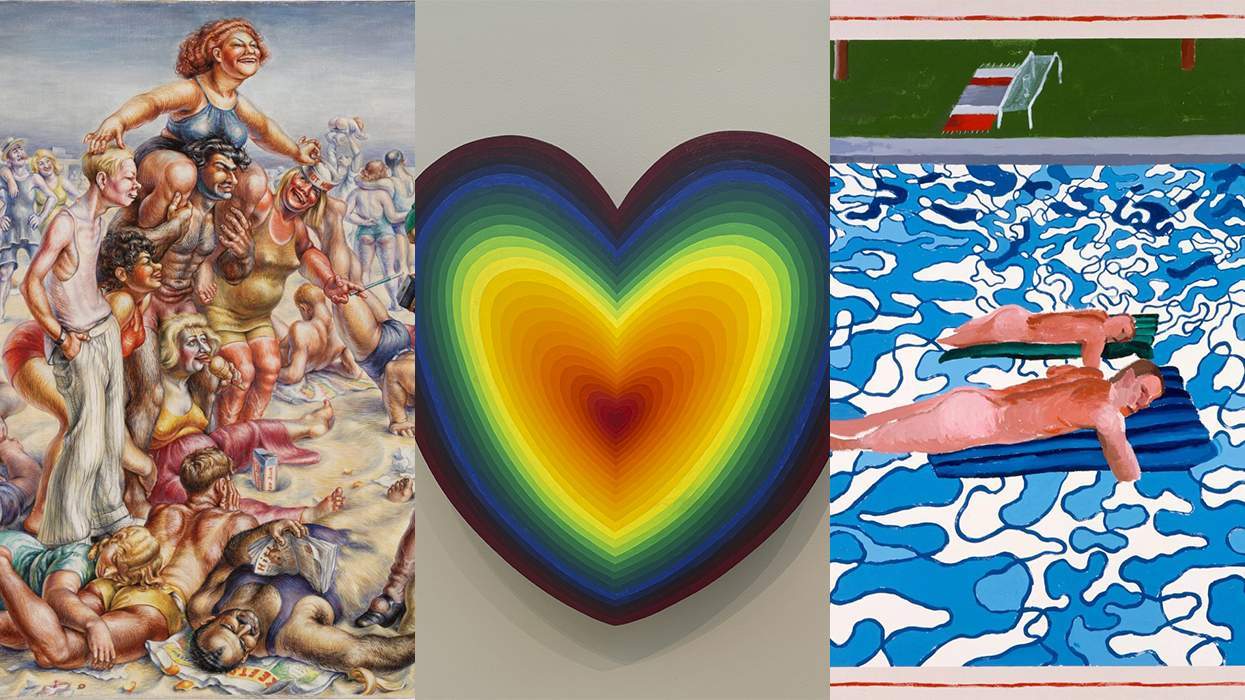
Then, your eye catches Ay-O's Rainbow Heart (1967), created a decade before the rainbow flag became the symbol of Pride. Stand close enough and its vibrating colors seem to shimmer, evoking the joy and liberation that queer communities have always created for themselves.
David Hockney's California
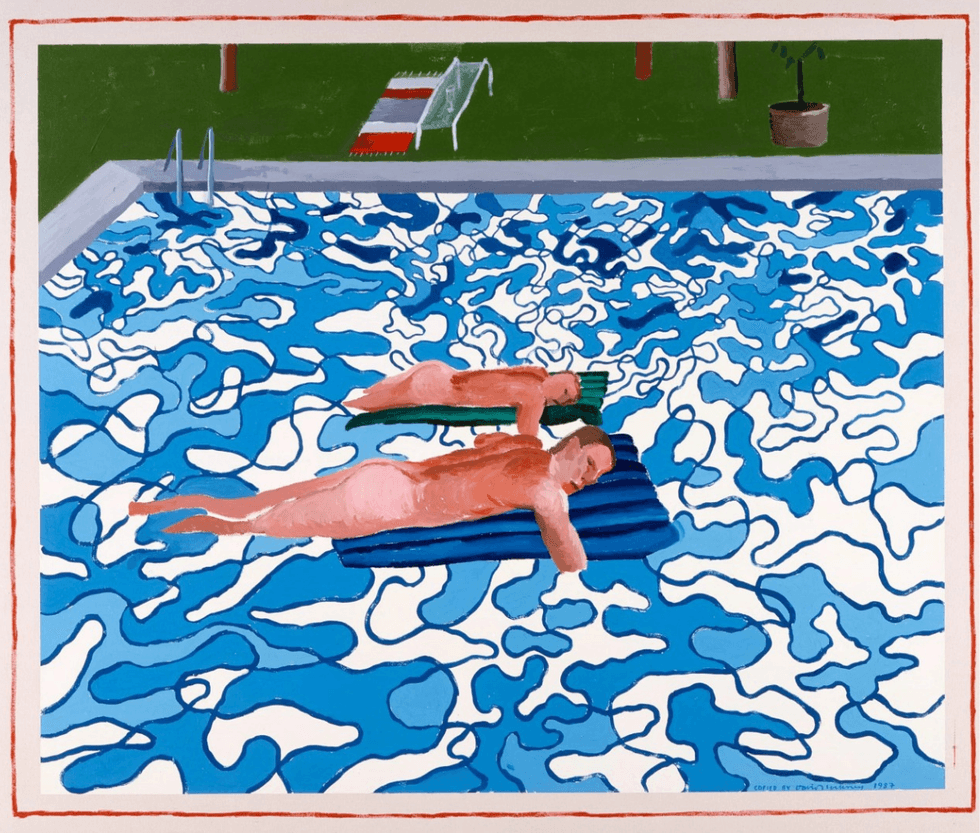
David Hockney, California Copied From 1965 Painting in 1987, 1987
Los Angeles County Museum of Art, Genuine gift of David Hockney
Before leaving BCAM, return once more to David Hockney. His painting California Copied From 1965 Painting in 1987 (1987) hides a fascinating story.
When the 26-year-old Hockney arrived in Los Angeles in 1964, California offered something unimaginable back home: sunshine, handsome young men, and an intoxicating sense of freedom.
Hockney realized that this vision of California hadn’t been represented in art and he decided to become the artist who would bring this gay utopia to life. He painted California (1965), depicting two nude men floating in a glistening pool. The graceful blue swirls suggest lives unconstrained by rigid rules — a subtle metaphor for sexual liberation.
It instantly became one of his quintessential images. When LACMA was preparing its Hockney retrospective in the ’80s, Hockney desperately wanted to include it. When the owner refused to loan it, Hockney decided to paint it again from memory and donate it to the museum, a reminder that queer history is often preserved by artists determined to ensure their stories endure.
Francis Bacon's 'Three Studies of Lucian Freud'
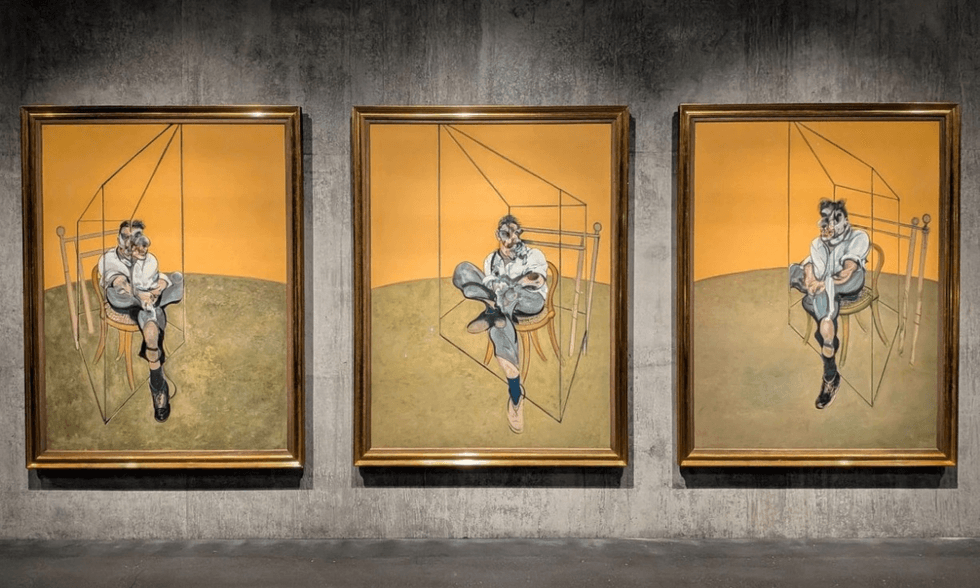
Francis Bacon, Three Studies of Lucian Freud, 1969
Gift of Elaine P. Wynn
From BCAM, make your way into LACMA's new David Geffen Galleries. To help navigate the building, we are using the gallery numbers indicated on the museum map.
Our first stop is Gallery 64 in the Atlantic Ocean section, presided over by Francis Bacon's Three Studies of Lucian Freud (1969).
Towering over visitors, the triptych captures Bacon's close friend and greatest rival, Lucian Freud. Here, Freud twists and dissolves before our eyes, becoming simultaneously recognizable and abstract.
One of the museum’s greatest benefactors, Elaine Wynn, purchased it in 2013 for $142.4 million, then the highest price ever paid at auction for a work of art. She donated it to LACMA, whose northern wing now bears her name.
Paul Cadmus's 'Coney Island'
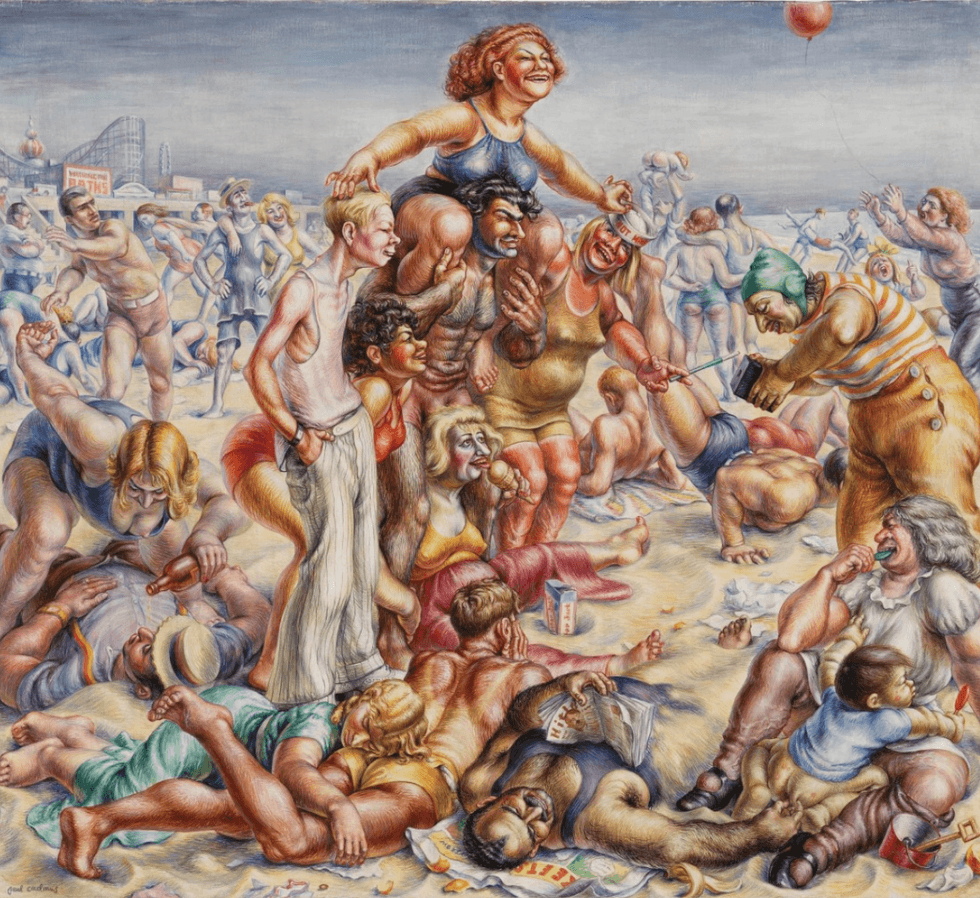
Paul Cadmus, Coney Island, 1934, Los Angeles County Museum of Art
Gift of Peter A. Paanakker
Continue to Gallery 66, which holds two of the most important queer works in the collection, starting with Paul Cadmus’s (1904-1999) Coney Island (1934).
A satirist by nature, Cadmus portrays the characters at the beach in an exaggerated way. Just like many of his works, this painting includes queer Easter eggs. Check out the reclining man transfixed by the athlete exercising before him. A bather reading about Hitler is the only reminder that this defiantly modern image was painted back in 1934.
Thomas Eakins's 'Wrestlers'
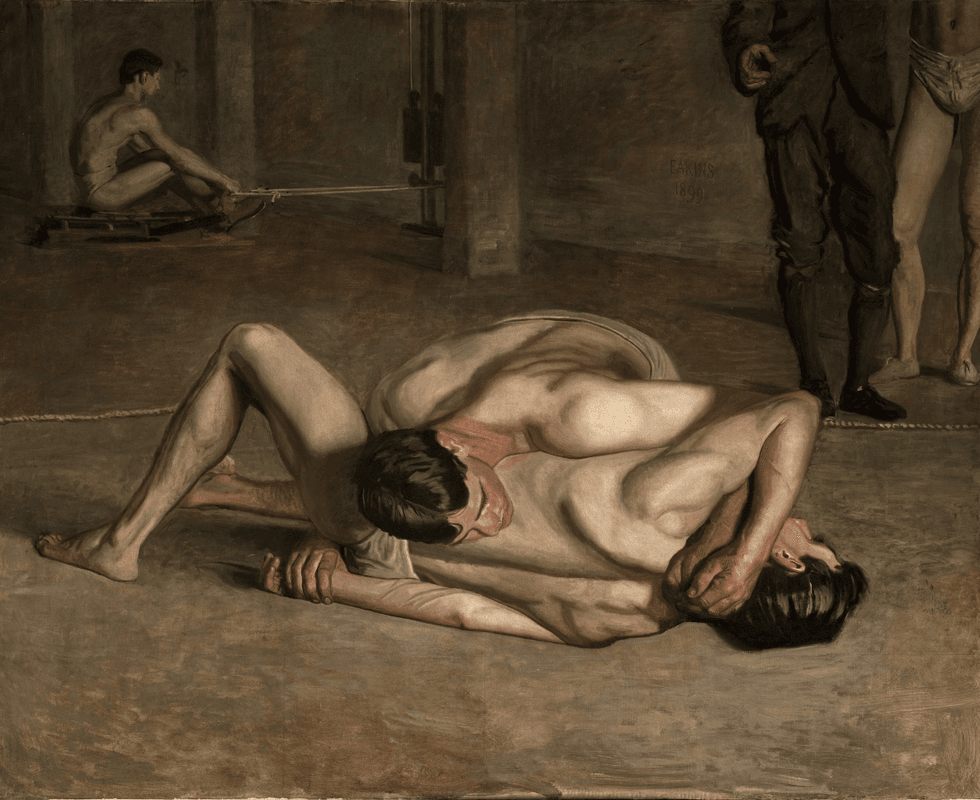
Thomas Eakins, Wrestlers, 1899
Gift of Cecile C. Bartman and The Cecile and Fred Bartman Foundation
Another masterpiece hangs steps away, Thomas Eakins’s (1844-1916) Wrestlers (1899). On the surface, it’s a traditional sporting scene. Look again. Wrestlers is a far cry from depictions of combat sports at the time, which highlighted strength, sweat, violence, and triumph.
The two young men are locked with remarkable tenderness, their intertwined bodies becoming a single sculptural form. Their clasped hands and softened expressions shift the focus toward physical closeness and emotional connection. This titillating image brought a queer viewpoint to American painting, proposing a softer version of masculinity.
Created after public scandal derailed his career, Wrestlers can be interpreted as Eakins’ spiritual self-portrait at a time of struggle with his life and his sexuality.
Gustave Caillebotte's 'A soldier'
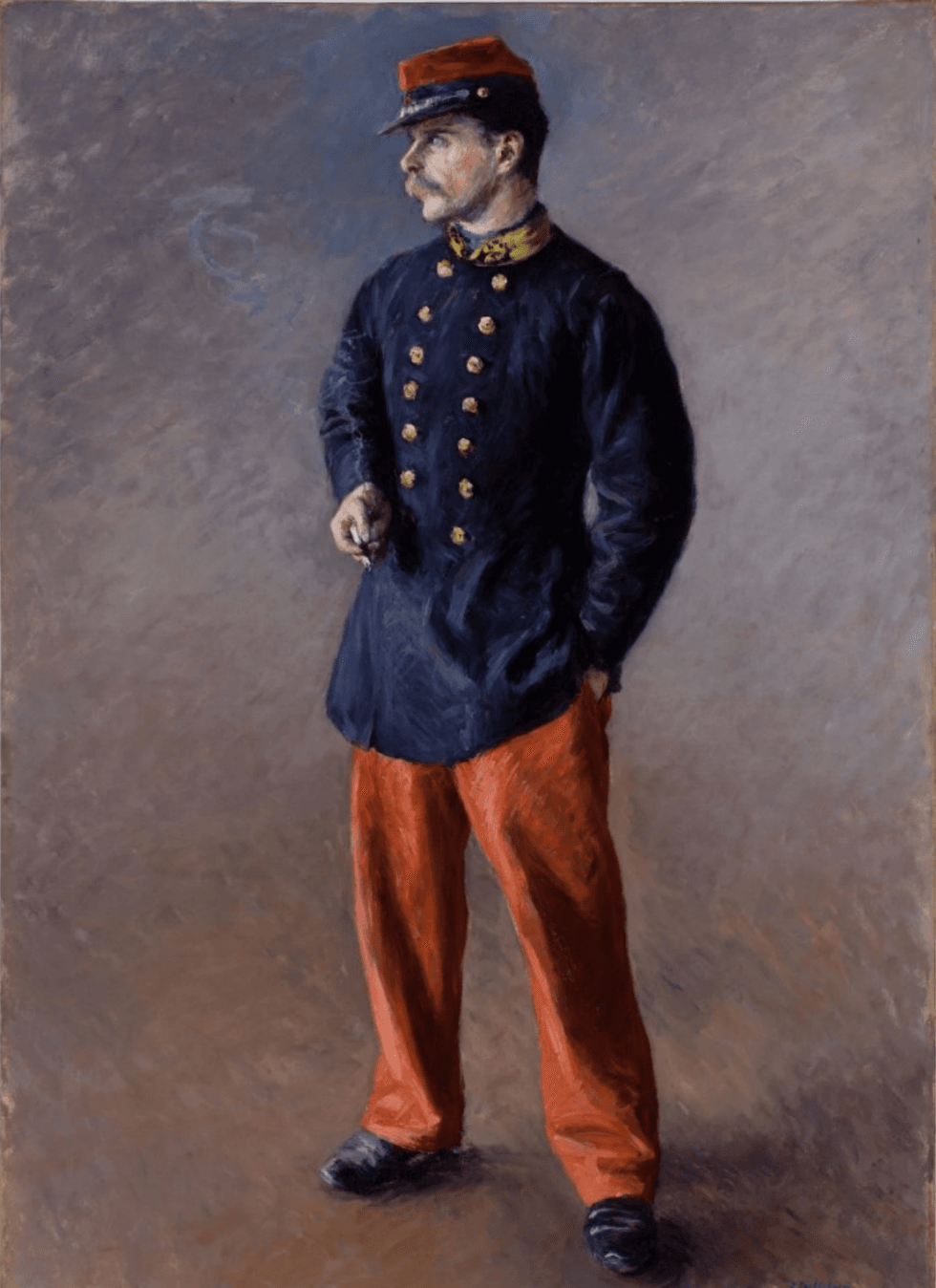
Gustave Caillebotte, A soldier, c. 1879
Gift of A. Jerrold Perenchio
Continue into Gallery 67, home to A. Jerrold Perenchio’s Impressionist collection, in which Gustave Caillebotte’s (1849-1894) A soldier (1879) steals the show.
Unlike his peers, Degas, Monet and Renoir, who usually painted female portraits, which were easier to sell, Caillebotte, who was a wealthy bachelor, painted what interested him: his circle of male friends, nude men, muscular rowers, sultry workers and dashing soldiers such as this one.
In Caillebotte’s depiction, the soldier’s ravishing uniform glows. His casual stance, one hand in pocket, the other holding a cigarette, subverts the traditional heroic portrait of a military figure with an overt sensuality that reveals the artist’s desire.
Guido Reni's 'Bacchus and Ariadne'
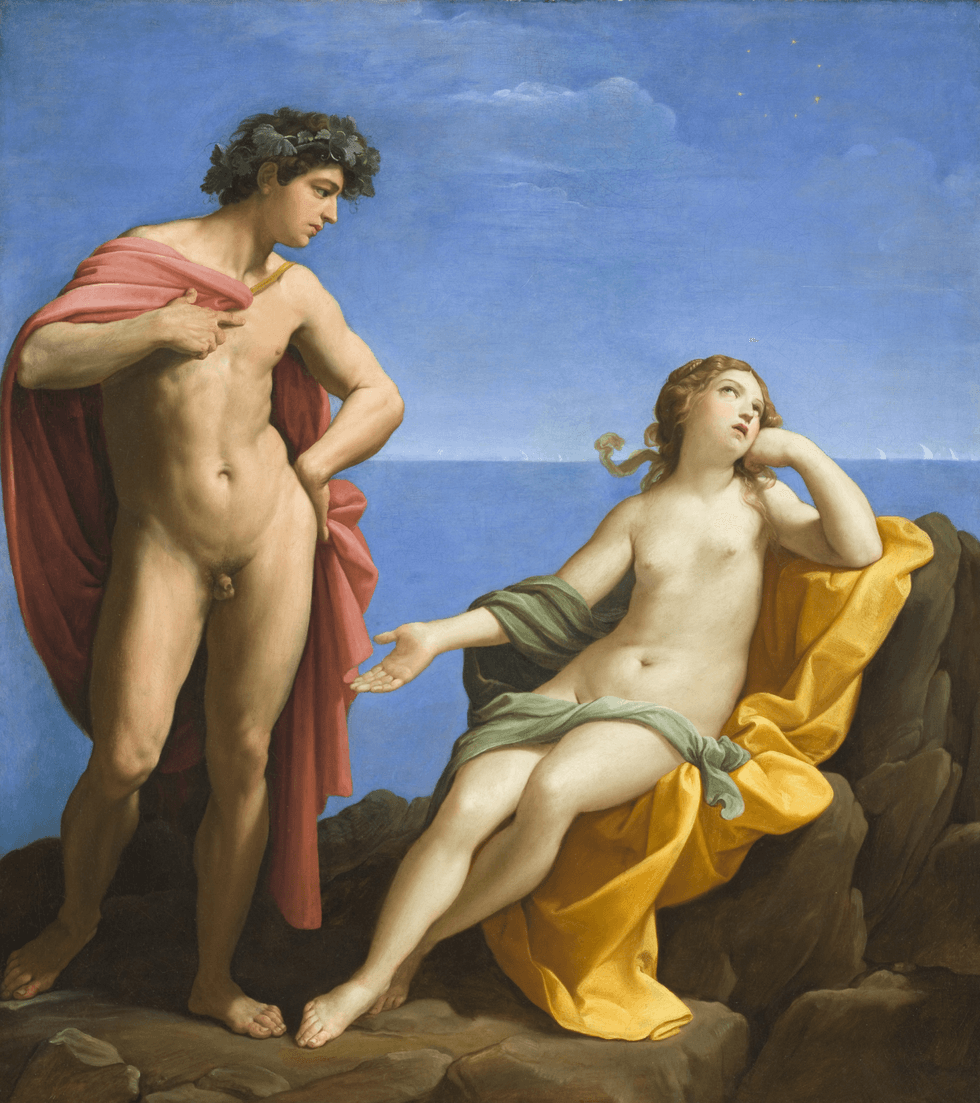
Guido Reni, Bacchus and Ariadne, c. 1619-1620
Los Angeles County Museum of Art, Gift of The Ahmanson Foundation
Leaving the Atlantic galleries, head toward the Mediterranean Sea Galleries, where the magnificent Bateman Mercury (2nd-century Roman marble) still possesses the power to stop people in their tracks nearly 2,000 years after it was carved.
His athletic physique, graceful proportions, and effortless beauty remind us that classical sculpture established ideals of masculine perfection that artists continue to return to today.
This section includes many works featuring mythological Greek gods, which were used by artists throughout history as an alibi to express their same-sex desire under the pretense that the nudity takes place in fantasy.
Gallery 51 contains a fine example, Guido Reni's Bacchus and Ariadne (1620).
Reni transforms the Roman god of wine into an irresistibly sensual young man inspired by classical sculpture. Every inch of Bacchus's body has been carefully idealized, from his graceful stance to his small penis, which, following Greco-Roman aesthetics, symbolizes moderation and self-control — qualities considered marks of perfection.
Outside, next to BCAM, one of Alfonso Gonzalez Jr.'s painted benches playfully reimagines Reni's painting in 21st-century Los Angeles.
Richmond Barthé's 'Inner Music'
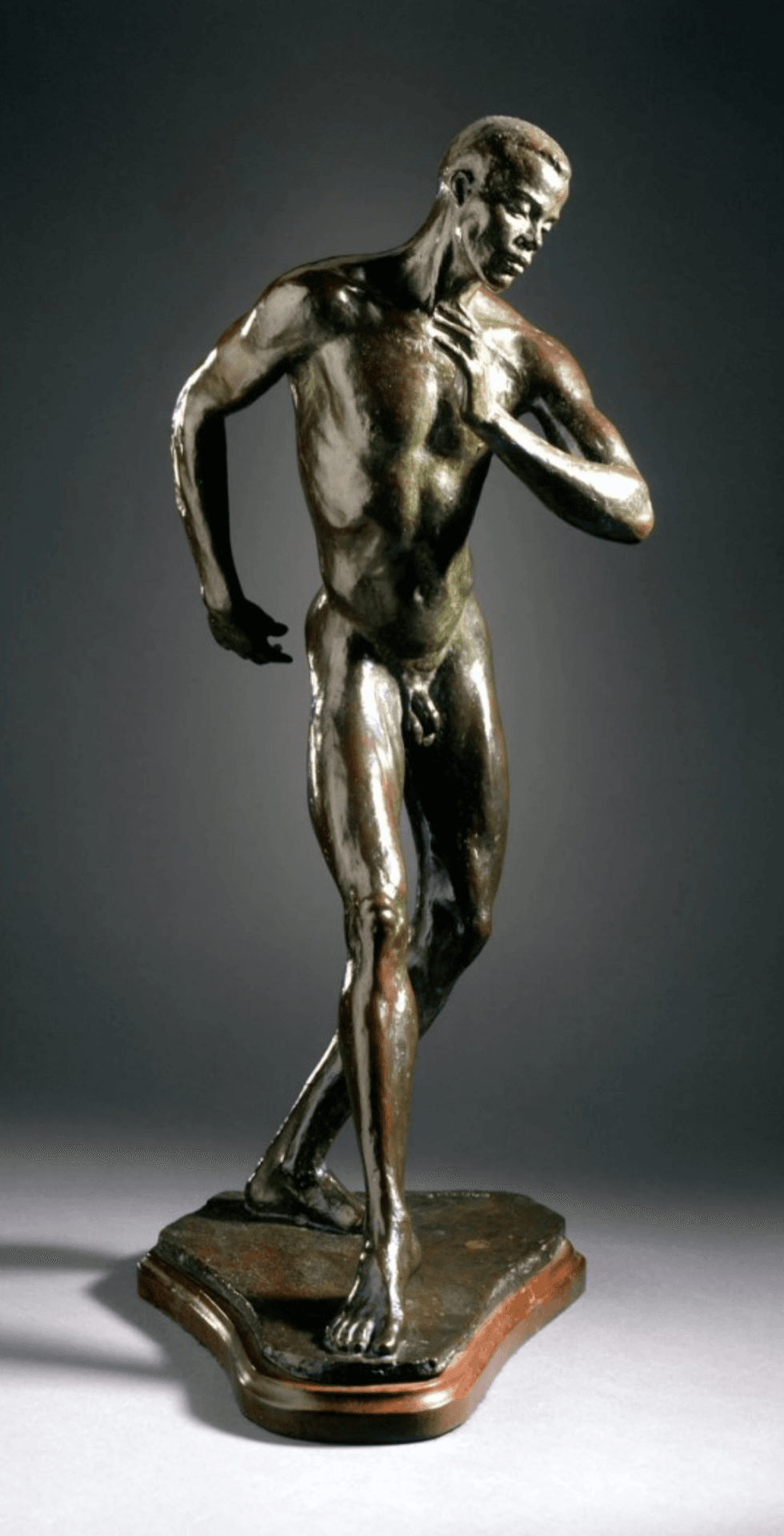
Richmond Barthé, Inner Music, 1956
Los Angeles County Museum of Art, Gift of the 1989 Collectors Committee
The museum's conversation between past and present continues on the large table in Gallery 55. There, Antoine Etex's small bronze The Death of Hyacinthus (1829) immortalizes one of mythology's most poignant same-sex love stories. Hyacinthus, beloved by Apollo, died after a discus-throwing accident engineered by a jealous god. Rather than emphasizing tragedy, Etex dwells on the youth's extraordinary beauty.
On the same table stands one of Richmond Barthé's (1901–1989) most important sculptures, Inner Music (1956). A nude Black male figure suggests rhythm, spirituality and sensuality all at once, challenging the racial and gender conventions of Barthé’s era.
Greek mythology and queer desire
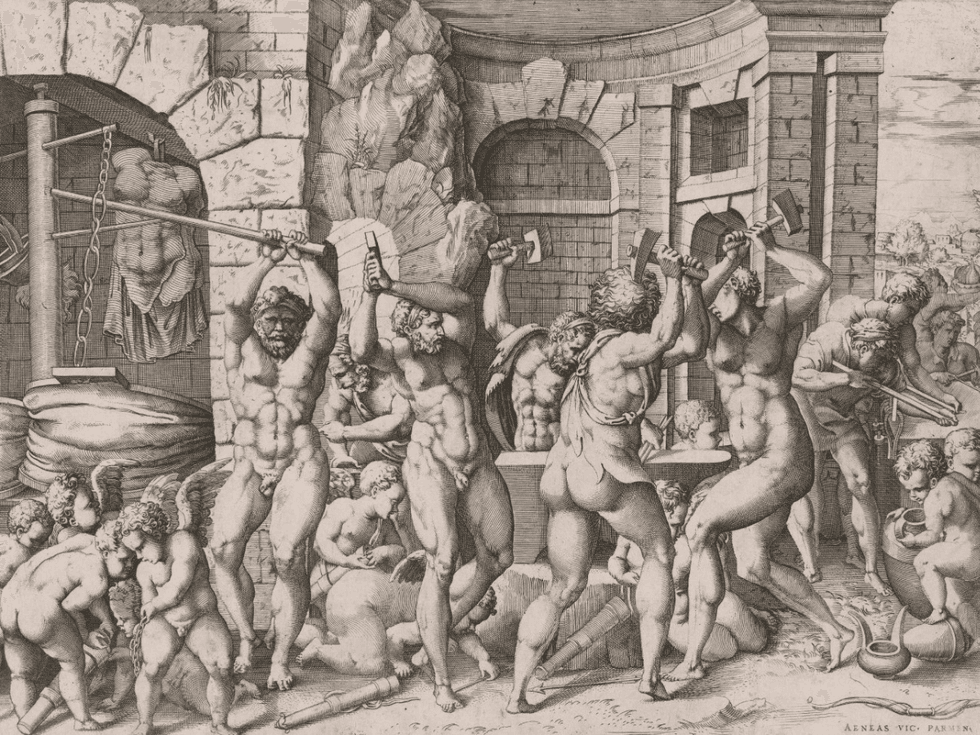
Enea Vico, The Forge of Vulcan, c. 1543–1545
Mary Stansbury Ruiz Bequest
Gallery 56 includes two mythological prints which manage to raise eyebrows. In Enea Vico‘s The Forge of Vulcan (1545), muscular Cyclopes are positioned so their bodies can be admired from multiple angles. Next to it is Giorgio Ghisi’s Hercules Resting from His Labors (1567). Hercules, the epitome of bravery and masculinity, had many male lovers, which increased his queer appeal. In this image, he appears resting, seemingly on the lookout for his next conquest.
Ken Gonzales-Day's haunting landscapes
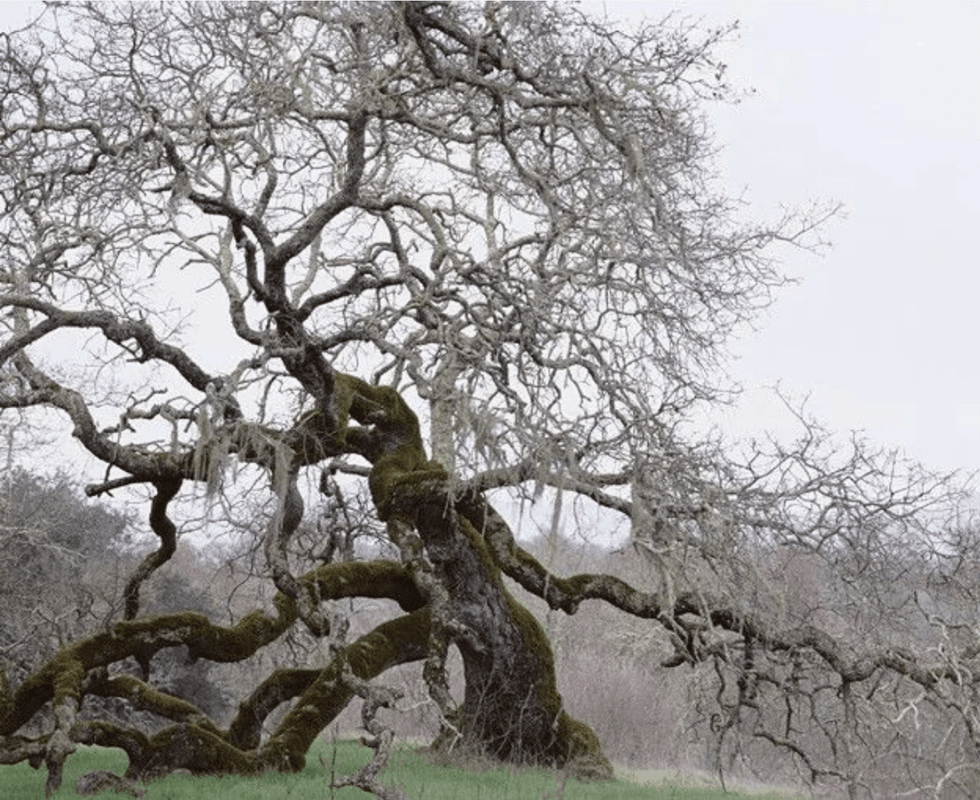
Ken Gonzales-Day, Run Up, 2002
Purchased with funds provided by Paula Ely and Cesar Rueda with additional funds provided by the Ralph M. Parsons Fund
Gallery 30 in the Pacific Ocean Galleries features one of Ken Gonzales-Day's haunting landscapes. His series Searching for California's Hang Trees (2002–2007) documents sites where lynchings occurred, deliberately excluding the victims to focus attention on the landscape itself. Gonzales-Day's research revealed that Native Americans, Chinese immigrants, and Latinos were among the primary victims of lynching in early California, expanding the national conversation about racial violence beyond the American South.
Rafa Esparza's adobe walls
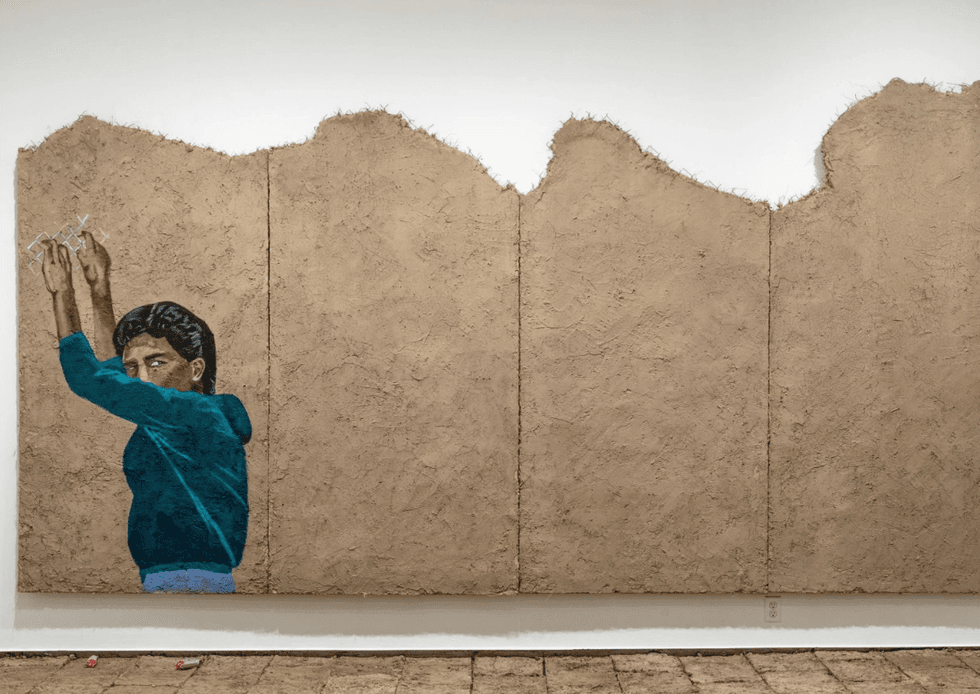
Rafa Esparza, ...we are the mountain, 2019
Los Angeles County Museum of Art, with funds provided by AHAN: Studio Forum, 2020 Art Here and Now purchase, and the Vincent Price Art Museum, with funds provided by the Vincent Price Art Museum Foundation, and Kevan and Norma Newton
Next, visit Gallery 28, where queer artist Rafa Esparza's ...we are the mountain (2019) consists of large adobe panels created from earth. He uses adobe to symbolize brown-skinned people and the spaces they inhabit, suggesting that although adobe is strong, it requires care and commitment to survive.
The work draws on Esparza's experience growing up as a queer Latino in Los Angeles, exploring how marginalized communities build their own spaces of belonging.
Carlos Almaraz's Los Angeles
In the same gallery, Carlos Almaraz's (1941–1989) explosive painting captures Los Angeles as both dream and nightmare. A founding member of the Chicano art collective Los Four, Almaraz lived openly as bisexual later in life. His car crash series became a metaphor for the city's collisions between cultures, politics, and personal desires — themes that affected him deeply.
Mapplethorpe's muse
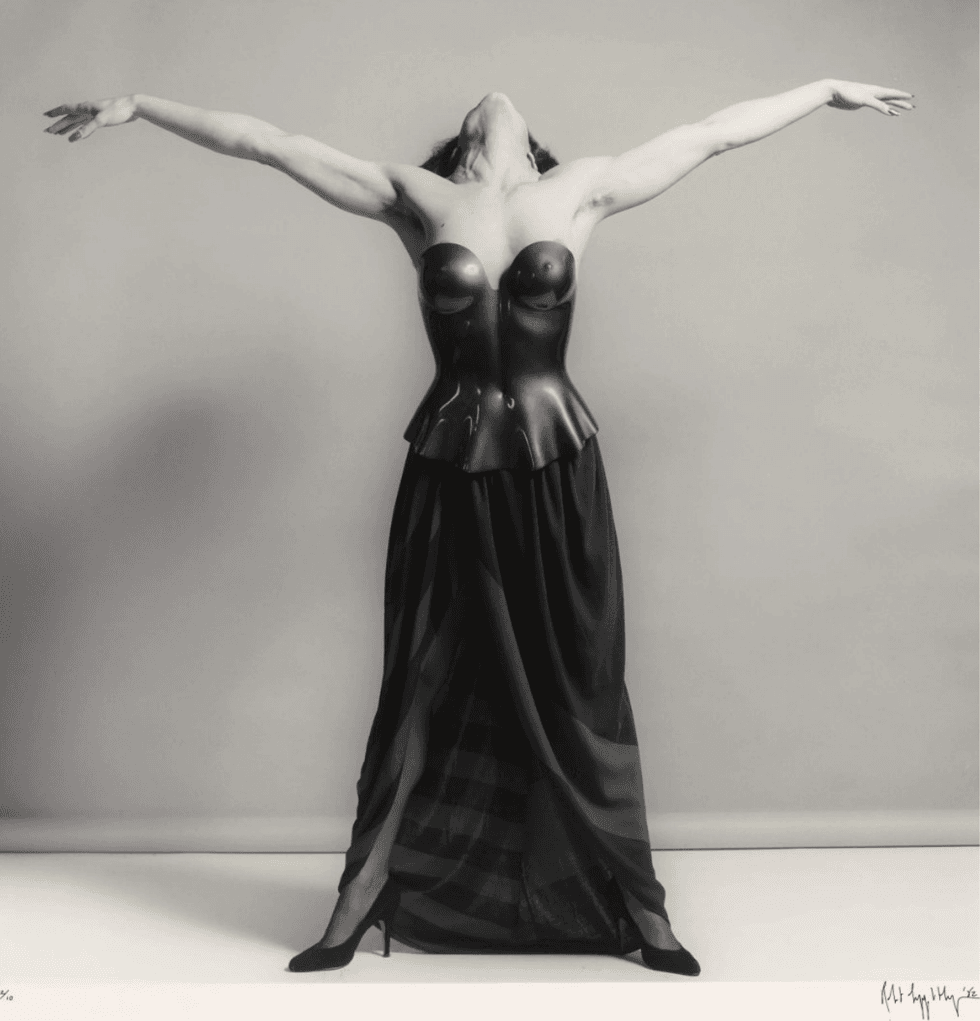
Robert Mapplethorpe, Lisa Lyon, 1982
Gift of The Robert Mapplethorpe Foundation to the Los Angeles County Museum of Art and to The J. Paul Getty Trust
The final room, Gallery 27, includes a large Robert Mapplethorpe photograph of Lisa Lyon, the first World Women's Bodybuilding Champion. When Mapplethorpe met her in 1979, they began an artistic partnership that would produce more than 200 photographs.
Together, they challenged traditional ideas of gender and femininity. Lyon's muscular body becomes both masculine and feminine, powerful and sensual, while Mapplethorpe's precise compositions transform her into a living sculpture.
The perfect ending: Shiva and Parvati
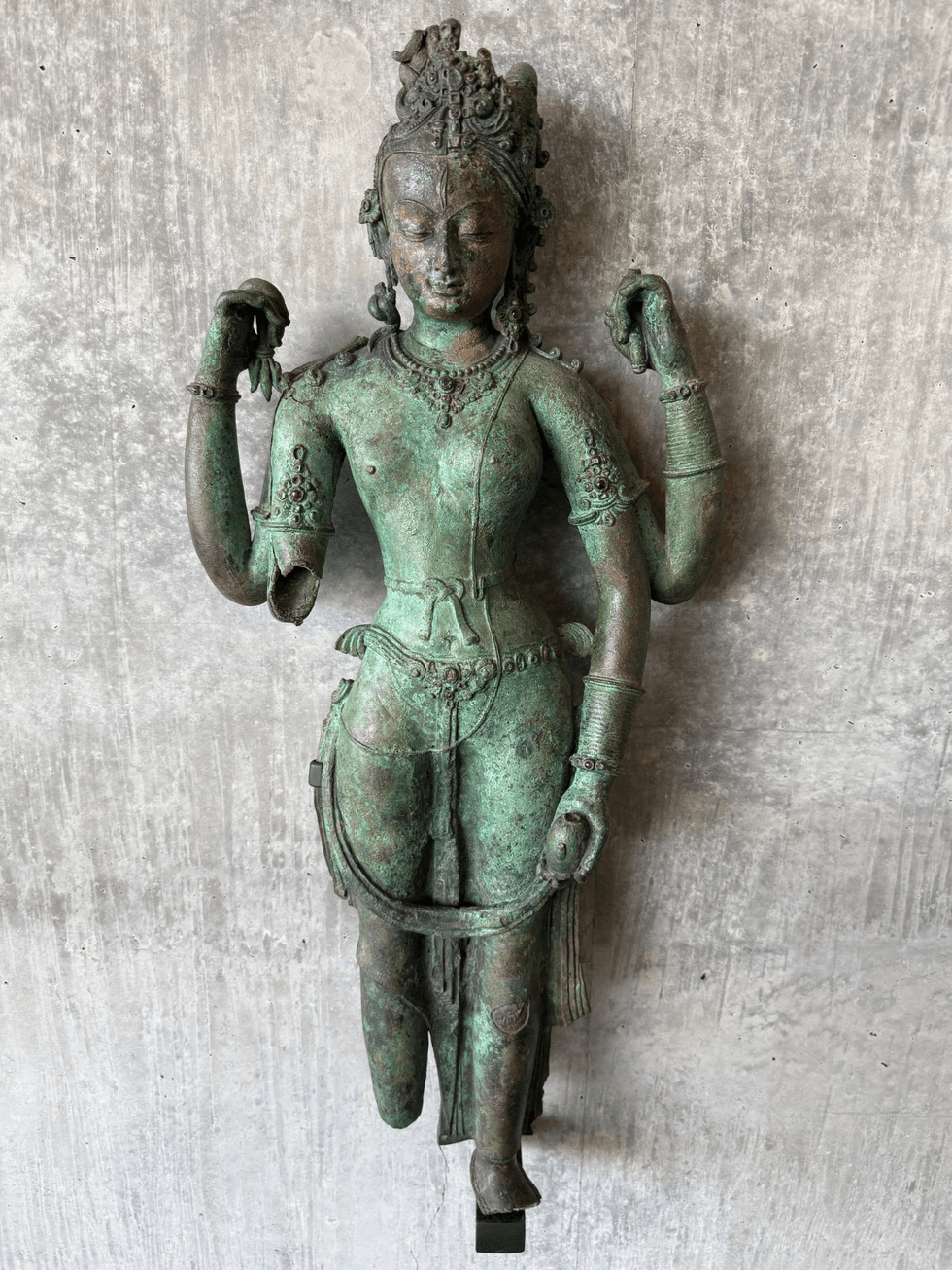
Unknown, The Androgynous Form of Shiva and Parvati (Ardhanarishvara), circa 1000
From the Nasli and Alice Heeramaneck Collection, Museum Associates Purchase
It is hard to imagine a more fitting conclusion to this queer tour than one of LACMA’s most quietly revolutionary objects, even though it is over 1,000 years old.
Holding court in the Indian Ocean Galleries, the Nepalese bronze sculpture Ardhanarishvara The Androgynous Form of Shiva and Parvati (circa 1000) offers a breathtaking meditation on gender fluidity.
The right side is the male Shiva, while the left is the female Parvati, embodying the Hindu concept that masculine and feminine energies are inseparable. It is a timely reminder that ideas many people consider contemporary have existed for centuries in cultures around the world.
These 20 works are only the beginning. Countless other objects invite queer readings, reminding us that LGBTQ+ history is not an isolated chapter tucked away in a separate gallery. It stretches across continents, religions, centuries, and artistic movements even though most museums have refused to explicitly label it as such.
Once you learn to recognize the clues, you notice them everywhere. LACMA’s new installations encourage us to forge our own path, wandering as Hockney suggests rather than following a predetermined direction.
Ignacio Darnaude is an art historian whose ongoing project, Breaking the Gay Code in Art, explores queer narratives hidden within art history. His lectures and articles are featured on his Instagram account, @breakingthegaycodeinart.
Learn more about LACMA and its collections at lacma.org.


