
You can tell which Real Housewives are cool with the gays and which ones are not. For those who partake, Ashley Darby is definitely not MAGA, and it shows in her looks. America feels like the MAGA housewife right now. No one wants to do its glam. No one wants to design its gown. No one wants to take its picture. No one wants to take it to the club for its birthday.
Which is unfortunate, because America is turning 250.
Although America has given the world jazz, disco, hip-hop, punk, house music, drag, Linda Ronstadt, Dolly Parton, Prince, ballroom culture, Public Enemy, Hole, Buffalo wings, Springsteen, Beyoncé, Madonna, lobster rolls, The Hunting Wives, the airplane, Bad Bunny, The Real Housewives of Salt Lake City, and the deeply sacred tradition of getting too drunk at a state fair and throwing up next to a ride called the Gravitron, it is definitely not getting a great birthday party this year.
Instead, America's 250th birthday is shaping up to be the mustiest, saddest county-fair-on-fentanyl nostalgia concert imaginable.
For America's 250th birthday, Donald Trump and his orbit have assembled a national celebration so aggressively tacky, confusing, and spiritually empty that even some of the announced performers immediately began publicly distancing themselves from it like passengers escaping a sinking Carnival cruise ship simultaneously suffering from both hantavirus and norovirus.
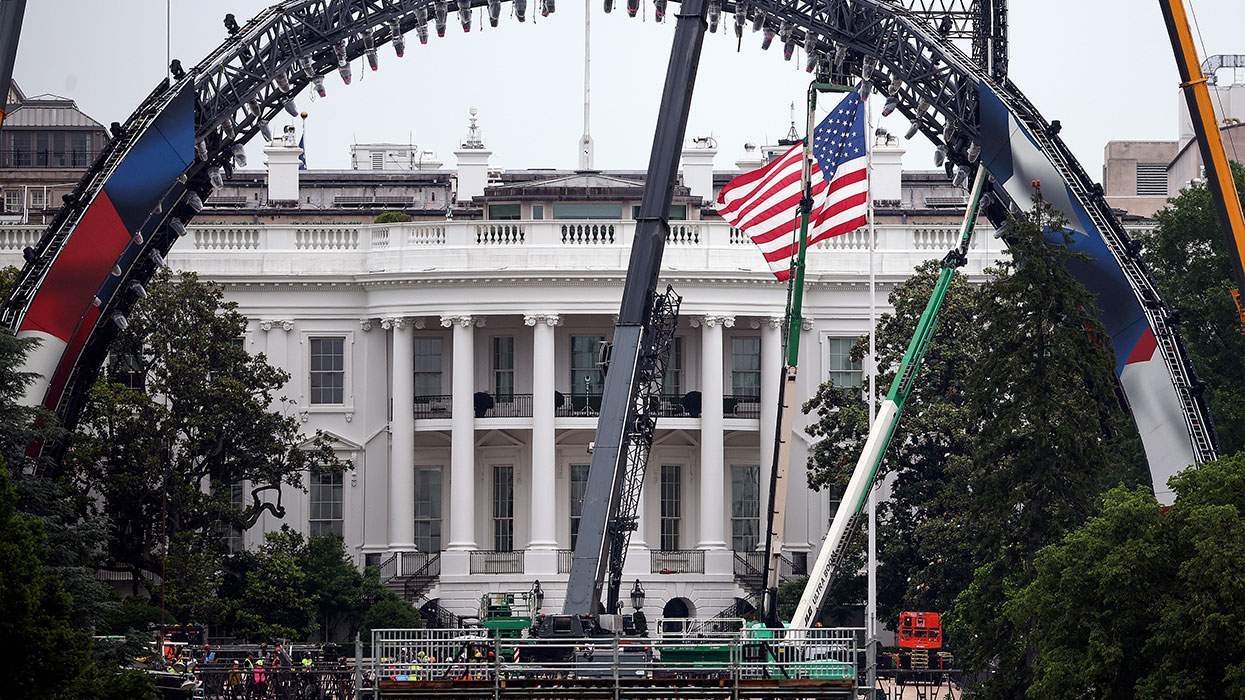
Nothing says "the enduring promise of American democracy" quite like Vanilla Ice, a UFC cage on the White House lawn, and screenings of National Treasure 2. Or, at this point in our national decline, perhaps it does.
The event, dubbed the "Great American State Fair," somehow manages to feel both dystopian and impotent at the exact same time. It reads less like a historic national milestone and more like someone handed a regional casino entertainment coordinator access to federal infrastructure, a Pinterest account, and a moderate cocaine habit.
And people are either laughing at the lineup or ignoring it altogether. Not because every artist involved is untalented. Some are perfectly respectable legacy acts. One group is C+C Music Factory, a group whose history includes famously replacing legendary vocalist Martha Wash in music videos because executives believed she was too fat for television. Yet the entire production radiates the energy of a man standing in the electronics aisle at Walmart screaming that nobody makes real music anymore while a Bluetooth speaker blasts Kid Rock at maximum volume.
America deserves better for its 250th birthday than a bargain-bin grievance-palooza assembled by people who seem to fundamentally dislike modern American culture.
What makes the whole spectacle especially embarrassing is that it arrives during a period of extraordinarily blah mainstream cultural output. Corporate consolidation has mediocritized enormous portions of American life into the same algorithmic hiss. The entertainment industry increasingly resembles a machine designed to endlessly recycle intellectual property, focus-grouped nostalgia, and sequels to sequels nobody asked for. Much of contemporary culture can feel as interchangeable as the wallpaper patterns that once covered suburban dining rooms in the 1990s; familiar, unobtrusive, pastel, and ultimately forgettable.
Unfortunately, we also live in a political culture where many of the people responsible for celebrating American culture appear to possess the intellectual depth of a drained kiddie pool. Their understanding of art rarely extends beyond whatever happens to be sitting directly in front of them. They confuse visibility with significance and mistake popularity for importance. They assume that whatever occupies the largest screen, or more often the small glowing screen directly in front of their faces, receives the largest marketing budget, generates the loudest outrage cycle, or dominates a social media feed must somehow represent the state of American culture itself.
What makes this particularly absurd is that the algorithmic culture many of these people consume is specifically designed to narrow their field of vision. It rewards familiarity over discovery, outrage over curiosity, repetition over exploration, mediocrity over discomfort, and certainty over complexity. The result is a worldview in which culture appears simultaneously omnipresent and incredibly small. They are surrounded by information while encountering remarkably little of it. They consume endless amounts of content while remaining strangely disconnected from the actual artistic, intellectual, and creative life unfolding around them. And they will never understand that the most interesting American art has almost never lived comfortably inside the mainstream.
Beneath the surface of an increasingly corporatized culture, something far more interesting is always happening. Artists are making work in bedrooms, basements, warehouses, community centers, independent venues, Discord servers, and corners of the internet that most politicians could not locate if their lives depended on it. Immigrants, drag queens, punks, rappers, filmmakers, DJs, writers, designers, performers, and countless other weirdos are building entirely new cultural languages in real time. The work is messy, global, sexual, contradictory, offensive, vulnerable, brilliant, and impossible to control. That is precisely what makes it threatening.
It cannot be focus-grouped into existence. It cannot be manufactured by committee. It cannot be reduced to a slogan, folded neatly into a campaign platform, licensed into a streaming franchise, or transformed into a nostalgic fantasy about an America that was supposedly better before all the wrong people started showing up and making things interesting. Real culture is unruly. It emerges from collisions and from tension. It emerges from communities remixing identities, histories, aesthetics, traditions, and experiences into forms that established institutions rarely understand until years later.
What makes this moment particularly exciting is that much of this creativity emerges in direct response to the suffocating blandness of mainstream culture itself. People are increasingly exhausted by stale entertainment optimized by committee for profit. They are exhausted by brands cherry-picking just enough from a subculture to throw it into a Walmart ad and claim they are making some profound piece of art. We are collectively exhausted by corporations treating culture as raw material to be extracted, repackaged, monetized, and sold back to us with a lifestyle campaign attached. We are exhausted by content masquerading as culture. We are exhausted by nostalgia masquerading as creativity. We are exhausted by people with enormous budgets and no imagination insisting they are visionaries simply because they own the distribution channels.
As a result, artists are beginning to return to something older, riskier, and far more dangerous: making things because they have something to say.
That impulse has always been at the heart of American cultural innovation because the country's most influential artistic movements rarely emerged from institutions attempting to preserve culture. They emerged from people refusing to accept the version of America they inherited. Outsiders, immigrants, dissidents, queer people, artists, musicians, writers, and communities who looked at the dominant culture of their time and found it inadequate to the reality of their lives. They emerged from people who were alienated, ignored, underestimated, broke, horny, angry, ecstatic, frightened, ambitious, or completely out of place, and from collisions between identities, traditions, histories, and experiences that conventional wisdom insisted should never belong together in the first place.
If you wanted to build a genuinely inspiring celebration of American culture at 250, that is where you would look. You would look toward the people inventing the future rather than endlessly recreating an imaginary version of the past, and toward the communities and creators who continue expanding the definition of what America can be rather than romanticizing periods defined by racism, misogyny, homophobia, xenophobia, repression, and an almost supernatural commitment to bad taste.
Instead, we are left with a cultural celebration assembled by people who increasingly position themselves as defenders of American culture while appearing fundamentally incapable of participating in contemporary American culture except as critics, spectators, or antagonists. Every movie becomes propaganda, every pop star becomes a threat, every television show becomes evidence of civilizational decline, and every cultural event eventually turns into a hostage situation involving someone yelling about pronouns.
Which is how a country that produced jazz, disco, punk, hip-hop, house music, drag, ballroom culture, and countless other art forms that reshaped the world ends up celebrating its 250th birthday with a strange WWE-History-Channel-county-fair hybrid assembled by people who seem genuinely furious that the country changed after 1987, or 1957, or perhaps 1857.
Even funnier, many of the artists themselves increasingly do not want anything to do with it. Morris Day and The Time responded to rumors of their involvement with the digital equivalent of "absolutely the fuck not," while Young MC publicly clarified he wanted no part of a politically charged spectacle, which makes perfect sense because nobody wants to wake up one morning and discover they accidentally became halftime entertainment at the grievance Olympics.
The whole thing feels especially sad because America really does deserve a giant, ridiculous, beautiful birthday party. We are a loud, absurd, contradictory country. Our chaos is not a flaw. It is the American story. What has always made American culture powerful is not purity, nostalgia, or tradition but an almost unmatched ability to absorb new influences, new communities, new ideas, and new voices before transforming them into something nobody has seen before. Our greatest artistic achievements emerged from friction, experimentation, vulnerability, audacity, sexuality, imagination, and the occasional beautiful disaster, which is why it feels so bizarre to watch the country's 250th birthday handed over to people who seem actively suspicious of nearly every force that made American culture worth celebrating in the first place.
America deserves a birthday party worthy of that legacy. Instead, it's getting the equivalent of a nauseous bratty child getting sick at the county fair.
Josh Ackley is a political strategist and the frontman of the queerpunk band The Dead Betties. @momdarkness
Opinion is dedicated to featuring a wide range of inspiring personal stories and impactful opinions from the LGBTQ+ community and its allies. Visit Out.com/submit to learn more about submission guidelines. We welcome your thoughts and feedback on any of our stories. Email us at voices@equalpride.com. Views expressed in Opinion stories are those of the guest writers, columnists, and editors, and do not directly represent the views of Out or our parent company, equalpride.