



This story originally appeared on Them.
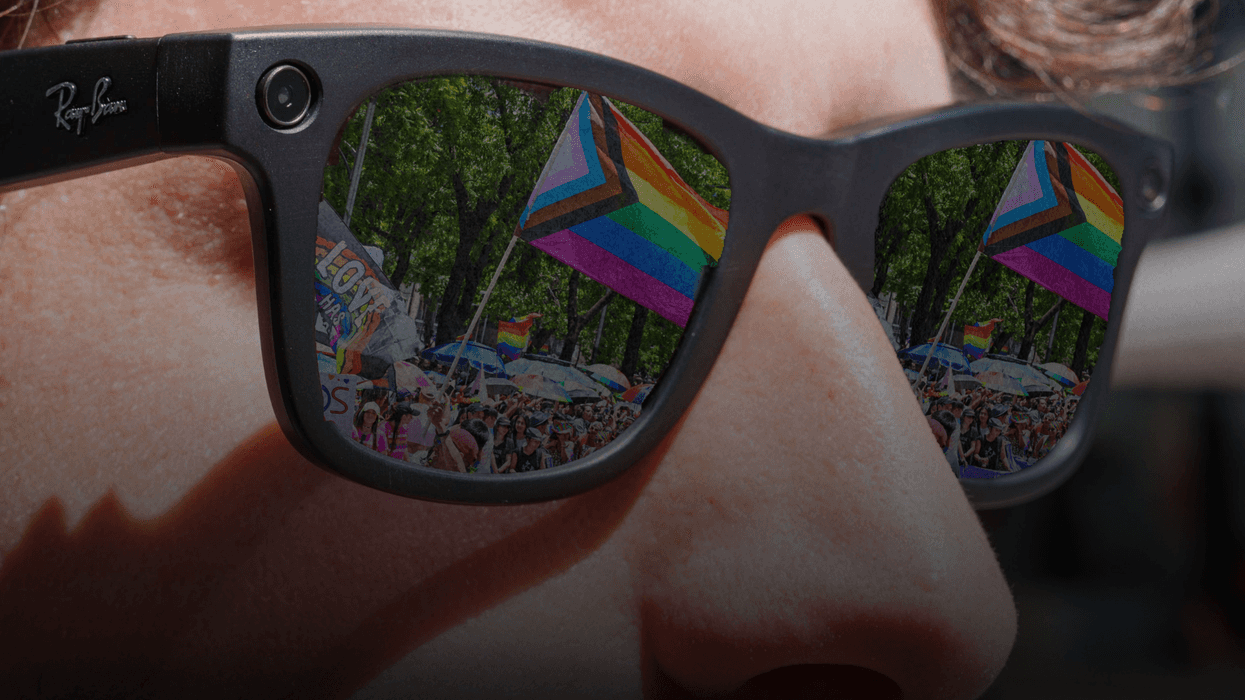
Billboards featuring Kylie Jenner have popped up across the nation promoting new AI glasses, the latest from Meta’s Big Brother empire. The new collection features frames that are meant to look sleek and fashionable, just like any other pair of sunglasses, making it even harder for people in the wearer’s company to know they’re being monitored and recorded. It should come as no surprise that technology like this is already being used to deepen our dystopian surveillance apparatus.
Earlier this year, the Trump administration proposed allocating funding in the fiscal year 2027 for the Department of Homeland Security to develop wearable surveillance technology like AI smart glasses similar to Meta’s, though not actually created by Meta. The proposal noted the glasses would aid agents’ ability to “encounter, transport, detain and remove migrants who are in the United States illegally” in real time. Though not yet passed, the proposal signals a clear — and alarming — vision for the agency’s future.
Thousands of AI glasses on the street that could livestream, record, recognize a location, and eventually recognize a face would remove the ability for nearly anyone to go from place to place without having their whereabouts known. This tyrannical surveillance would force communities who are already under the highest scrutiny by our government to live in a constant state of fear.
However, federal operatives apparently may not be waiting for this development to trial-run the technology as a weapon against immigrant communities: ICE agents in at least six states have already been seen wearing Meta glasses on the job, according to an Independent investigation. It’s unclear at this point whether these agents were directed by DHS to pilot the use of this technology or if they took it upon themselves, but either way, it’s cause for concern. While Meta is publicly touting the glasses as the cutting edge of culture and fashion, federal agents carrying out President Trump’s anti-immigrant campaign are well on their way to making themselves the face of the product.
Of course, this is far from the worst of the surveillance tools that have been wielded by DHS against immigrants. The federal government partners with private corporations like Palantir and Clearview AI to collect data on immigrants en masse, including tax information, social media posts, and more. Presidential administrations on both sides of the aisle have cozied up to tech giants to expand federal law enforcement over the years, and they have been critical in helping President Trump’s unprecedented escalation of immigration enforcement. The passage of a reconciliation bill in 2025 added roughly $170 billion to DHS, making ICE “the highest-funded federal law enforcement agency in history,” as Aaron Reichlin-Melnick, senior fellow at the American Immigration Council, noted on Bluesky.
Next to that vast data collection machine, Meta glasses and other AI-powered eyewear might seem like it's in a more rudimentary place. But while Meta’s smart glasses don’t have the capability to recognize individual faces yet, that’s the next frontier. According to Wired, Meta is reportedly working on adding facial recognition technology using Rank One Computing, a company that derives the overwhelming majority of its revenue from government clients, including contracts with U.S. law enforcement agencies and the military.
These surveillance tactics are not reserved only for immigration enforcement. The Trump administration, along with elected officials across the country, already use surveillance to bolster their attacks on transgender rights. These efforts range from attempts to create a list of trans patients who receive gender-affirming care to state-mandated reporting on people who change the gender on their drivers licenses. Even with the tools currently at their disposal, lawmakers are pulling plenty of government levers to compile makeshift registries of trans people.
The introduction of Meta glasses and wearable technology with embedded spyware threatens to not only aid these efforts to identify and track transgender people, it raises the stakes of what that tracking could do: Could it allow law enforcement to immediately identify — or misidentify — someone as trangender? Could government buildings have security personnel with AI glasses as part of the mandated uniform? These might seem like situations ripped out of 1984, but they’re not a far cry from tools the government is already deploying, like ICE’s reported use of fake cell towers to spy on people’s phones. If these Orwellian tools are already being used against immigrants, what’s to stop the government from using surveillance tactics on any group they deem unsuitable?
This technology could seep into all aspects of everyday life and help the government learn which doctors are serving trans patients, which schools are attended by trans youth, or even which people are not using restrooms aligned with the gender they were assigned at birth. This would only strengthen the Trump administration’s ongoing efforts to prevent hospitals from providing health care to trans youth and block schools from allowing trans kids to exist freely.
The pretext is already there: DHS eliminated protections against surveillance based on sexual orientation or gender identity in February of last year. The FBI is similarly making overtures toward considering trans rights a form of left-wing terrorism. In May of this year, the White House released a “Counterterrorism Strategy” noting that the Trump administration would “prioritize the rapid identification and neutralization of violent secular political groups whose ideology is anti-American, radically pro-transgender, and anarchist.” There is no speculation in the assessment that the current administration has mounted an all-out attack on transgender rights; the only question is where it will go next.
That’s not to mention the casual surveillance of simply moving through public in a world with even more, and less noticeable cameras than we already face every time we step out our doors. It’s not uncommon for transgender people to be filmed or photographed while going about their daily lives, and Meta glasses will just worsen this problem; we’ve already seen this happen with women at large. Cis women are also at risk of suffering further consequences from the ubiquity of this technology, as “transvestigators” continually claim that cis women are actually men in disguise, most notably with women athletes — and particularly Black women athletes — who are especially muscular by nature of their career. Normalizing spyware that anti-transgender advocates can wear to record suspected trans people more covertly than they already do has the potential to supercharge the everyday targeting of women and the transgender community.
While Meta does have certain protections in place for privacy and data sharing, its policy is that the company will disclose data under an obligation from the government, like a subpoena or a search warrant. The company promises to comply with requests that are “in accordance with applicable law,” and DHS has already sent a high volume of subpoenas to Meta and other tech companies on the topic of immigration enforcement, with which the company has reportedly complied. Under a government that does not hold back in demanding personal data in pursuit of its agenda, Meta’s privacy policies do little to assuage fears of a drastic increase in state-led surveillance that finds a way to incorporate the company’s latest wearable technology.
These glasses aren’t just tacky — they’re a dystopian nightmare in the making, with minority communities having the most to lose.
Get the best of what’s queer. Sign up for Them’s newsletters.