


Gregg Araki found the spark for I Want Your Sex in an unlikely place: a statistic about Gen Z's dwindling sex lives.
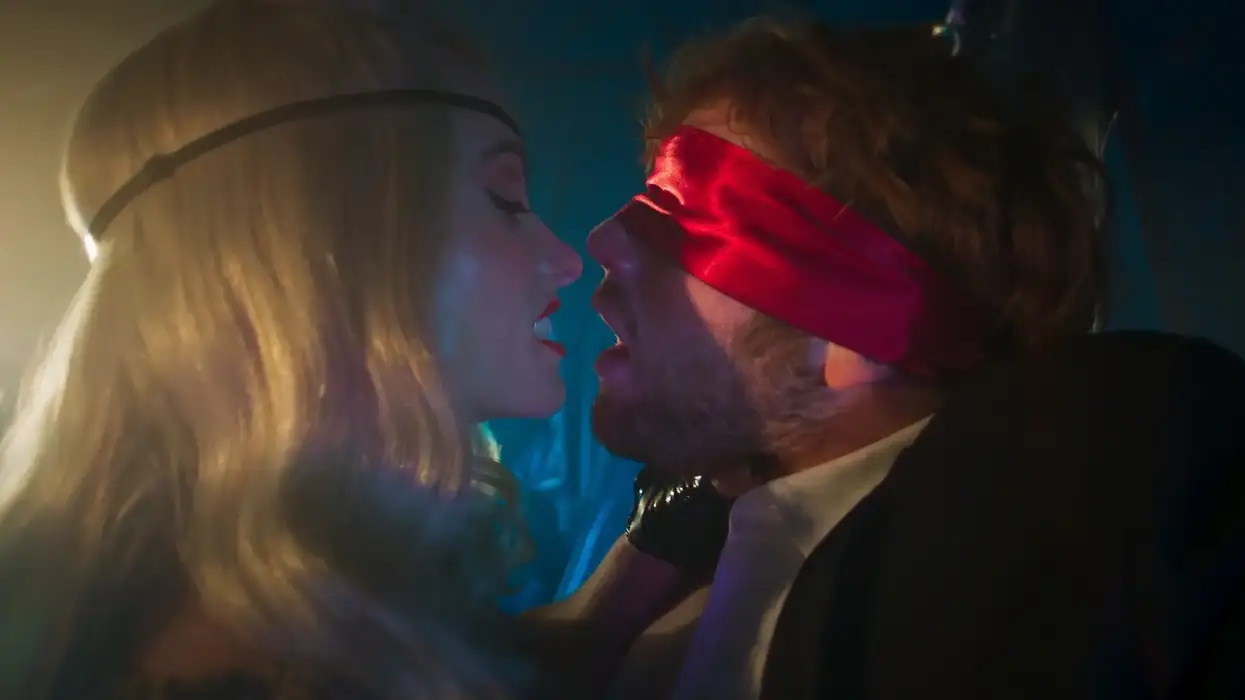
Directed and co-written by Araki, along with co-writer Karley Sciortino, the erotic comedy centers on the sexual relationship between renowned provocative artist Erika Tracy (Olivia Wilde) and naive new intern Elliot (Cooper Hoffman). During one of the later passes on the script, Araki read that about 30 percent of Gen Z hadn't had sex in the previous year, and the shape of the film changed as a result.
"That's actually a real article that I had read, sort of as I was doing the last drafts of the script, probably maybe the very last or the second last, and it became kind of the major theme of the movie," he tells Out. The stat shows up almost verbatim in the film, as a piece of information Erika uses to make a point to Elliot.
Erika may be Araki's clearest on-screen surrogate in years. Like Araki, she's an artist whose reputation has been built on provoking audiences. "This notion of the Erika Tracy character, in a way, very much speaks for me because she, like myself, is an artist who deals with a lot of sexual themes and sexuality in her work," Araki says. "Her work is controversial; it's provocative. All the things people have said about my movies all these years."
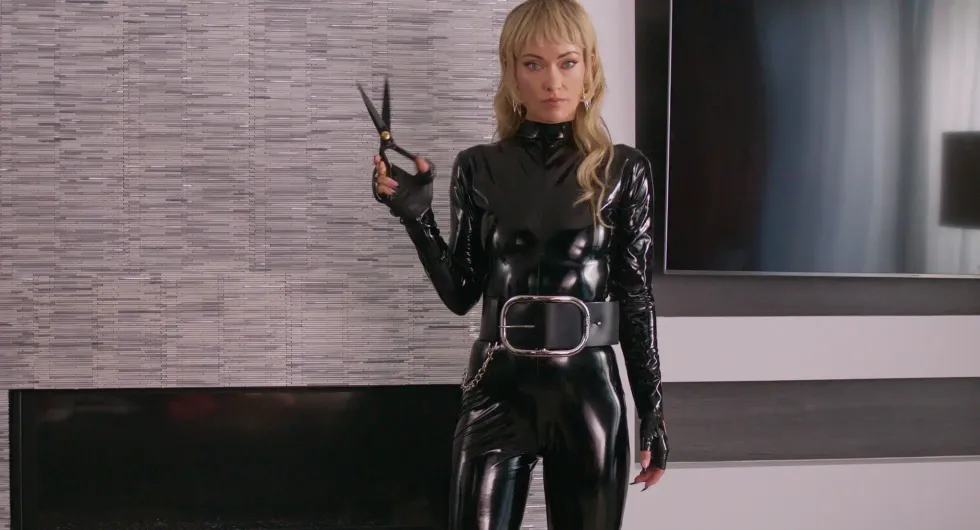 Olivia Wilde as Erika Tracy in 'I Want Your Sex.'Photo courtesy of Magnolia Pictures
Looking at a generation raised on phones, constant surveillance, and a pandemic that reshaped intimacy, Erika argues that openness about sex hasn't necessarily translated into sexual freedom. She's an older artist who built a career on sexual candor, looking at a culture that talks more openly about kink and desire than any before it, and still can't quite parse why so many of its members are opting out entirely.
Elliot serves as a counterpoint. "As sort of representative of Gen Z, very eloquently I think presents what's going on with his generation and why their context is so different from older generations," Araki says. Social media, constant filming, and COVID impacted on how the current generation interacts. It's less a disagreement than a translation: two languages describing the same subject.
Elliot and Erika don’t have that debate, but instead show those differences through their characters' interactions. That’s done through a mix of sharp dialogue, their sex scenes, and Araki’s style as a filmmaker. Here it’s done through a delicate balance of humor and eroticism.
When asked about making those scenes, Hoffman reflects on how important it is to not focus on the joke to effectively deliver the humor. He and Wilde shot most of the mansion material, the bulk of the film's sex comedy, in the first week, blocked out ahead of time with an intimacy coordinator so nobody had to think on their feet about logistics. But the comedy itself, he says, isn't something you rehearse.
"It's really easy when you're working with really just funny people," he explains. "To not play the comedy is kind of the first thing they teach you about doing comedy. You can't lean into it. You just have to let a crazy situation be crazy."
He points to the moment where Chase Sui Wonders's Apple spins on a dime mid-scene and starts crying, saying, “you think I'm ugly,” cutting the joke off at the knees with something real. It also applies to the moment during their first conversation at work when Mason Gooding's Zap asks, bluntly, if Elliot has ever sucked dick. "It's very grounded and very real," Cooper says. "As long as you have that, it is just inherently funny."
Wonders and Gooding, when asked whether making the film shifted how they think about talking about sex, don't hesitate. "It forces you to kind of engage with how we've been talking about sex," Wonders says, "and realizing the discomfort that might come from having a more liberal perspective on how to engage with sexuality and intimacy."
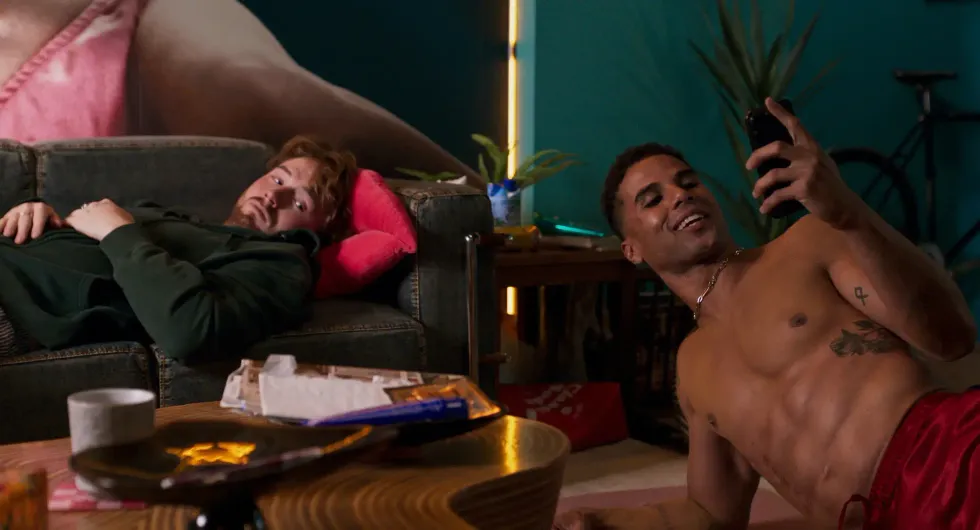 Cooper Hoffman and Mason Gooding in Gregg Araki's 'I Want Your Sex.'Photo courtesy of Magnolia Pictures
She thinks Gen Z has already made room for a franker conversation about kink and desire than the media has caught up to, and that the movie is proof the culture is catching on. Her hope isn't just that twenty-somethings watch it and recognize themselves. It's that they pass it up the family tree. "Send your mom to I Want Your Sex," she says. "Send your mom. Initiate conversation."
Gooding traces the way American culture has cycled through its relationship to sex for decades. Free love in the '70s, cocaine and excess in the '80s, and now something that looks, on the surface, like a retreat. Fewer teenagers experimenting the way they used to. But underneath it, he argues, is also more openness about identity than there's ever been. Both things are true at once, and that contradiction is the movie. "This movie is totally the times in a nutshell," he says, "but then coded in this awesome epic rom-com."
“A dom-com,” Wonders quickly adds.
Two generations, as the actress puts it, "completely misunderstanding each other, yet wanting the exact same thing." I Want Your Sex doesn't resolve that gap so much as sit inside it, funny and a little tender, until it starts to look less like a gap and more like a conversation neither side knew it was already having.
I Want Your Sex hits theaters today. Check out the trailer below.