
This story originally appeared on Them.
Bisexual might make up the vast majority of LGBTQ+ people in the United States, but that doesn’t mean we see that reflected on our screens.
In fact, despite bisexual people accounting for 58.6% of queer and trans adults in the country, according to the latest Gallup poll, there is a woeful dearth of movies that center bisexual characters. Per a GLAAD report on LGBTQ+ representation in film, only 24% of LGBTQ+ characters on screen were bisexual. And if you do the math on how many queer and trans characters there are on television and film these days – 489 LGBTQ regular characters according to GLAAD, though the organization says that will likely shrink due to the cancellation of queer shows — that isn’t a lot of bisexual people on screen!
Likely, this is connected to bi erasure, an existing phenomenon that renders bisexual people invisible and their struggles minimized. Frequently, bisexual erasure involves seeing bi people as “just gay” or “just straight” depending on who they’re dating, which unfortunately is a common trope that extends to television and film. But as Them alumni Catherine Mhloyi writes, bisexual representation doesn’t have to suck or at the very least should avoid these harmful tropes. This brings us to the bisexual film canon.
The canon of, well, canonically bisexual movie characters isn’t as robust as the bisexually-coded ones — if you need an example of de facto bisexual films, think Twilight, Foxfire or The Materialists — but below we’ve provided a list of bisexual movies, de jure. These films have bonafide bisexuals on the screen, not just hints of sexual fluidity that leave you wanting. The criteria includes characters that are openly bisexual or at least openly dating or romantically involved with people of multiple genders. This is far from a comprehensive list of every bisexual movie and is more of a living document that can grow over time as we get better representation. — Quispe López
The Wings (1916)
- YouTube www.youtube.com
This Swedish silent film is widely cited as the first movie to feature homosexual content on screen, but many have argued that The Wings is also likely the first to include a canonically bisexual character, model Mikaël. Though the characters may not have used the term “bisexual” to describe him, as the term wouldn’t become a widely-known identity label for another decade or so, the primary conflict of the film focuses on Lucia De Zamikow, a countess who tries to come between Mikaël and his boyfriend Claude Zoret, a gay sculpture, but seducing the model. Though queerness was illegal in Sweden at the time of the film’s release, The Wings managed to center homoeroticism and include history’s first bisexual movie character all in one foul swoop. — Quispe López
Cabaret (1972)
- YouTube www.youtube.com
A grainy and gritty cult classic, fueled with sexual energy and tension, Cabaret is a beloved queer film set in the tail years of the German Weimar Republic. This is the last hurrah of a liberated and open society before the rise of Nazism which takes Europe by brute force. Our journey follows sensual performer Sally Bowles (played by Liza Minnelli) and her bisexual British lover Brian Roberts (played by Michael York) as he becomes immersed in the fantastic world of the Kit Kat Klub, a performance space that defies all of the heinous societal ideals of the Nazis. As Bowles pines over Roberts, it’s revealed that his last three relationships with women have failed, but Bowles becomes the exception in their whirlwind romance which eventually sees them both having sex with an ultra-wealthy Maximilian von Heune. Throughout the film, the fascist undertones of Nazism can be felt as the environment of the club changes over time as we near their ultimate take over while following the stories of the club’s performers and patrons. — Delia Curtis
The Talented Mr. Ripley (1999)
- YouTube www.youtube.com
Is Tom Ripley bisexual, as strictly defined? That question may not be answerable. In the 1999 film adaptation especially, he’s presented as an almost sphinxlike schemer whose interiority may be opaque even to himself. But even if Matt Doman’s Ripley may not exactly be waving a bi flag — he’s more busy looking for murder weapons — he certainly has a sexuality that spills over strict social binaries. Does he want money? Power? Proximity to Dickie? Or does he just want wanting itself? It’s all a mystery, but that’s what makes this such a delicious watch. — Samantha Allen
Frida (2002)
- YouTube www.youtube.com
Mexican surrealist artist Frida Kahlo is one of history's most famous bisexuals. Her biopic, which was aptly named Frida and came out in 2002 starring Salma Hayek, is also incredibly bisexual. Charting her early life and why she developed a love for painting all the way through her open marriage to muralist Diego Rivera (played by Alfred Molina). Throughout the movie, Frida is shown embracing her bisexuality and having relationships with women over the course of her life, which is true to form for Frida’s actual life. The end of the film even features one of Frida’s longest lasting loves, famous musician Chavela Vargas, singing a haunting rendition of “La Llorona” as she personifies death. This touching ending truly encapsulates the importance that queerness played in Frida’s life and art. — Quispe López
Jennifer’s Body (2009)
- YouTube www.youtube.com
It’s hard to think of a more quintessentially bisexual film quote than Jennifer Check saying, “I go both ways.” Jennifer’s Body was derided upon release for purportedly catering to a “male gaze” because of its marketing, but real queer cinephiles know this to be a funny — and at times even aching — portrait of teenage sapphic love. The film follows Needy (Amanda Seyfried), a high schooler whose best friend Jennifer (Megan Fox) returns to class as, well, a succubus. It’s hilarious, it’s gross, and it’s extremely bi. Thank goodness it was rescued from the critical dustbin. — Samantha Allen
Behind The Candelabra (2013)
- YouTube www.youtube.com
Filled with all the glitz, glam, and gigantic personality that Liberace is known for, this dazzling drama set in the late 1970s, follows young 18-year-old bisexual Scott Thorson (played by Matt Damon) who becomes a companion and stage chauffeur for the much-older theatrical pop singer (played by Michael Douglas). The film follows the pair's intense and tumultuous romantic and sexual relationship which Liberace desperately tries to hide from the public all the while attempting to turn Thorson into a Liberace look-alike with surgical enhancement and major wardrobe changes. Based on a 1988 book written by Scott Thorson himself and Alex Thorleifson, the film is a translation Thornson’s personal account of the rise and fall of his relationship with Liberace which includes a fall into drug use, lawsuits, relationships with other people, and a sorrowful last parting at the hands of the AIDS crisis of the 1980s. — Delia Curtis
Blue Is The Warmest Color (2013)
- YouTube www.youtube.com
As fraught as it is beautifully filmed, Blue Is The Warmest Color follows a sapphic love story from start to tragic end. Without giving the ending away, the French film follows high school student Adèle (played by Adèle Exarchopoulos) as she navigates her burgeoning sexuality and falls in love with an older lesbian artist Emma (Léa Seydoux). Throughout the film, which includes shots of Adèle and Emma meeting each other’s families, moving in together, and otherwise living life together over their five year relationship, Adèle grapples with a growing feeling of distance from Emma and confusion about her own happiness. Her bisexuality is in some ways central to the theme of the film, and has received mixed reviews over the years. — Quispe López
Boy Meets Girl (2014)
- YouTube www.youtube.com
In a romantic comedy set in rural Kentucky, the main character, a bisexual trans woman named Ricky is played by authentically cast Michelle Hendley. At just 21 years old the aspiring fashion designer has dreams to move to New York City. Her best friend of 15 years, who’s never left her side throughout her transition seems to be hopelessly in love with her, but also encourages her to explore her desire for women. But when enigmatic (and engaged) Francesca moves to town with her marine fiance, Ricky unexpectedly becomes entangled in an affair, during her first sapphic endeavor. From the trailer alone, you can tell that this film is filled with love in all forms, and plenty of (good) queer jokes to boot. — Delia Curtis
Appropriate Behavior (2014)
- YouTube www.youtube.com
Shirin (played by Desiree Akhavan) is a first-generation Iranian woman who lives in Brooklyn, and just so happens to be a closeted bisexual. The 2010s rom-com follows our messy main character who recalls flashbacks to a past relationship with a lesbian named Maxine, who’s estranged from her own family. As she tries to move on from her past without clear goals for the future by going on terrible dates with both men and women, teaching film to five-year-olds in Park Slope, and avoiding coming out to her fairly traditional parents, Shirin’s life is explored with a funny, yet deadpan tone not dissimilar from the HBO series Girls. — Delia Curtis
Colette (2018)
- YouTube www.youtube.com
Based on the life of bisexual French literary icon Sidonie-Gabrielle Colette, actress Keira Knightley portrays the wildly talented but penniless girl from a village in north-central France who falls in love with and marries author and publisher Henry Gauthier-Villars. Her charismatic, yet selfish husband persuades her to move to Paris with him to join the upper echelons of polite society, and convinces her to ghostwrite some of her school-day stories (which contain some serious sapphic undertones) using his pseudonym, “Willy.” To both their surprise, the stories, dubbed the Claudine novels, are a smash hit. For awhile, the two revel in their mutual success, but living in her husband’s shadow without proper credit, his attempt to shape her into an archetype, and his forcing her to continue writing under his name leads to the main plot of the movie, fighting for the copyright over her work while shucking the societal constraints at the time and engaging in romantic connections with women, including the traditionally unconventional Missy who dons men’s clothes in public. Plus, Keira Knightley in a suit, too. Need I say more? — Delia Curtis
Shiva Baby (2020)
- YouTube www.youtube.com
If you’re in the mood for a dramedy packed with second half embarrassment, relatably drought family dynamics, all set during while, you might have guessed it, our protagonist sits shiva with her ex-girlfriend and current sugar daddy, look no further than Shiva Baby. Directed by Emma Segliman, the mind behind Bottoms, comedian Rachel Sennot delivers an unmatched performance as Danielle, a young bisexual Jewish woman in New York City navigating her senior year of college. As she ventures to her aunt’s house to sit shiva, her mother lets her know her ex-girlfriend Maya (played by Molly Gordon) will be there, which naturally fills Danielle with dread. The grief proceedings devolve as Danielle’s relatives ask her about law school (which she does not plan to attend), runs into her married sugar daddy Max (played by Danny Deferrari) along with his wife and infant, and drinks more Manischewitz wine to cope. If you like comedy that brings you to the edge of your seat, and bisexual drama, this one’s for you. — Quispe López
Anatomy of a Fall (2023)
- YouTube www.youtube.com
One of the most compelling crime movies of the decade so far also happens to center on a bisexual novelist, played to perfection by the inimitable Sandra Hüller. When writer Sandra Voyter’s husband Samuel dies after tumbling off an upper story of their cabin home in the dead of winter, the justice system has to answer one question: Was he pushed? And the only real person who might be able to answer that is the couple’s son Daniel, who is partially blind. Over the course of the trial, Sandra’s sexuality takes center stage in a (realistically) stigmatizing fashion. Look, maybe you’ve already seen the memes of Sandra delivering her incredible line, “You complain about a life that you chose,” and I promise the rest of this movie is just as good as that brutal read. — Samantha Allen
Love Lies Bleeding (2024)
- YouTube www.youtube.com
Finally, sapphics get an unapologetically, horny, gross film. Set in rural New Mexico during the 1980s, Love Lies Bleeding, arguably one of the films of 2024, follows drifting gym manager Lou (played by bi-con Kristen Stewart) as she falls in love with Jackie, a bisexual body builder with dreams of competing and reigning supreme in the body building circuit. Lou, who is loosely involved in organized crime, offers Jackie steroids to help with her training, which she reluctantly accepts. Over a montage of injections, work out scenes, and increasingly intense sex, the pair move in together and fall widely in love over a series of weeks. The film is filled with spit, sweat, and blood, along with a true crime element that gives the entire thing a sapphic Bonnie and Clyde feel. — Quispe López
Challengers (2023)
- YouTube www.youtube.com
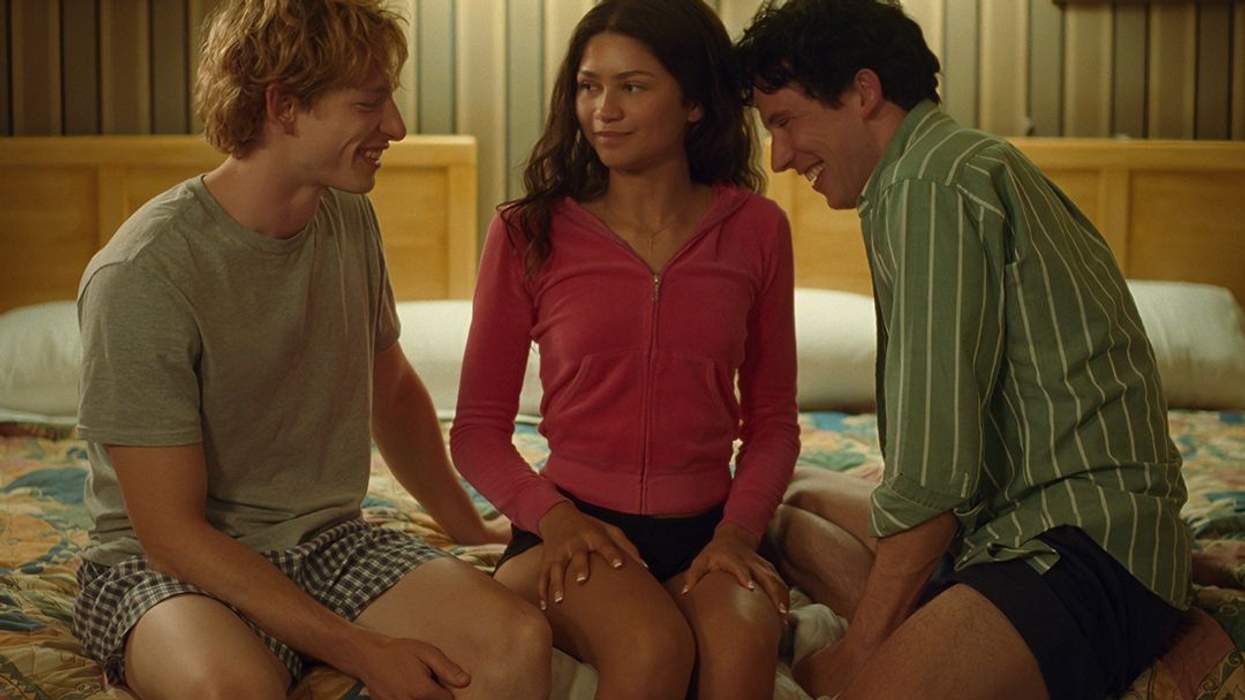
Balls, saunas, and phallic-shaped desserts, oh my! Challengers may be the most bisexual film of the century so far, in a competition that's nowhere near as close as the New Rochelle matchup between Patrick Zweig (Josh O’Connor) and Art Donaldson (Mike Faist). Whether they're eating churros together or leaping over a tennis net at each other, it's clear there's a lot going on between these two. As for Zendaya, whose character Tashi Duncan starts out dating Patrick before marrying Art, I have always maintained that she is tennisexual more than anything else. She just wants to watch balls go back and forth — and so, it would seem, does Patrick, just in a different way. — Samantha Allen
Heartstopper Forever (2026)
- YouTube www.youtube.com
A tender coming of age film, Heartstopper Forever is the cinematic conclusion of Netflix’s Heartstopper series, which follows high schoolers Charlie Spring (played by Joe Locke) and Nick Nelson (played by bi-con Kit Connor). Much like the series, the film confronts important issues that LGBTQ+ people face when coming of age, such as homophobia, managing mental health, and the transition from high school to college life. Throughout the series Nick has had to grapple with bi-erasure and biphobia, a frequent theme that he continues to address in the film. But systemic phobias and interpersonal conflict aside, what is the most beautiful about Heartstopper Forever is the way it portrays Nick and Charlie navigate their changing relationship as they shift into the next phase of life. — Quispe López
Get the best of what’s queer. Sign up for Them’s newsletters.