

The future of Star Trek may be unclear as the beloved sci-fi franchise celebrates its 60th year next month. With no new TV projects on the horizon, its place in the hearts of queer stars, fans and allies is secure. However, many told Out they fear that a conservative-leaning owner in Paramount Skydance could undo all the diversity that has been at the heart of Trek since its beginnings in September 1966.
Listen to those who gathered this summer at conventions and you'll hear one thing over and over: IDIC.
"There are many acronyms on Star Trek," said out gay actor George Takei said at San Diego Comic Con last month. Takei, of course, played Sulu — the Asian helmsman and eventually, captain — in the 1960s show and movies. IDIC, Takei said, "is recognizing that amongst all of us coming together and realizing that our strength is in our working together."
Created in 1968 by executive producer Gene Roddenberry, IDIC stands for "Infinite Diversity in Infinite Combinations." What was originally bemoaned as his cheap merchandising gimmick to make extra money off the ratings-challenged television show, has over the years become a message of hope and inclusion that speaks to both fans and the actors they adore.
"We have various thoughts that were exchanged, we have maybe different reactions to what was said, but it's our recognition that that difference and the courage, the boldness to think about that difference and learn from it," Takei said. "I think that's what the strength of Star Trek is, in creative diversity in infinite combinations, and then you'll live long and prosper."
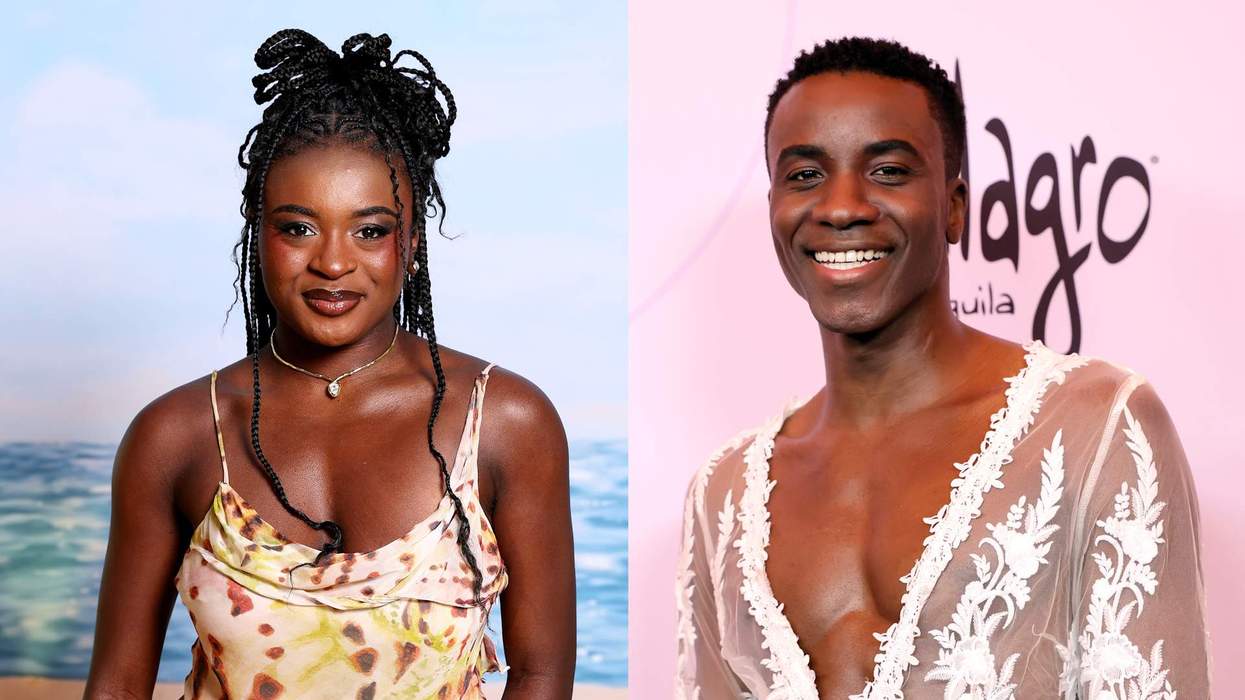
Actor Karim Diané plays the franchise's first out gay Klingon on Star Trek: Star Fleet Academy, and is out in his real life as well. Speaking at that same panel with Takei, he addressed blowback from fans who balked at the idea of a male alien warrior who is attracted to other males.
"Heated Rivalry is like the biggest show on the planet, right? So I thought people were with the program," Diané said. "I thought they were like, 'Okay, whatever. It's not a big deal.' I was wrong. It is a very big deal. I was wrong."
He was then asked by Michael Dorn — the straight actor and ally who played Worf, perhaps the most famous Klingon in Trek — if he'd prefer people not discuss his characters' sexuality: "That's a great question. I think it's dependent on where we are as a human race. And as a human race, we're not there yet," Diané said. "So, I would rather talk about it extensively. But eventually, I do want to get to a point where we don't talk about it at all. It's like literally the least interesting fact about a character or human being."
The appearances by Takei, Diané and Grammy-winner Celia Rose Gooding of Star Trek: Strange New Worlds, at Comic Con San Diego paled in their LGBTQ+ representation, however, compared to the queerest convention on the planet: Trek Long Island, held in June for its third year in Hauppauge, New York.
"While others may be scaling back on DEIA initiatives, we moved forward with panels covering disability, mental health, voices of color, and LGBTQ+ representation in media and literature," Trek Long Island's diversity, equity and inclusion program director Paul Michael Adams told Out. "We also had a drag show, a story hour, and a group photo. Our sessions featured a mix of professionals and actors who represent these communities."
In addition to conversations with the actors, playwrights and authors, the varied panels included discussions about sexuality, identity, disability and race in Trek and other sci-fi. A pansexual drag king who uses a wheelchair to get around, Beau Dacious, talked with fans about disability in the franchise as well as in the real world.
"The more we talk about it, the more we make other people aware of those things, the better that we're going to be able to make change," he said.
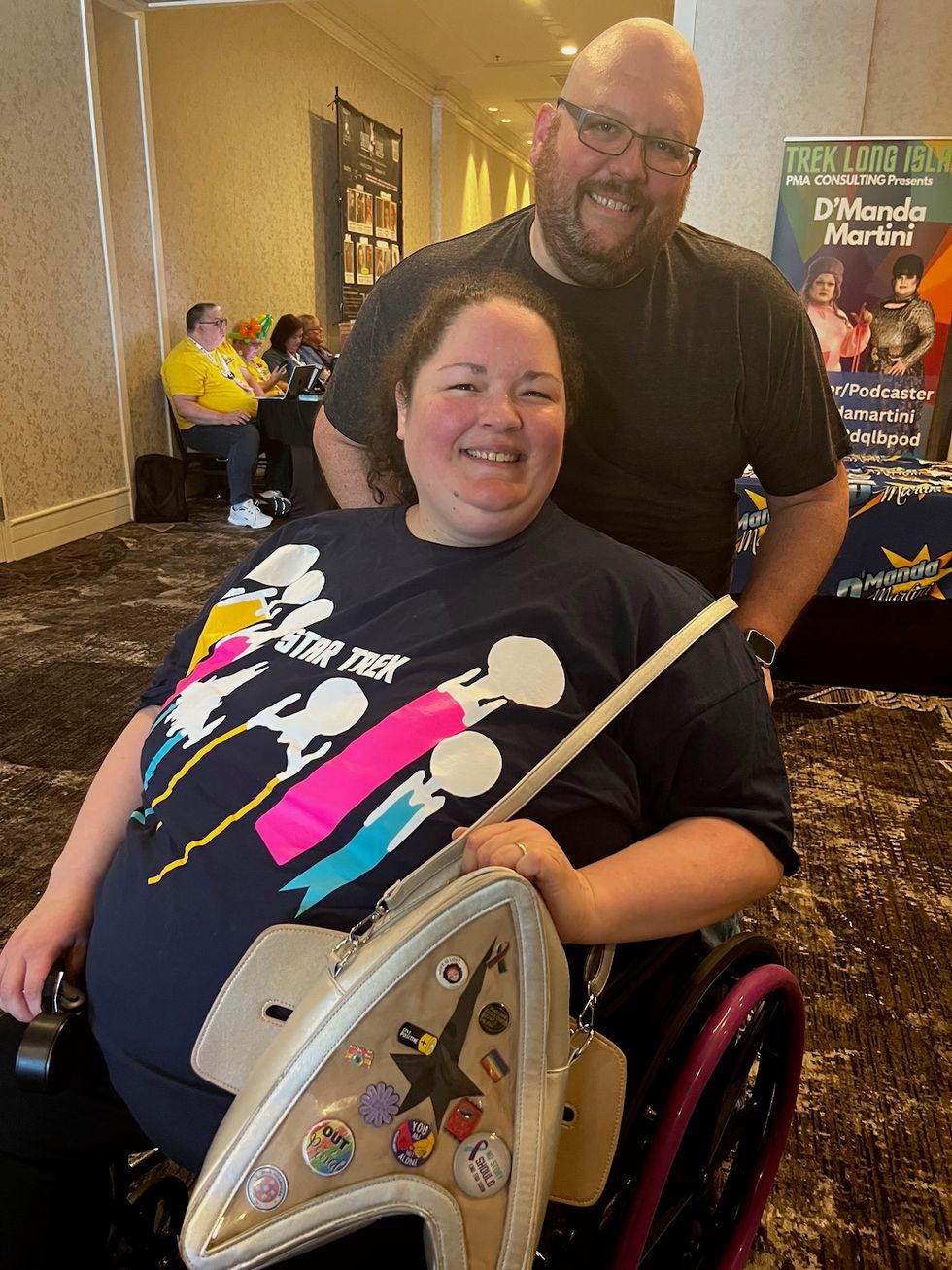 Drag King Beau Dacious and Chad Briggs at Trek Long Island June 2026. Photo by Dawn Ennis
"There was a lot of disability representation in Star Trek," said Beau Dacious of Carlisle, Penn. "We actually found examples in Voyager, Deep Space Nine, The Next Generation, TOS and even Discovery had a character who was an actor who was suffering from multiple sclerosis. And they created a character around his disability."
Strange New Worlds also broke new ground in its first season by casting Bruce Horak, a blind actor, to play a blind chief engineer. It was a step up from when actor and director LeVar Burton portrayed blind helmsman and engineer Geordi La Forge in Star Trek: The Next Generation, four feature films and Star Trek: Picard. That kind of representation, Beau Dacious said, gives him hope.
"As someone who is a queer woman, a queer disabled woman, seeing representation is incredibly important," he said. "It means so much. It can be as simple as, you know, a little kiss. And I'm like, 'Oh my god, oh my goodness, they're gay, yay!' It makes me feel like it's okay for me to be who I am," Beau Dacious said. Same-sex affection has been seen at least twice in Trek, as TrekMovie reported, on Deep Space Nine and on Star Trek: Lower Decks.
Trek Long Island gave Out exclusive access to interview several out actors, including Jesse James Keitel, Diané and Gooding — who plays Ensign Uhura, the role created by Nichelle Nichols — one on one.
Gooding noted Trek "is the franchise that started MLM Slash fan fiction." Stories written by fans that paired Capt. James T. Kirk and Spock as lovers, known as "Spirk," first surfaced in the late 1960s and finally appeared in print starting in 1974. But in 2026, they think Trek could be headed in the wrong direction.
"I'm not going to mince words. I think we're regressing a little bit," Gooding told Out. "I think there's a lot more work to be done. I think that we have sort of passed the point of looking to television to tell us the type of world that we need to inherit. I think it's time for us to sort of take the lessons that we've had for these 60 years and start to employ them and start to actually put the building blocks in place so that we can inherit the utopia that Star Trek has laid out for us."
This is the second interview the out queer actor did with Out. They joined their costars Jess Bush and Melissa Navia for a story about queer representation in Star Trek in July 2025.
"I like to think that being a queer person, playing a character who is in her infancy and learning to understand herself, who knows the person she could have been in the future, I think having an opportunity to put my little 'zhuzh'-ary and flavoring on this character continues to play into the message that is Trek. It's infinite diversity and infinite combinations. And right now we're in a very specific combination."
Gooding brought along an Uhura action figure, and talked about how much it means to "share space" with the late Nichelle Nichols — who died on July 31, 2022 — and to inspire a new generation.
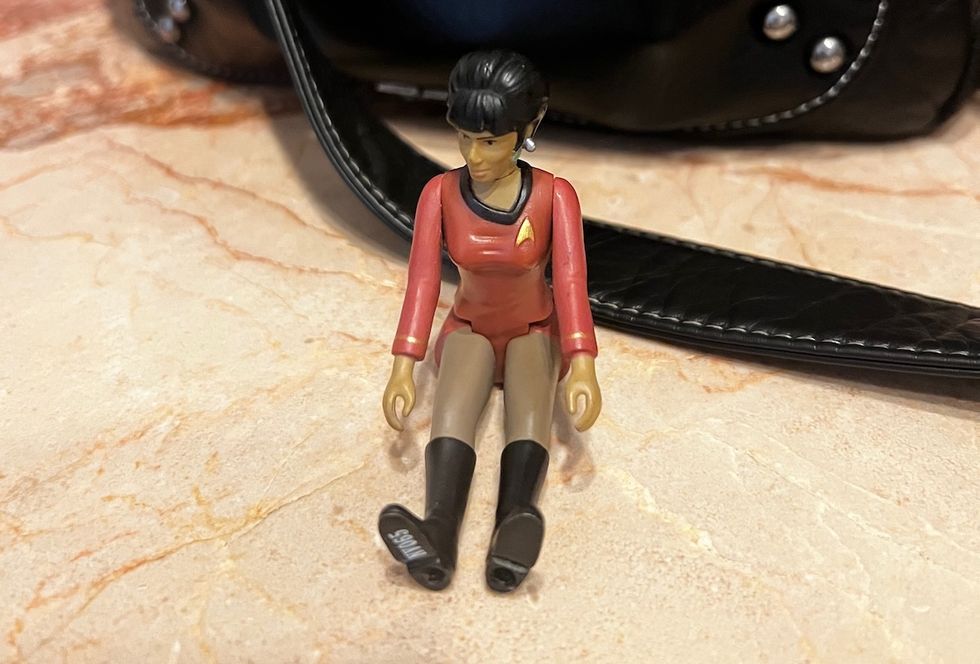 Toy action figure of Lt. Uhura from the original series of Star Trek, modeled on the late actress Nichelle Nichols. Photo by Dawn Ennis www.out.com
"To see young Black girls cosplay as my version of Uhura with the Caesar, I weep openly every time, because I was that little girl at some point who was, oh, here they start," said Gooding as she paused to dry her eyes. "I was that little girl at one point, just ravenous to see somebody who looked like me experience growth and joy and happiness and love and appreciation and validation. And so to be a part of a change I wanted to see in the world, it's breathtaking."
"I quickly learned that there's definitely a lot of homophobia out in the world. I live in New York City. So I was surprised to go online to see, like, wow, a lot of people find an issue with this queer Klingon," Diané told Out, after signing autographs for fans attending Trek Long Island.
"A lot of people also found, like, love and hope. And there's people, like, crying and shaking. And they're so inspired and moved by this character. So, all of the negativity doesn't really matter to me, to be honest with you, because it's the people that are fans that are really, that's all that matters, to be honest."
For out transgender actress and Queer as Folk alumna Jesse James Keitel, Trek Long Island meant a homecoming for the native Long Islander. And in our one-on-one conversation, Keitel spoke about being a trailblazer, as the first out trans actor to be cast in a major role in Trek history. She played nonbinary space pirate Captain Angel in season one of Star Trek: Strange New Worlds.
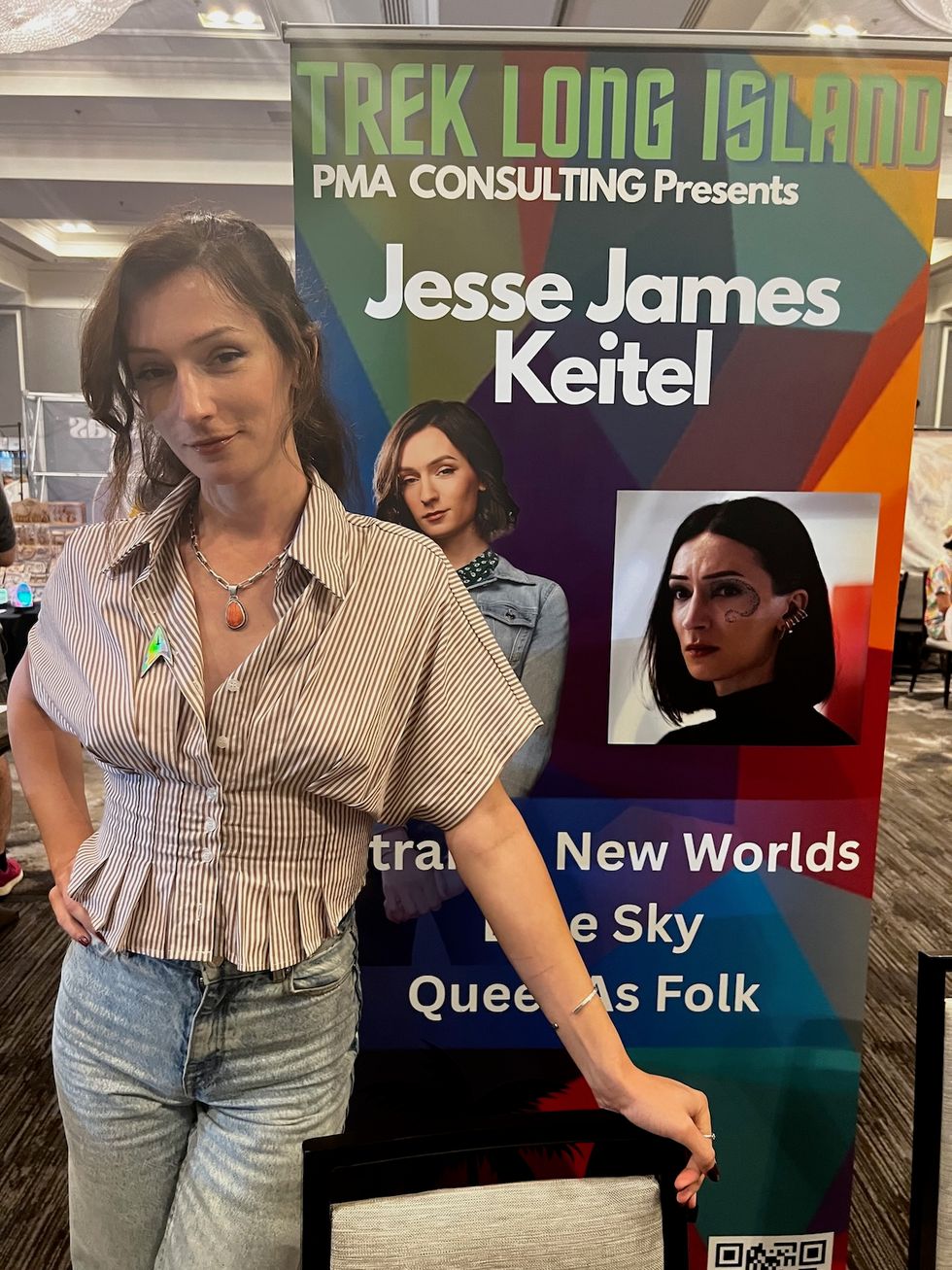 Jesse James Keitel was the first out trans actor cast in a role in Star Trek and appeared in season one of Star Trek: Strange New Worlds. Photo by Dawn Ennis
"I'd like to think Captain Angel skirted a line that could have been a very dangerous territory," said Keitel of the trope that trans people are often portrayed as deceitful or duplicitous. "Captain Angel wasn't duplicitous because they're trans. Captain Angel's just a fucking space pirate. Their job is to deceive you."
Strange New Worlds is now streaming its fourth season on Paramount+, and with the fifth and final season of only six episodes already in the can, Keitel found herself in the awkward position of being asked by many fans if she would be reprising her role. Sadly, it's not to be, she said, but remained optimistic.
"I think the representation of trans people in Star Trek is hot, iconic, fun, fab, futuristic, and everything I ever could have dreamed of," Keitel said. "And I think we need more of it."
After a wave of online criticism that the show was "too woke," Paramount Skydance canceled Star Fleet Academy after season one, with a second and final season still waiting to be streamed. Out asked Diané what fans should expect, given the backlash.
"Let's wait and see what happens. It might be the most amazing thing you've ever seen." he said. "I'm a very optimistic person. I have hope about the future of Star Trek. I am optimistic about the present of Star Trek. I am optimistic about season two of Starfleet Academy coming out so soon, It's even better than season one. It is so exciting. There's so much romance. There's so many gay things. So gay!"
That's reassuring news to queer Star Trek fans, who even have their own LGBTQ+ organization called "To Proudly Go," whose motto is, "Live Proud and Prosper."
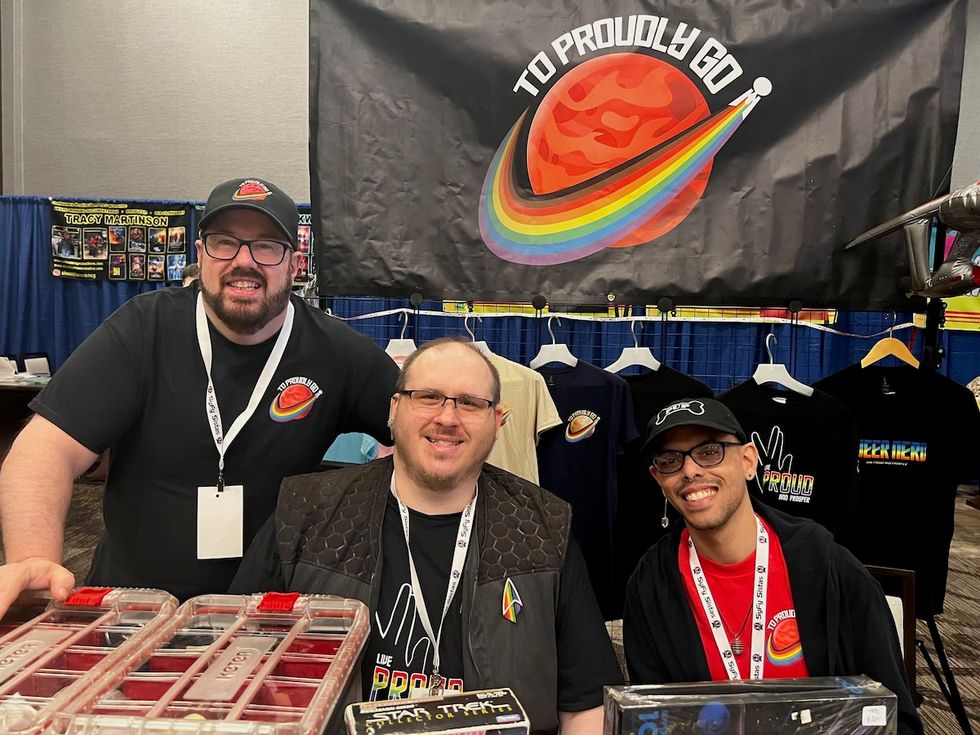 From L-R,: John Lutton, Sean Rusnack and Johnathan Torres of To Proudly Go at Trek Long Island in June 2026. Photo by Dawn Ennis
"We are about creating safe spaces for queer communities and queer nerds," said the group's Sean Rusnack. "We just want everyone to feel welcome and excited for the future."
He said he felt queer fans were feeling very welcome at this convention. "I see a lot of people walking around with their partners and they look excited. And we have some queer stars who are here and they love it."
But Rusnack said corporate changes have left him feeling a new Star Trek film, now under development at Paramount Skydance, will be less queer.
"Because the Paramount merger with Skydance does not feel hopeful," said Rusnack.
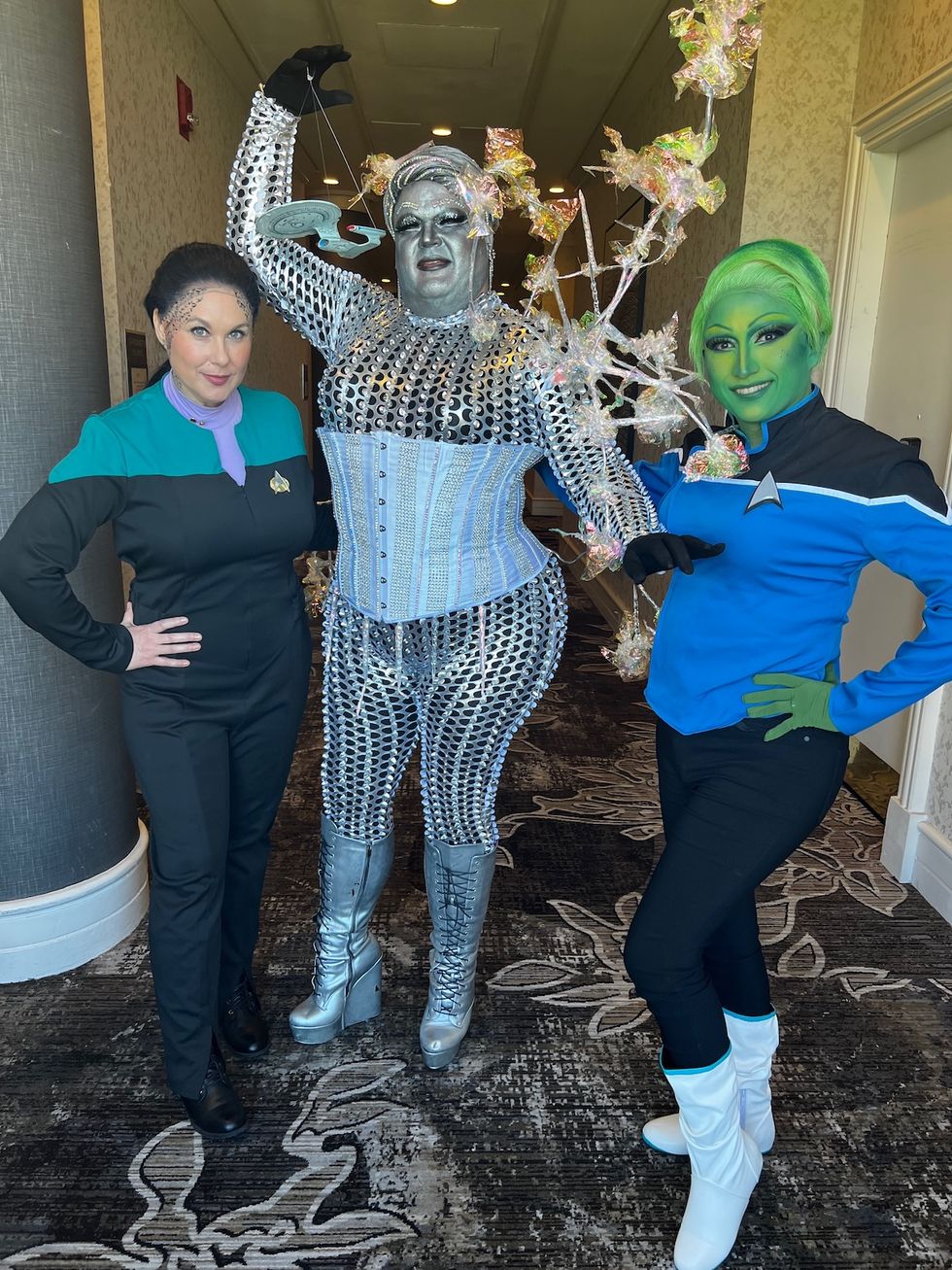 From L-R, out lesbian Jessica Crouse and out trans woman D'Manda Martini of Maryland, and out nonbinary drag performer Logan Stone of Washington, D.C. at Trek Long Island in June 2026. Photo by Dawn Ennis
Actor Stephanie Czajkowski, who played Lieutenant T'Veen on Star Trek: Picard, agrees.
"It's a company that is, in a lot of ways, incredibly regressive based on their views of what the world should look like and who should be in power because that's not the real world," said Czajkowski. "The world is, if anything, it is always infinitely diverse in ways that we haven't even discovered."
"You know, I always go back to an interview of years ago when the scientist was interviewed when they finally let left-handed kids start to write with their left hand and suddenly there were all these left-handed kids and they're like, 'Oh my god, where did they come from?' And the answer was, 'Well, they've always been there, you just let them be who they are.' And I think the same thing would be true of our trans brothers and sisters," she told Out "Queer people have always been here, trans people have always been here."
Like Czajkowski, Gooding isn't shy about sharing her opinions on her social media.
"At the end of the day, I would much rather close doors of working with people who are not interested in my wholeness as opposed to remain open to people who may want to employ a part of me and not all of me," she told Out. "And that may fuck me over in the future. Also, the planet is heating. Now is the time to say what you can before you're not allowed to at all. And I have made my choice, so I'm sticking to it."
Season four of Star Trek: Strange New Worlds is streaming now on Paramount+.