




Erectile dysfunction shouldn’t be an embarrassing health problem, but that doesn’t mean that you don’t feel shame about it. Or maybe you’re just frustrated because you're a top who can’t have the kind of sex you want unless you can get hard and stay hard.
Either way, there are steps you can take to improve the situation. Not only are there plenty of ED medications on the market and penile Botox, but pelvic floor exercises can also be a lifesaver if you want to get it up and keep it up.
Most people think of pelvic floor exercises as something that new mothers need to do after giving birth, but it turns out these exercises can treat a whole host of problems, including erectile dysfunction.
So what exactly are pelvic floor exercises for men, and should you give them a try?
What is erectile dysfunction?

Man holding an eggplant.
Alena A/Shutterstock
According to Dr. Justin Katz, who has been treating erectile dysfunction and pelvic floor dysfunction for 11 years as a chiropractor and co-founder of City Integrative Rehabilitation in New York City, erectile dysfunction is the consistent or recurrent inability to get or keep an erection that is hard enough for you to have satisfactory sex.
“The keyword is consistent. Every guy has an off night. ED is when it becomes the pattern,” he tells Out.
“Most cases are vascular,” Katz says. "The penis is essentially a vascular organ, and an erection is a plumbing event: Blood has to get in, and then the body has to trap it there. Anything that chips away at blood vessel health over time (blood pressure, cholesterol, diabetes, smoking, sedentary life, bad sleep) eventually shows up as ED. Less commonly, it's neurological, hormonal, medication-induced (SSRIs and some blood pressure meds are common culprits), or psychological. Usually it's a combination.”
Erectile dysfunction can also be the first warning sign of cardiovascular disease, so if you’re dealing with erectile dysfunction and you’re over 40, it’s time to get checked.
"ED is almost always more treatable the earlier you catch it, and it's a cardiovascular warning shot that deserves a real workup,” Katz says. “If your blood pressure, cholesterol, blood sugar, and testosterone haven't been checked in the last year, start there.”
Why is erectile dysfunction particularly hard for gay men to cope with?

Two shirtless men sit back-to-back on a bed, appearing contemplative.
lopolo/Shutterstock
Erectile dysfunction comes with a lot of embarrassment and shame for many men, but gay men — especially those who like to top — will have an even harder time coping with this issue.
“Straight men usually deal with ED in the context of a long-term partner who already loves them,” Katz says. “Gay men, especially single gay men, are often dealing with ED inside a hookup and dating culture where performance is on display pretty quickly. Apps, bathhouses, PNP scenes, sex parties — the first time you're with someone is often also the first time you're expected to perform, and that pressure alone will tank an erection in a guy whose vascular system is completely fine.”
And this is especially challenging if you prefer to top. Many gay men feel locked into their roles within a sexual relationship, which means that if you can’t stay hard during sex, it’s not just that one type of sexual experience that is “ruined,” but your whole identity will take a hit.
“A lot of gay men, especially those who identify as tops, find that a huge part of their sexual identity is their ability to perform as a top,” says Ilana Grines, a queer licensed marriage and family therapist and certified sex therapist in Los Angeles. “Not being able to maintain an erection can feel like a loss in terms of the role that they want to portray and also limits them from being able to sustain an erection that is required of tops. When men experience ED it usually leads to a cycle of avoidance, anxiety, and performance pressure that makes the ED worse.”
The mechanics of topping mean that being able to maintain an erection is key since anal sex requires the top to be more rigid than with vaginal intercourse, Katz explains.
“Oral and receptive sex are more forgiving. And the ‘just bottom instead’ advice you sometimes see is condescending,” he says. "Some men don't want to bottom. Some top for specific partners. Some find receptive sex painful for their own reasons. Telling a man to reorganize his sex life around a problem you can actually treat is bad medicine.”
Men often wait years after symptoms start before they seek treatment, but the stigma that keeps them out of the doctor’s office is even more pervasive in gay hookup culture. So instead of avoiding telling anyone about your problem, Katz recommends seeking out an LGBTQ-inclusive provider.
“You should not have to explain to your doctor what topping is, or why role matters, or why ‘just use more lube’ is not the answer to a rigidity problem,” he says. “When you find the right provider, this whole conversation gets easier and the treatment gets better.”
Are pelvic floor exercises an effective way to treat erectile dysfunction?

Gay couple cuddling.
Rawpixel.com/Shutterstock
There is good evidence that most men will benefit from doing pelvic floor exercises to treat erectile dysfunction. A 2005 study led by Grace Dorey found that after six months of doing pelvic floor exercises, 40 percent of men had regained normal erectile function, and another 35.5 percent improved.
“More recent research has shown similar patterns, especially for men with venous leak, where the problem isn't getting blood in but keeping it from draining back out,” Katz explains. “That’s the population where pelvic floor training is most powerful, because venous leak is largely a muscle problem.”
According to Grines, whether pelvic floor exercises will be an effective solution for your erectile dysfunction is dependent on what the underlying cause is. “If the individual has gone to the doctor and they have ruled out any vascular/hormonal, and/or other medical conditions that could be playing a part in the ED, pelvic floor work could make a difference,” she says.
Do you need to see a specialist?

Doctor in a white coat holding a stethoscope.
Drazen Zigic/Shutterstock
Pelvic floor exercises can absolutely be done from the comfort of your own home, but to get the best results, you should seek out professional help to be evaluated and taught how to do the exercises correctly.
“Over 11 years, the single most common thing I see is men who think they're doing Kegels correctly and are actually doing the opposite, either bearing down or recruiting the wrong muscles,” Katz says. “Even more importantly, a subset of men with ED actually have a pelvic floor that's already too tight (hypertonic), and for them, more Kegels make things worse, not better. A hypertonic pelvic floor can itself cause ED, painful ejaculation, and post-orgasm discomfort, and the treatment for those guys is down-training and release work, not strengthening.”
Before starting to do the exercises on your own, Katz recommends seeing a pelvic floor physical therapist, a chiropractor with pelvic floor training, or a pelvic health-oriented doctor. “After that initial assessment, the work is done at home,” he says. “You don't need to come in three times a week forever. You need someone to teach you once, correct your form, and then you run the program yourself.”
Which exercises should you do and how often?
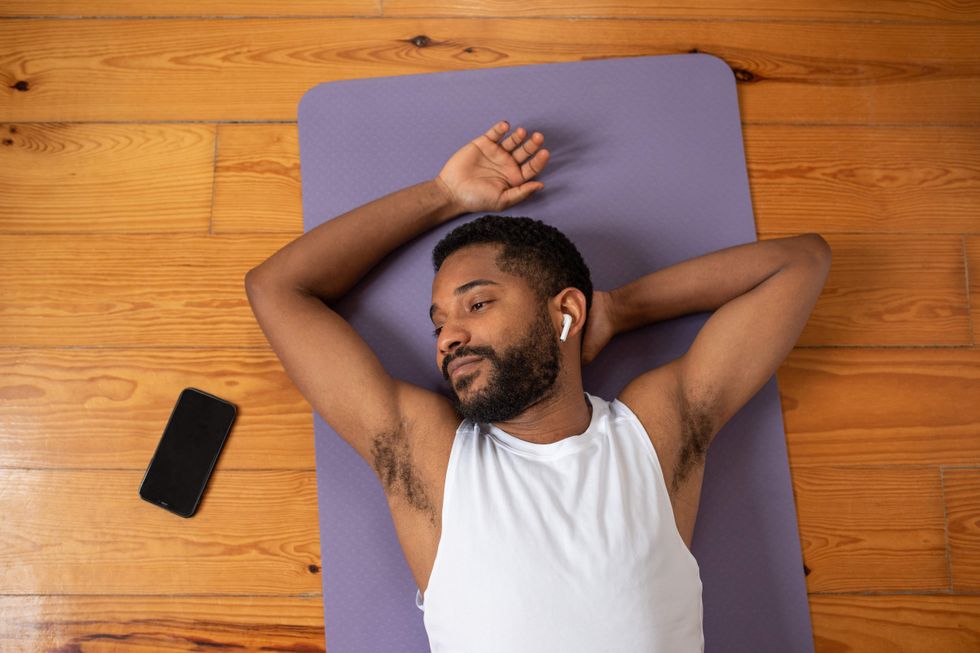
Man lying on a yoga mat.
ViJpeg/Shutterstock
You should see a specialist before you start doing pelvic floor exercises, but once you’ve been checked out and taught how to contract your pelvic floor correctly, Katz recommends doing these three main exercises three times a day for about five minutes each time.
“Most men notice a difference in four to six weeks, and the studies that show real erectile function improvement ran for about three months. This is not a 'do it for a week' intervention,” he says.
Exercise 1: Long holds
“Contract the pelvic floor, hold for 5 to 10 seconds, fully relax for the same amount of time, and repeat 10 times. The relaxation phase matters as much as the contraction. If you can't fully let go between reps, you're building the wrong kind of tone," Katz says.
Exercise 2: Quick flicks
“Sharp, fast contract-and-release, aiming for 10 in a row. These train the fast-twitch fibers, which are the ones that fire during the rigidity phase of an erection," Katz says.
Exercise 3: Integrating the contraction
“Doing a controlled contraction while standing, while transitioning from sitting to standing, and eventually during intercourse itself. The muscle is useless if it only works when you're lying on your back on the bedroom floor," he recommends.
Will you also need to take prescription ED medications?

Erectile dysfunction pills.
artem evokimov/Shutterstock
Whether or not you’ll be able to treat your erectile dysfunction with pelvic floor exercises alone or if they’ll need to be one component of your treatment plan depends largely on the underlying cause of the problem.
“The honest answer is that for mild ED with a muscular or venous component, pelvic floor work alone can absolutely be enough, and it's often the right first step because it treats the root problem instead of just masking it for four hours,” Katz says. “For moderate to severe ED, especially when there's vascular disease underneath, pelvic floor work is usually one piece of a bigger plan.”
Katz likes to use pelvic floor exercises as part of a holistic approach that treats the whole patient. This includes not only the exercises, but lifestyle changes, like exercise, sleep, cardiovascular training, and cutting nicotine, as well as low-intensity shockwave therapy to “stimulate new blood vessel growth in the penis,” and medications like Viagra, Cialis, or Tadalafil.
“A lot of my patients eventually need less medication than they started with, or come off it completely, because the pelvic floor work and shockwave have improved the underlying function. Medication is a tool, not a failure,” he says.
Grines says that when treating erectile dysfunction, a lot of people neglect to think about the underlying mental health struggles that could be contributing. And if your ED stems from anxiety, you’ll also need to treat that underlying issue in conjunction with things like pelvic floor exercises.
“Many individuals do not thoroughly investigate the psychological impacts of ED before turning to medication,” Grines warns. “Therefore, sometimes the medications and PFE [pelvic floor exercises] are just a band-aid. That being said, a lot of men have reported that a combination of pelvic floor exercises and ED medication help reduce performance anxiety while they do the work in therapy to address their underlying anxieties and shame.”
Sources cited:
Dr. Justin Katz has been treating erectile dysfunction and pelvic floor dysfunction for 11 years as a chiropractor and co-founder of City Integrative Rehabilitation in New York City.
Ilana Grines, a queer licensed marriage and family therapist and certified sex therapist in Los Angeles.