
Madonna wiped her Instagram clean and announced a new album, described as a sequel to Confessions on a Dance Floor, and the reaction was immediate, outsized, almost physical, moving across media, across group chats, and across the quiet, private channels where people who have been paying attention for a long time recognize a signal when they see one. It would be easy to read that response as nostalgia or fan culture behaving as it always does, but that reading misses something more specific — something that has less to do with celebrity and more to do with timing. Madonna has a habit of reemerging at moments when the atmosphere tightens, when politics harden, and when the culture begins to narrow in ways that feel suffocating. People who have lived through that pattern recognize it in their bodies before they articulate it out loud.
The last time she released Confessions on a Dance Floor was 2005, at the height of a war built on lies, in a country that had grown comfortable with fear as a governing principle, where dissent was treated as disloyalty and the boundaries of acceptable life were quietly redrawn. That record did not arrive as commentary, it arrived as release, as insistence, as something ecstatic and physical that refused the moral heaviness of the moment without ignoring it. It became one of the most beloved records of her career not only because of how it sounded but because of what it allowed people to feel when the world outside felt increasingly rigid and controlled. So when she signals a return to that era now, in a year that feels darker, more unstable, and increasingly hostile to difference, the reaction is not just excitement, it is recognition. For a lot of us, Madonna has never simply been a pop star, she has been a figure we associate with permission, with defiance, with the refusal to shrink when shrinking is what the culture is asking for.
I grew up in a small oil and coal town in northern New Mexico, a place where isolation was palpable. The social language ran through talk radio and if you weren’t listening to Rush Limbaugh, you didn’t have much to offer. His obsession with gay people and AIDS wasn’t distant rhetoric but something that seeped into everything, shaping what could be said, what could be heard, and what could safely exist. I was young, but I wasn’t confused. I knew what I was feeling, I had just never seen it lived out anywhere around me, and that absence carried its own kind of discipline. You learned to keep it contained, to move through without offering it up, not because it wasn’t real, but because there was nowhere for it to land. There was no version of you that would be fully recognized or fully safe if you let it surface, and you understood that early.
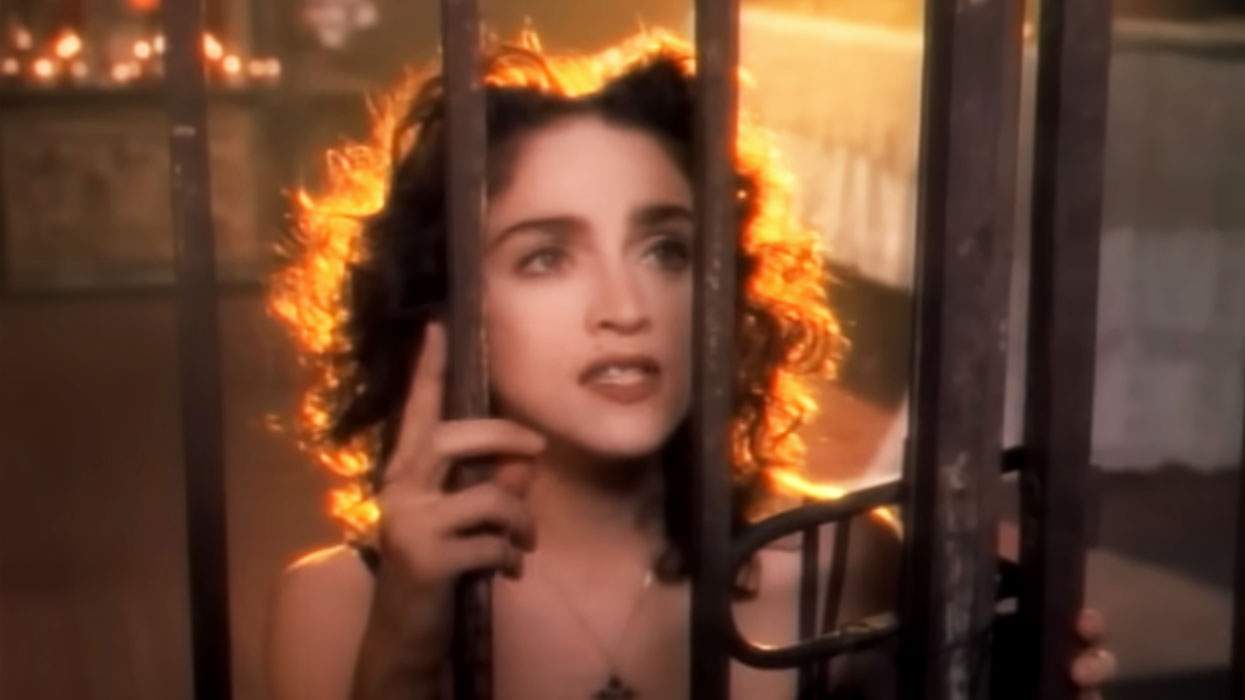
When I was 8 years old, my parents made the premiere of the “Like a Prayer” video an event in our house, which in retrospect feels almost unbelievable, not just because of what that video contained but because of what it made possible. Madonna dancing in front of burning crosses, invoking the visual language of the Ku Klux Klan, placing herself inside a narrative of racial violence and false accusation, kissing a Black saint inside a church that felt both sacred and transgressive at the same time, collapsing religion, sexuality, and race into a single frame that refused to resolve neatly into anything polite or easily digestible, all of it landing in our living room, all of it landing on me before I fully understood what I was seeing, but understanding enough to feel that something important was happening.
It was not just that the imagery was provocative, it was that it carried a moral force that did not ask for permission, that did not soften itself for comfort, that did not behave as though controversy was something to be avoided. My parents used that moment to talk to us about race, about injustice, about history, but what stayed with me just as strongly was the feeling of watching someone refusing to be contained by the rules that seemed so fixed in the world I was growing up in. That was the first time I felt something like a permission structure, the sense that there were other ways to exist, other ways to move through the world, other ways to hold your ground without disappearing.
A few years later, Truth or Dare arrived, and with it something even more direct. This was not symbolism or abstraction, it was a group of queer men on screen, charismatic, funny, sexual, complicated, fully alive in a moment when the dominant narrative around gay men in America was still saturated with fear, stigma, and death, in the middle of the AIDS crisis, when public culture preferred gay people either invisible or reduced to cautionary tales. Madonna did not place them at the margins of that film, she placed them at the center, gave them space, gave them voice, allowed their relationships, their humor, their grief, and their desire to exist without apology in front of a massive audience.
I knew every dance from that movie. I watched it over and over again. I watched it in a room that felt very far away from New York, very far away from any place where people like me seemed to exist openly, and yet there they were, not as something to be hidden but as something undeniable. It is easy, in retrospect, to talk about representation as though it were an abstract good, but at that time it was something much more immediate, something that cut directly through isolation and gave form to a life that I did not yet see around me. Madonna was speaking openly about AIDS, about loss, about fear, in a way that very few public figures were willing to do at that scale, and she did it without hedging, without distancing herself from the people most affected, without behaving as though proximity to queer life was something that needed to be managed or disguised.
That mattered in ways that are difficult to quantify cleanly, but easy to feel. It made it possible to imagine surviving. It made it possible to imagine a future that was not defined entirely by absence or silence. It made it possible to live a visible and free life when the alternative was to disappear into the expectations of a place that had no real language for who I was.
By the time Confessions on a Dance Floor came out, I was in New York, in my 20s, out in a way that was hard-won, moving through a city that was alive with protest, with anger, with people pushing back against a war that had been sold under false pretenses, against an administration that had reshaped the country through fear and misinformation. My band was playing shows tied to that moment, we were in the streets, at anti-war protests, at anti-Bush demonstrations, part of a broader refusal that felt urgent and necessary, and again Madonna was there, not as a distant icon but as someone still willing to take a position, still willing to antagonize power, still willing to risk the backlash that comes with refusing to stay quiet.
She built a tour around that defiance, around that anger, around that refusal, and she did it at a point in her career when it would have been easier, and more profitable, to simply lean into legacy, to smooth the edges, to become palatable in the way the culture often rewards once it decides you are no longer a threat. Instead, she kept pushing, kept insisting, kept showing up in ways that reinforced something I had felt since I was a kid, that being visible, being loud, being unwilling to collapse into something smaller was not only possible, but also necessary.
That is why this announcement lands the way it does now. Not because people are waiting for a soundtrack, not because nostalgia is powerful, but because for many of us Madonna has been tied, across different moments in our lives, to the experience of being given permission when the world was asking us to disappear. She has been tied to survival, not in a dramatic or abstract sense, but in the daily sense of pushing through environments that were not built to accept us, of finding something to look up to when there was very little around us that reflected who we were.
There is also something else that is easy to forget if you reduce her to iconography or legacy, which is that Madonna is fun. Not in a trivial way, not as an escape from seriousness, but as a refusal to let seriousness become a cage. The joy, the sexuality, the humor, the excess, the theatricality, all of it has always been part of the same project as the defiance, part of the same insistence that life should not be reduced to something narrow or disciplined into something manageable for other people’s comfort.
So when she clears the slate and signals that something new is coming, something that reaches back to one of the last moments the world felt this tightly wound, people react. They stop. They pay attention. Because for those of us who have lived through her at different stages, who have needed what she offered at different points in our lives, it does not feel like a routine album cycle. It feels like the return of a force that has, more than once, made it possible to keep going.
Josh Ackley is a political strategist and the frontman of the queerpunk band The Dead Betties. Follow at @momdarkness and listen to music on Spotify.
Opinion is dedicated to featuring a wide range of inspiring personal stories and impactful opinions from the LGBTQ+ community and its allies. Visit Out.com/submit to learn more about submission guidelines. We welcome your thoughts and feedback on any of our stories. Email us at voices@equalpride.com. Views expressed in Opinion stories are those of the guest writers, columnists, and editors, and do not directly represent the views of Out or our parent company, equalpride.