



This story originally appeared on Them.
Yellowjackets: The Final Season premieres November 20 on the Paramount+ Premium plan.
What would we have been talking about when the Yellowjackets came home? A lot, and not just because gay people have always loved to yap no matter the decade.
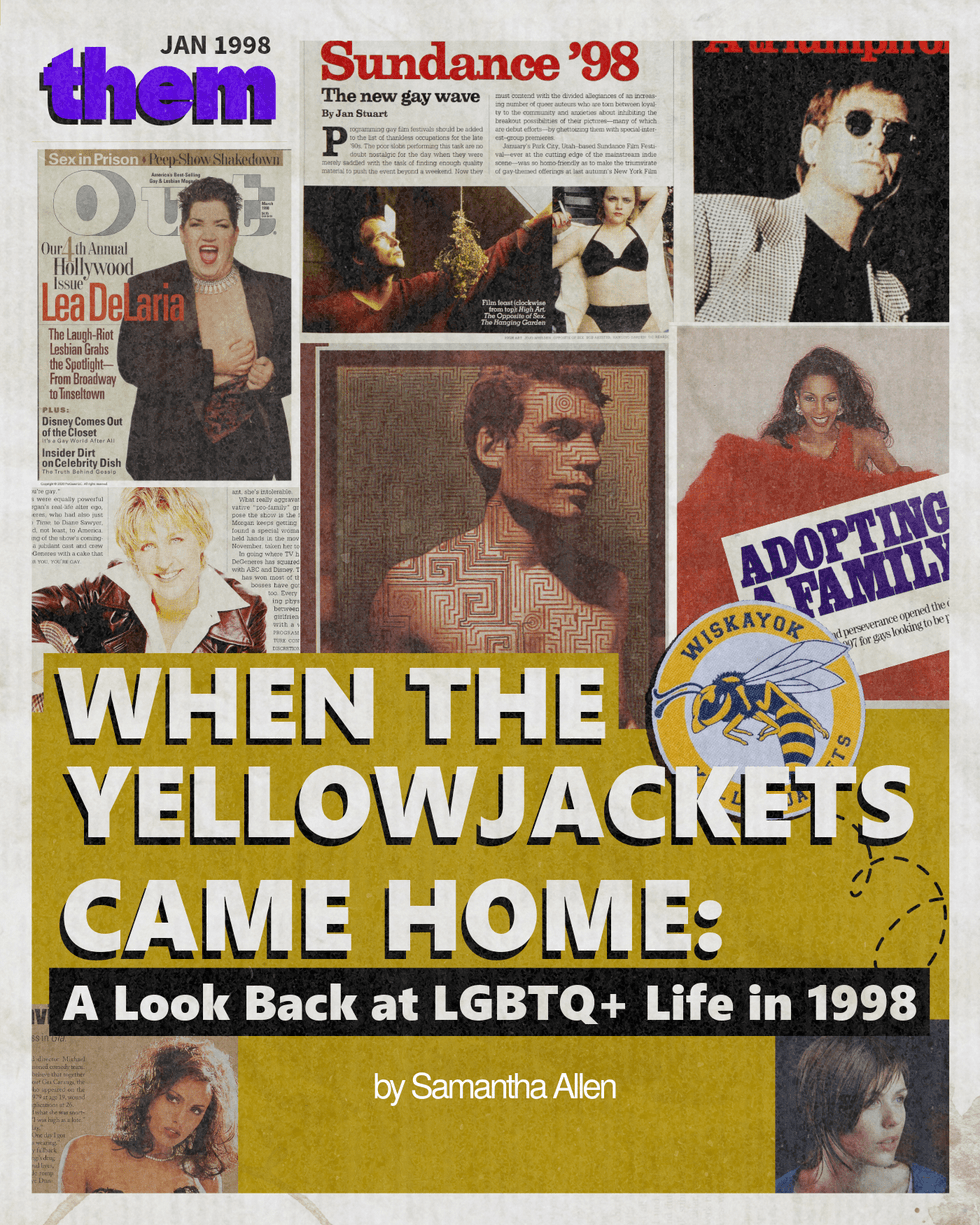 When the Yellowjackets Came Home: A Look Back at LGBTQ+ Life in 1998 Them
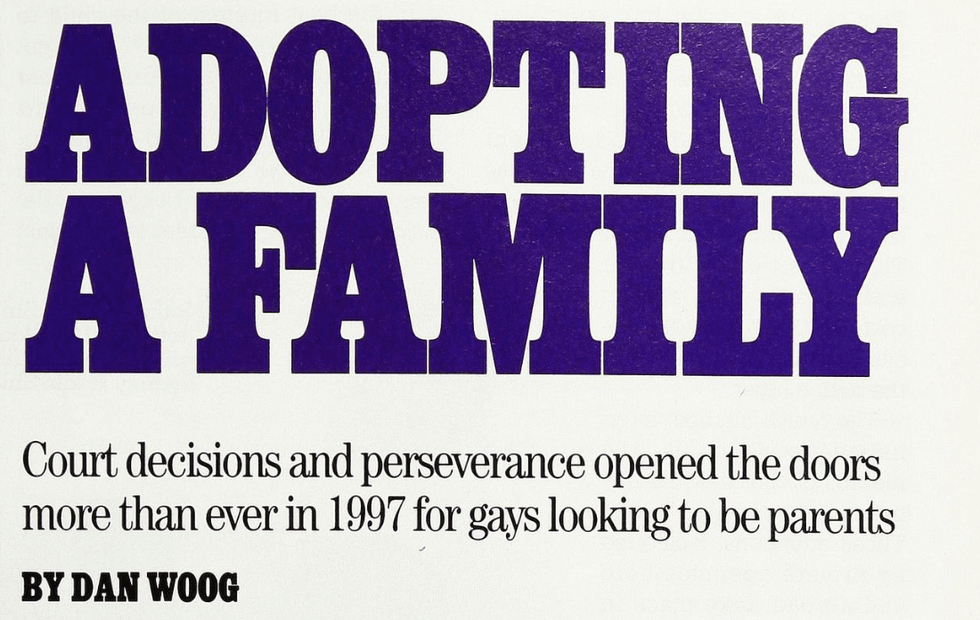
The dawn of 1998 was an exciting time for LGBTQ+ culture — including in New Jersey, where the fictional Wiskayok High School girls’ soccer team would have been reacclimating to polite society after 19 months spent in the wild. In December 1997, just a few weeks before our favorite fictional plane-crash survivors were preparing for the trip back home after their rescue, the Garden State officially allowed gay couples to adopt children, with The Advocate celebrating it as a decision that “opens the door for future generations of boys and girls to be part of loving, legal families.” In another timeline, we’re sure Taissa and Van would have benefited from that court ruling. (Look, we’re still not over it! I’ll stop crying when you do!)
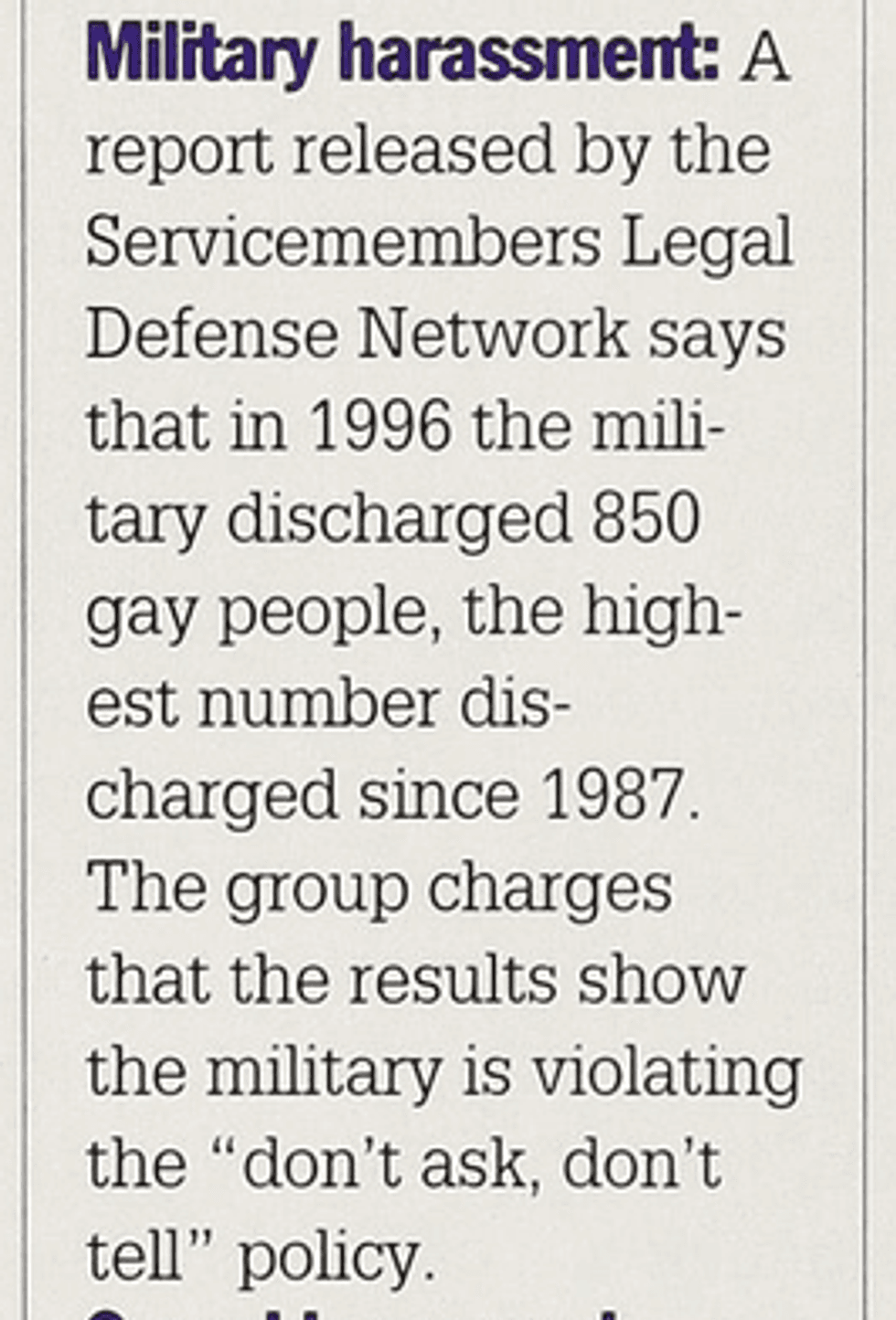
Simply put, there was a lot going on at the start of 1998: Ellen DeGeneres had just come out and Elton John’s sequins were shimmering in the spotlight anew after he rerecorded “Candles in the Wind” to pay tribute to Princess Di. The film adaptation of Midnight in the Garden of Good and Evil, released in 1997, introduced Savannah club staple The Lady Chablis to a national stage — one of the first movies of that scale to feature a transgender performer. And although The X-Files was decidedly in full swing when the Yellowjackets got access to their TV antennas again, Will and Grace hadn’t quite premiered yet — but that generation-defining sitcom would soon prove to be a phenomenon, overriding some viewers’ complaints that it was “too gay.” Is that supposed to be a bad thing?
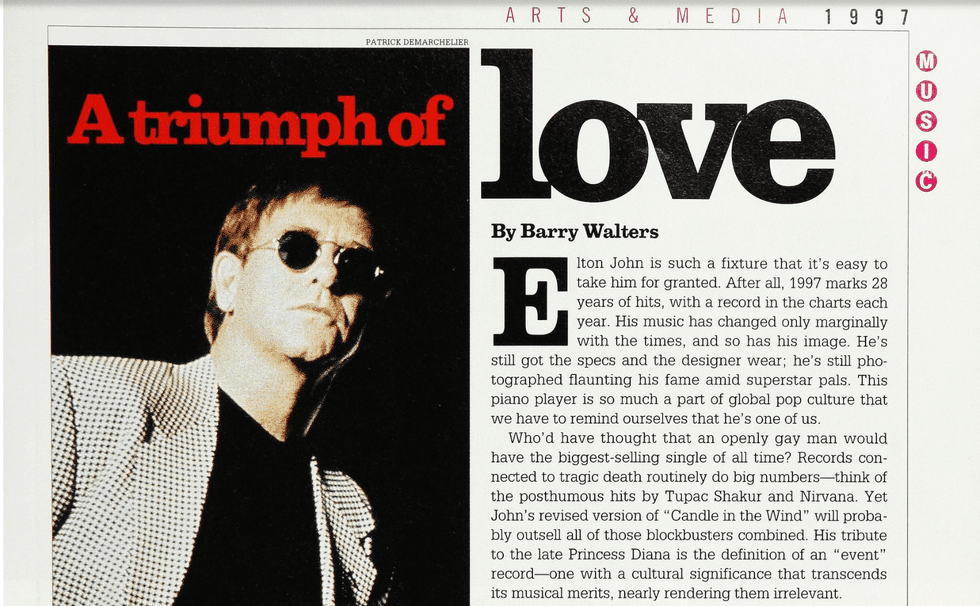
That was all happening amid a hinge point in LGBTQ+ history. First introduced in 1996, combination therapies were making life with HIV more livable, and for the first time people were talking about a future beyond the epidemic. Serving openly in the military was out of the question under “Don’t ask, don’t tell,” but that policy was already being challenged in court. Marriage equality still felt painfully distant, and had recently been dealt a blow by the 1996 Defense of Marriage Act, but gay couples were undeterred, continuing to fight for their freedom to love. The light at the end of the tunnel may have seemed dim, but it was getting brighter.
Writing for The Advocate in January 1998, then-editor-in-chief Judy Wieder called 1997 “the year our issues and personalities jumped [to] still another level in national coverage.” There was a sense in 1998 that the LGBTQ+ community was finally reaching the center of American life, even if it still felt, in ways, like we were in a sort of wilderness of our own. But to get an even clearer picture of the queer cultural milieu that would have surrounded the Yellowjackets’ homecoming, we turned to the Equalpride archives, poring through old issues of Out, which released its first issue in 1992, and The Advocate, which has been publishing since 1967. According to our research, here’s what everyone would have been buzzing — get it? — about back then.
Gay actor Rupert Everett was on a hot streak between My Best Friend’s Wedding and Shakespeare in Love
“Who would have guessed that playing the gay best friend could make you the hottest actor in Hollywood? … [T]hat’s what happened to Rupert Everett, the lanky and louche Brit whose career shot into hyperdrive after the success last summer of My Best Friend’s Wedding, in which he appeared as Julia Roberts’s best friend, who wasn’t getting married.” — Bruce Vilanch profiling Rupert Everett for the January 20, 1998 cover story of The Advocate
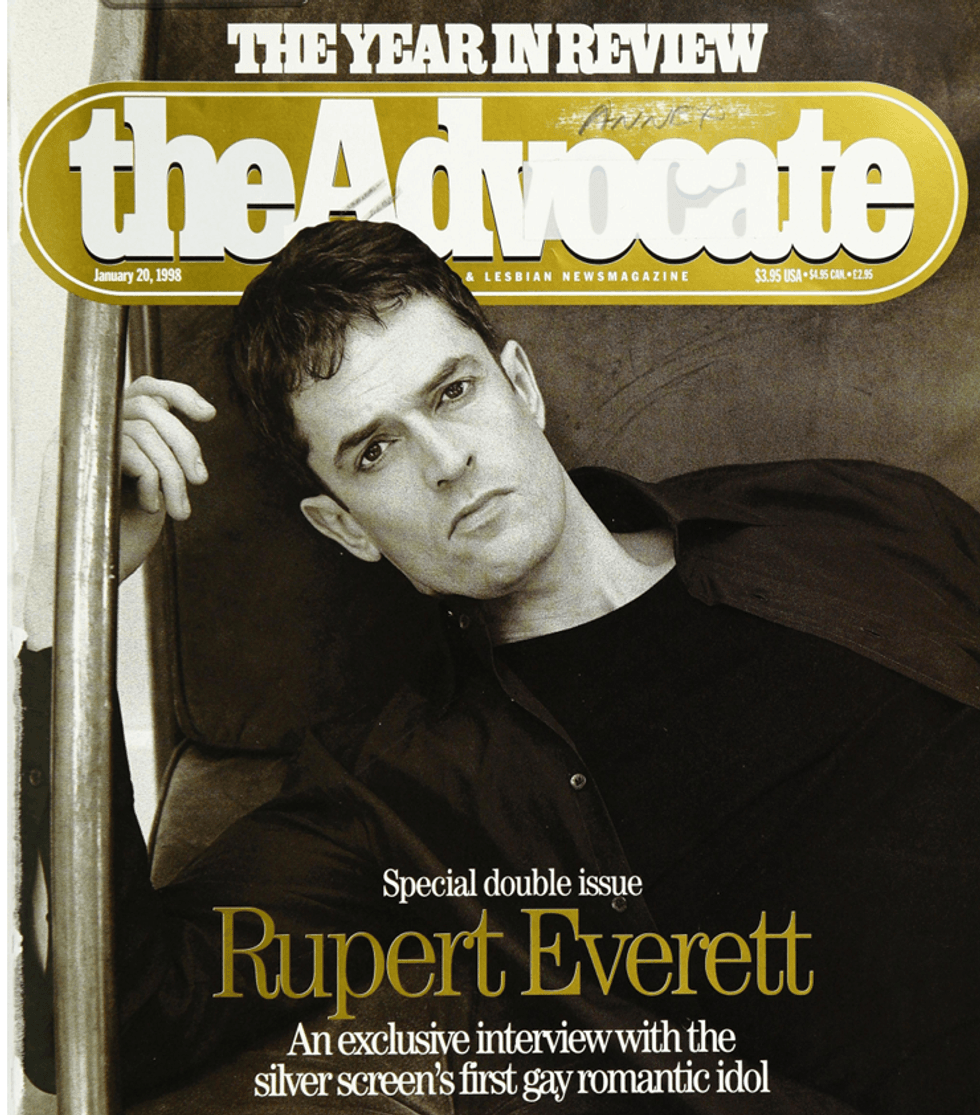
The iconic Lady Chablis hilariously predicts Midnight in the Garden of Evil will make women bolder and make men go wild
“Seeing me in Midnight will change people. It’s going to encourage women to be a little bit sassier. And encourage female impersonators to be a little more proud. And it will make men just crazy for the Doll.” — The Lady Chablis to Tom Beer in the February 1, 1998 issue of Out magazine
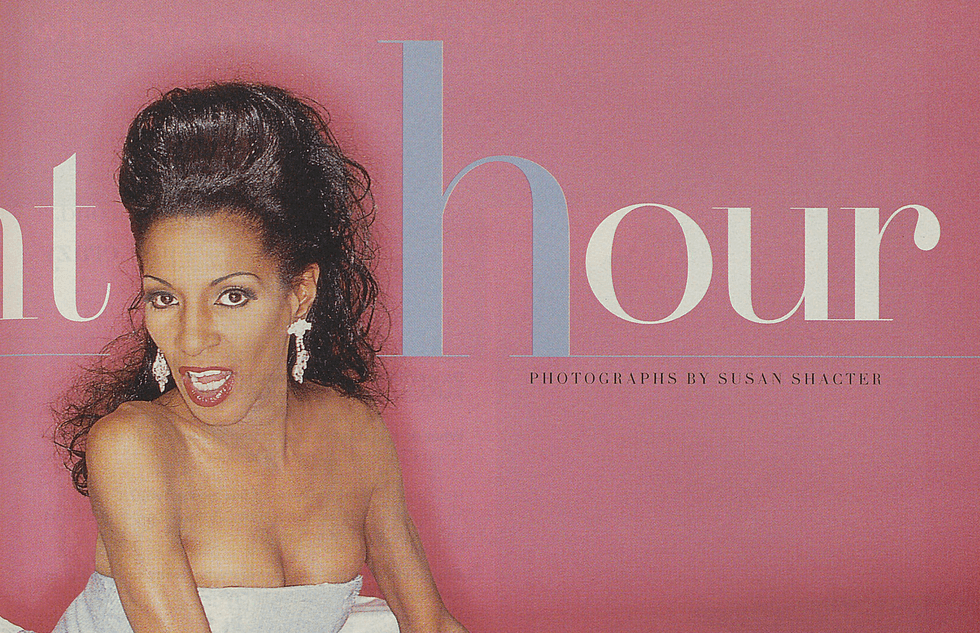
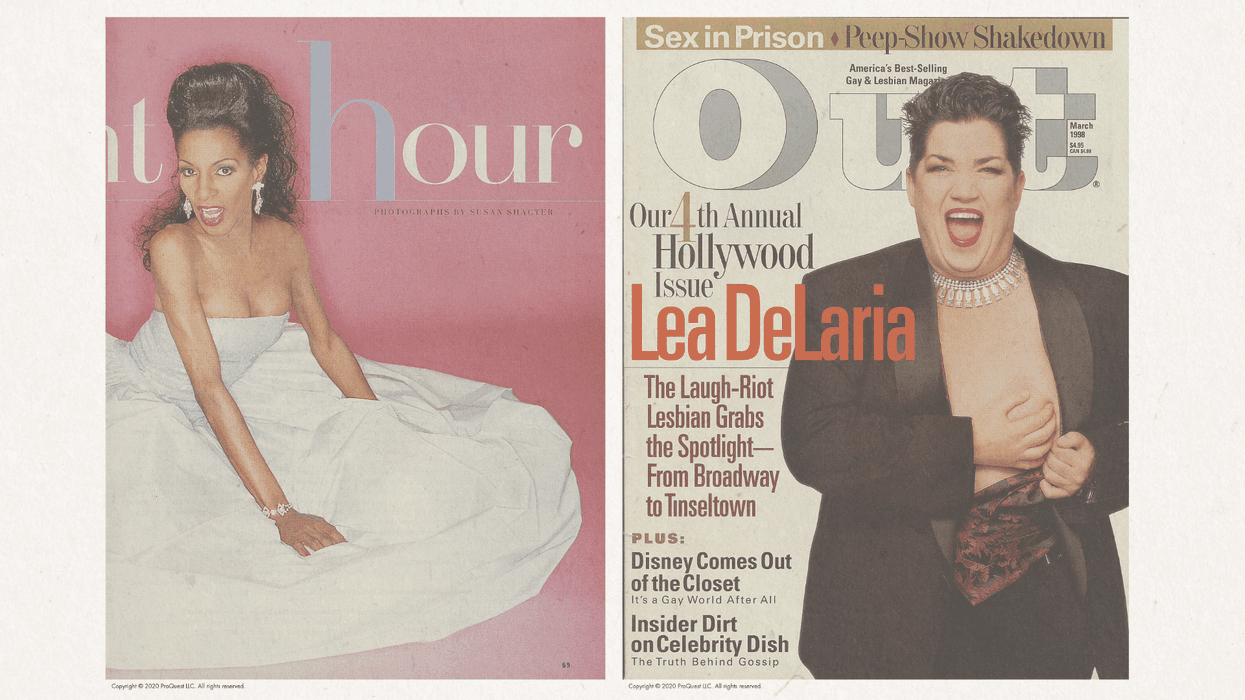
Lea DeLaria got bold and bawdy with Out amid her New York stage success
“I just lost a part to an arm wrestler, just because she was a real arm wrestler and not an actor! You would think that after all the glowing reviews in all the freaking magazines of the world that it wouldn’t happen — but there’s Hollywood!” — Lea DeLaria to Tom Beer in the March 1, 1998 issue of Out magazine
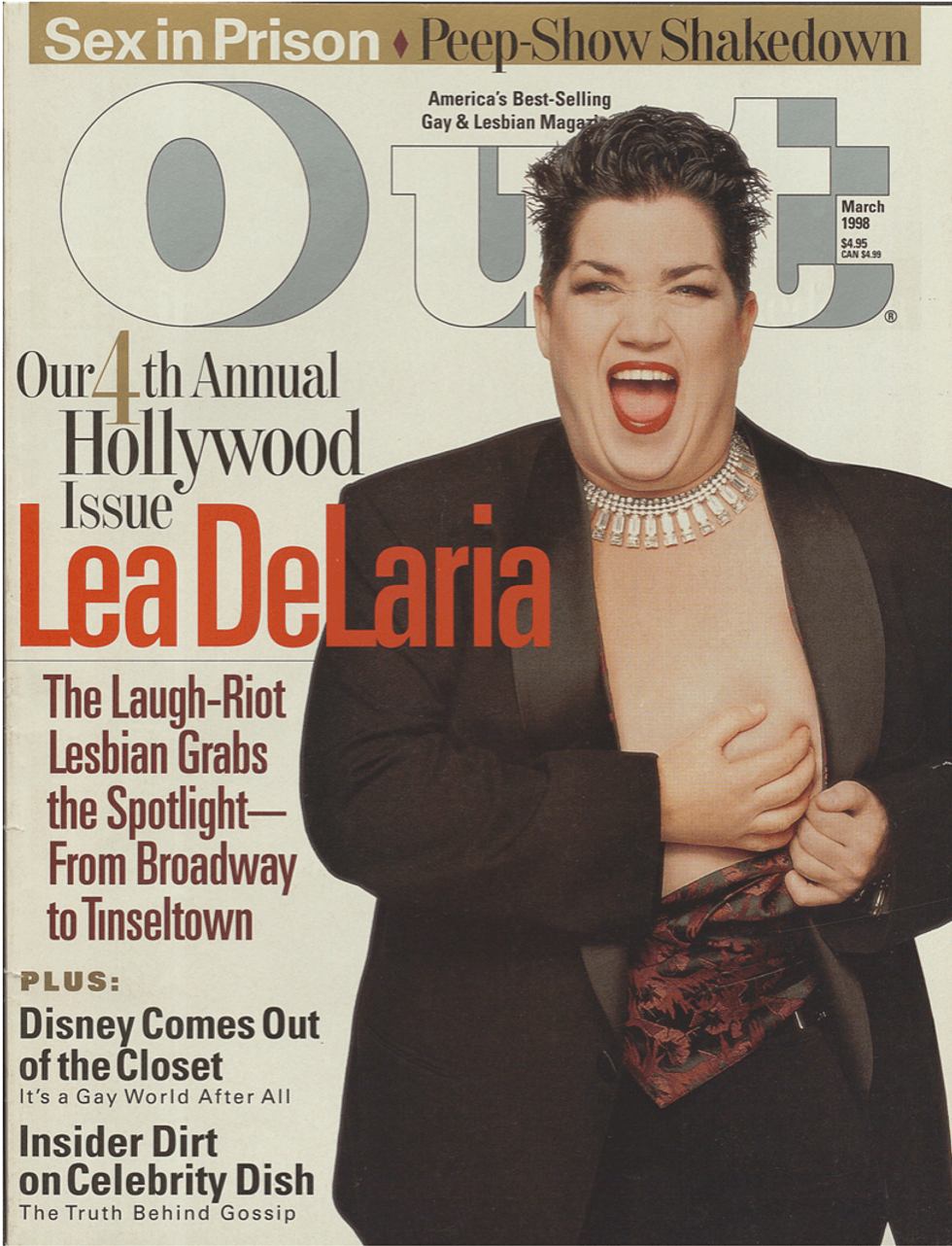
Anticipation was growing for a new Broadway revival of Cabaret starring a certain future Traitors host…
“Departing from Joel Grey’s memorable devil-doll portrayal, Brit newcomer Alan Cumming’s emcee (with rouge-painted nipples) is a lascivious transvestite whose politics and sexuality seem constantly in flux.” — “People,” February 1 1998 issue of Out
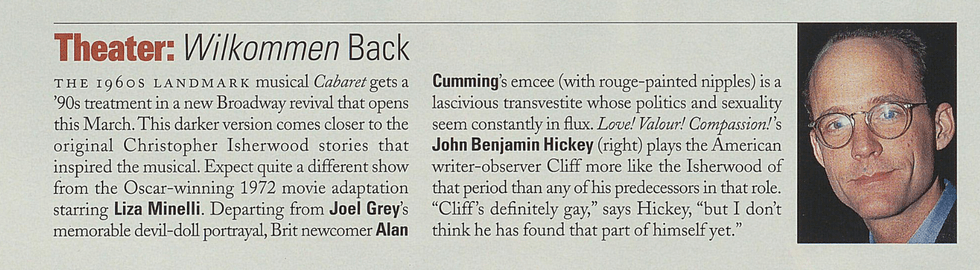
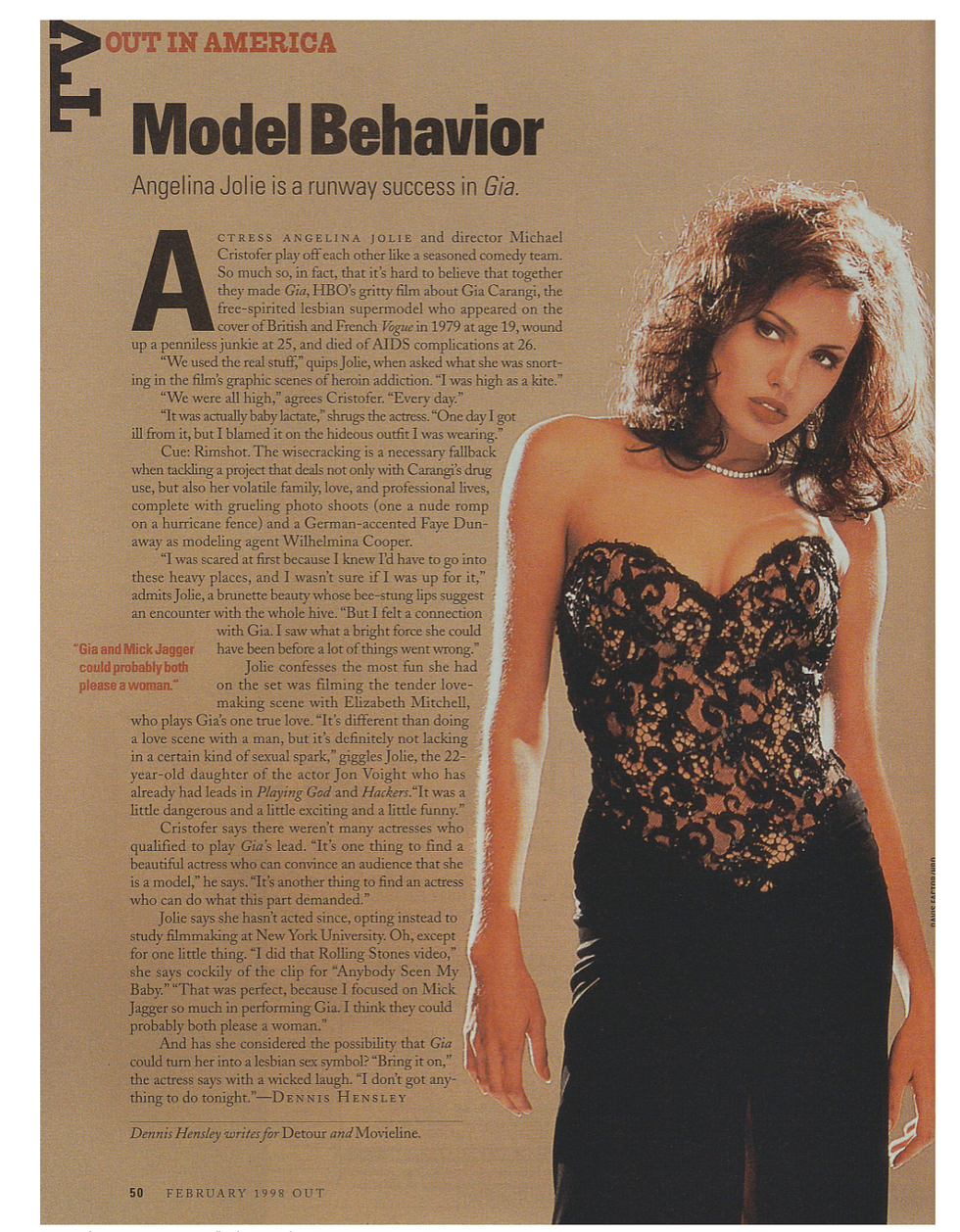
Angelina Jolie opened up about her love scene with Elizabeth Mitchell in Gia, which came out in January 1998
“It’s different than doing a love scene with a man, but it’s definitely not lacking in a certain kind of sexual spark. It was a little dangerous and a little exciting and a little funny.” — Angelina Jolie to Dennis Hensley for the February 1998 issue of Out
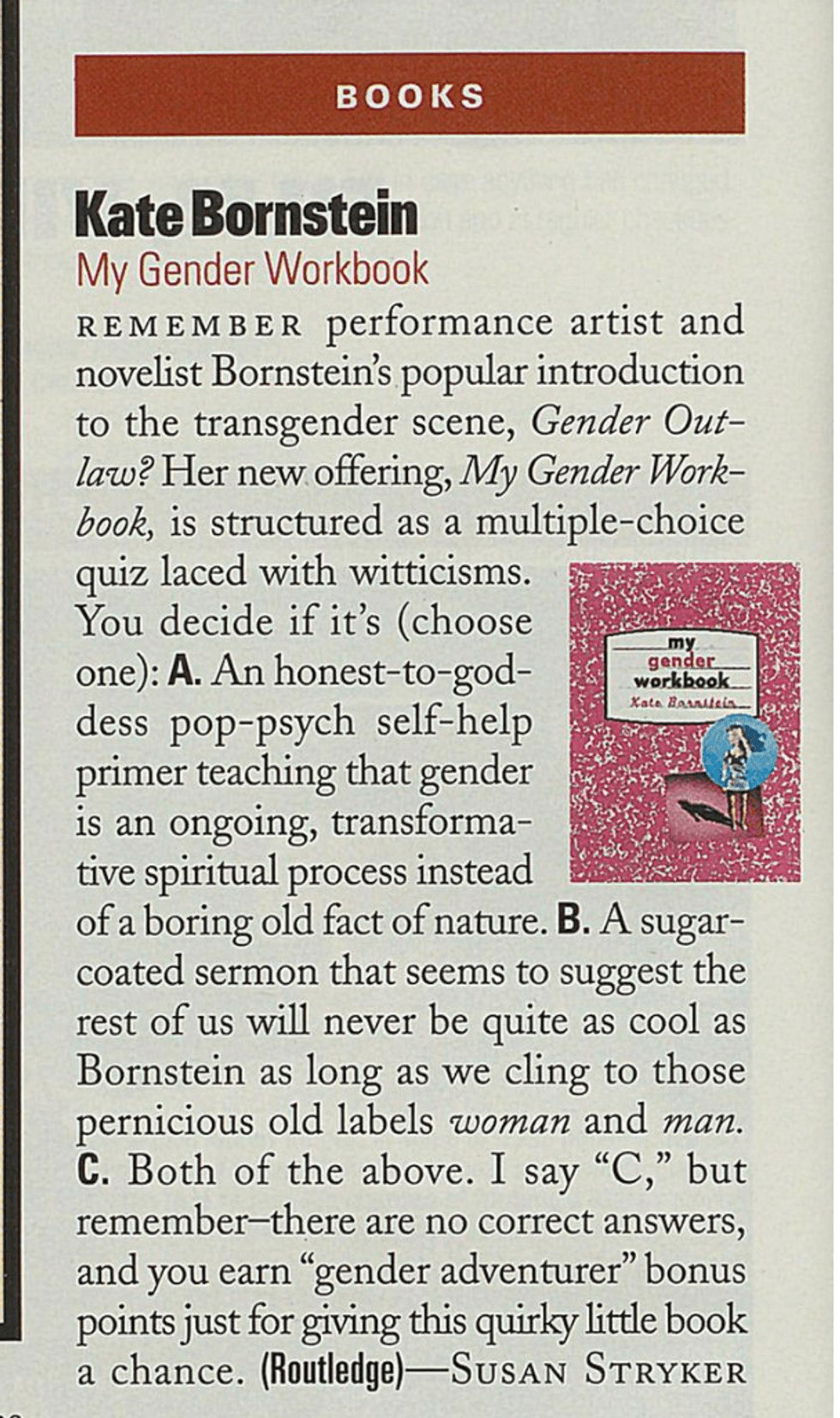
Trans artist Kate Bornstein came back with a new book to her hit Gender Outlaw
“Remember performance artist and novelist Bornstein’s popular introduction to the transgender scene, Gender Outlaw? Her new offering, My Gender Workbook, is structured as a multiple-choice quiz laced with witticisms.” — trans scholar Susan Stryker reviewing the book for the February 1998 issue of Out
Major advancements in HIV treatment were opening up new possibilities
“Could a bolstered immune system keep HIV in check? If so, then the picture may be brighter. Forecasting a positive future, individuals may discover they can live—and stay healthy—without completely eliminating every particle of HIV.” — Anne-Christine D’Adesky writing about the state of HIV treatment in the February 1998 issue of Out
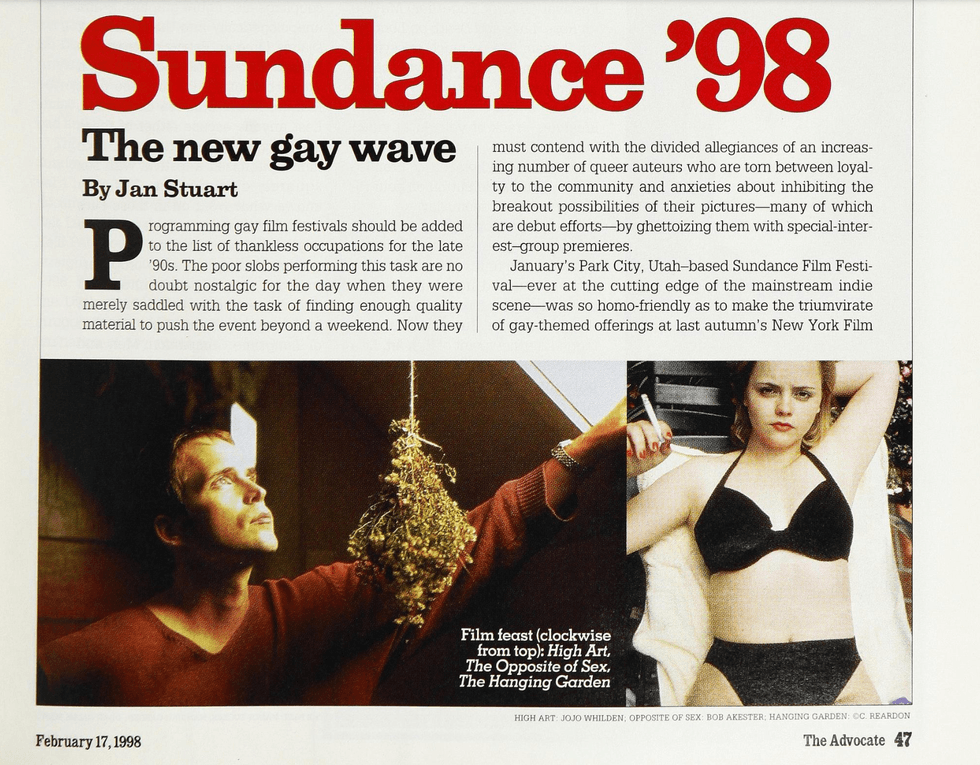
The Advocate was excited for a Sundance premiere featuring a future Yellowjackets star…
“Martin Donovan (who had a torrid love scene with Ian Hart in 1996’s Hollow Reed) gets close to Ivan Sergei in Don Roo’s The Opposite of Sex but has his applecart overturned by a reckless teen sis, played by Christina Ricci.” — Jan Stuart, writing about the very queer lineup of Sundance ’98, for the February 1998 issue of The Advocate
The Advocate runs a headline that feels almost quaint today: “Internet connects those of like interests”
“The Internet has been the best tool I could have for interacting with other people who have my same interests. I haven’t been in a relationship, so occasionally there have been times when I’ve gone out and picked up a trick—but not that many, only seven [in the past year.] There isn’t a lot of emotional attachment that happens. It’s more a way of just getting my rocks off.” — Clay Spillman, a 31-year-old ad executive, speaking to Jeff Ofstedahl for the January 1998 issue of The Advocate

An Advocate editor never could have imagined a show like Ellen would go where it did
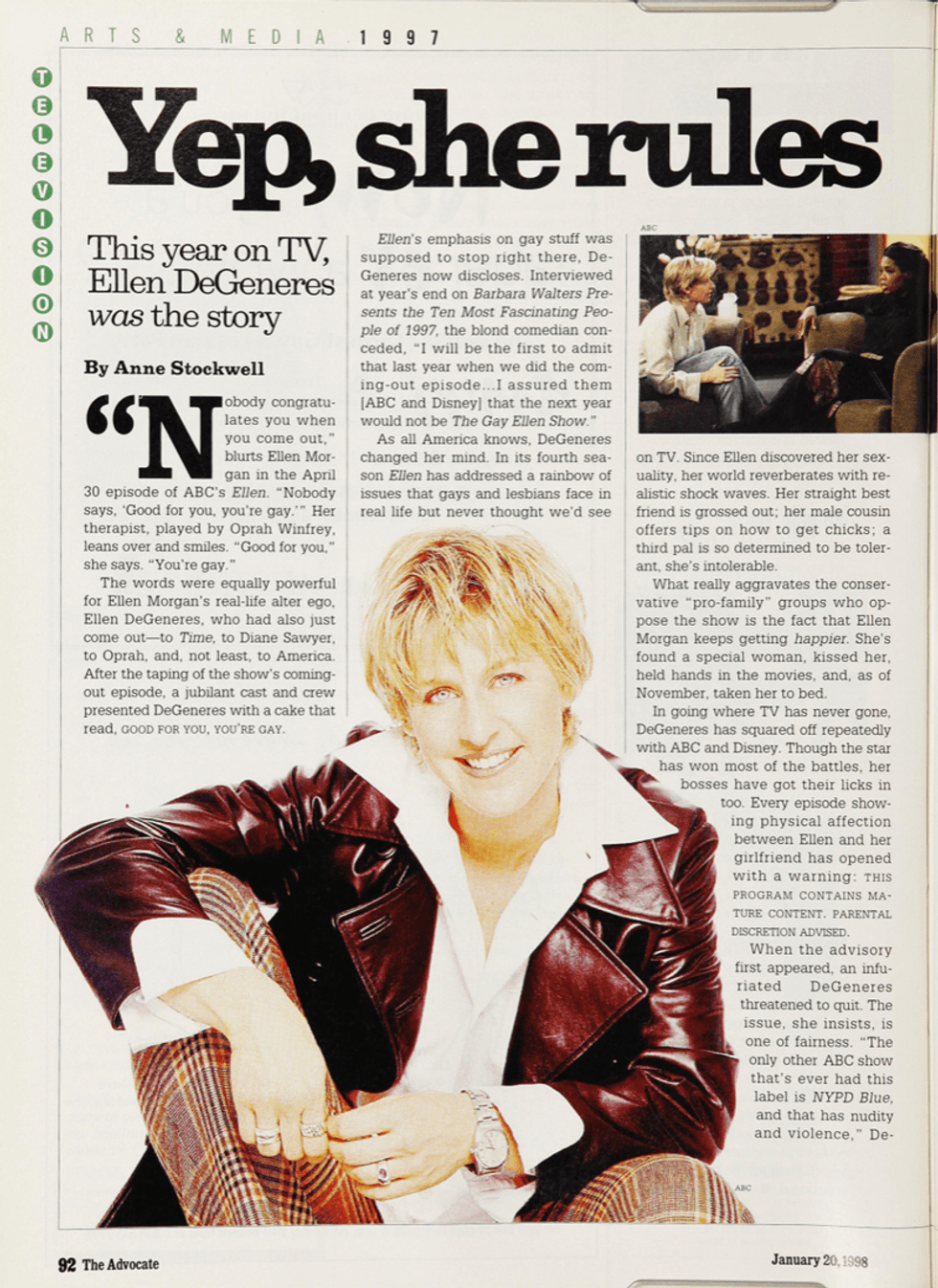
“In its fourth season Ellen has addressed a rainbow of issues that gays and lesbians face in real life but never thought we’d see on TV. Since Ellen discovered her sexuality, her world reverberates with realistic shock waves. Her straight best friend is grossed out; her male cousin offers tips on how to get chicks; a third pal is so determined to be tolerant, she’s intolerable.” — Anne Stockwell, recapping Ellen’s year for the January 1998 issue of The Advocate
Elton John’s “Candle in the Wind” reaches astonishing levels of success, with proceeds going to Princess Diana’s AIDS-inclusive trust
“Who’d have thought that an openly gay man would have the biggest-selling single of all time? Records connected to tragic death routinely do big numbers—think of the posthumous hits by Tupac Shakur and Narvina. Yet John’s revised version of ‘Candle in the Wind’ will probably outsell all of those blockbusters combined.” — Barry Walters, pop music critic, writing for The Advocate’s January 1998 issue
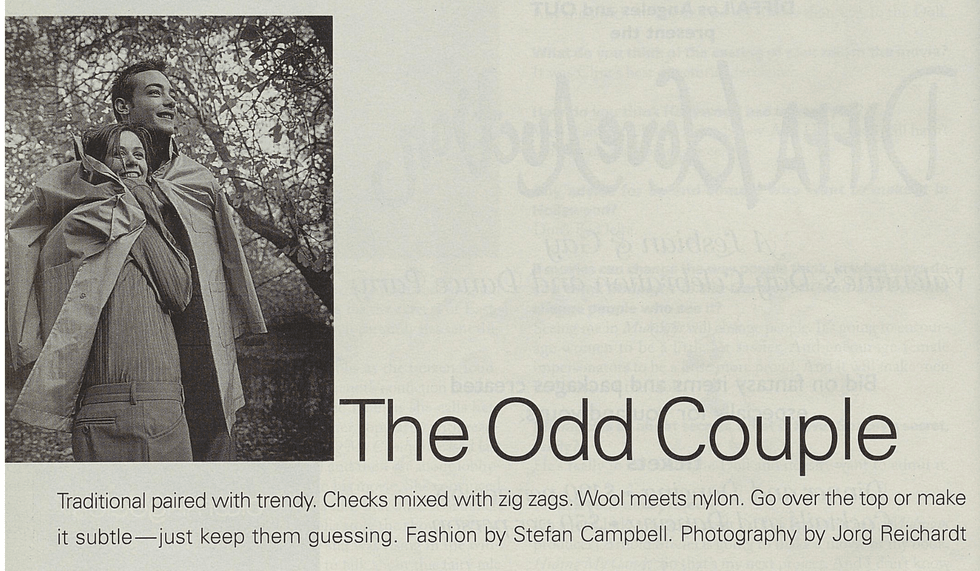
Out’s February 1998 fashion feature focused on “the odd couple”
“Traditional paired with trendy. Checks mixed with zig zags. Wool meets nylon. Go over the top or make it subtle — just keep them guessing.” (Fashion by Stefan Campbell, photography by Jorg Reichardt)
- YouTube
Get the best of what’s queer. Sign up for Them’s newsletters.