


Here is the thing about being seen by another trans woman on the New York City subway: It is nothing like being seen by anyone else, and both of us know it, and neither of us will say so, because we are New Yorkers and we have standards. What most of us will do, reliably, on Friday and Saturday nights when the train is running and the earrings are good and the week has been survived, is this: We will look at each other for exactly two seconds longer than strangers usually look at each other on the New York City subway, which is to say we will look at each other at all. In those two seconds, something passes between us that most of us have spent years trying to name and have decided, finally, to simply observe.
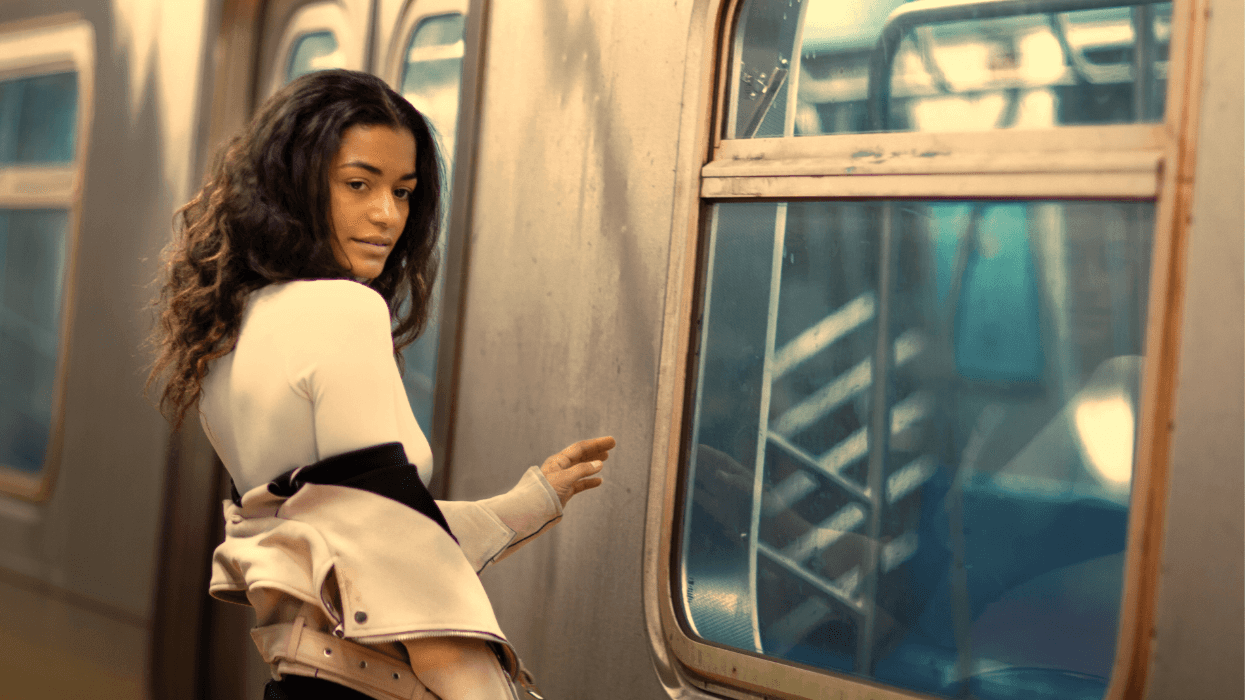
Let me set the scene, because the scene matters. It is somewhere between 10 and 11 p.m. on a Friday night, and I am on the express train heading downtown from the Upper West Side, preparing to meet my friend and transfer across the East River to Williamsburg, where I'll spend three hours being completely, exhaustingly, gloriously myself in a room full of people who understand that this joy — the kind Stonewall was about, the kind that had to be fought for — is well alive and endures. I am wearing the earrings I bought during one of the Trump administration's regularly scheduled news cycles of needing a villain and, as usual, settling on us (the fourth one this month, if memory serves). This is how I shop now, by national mood, like a very specific index fund. And then, there she is, just walked into the subway and seated across from me, or framed in the doorway just before the doors close. The exact geometry changes depending on which Friday I'm remembering, because this has happened more than once.
She looks at me. And what follows is so small it would register on a security camera as nothing. A micro-expression, a not-quite-smile, a gaze sustained for the length of time it takes to detect or clock someone trans and be clocked in return. It is also, not coincidentally, the length of time it takes to decide that someone is safe. And yet, I will be thinking about it for the rest of the week.
This is the trans gaze, and before you assume you know what that means, let me clarify. The world has been getting us wrong for long enough that I have stopped leaving it to inference. It is not about being looked at. It is about being kept in view and looked after, preferably by another trans person who knows exactly what the view costs. It is profound and practical in equal measure. The joy of seeing trans people and women not merely survive the week, but arrive at Friday dressed however they please and headed to their life. Visible in the world, represented in their complexities, seen not as a problem but as belonging in view without question.
I should say who we are, because context is a form of respect. I am a Filipina trans woman and an epidemiologist, which means I think in populations and probabilities. It also means that when I see her on the subway, I am, despite my best efforts, doing statistics. The trans people and women I find on these late trains are often Asian, Black, Latina, or multiracial in ways the U.S. Census struggles to capture. These identities do not layer like coats; they fuse, structurally compounding and simultaneous. A Latina trans woman moving through a city at night is not navigating the same city I am, even when we are on the same train. What we share is the knowledge that vigilant navigation is required. And the relief, the genuine, chemical, Friday-night relief, of finding someone else who already knows.
In trans vernacular, "clocked" has traditionally been bad news. It is not a reading, which Dorian Corey in Paris Is Burning described as an art form requiring precision, wit, and a certain genius for the truth, but a detection: your gender noticed, your body converted, without your consent, into someone else's point of interest. Bad news because what follows is unpredictable. A second look, a comment, a follow, a firing, a fist. The range is wide. Being clocked is not an art form; it is exposure.
But here is what I have learned on weekend nights on the subway: a word can be expanded by experience. Film theorist Laura Mulvey gave us "the male gaze" in 1975. Cinema's default eye, she argued, is heterosexual and masculine, its object the woman onscreen, who exists to be looked at rather than to look. It was and still is a gift of a concept. What happens between trans people is the view from the other side of that framing: a gaze that does not fix or diminish or consume but finds and reassures and keeps in view. Being kept in view requires that someone is looking. And looking, really looking, with the attunement trans people develop over time, is not passive. Julia Serano, in Whipping Girl, theorized the architecture of a trans self built against the grain. Janet Mock, in Redefining Realness, showed us what it costs to carry that architecture through a world that keeps trying to undo it. We read this in each other not to expose it, but because we recognize it instantly as the truest part. When she clocks me and I clock her, what passes between us is not exposure. It is recognition. Relief, belonging, and safety in a single glance.
What I want to resist, and will fail to resist, is the epidemiologist's reflex to explain why this matters. So let me explain briefly. Between 2012 and 2021, fatal violence against trans women of color accounted for 95.2 percent of all documented cases (n=229), a rate that would, in any other population, have generated a federal task force by now, and has instead generated a federal task force’s worth of policy aimed in the opposite direction. The N.I.H. has terminated or frozen $22 million in unspent research grants studying trans health, less than a fifth of the cost of parts of a single F-35 fighter jet, and apparently still five times as threatening. We are being, in the precise technical language of my field, unaccounted. And in public health, what is not counted does not generate evidence.
The trans gaze is the refusal to accept invisibility. Conducted in seconds, wordlessly, between strangers on a train. It says: I will keep you in view, regardless of what the paperwork or policy says. To be kept in view by someone who knows exactly what this week cost is witness. And witness, it turns out, is a form of safety.
There is a concept in epidemiology called the "healthy survivor effect": populations facing extraordinary adversity sometimes appear more resilient than expected in the data, not because hardship is beneficial, but because surviving long enough to be counted is itself a kind of selection. Which means every trans person and woman I find on this train is already, statistically, extraordinary. Here in part because something held: a city that has not yet abandoned trans rights, a clinic that stayed open, a policy that protected long enough to make it to Friday night. In the years ahead, when policies are hostile and the data is vanishing, the job is to keep every individual that way. In view. Alive and safe.
Across the boroughs, on a Friday night, the city is still throwing the kind of party Stonewall in 1969 already understood: getting to the dance safely, being seen and held by it, was never beside the point. It was the point. The trains back carry people still warm with the night. And sometimes she is there, across the subway bench, the night still on her face. Because getting to the weekend in this particular year is not nothing.
We do the thing. A not-quite-smile, but let’s-keep-each-other-in-view, for the rest of the ride at least. The trans gaze is not pity, which requires one person to be suffering and another to have noticed. It is not quite solidarity either, which, however sincere, has always carried a slight satisfaction of having shown up. The trans gaze is what you get when no one is the tourist. When you look at her and think not I see what you're going through, but we are still in view. Warmer than pity, more honest than solidarity, and on a good Friday, more fun than either. It says, in the seconds available: safe.
I do not know her name. I will have my Monday, and I only hope, with the stubborn hope of someone who has looked at the data and decided to hope anyway, that she will have hers. Walking into a hard-earned job, competent and present, in view of people quietly rooting for her to succeed. Waking up, in 10 years, to the life that was always supposed to be available to her.
The doors open. One of us steps out. Somewhere in this city, a trans woman of color is on her way somewhere, and another trans woman of color, good earrings, overthinking memory, and a night that defies every epidemiological odd, felt the trans gaze. Not to catch each other. Not to read each other. Just to see each other get there.
Arjee Javellana Restar, PhD, MPH, is a social and legal epidemiologist whose work focuses on trans health and policy.
Opinion is dedicated to featuring a wide range of inspiring personal stories and impactful opinions from the LGBTQ+ community and its allies. Visit Out.com/submit to learn more about submission guidelines. We welcome your thoughts and feedback on any of our stories. Email us at voices@equalpride.com. Views expressed in Opinion stories are those of the guest writers, columnists, and editors, and do not directly represent the views of Out or our parent company, equalpride.