


What we wear has always served as a means to wield power. With wigs and makeup, drag queens summon larger-than-life alter egos; with a colored handkerchief tucked in the back pocket of his Levi's, a gay man can broadcast his sexual appetites; and with studs, nose rings, and leather jackets, punks can call out to members of their subculture while also fending off anyone they may want out of their path. Through the ritual of getting dressed, we are transformed, by visual language, into someone entirely new -- identified and differentiated by our chosen armor.
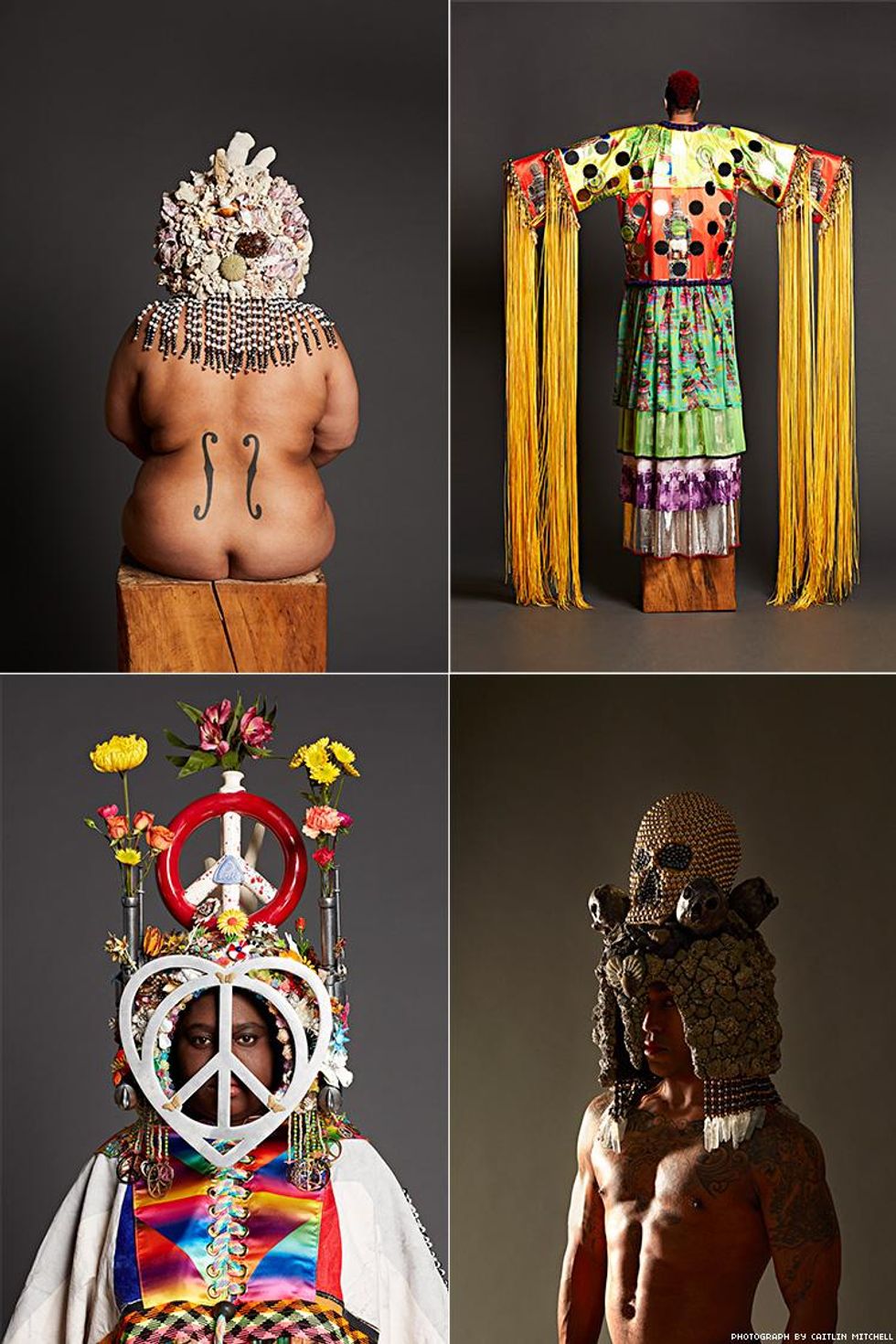
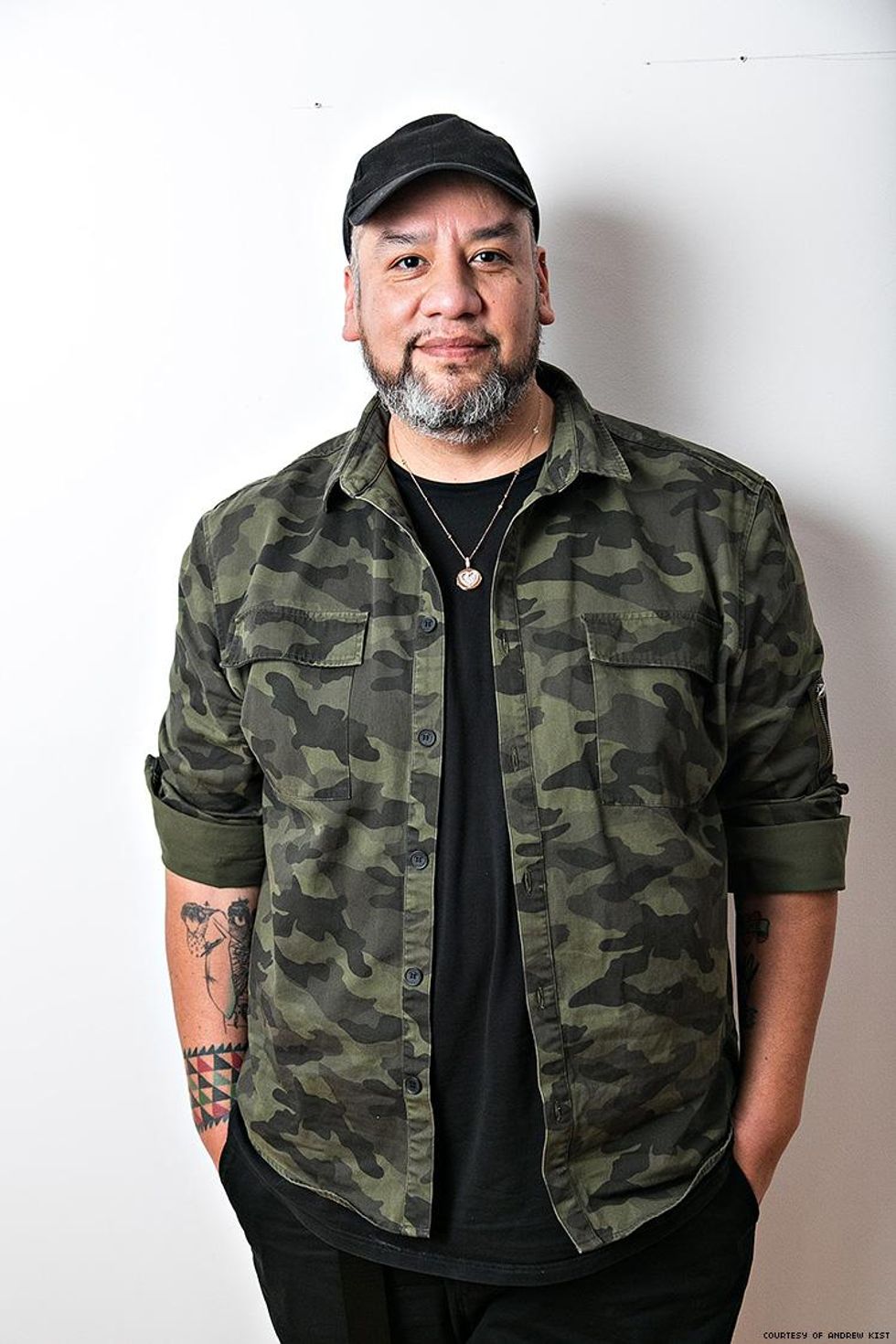
This notion was the launching point for Jeffrey Gibson's exhibition "This Is the Day" at the Wellin Museum in Clinton, N.Y., one of four solo shows now on view from the 46-year-old artist. In addition to more than 50 works of sculpture, painting, and video, there are five helmets decadently adorned with found objects, and seven glorious large-scale tunics hung from tepee poles. A gay man and a Native American of Choctaw and Cherokee heritage, Gibson has woven his own multifaceted identity within the fibrous layers of these tunics, which reference traditional shirts associated with the Ghost Dance movement, originating with the Paiute in the late 19th century.
 "You would make these shirts, and then you would dance in them," says Gibson, who spent much of his youth moving around with his family. (His father, a civil engineer with the United States government, brought him from Germany to New Jersey to Korea and finally to Maryland.) Gibson notes that while he attended powwows, he wasn't raised in a traditional Native American environment. He did, however, absorb the philosophies behind the fashions. "The idea was that [the dance] would bring unity and prosperity and strength back to the tribe, but at the same time, the shirt would protect you from what was called the white man's bullet."
 For the makers of these ceremonial shirts, and for the artisans who keep these traditions alive, there is spirituality in both the process and the performance -- a spirituality Gibson adopts in his own art-making. "There's a tremendous amount of faith in the practice of these artisanal techniques," he says, "which are really about strengthening and continuing cultures that might otherwise not survive. I began to understand that it was a real form of resistance for people to continue to create and to pass down their dance regalia within their communities."
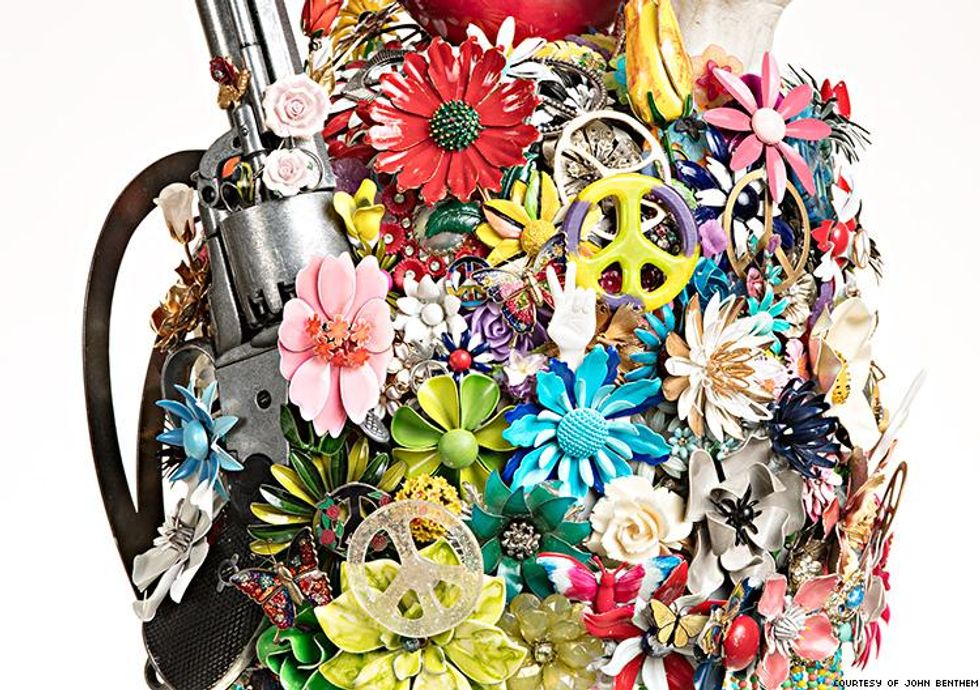
The garments and helmets Gibson has created are an amalgam of far-flung references mined from aspects of his own history as well as pop culture and contemporary political issues. Incorporating a variety of materials (from beads and vintage quilts to chiffon and silk that are digitally printed with Gibson's writing and photos from the Dakota Access Pipeline protests), they are at once a comment on race and religion and an indulgent ode to the richness of identity -- dripping with fringe ribbons. Exaggerated in size and incredibly heavy, the garments are more sculpture than practical garb. They also serve as a nod to the subversive, over-the-top humor that has occasionally left viewers dismissing Gibson's work, even if that type of humor has long been a source of parody in the queer community. "Kitsch and camp, when they occurred initially, were really survival tools," the artist says. "I wanted to embrace that because for a long time, I kind of rejected it...like, 'No, I'm not that kind of gay.' I finally gave in to the glittery, shiny excess."
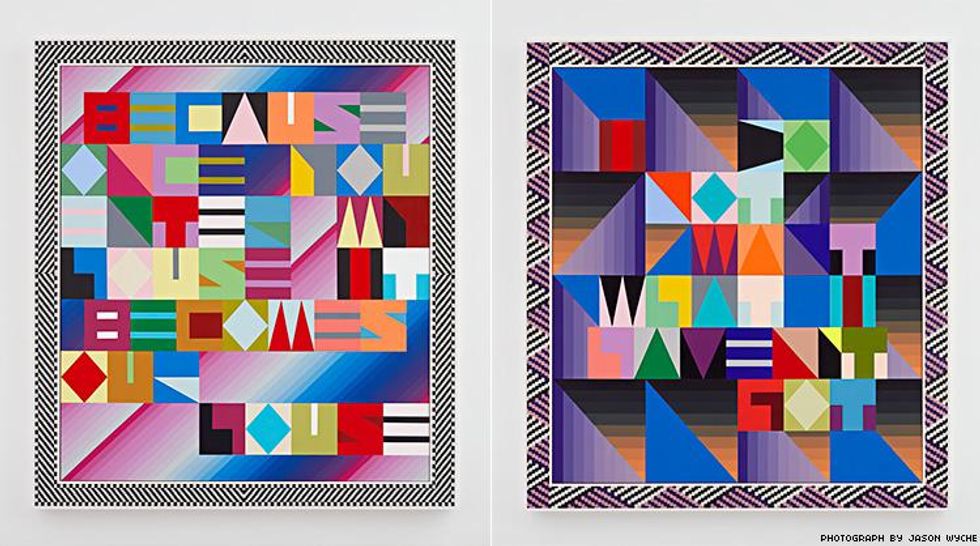 Gibson, who attended the Art Institute of Chicago in the early '90s, began his career as a painter. His signature style is identified by exuberant, technicolor geometric abstractions, a technique he's also applied to his garments. "I think about everything from a painting perspective," he says. By which he means, in two dimensions. "Even when I make a three-dimensional object or garment, I think about multiple two-dimensional surfaces coming together. So you really end up with a front and a back, and when the garments are on somebody, you're getting an image."
Another just-opened exhibition, "I Am a Rainbow Too" at Sikkema Jenkins Gallery in New York City, shines a light on Gibson's painting since 2010, showcasing a series of compositions in which, for the central imagery, he has lifted lyrics from '80s and '90s club hits, along with melancholy words from Nina Simone, one of his longtime inspirations.
"I remember going to nightclubs in the late '80s and early '90s and just feeling like, within the club, there was a kind of tribal feel of unity, and feeling like there was family," says Gibson, who relates the celebratory themes in his work to the microcosms of the powwow and the gay club. "I know there was a lot of pain. There were a lot of people dying at that time. There were a lot of people mourning. But somehow, at a club, you were united in celebration."