

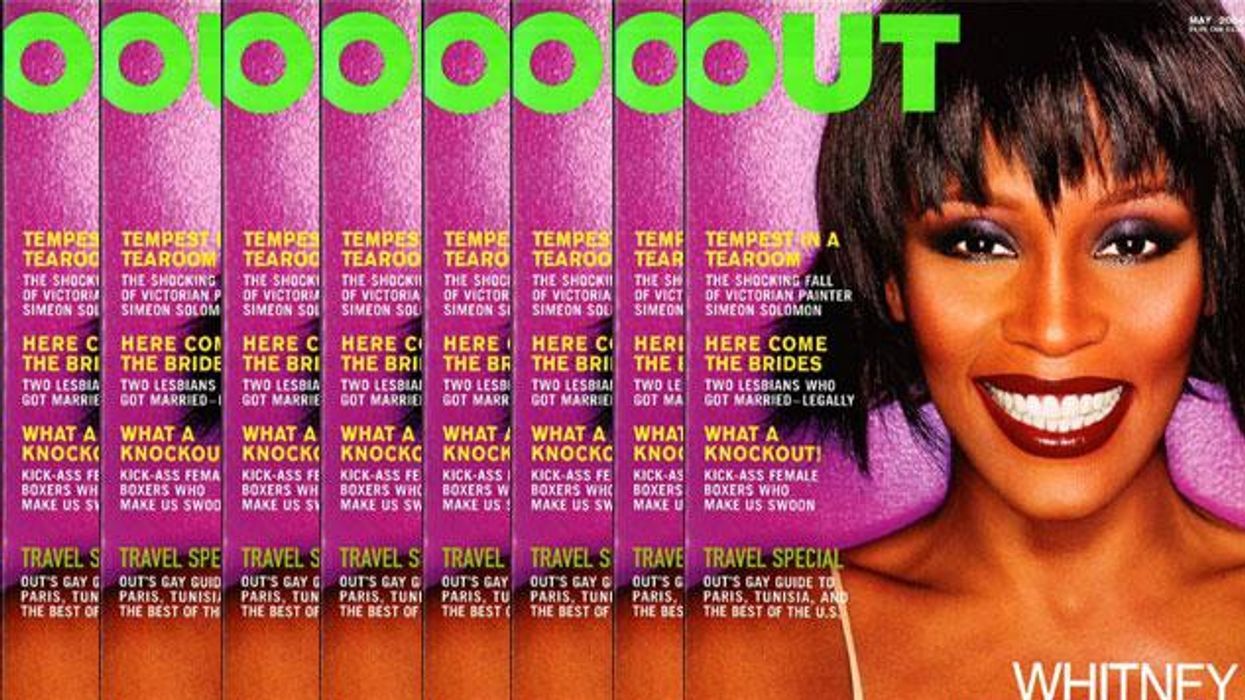

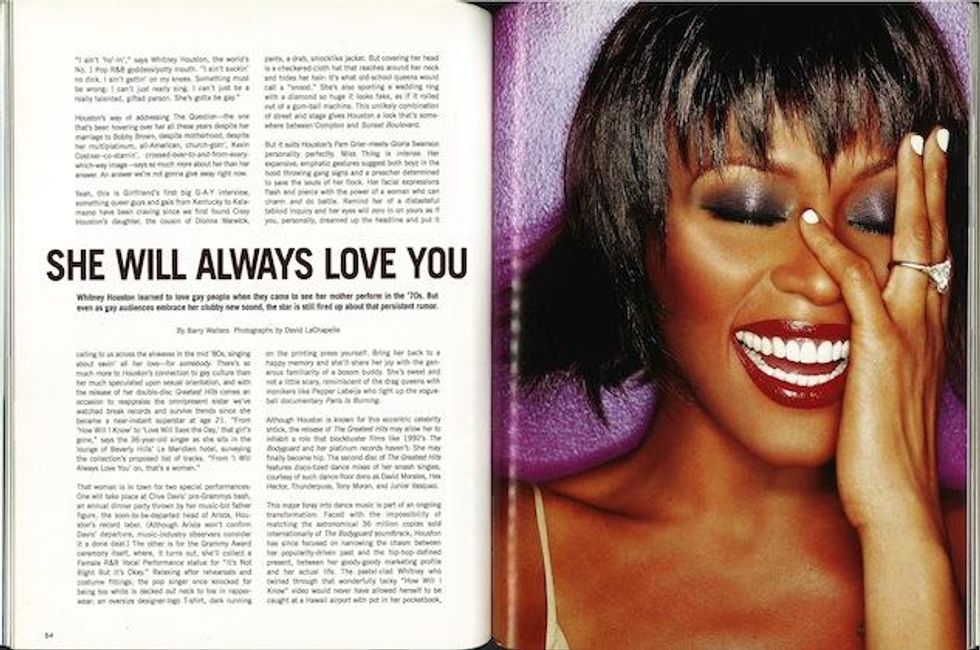
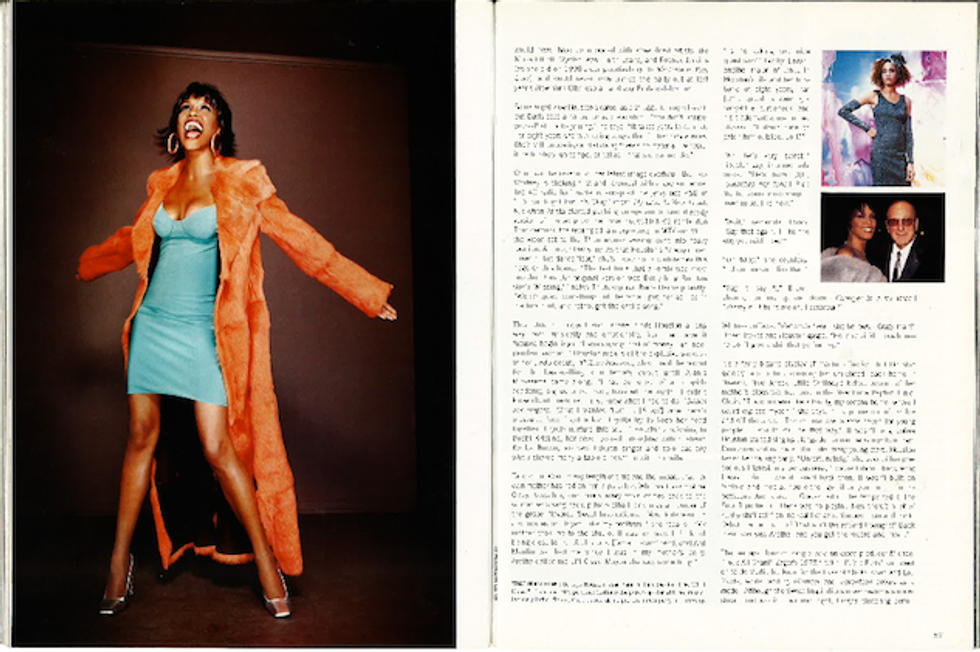
In May 2000, Out magazine published this cover story on Whitney Houston with cover and interior photography by David LaChapelle. In the story, writer Barry Walters asks Houston about the lesbian rumors that had persisted throughout her career and includes the quote: "I suppose it comes from knowing people...who are. I don't care who you sleep with. If I'm your friend, I'm your friend. I have friends who are in the community. And I'm sure that in my days of bein' out, hanging with my friends, having nothing but females around me, something's gotta be wrong with that."
"I ain't 'ho'-in," says Whitney Houston, the world's No. 1 Pop R&B goddess/potty mouth. "I ain't suckin' no dick. I ain't gettin' on my knees. Something must be wrong: I can't just really sing. I can't just be a really talented, gifted person. She's gotta be gay."
Houston's way of addressing The Question--the one that's been hovering over her all these years despite her marriage to Bobby Brown, despite motherhood, despite her multiplatinum, All-American, church-goin', Kevin Costner-co-starrin', crossed-over-to-and-from-every-which-way image--says so much more about her than her answer. An answer we're not gonna give away right now.
Yeah, this is Girlfriend's first big G-A-Y interview, something queer guys and gals from Kentucky to Kalamazoo have been craving since we first found Cissy Houston's daughter, the cousin of Dionne Warwick, calling to us across the airwaves in the mid '80s, singing about savin' all her love--for somebody. There's so much more to Houston's connection to gay culture than her much speculated upon sexual orientation, and with the release of her double-disc Greatest Hits comes an occasion to reappraise the omnipresent sister we've watched break records and survive trends since she became a near-instant superstar at age 21. "From 'How Will I Know' to 'Love Will Save the Day,' that girl's gone," says the 36-year-old singer as she sits in the lounge of Beverly Hills' Le Meridian hotel, surveying the collection's proposed list of tracks. "From 'I Will Always Love You' on, that's a woman."
That woman is in town for two special performances: One will take place at Clive Davis' pre-Grammys bash, an annual dinner party thrown by her music-biz father figure, the soon-to-be-departed head of Arista, Houston's record label. (Although Arista won't confirm Davis' departure, music-industry observers consider it a done deal.) The other is for the Grammy Award ceremony itself, where, it turns out, she'll collect a Female R&B Vocal Performance statue for "It's Not Right But It's Okay." Relaxing after rehearsals and costume fittings, the pop singer once knocked for being too white is decked out neck to toe in rapper-wear: an oversize designer-logo T-shirt, dark running pants, a drab, smocklike jacket. But covering her head is a checkered-cloth hat that reaches around her neck and hides her hair: It's what old-school queens would call a "snood." She's also sporting a wedding ring with a diamond so huge it looks fake, as if it rolled out of a gum-ball machine. This unlikely combination of street and stage gives Houston a look that's somewhere between Compton and Sunset Boulevard.
But it suits Houston's Pam Grier-meets-Gloria Swanson personality perfectly. Miss Thing is intense. Her expansive, emphatic gestures suggest both boys in the hood throwing gang signs and a preacher determined to save the souls of her flock. Her facial expressions flash and pierce with the power of a woman who can charm and do battle. Remind her of a distasteful tabloid inquiry and her eyes will zero in on yours as if you, personally, dreamed up the headline and put it on the printing press yourself. Bring her back to a happy memory and she'll share her joy with the generous familiarity of a bosom buddy. She's sweet and not a little scary, reminiscent of the drag queens with monikers like Pepper Labeija who light up the vogue-ball documentary Paris Is Burning.
Although Houston is known for this eccentric celebrity shtick, the release of The Greatest Hits may allow her to inhabit a role that blockbuster films like 1992's The Bodyguard and her platinum records haven't: She may finally become hip. The second disc of The Greatest Hits features disco-tized dance mixes of her smash singles, courtesy of such dance-floor dons as David Morales, Hex Hector, Thunderpuss, Tony Moran, and Junior Vasquez.
This major foray into dance music is part of an ongoing transformation: Faced with the impossibility of matching the astronomical 36 million copies sold internationally of The Bodyguard soundtrack, Houston has since focused on narrowing the chasm between her popularity-driven past and the hip-hop-defined present, between her goody-goody marketing profile and her actual life. The pastel-clad Whitney who twirled through that wonderfully tacky "How Will I Know" video would never have allowed herself to be caught at a Hawaii airport with pot in her pocketbook, would never have collaborated with street-bred artists like Missy Elliot, Wyclef Jean, Faith Evans, and Rodney Jerkins (as she did on 1998's comparatively gritty My Love Is Your Love), and would never have turned the party out at last year's New York City lesbian and gay Pride celebration.
Some might view Houston's career as a struggle to stay relevant, but Davis sees a natural artistic evolution. "You don't unravel yourself at the beginning," he says. "It takes years to do that. For eight years she was doing songs that fit her movie roles. She's still unraveling and showing there's no material--whether it be hip-hop, up-tempo, or ballad--that she cannot do."
Whatever the reason for her latest image overhaul, the new Whitney is clicking first and foremost with a gay audience. Top 40 radio halfheartedly accepted the jerky neo-R&B of "It's Not Right But It's Okay" (from My Love Is Your Love), but when Arista started pushing an up-tempo, circuit-ready version of the song by the tribal-house/Hi-NRG remix duo Thunderpuss, the revamped jam exploded; on MTV and VH1, the video set to the Thunderpuss version went into heavy rotation. Although Davis insists that Houston's "always been queen of the dance floor," she's never had a club record this huge or this homo. "The last time that a remix was more popular than the original version was Everything But the Girl's 'Missing,'" notes Thunderpuss' Barry Harris proudly. "We scrapped everything but the vocal, put her ad-libs in the forefront, and rethought the entire song."
This latest hit, urgent and urbane, finds Houston a long way, both musically and emotionally, from her naive if focused beginnings. "I was singing, makin' money--an independent woman," Houston recalls of the explosive success of her 1985 debut, Whitney Houston, which held the record for the best-selling solo female debut until Alanis Morisette came along. "I had come out of an all-girls academy, signed a contract, traveled the world--I didn't know about pressure. I just knew what I had to do. [Snaps her fingers.] What I wanted from it. [Snap!] Now there's pressure. Now I got a kid. I gotta try to keep her head together. I gotta nurture this soul." Houston's referring to Bobbi Kristina, her seven-year-old daughter with husband Bobby Brown, ex-New Edition singer and solo bad-boy who's shared many a tabloid headline with his wife.
Talk to Houston for any length of time and the impact that her own mother has had on her is palpable: Whitney loves mother Cissy, loves her, and nearly every topic comes back to the woman who sang backup for Aretha Franklin as a member of the gospel-flavored Sweet Inspirations. "Most kids went to the movies or played, like my brothers," she recalls. "My mother took me to the studio. It was her way, I think, of being close to me. Aretha and [famed record producer] Arif Mardin watched me since I was in my mother's belly. Aretha called me Li'l Cissy. Maybe she saw something."
"Is he asking you nice questions?" Bobby Brown, another major influence in Houston's life and her husband of eight years, has just dropped by, wearing a baby-blue turtleneck and his trademark wire-rimmed glasses. "I don't have to catch him outside, do I?"
"No--he's very sweet," Houston says in a motherly voice. "He's from OUT. [Switches her tone.] Pick me up some miso soup. I need miso, like now."
"Wait," responds Brown. "Say that again. I like the way you said 'now.'"
"Oh baby," she counters. "I didn't mean it like that."
"Say it, say it," Brown chants, jumping up and down. [Changes to a fey voice.] "Ssssay it; it turns me on, I sssswear!"
Whitney guffaws. "Get outta here!" she bellows. "Crazy man!" Brown leaves and Houston gasps, "He is so sick! I love him--and he don't give a shit that you're gay."
It's a fairly bizarre display of marital affection, but Houston quickly returns to discussing her childhood, back home in Newark, New Jersey. Little Whitney's kiddie version of her mother's pipes was nurtured in the New Hope Baptist Junior Choir: "The choir was like a family, my second home, where I could express myself," she says. "It kept me out of trouble and off the street. The church was a safe haven for young people. It should still be that way." It wasn't long before Houston started singing alongside her mother at nightclub performances and in the studio. Like many young stars, Houston heard her calling early. "Unfortunately," she says of her precocious interest in show business, "'cause I didn't know what I was in for. It was different back then. It wasn't built on tabloid and media. You either got it or you don't; no in-betweens. Aretha had it. Gladys had it. The Temps had it. The Four Tops had it. There was no playin'. Now there's a lot of studio stuff goin' on, no real live acts. You see them and think, 'What the hell is this? That ain't the record I bought!' Back then, you saw Aretha, and you got the record and more."
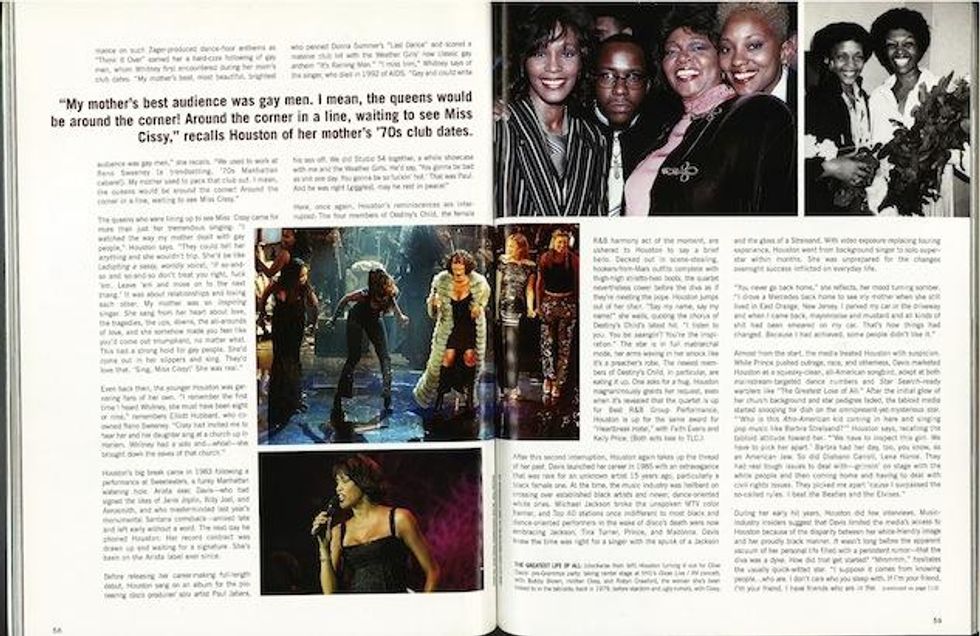
The teenage Houston sang a solo on disco producer Michael "Let's All Chant" Zager's 1978 track "Life's a Party" and went on to do studio backups for the likes of Chaka Khan and Lou Rawls, while landing Glamour and Seventeen covers as a model. Although the Sweet Inspirations never became a mainstream success in their own right, Cissy's blistering performance on such Zager-produced dance-floor anthems as "Think It Over" earned her a hard-core following of gay men, whom Whitney first encountered during her mom's club dates. "My mother's best, most beautiful, brightest audience was gay men," she recalls. "We used to work at Reno Sweeney [a trendsetting, '70s Manhattan cabaret]. My mother used to pack that club out. I mean, the queens would be around the corner! Around the corner in a line, waiting to see Miss Cissy."
The queens who were lining up to see Miss Cissy came for more than just her tremendous singing. "I watched the way my mother dealt with gay people," Houston says. "They could tell her anything and she wouldn't trip. She'd be like [adopting a sassy, worldly voice] 'If so-and-so don't treat you right, fuck 'em. Leave 'em and move on to the next thang.' It was about relationships and loving each other. My mother was an inspiring singer. She sang from her heart about love, the tragedies, the ups, downs, the all-arounds of love, and she somehow made you feel like you'd come out triumphant, no matter what. This had a strong hold for gay people. She'd come out in her slippers and sing. They'd love that. 'Sing, Miss Cissy!' She was real."
Even back then, the younger Houston was garnering fans of her own. "I remember the first time I heard Whitney, she must have been eight or nine," remembers Elliott Hubbard, who co-owned Reno Sweeney. "Cissy had invited me to hear her and her daughter sing at a church up in Harlem. Whitney had a solo and--whoa! --she brought down the eaves of that church."
Houston's big break came in 1983 following a performance at Sweetwaters, a funky Manhattan watering hole. Arista exec Davis--who had signed the likes of Janis Joplin, Billy Joel, and Aerosmith, and who masterminded last year's monumental Santana comeback--arrived late and left early without a word. The next day he phoned Houston: Her record contract was drawn up and waiting for a signature. She's been on the Arista label ever since.
Before releasing her career-making full-length debut, Houston sang on an album for the pioneering disco producer/solo artist Paul Jabara, who penned Donna Summer's "Last Dance" and scored a massive club hit with the Weather Girls' now classic gay anthem "It's Raining Men." "I miss him," Whitney says of the singer, who died in 1992 of AIDS. "Gay and could write his ass off. We did Studio 54 together, a whole showcase with me and the Weather Girls. He'd say, 'You gonna be bad as shit one day. You gonna be so fuckin' hot.' That was Paul. And he was right [giggles], may he rest in peace!"
Here, once again, Houston's reminiscences are interrupted: The four members of Destiny's Child, the female R&B harmony act of the moment, are ushered to Houston to say a brief hello. Decked out in scene-stealing, hookers-from-Mars outfits complete with thigh-high stiletto-heel boots, the quartet nevertheless cower before the diva as if they're meeting the pope. Houston jumps out of her chair. "Say my name, say my name!" she wails, quoting the chorus of Destiny Child's latest hit. "I listen to you. You be saangin'! You're the inspiration." The star is in full matriarchal mode, her arms waving in her smock like it's a preacher robe. The newest members of Destiny's Child, in particular, are eating it up. One asks for a hug. Houston magnanimously grants her request, even when it's revealed that the quartet is up for Best R&B Group Performance; Houston is up for the same award for "Heartbreak Hotel," with Faith Evans and Kelly Price. (Both acts lose to TLC.)
After this second interruption, Houston again takes up the thread of her past. Davis launched her career in 1985 with an extravagance that was rare for an unknown artist 15 years ago, particularly a black female one. At the time, the music industry was hellbent on crossing over established black artists and newer, dance-oriented white ones. Michael Jackson broke the unspoken MTV color barrier, and Top 40 stations once indifferent to most black and dance-oriented performers in the wake of disco's death were now embracing Jackson, Tina Turner, Prince, and Madonna. Davis knew the time was right for a singer with the spunk of a Jackson and the gloss of a Streisand. With video exposure replacing touring experience, Houston went from background singer to solo superstar within months. She was unprepared for the changes overnight success inflicted on everyday life.
"You never go back home," she reflects, her mood turning somber. "I drove a Mercedes back home to see my mother when she still lived in East Orange, New Jersey. I parked my car in the driveway and when I came back, mayonnaise and mustard and all kinds of shit had been smeared on my car. That's how things had changed. Because I had achieved, some people didn't like it."
Almost from the start, the media treated Houston with suspicion. While Prince pushed outrage, race, and otherness, Davis marketed Houston as a squeaky-clean, all-American songbird, adept at both mainstream-targeted dance numbers and Star Search-ready warblers like "The Greatest Love of All." After the initial glow of her church background and star pedigree faded, the tabloid media started snooping for dish on the omnipresent-yet-mysterious star. "'Who is this Afro-American kid coming in here and singing pop music like Barbra Streisand?'" Houston says, recalling the tabloid attitude toward her. "'We have to inspect this girl. We have to pick her apart.' Barbra had her day, too, you know, as an American Jew. So did Diahann Carroll, Lena Horne. They had real tough issues to deal with--grinnin' on stage with the white people and then coming home and having to deal with civil rights issues. They picked me apart 'cause I surpassed the so-called rules. I beat the Beatles and the Elvises.'"
During her early hit years, Houston did few interviews. Music-industry insiders suggest that Davis limits the media's access to Houston because of the disparity between her white-friendly image and her proudly black manner. It wasn't long before the apparent vacuum of her personal life filled with a persistent rumor--that the diva was a dyke. How did that get started? "Mmmmm," hesitates the usually quick-witted star. "I suppose it comes from knowing people...who are. I don't care who you sleep with. If I'm your friend, I'm your friend. I have friends who are in the community. And I'm sure that in my days of bein' out, hanging with my friends, having nothing but females around me, something's gotta be wrong with that."
Push closer to the Question and Houston's playful demeanor vanishes, replaced by the bitterness that's often defined her media profile. "Listen, I took a lot of grief for shit that wasn't me, OK, 'cause I had friends, 'cause I was close to people," she says, eyes blazing and hands waving. "But that ain't me. I know what I am. I'm a mother. I'm a woman. I'm heterosexual. Period."
"But I love everybody. If I was gay, I would be proud to tell you, 'cause I ain't that kind of girl to say, "Naw, that ain't me.' The thing that hurt me the most was that they tried to pin something on me that I was not. My mother raised me to never, ever be ashamed of what I am. But I'm not a lesbian, darling. I'm not [laughs]." Later, when the interview is over, she introduces me to her assistant, Robyn Crawford, the woman said in the tabloids to be her girlfriend. The introduction suggests these longtime friends have nothing to hide.
I mention to Houston that perhaps her new, public gay friendliness (such as this Out cover story) is not simply an opportunity to make sure the homo market buys a hits package sweetened with dance mixes of songs they've bought several times before, but a chance for her to set the record straight, so to speak, about her sexual orientation, and move on.
"Listen, I always move on," she says. "Nothing can stop me from movin'. What didn't kill me made me stronger, sweetie. [Laughs] People still don't believe me. I did another interview today and after an hour and a half of talking to him, [the reporter] said, 'I still don't know you.' I think he was looking for something he didn't find, trying to understand if I was a jeans girl or a gowns girl. Is she R&B, or is she pop? I am me. I'm a mother, thank you. I love to hear my child call me mommy. That's what I am, not lesbian, not gay, not all the bullshit. I don't wanna hear that. It's over. It's done."
Houston's typical defensiveness suggests, of course, that she hasn't really moved on at all. When I tell her that I believe she's straight, she retorts, "It's not for you to believe me. I don't give a shit if you believe me or not."
Unlike the previous reporter, though, I feel I've glimpsed the real Houston, and what's more, I actually like her. Her feistiness reads as vindictive, but there's a playfulness about her that can put you at ease even when she isn't. And when she's sad, as she is when contemplating a future without Clive Davis at the helm of her label, she reveals true vulnerability. "He treats me like his daughter," Houston says at one point, her eyes filling with tears. "It's been like that for 15 years. I'm gonna miss him."
The arrival of Greatest Hits--shortly before Davis' departure from Arista--marks the end of an era. The significance isn't lost on Houston. First known as Cissy Houston's daughter and Dionne's cousin, then Davis' protege, Whitney has had plenty to prove. But the musical and emotional evolution documented on Hits speaks for itself, and now she's focused on matters closer to home, like being as devoted to Bobbi Kristina as Cissy Houston was to her.
"Sometimes, I swear to you, it feels like nothing is going my way," Houston says with self-aware petulance. "Then I look at my little girl and know that she needs me for me and not anything else. That makes me wanna live on so much harder, 'cause I can't stand to think the world would teach her something I wouldn't teach her. That makes me live, baby."
The next day, at Davis' pre-Grammys soiree, Houston springs to life during her 45-minute set: She's spontaneous, in a way the public rarely witnesses; you can hear how the years have put a growl in her deepened voice and grounded her vocal gymnastics. Surrounded by friends and peers such as Mary J. Blige, Lauryn Hill, and Stevie Wonder, and of course, Davis, Houston gives a strikingly heartfelt performance. But the most memorable sight of the evening--more memorable even than Davis' giving the star a plaque signifying the 110 million Houston albums sold worldwide--is the image of Houston jumping up and down in her spangled black gown during "How Will I Know." The drag has matured, but Whitney still can't keep her feet on the ground.