


If you are a single gay man in search of a mate, and if you are at times prone to discouragement, you probably have friends who reassure you that someday you will find a man who'll cherish every part of you -- even your weaknesses, even your flaws.
If you have been wondering whether to believe this, wonder no more. There are in fact at least a few dozen guys out there who cherish your flaws. They work in Cambridge, Mass., in a historic building topped by a golden statue of Athena, the goddess of wisdom, in an oak-paneled office suite where a grandfather clock marks the passing of the hours. Here the guys who delight in your weaknesses oversee Manhunt.net, the world's fastest-growing gay website, which is quietly abetting a revolution in social and sexual mores, under the slogan 'get on, get off.'
The phrase evokes the product Manhunt sells: a fix of quick sex -- easy in, easy out. To partake, men market themselves in a style shaped by the site's profile template. Profile names, which tend to be histrionically masculine or graphically sexual, appear next to pictures, usually of a beefcake or X-rated variety, often with heads cropped out, accompanied by brief, blunt descriptions of sexual tastes ('I need oral and anal sex all the time'). Beneath these entries lie a series of boxes that can be checked to signal 'What I'm Into' (27 options, including 'JO', 'Exhibition,' 'Pig Play,' 'LTR' -- long-term relationship -- 'Feet/Socks'), 'When I Want It' (the box most frequently checked is 'Right Now!'), 'How I Like It' (top, bottom, etc.), 'Where It Happens' ('Your Place,' 'My Place,' and the popular 'Anywhere'), and 'What I Got' (age, build, ethnicity, eye color, hair color, HIV status, and height). To that last category will soon be added penis length and girth -- 'a controversial issue within the company,' says Manhunt's recently resigned director of marketing Phil Henricks, 'because men lie.'
This wealth of information makes Manhunt seem the most efficient place for its target customers to find sex, because the site's comprehensive search function can produce in seconds a list of, say, brown-eyed bottoms within one mile of your zip code wanting to get it on 'Right Now!'
Manhunt's apparent efficiency owes even more to its staggering number of members. The site's other advertising tag line, 'If he's out there, he is on here,' is only a slight exaggeration. In the United States, Manhunt now has nearly 1 million members, and the site receives more than 400,000 unique visitors per month. If you are among its target customers -- younger, hotter, and richer than average gay men in big cities -- Manhunt is the club that the proverbial everyone (meaning, the guys you've always fantasized about) belongs to.
Who knows? You might even find a boyfriend there. If it's true -- and everybody says it's true -- that sex is the gay handshake, then one of these days maybe you'll hit the jackpot. Thus, even many of the most overbearingly erotic profiles also haltingly express a dream of emotional connection. The headline of one man's ad, next to a big close-up of his butt, asks, 'Are you The One?'
Manhunt was founded in Boston in 2001 by Larry Basile and Jonathan Crutchley, who came into the business via phone chat rooms (they still have that business, but it's dwindling). Separately, both men, now in their 60s, had also made fortunes in real estate. (Among many other properties, Basile owned a hotel and gay bar in the former gay enclave of Boston's South End; today, he lives outside the city in a Frank Lloyd Wright house on a 17-acre farm.)
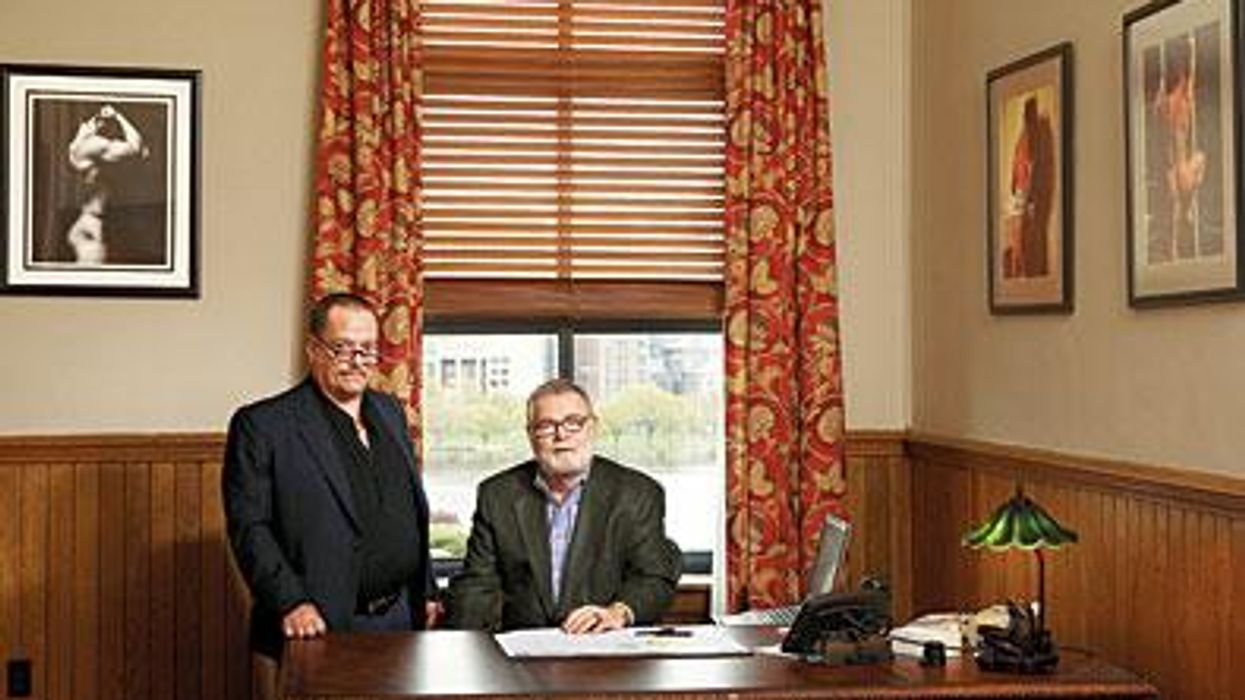
Crutchley, a liberal Republican with a tight white beard, admits that he felt anxious during Manhunt's first years, before his and Basile's initial investment of $800,000 bore fruit. Now, seated at his desk and surrounded by giant photographs of body builders' glutes, Crutchley says the company brings in at least $2.4 million per month -- almost $30 million a year -- not counting ad revenues, and prospects for growth are strong. Manhunt's success measures the extent to which online cruising has changed gay urban social life. Is it changing gay politics too?
I began wondering about this connection at a dinner party on Martha's Vineyard when the host asked why, during the past decade, so many national political victories and legal reforms -- an employment nondiscrimination act, a hate-crimes bill, repeal of the military ban, marriage or civil unions -- have remained beyond our grasp. A fashion photographer from Texas drawled, 'I think it's because so many of us spend so many hours of so many days online, doing things that make us feel ashamed of ourselves.'
We all laughed, and the conversation rolled on, but the comment stuck with me. Though not an exhaustive answer to the question, it is (for the kind of men who were at that dinner party, for the kind of men who read this magazine) an important part of the answer, and -- when followed to its logical conclusion -- more than a little unsettling.
During the 15 years since America Online men-4-men chat rooms introduced mass-market online cruising (earlier Internet cruising technologies, like IRC chat rooms, were mostly for techies), some aspects of our lives have become more visible than ever. We are ubiquitous in mainstream culture; we are out to our families, friends, and employers; we're able to hold hands in public, in some places, without having to worry that we might get beaten up; and some states and cities now permit gay marriage or civil unions (more will inevitably follow now that California has joined Massachusetts). As this wave of enculturation advanced, AIDS treatments made the ravages of that disease less visible and dispelled the sense of crisis that strengthened our connection to each other in the 1980s. These factors, along with straight gentrification of gay neighborhoods and the growth of the long-tail economy, hastened the decline of many urban gay enclaves, and the demise of many bars, businesses, and social groups that gave structure to gay life.
'Post-gay' social life grew mixed, and the physical drive that defines us as gay -- the drive to have sex with each other -- increasingly found vent online. This aspect of our lives became more private, and even secret, than ever. In 1993, 2.3% of gay men found their first male sexual partner online. In 2003 the number was 61.2%. (These figures come from the United Kingdom, and there's been no parallel study in the United States, but sociologists believe the findings here would be similar.)
'The implications of that trend are enormous,' says Jeffrey Klausner of the San Francisco Department of Public Health. 'It means that gay men who were once socialized in brick-and-mortar establishments, surrounded by other people, are now being socialized online.' Gay men still go out as well, but our nightlife habits are very different than they were 12 years ago. Jeffrey Parsons, professor of psychology at New York's Hunter College, says his unpublished research confirms the common sense that 'when guys go to bars, they're going to be with their friends, not to meet new people.'
The same thing is happening all over the world, and Manhunt is going global. Already catering to members in over 100 countries, Manhunt has recently expanded into such unexpected realms as China and India. In March of this year foreign memberships numbered 600,000, and worldwide, Manhunt adds 30,000 new members per week. Matt Foreman, former executive director of the National Gay and Lesbian Task Force, notes with some awe that Manhunt's membership is 'larger than the membership of every major gay political organization combined.'
Manhunt's annual income from memberships alone is roughly the same as the total amount of individual contributions to this country's two biggest gay political groups, the Human Rights Campaign and NGLTF. Foreman says, 'If we could leverage their membership for activism, there's no limit to what we could do.'
When the Department of Justice considered requiring proof of age for all Americans who post naked pictures of themselves online (ostensibly as part of an effort to crack down on child pornography), a link on Manhunt directed members to NGLTF's website for instructions on how to stop the regulation from taking effect. 'We got 130,000 hits in a two-day period and it crashed the site,' Foreman marvels. It was the heaviest site traffic in NGLTF's history, a fact that Foreman optimistically interprets as a reaction to the 'Bush administration's infringements on rights to privacy.' But there's another plausible reading of this activist surge: Perhaps the right that gay men are most willing to fight for is the right to cruise online.
I am not scolding. I have done practically every stupid thing a guy can do on Manhunt. I don't like to think about the number of books I could have read, languages I could have learned, and friends I could have stayed in better touch with if I had not wasted so much time cruising online these past 12 years. I hesitated to write this essay, because I am not proud of having acted like a moron, and because contemplating the just deserts of my online adventures is unpleasant.
I decided to write this piece anyway, because after I reflected on my own experience, talked to friends about theirs, and interviewed shrinks and doctors and academics, political activists, historians, journalists, novelists, and, via e-mail, heard from many dozens of random guys about how online cruising in general, and Manhunt in particular, has changed our lives, I found that their answers, taken together, told a surprisingly common story about the way gay men keep secrets and the destructive power those secrets hold.
Manhunt is the elite gay world's big secret. An acquaintance and his boyfriend, both successful executives, first met on a Manhunt hookup; months later they were married in a castle, surrounded by friends and family, few of whom have any idea how the couple met. We don't tell straight people about Manhunt. We don't even tell them it exists. And even when we do, we usually don't tell them what it's really like.
Manhunt is rarely mentioned in newspapers or magazines. Occasionally it shows up in stories about public-health crises (of which more later). A little more often, reporters discover the Manhunt profiles of public figures, who are subsequently embarrassed, or worse. The mayor of Spokane, Wash., and the chairman of the school board in Richmond, Va., for instance, both lost their office after their Manhunt profiles were made public. Last year, a 24-year veteran of the Norwalk, Conn., police department was arrested for having sex with two 15-year-old boys and trying to arrange to meet a third -- all of whom he found on Manhunt. Nude pictures from profiles reputed to belong to Thomas Roberts, the former CNN anchor, and American Idol runner-up Clay Aiken, were circulated on blogs and mentioned in gossip columns. And yet Manhunt members still seem to think they can get away with anything there: The profile of one of the world's most powerful entertainment executives includes full-length naked photos of him, clearly showing his face, having sex with another man. Another famous master of industry advertises on Manhunt as a hung top, with a headless version of a widely published portrait of himself. God only knows how many more ticking time bombs lie among the profiles.
But the most powerful secrets that live on Manhunt aren't the ones we keep from the outside world. The most powerful secrets on Manhunt are the ones we keep from ourselves. Practically every gay man has his own version of this secret, which we learned to keep while growing up in the closet: the secret fear that, if we were truly known, we would never be loved.
If you were asked to design the perfect weapon to exploit this vulnerability as it manifests itself in attractive, urban gay men, you'd want something that would intensify our isolation, exaggerate our propensity to objectify each other, and persuade us to objectify ourselves -- by encouraging us to believe that our purpose is to look good and have lots of sex.
Manhunt would be your perfect weapon, a heat-seeking missile for the weaknesses that have plagued us for decades. Perry Halkitis, a New York University associate dean and professor of applied psychology, says, 'Manhunt is a symptom. It does well because we don't know how to relate to each other and we don't know how to take care of ourselves.' Dan Savage, author of the sex column 'Savage Love' and editor of Seattle's The Stranger newspaper, says, 'Manhunt is a tool. Big, bad Manhunt doesn't make guys drag themselves to the webcam and take all those pictures of their dicks.'
It does, however, offer powerful incentives to do so. When we started cruising online, neither I nor any of my friends would have dreamed we'd post naked pictures of ourselves for strangers to see. Now almost all of us have done it. When we crossed that line most of us felt we were violating ourselves. But it got us laid. We took more pictures -- better ones -- because the hotter our pictures, the more we got laid. When we questioned our choices, we reminded ourselves, We're gay, this is our culture, Manhunt is the 21st-century gay bar, and you can't stop progress. Besides, every fuck, we rationalized, was another chance to find a boyfriend. Yet the more we did this, the fainter grew the hope of finding something more meaningful than a hookup. As our hopes faded, we learned to see one another, and finally even ourselves, as things.
When I say all of this to Larry Kramer, he asks, 'Do you realize you're quoting me?' In F****ts, Kramer's satirical novel of gay New York and Fire Island, published in 1978, the protagonist, wandering through a culture that has reduced its members to meat, exclaims, 'I'm tired of using my body as a faceless thing to lure another faceless thing, I want to love a Person!'
Gay urban life has always been a meat market, and cruising, you could argue, has always been a form of consumption. For gay men seeking sex, as for all kinds of shoppers, the Internet removed constraints of space and time on access to the market -- and at the same time offered an unprecedented range of products to choose from. Basile says that, from the start, he wanted Manhunt to be 'like eBay for men,' where users could find anything they wanted.
Yet cruising, unlike shopping, requires a buyer to also make himself a seller. And selling yourself online, unlike selling yourself in the meat markets of bars and clubs, requires you to create a sexy image that stands separate from your physical self.
You must create, in other words, a pornographic version of yourself, a thing that represents you but is not you. Michael W. Ross of the World Health Organization believes that such dissociation speeds development of a sense of intimacy, which accelerates the pace at which two people decide to trust each other, which increases the likelihood of their engaging in risky behavior.
There's still scant research linking online cruising to the most extreme risky behavior -- crystal meth use and unprotected sex. In the age of bioterrorism and bird flu, gay men's health and our mating habits are not of primary concern to most grant-making bodies. And relevant study results are somewhat inconclusive. Two recent studies indicate that men who have unprotected sex are equally likely to do so with partners met online or offline.
A number of others, though, indicate that men who hook up online are more likely to have unprotected anal sex, more likely to use drugs, and more likely to report having received money or drugs in exchange for sex. A San Francisco study found that men who hook up online were four times more likely than men who meet elsewhere to have unprotected sex with someone of opposite or unknown serostatus. In Boston, epidemiologist Matthew Mimiaga says that 'the vast majority' of subjects in his study of HIV-positive men who believe they contracted the virus while doing crystal meth first encountered that drug in the context of an online hookup. (Manhunt has been praised by some health officials for making information about safer sex and drug abuse available through its site, but no one really knows whether these activities amount to much more than a fig leaf.)
Both quantitative and qualitative analyses -- of health risks and of the psychological dissociation that's characteristic of online social life -- point to sobering conclusions about the utility of habitual online cruising for men who say they want to find love. You might as well train for a marathon by doing sprints on a minefield.
To pretend that the choice to have immense numbers of sexual encounters with little or no emotional context is value-neutral -- long an article of faith of modern gay life -- is a mistake. Decoupling sex from emotion is a fool's errand, and Manhunt seems to be the fullest expression of this project. It is hard to see how it could go any further.
It is about to go further.
Last winter Manhunt put out a casting call on its website asking for members to volunteer to have sex with each other on-camera. In short order 211 men had volunteered. Of these, Manhunt employees chose 40, paired them up, and sent well-known porn stars to digitally tape their hookups. Each performer was paid $1,000 for the right to show these videos on Manhunt's sister site, OnTheHunt.com, which went live in June -- Gay Pride Month.
Appearing in these videos will have the immediate effect of inflating the performers' prestige in Manhunt's membership at large. The long-term effects of Manhunt members' choice to do porn are less clear.
Employers now routinely reject job applicants after checking MySpace and Facebook profiles for suggestions of irresponsible or reckless behavior. Yet the explosion of amateur online porn has given many gay men, particularly younger men, a remarkable sense of security about their choice to perform. Last year a medical student in Manhattan told me he decided to have sex on-camera because 'I'm not going to run for the Senate. I'm going to be a doctor in New York City. If anything, being a gay porn star is something to talk about at a cocktail party. That sort of thing here is like, 'Oh you were in porn? Me too!''
The project of pornographying ourselves while cruising online -- whether by taking naked self-portraits in the mirror, masturbating with another guy via webcam, or volunteering to go for broke on OnTheHunt.com -- can impair or devastate gay men's ability to find intimacy with one another. 'It means you're always looking for the better or the best,' says Detroit psychologist Joe Kort. 'This is the negative effect of a culture where people spend lots of time looking at pornography and judging each other primarily based on naked pictures of each other: You always think there's something better, because you're seeing it -- it's out there -- so why shouldn't you hold out for somebody whose looks are everything you dream of?'
The seemingly endless stream of available men on Manhunt is, according to marketing director Henricks, 'addictive, like a slot machine. You keep hitting next, to see another screen of profiles, thinking you're gonna get lucky sevens.' This drive, according to Alan Downs, a psychologist and author of The Velvet Rage: Overcoming the Pain of Growing Up Gay in a Straight Man's World, lies at the core of the appeal of online cruising: 'Variable payout schedule, which is used in slot machine designs, is the most addictive form of psychological conditioning, because you never know when you'll get paid. It could be every 10 times you play, or every hundred.' In the same way, Downs adds, 'every time you log on, you never know what you'll find. That's why it expands to fill a person's time. Last night was a bust, but who knows who will be online this morning or tonight.'
How vulnerable are Manhunt users to its addictive quality? 'We're the second-stickiest website in America,' Henricks boasts. 'Stickiness,' he explains, is slang for attention ranking, the measure of the amount of time a user spends on a website each time he visits. According to Compete.com, the Web's Nielsen equivalent of attention rankings, the average Manhunt user spends 40 minutes on the site per visit. That's about twice the amount of time the average Facebook or MySpace user spends on those sites. And, back to the slot machines, the only website in this country that is stickier than Manhunt is the wildly popular gambling website Pogo.com.
Manhunt's employees can brag about the site's addictive quality because they're not doing anything illegal and because they can count on no one making a moral argument against their business, because no gay man wants to risk sounding anti-sex.
Jim Foster, a leading gay activist in the 1970s, often said, 'What this movement is about is fucking.' We are defined by our sex drive -- and our political goals amount, essentially, to ensuring that we are in no way legally penalized for it. In our personal lives, even now, almost 40 years after Stonewall, coming out requires a painful exertion of energy to rout the puritan fear that gay sex is bad. To vanquish this fear, especially when first coming out, many of us become preoccupied with the pursuit of sex.
Periods of promiscuity can help us make up for lost time and can be a healthy and meaningful part of our development as gay men. 'When we were teenagers, when straight people were learning how to connect, we didn't learn that,' explains Robert Weiss, a Los Angeles psychologist and the author of Cruise Control: Understanding Sex Addiction in Gay Men.
Yet as cruising migrates to the virtual world, the challenge of integrating desires for sexual and emotional connection can become much more difficult. As teenagers, Weiss continues, 'we learned that we had to survive on our own. That means inside ourselves, many of us don't have an innate belief that other people can meet our needs, which means that we don't believe we can connect with them. Which means I have to rely on myself, I have to live on my own. And there I am, in my bedroom, all by myself. And the computer is in the far corner, and all I have to do is turn it on'.'
When we turn it on, says novelist Andrew Holleran, we enter a world that amounts to 'the nightmare that gay people always have just underneath the surface, the fear that, I'm just my dick. I'm just my body. I'm just my age. It reduces everybody to statistics. You're presuming that nobody will love you for yourself, if you're offering yourself as just a bunch of statistics.'
This is, to say the least, a lonely place to be -- a place that anyone would want to escape. Problem is, the easiest way to salve that loneliness is to go back online. Manhunt 'creates loneliness and then relieves it,' Holleran says. Manhunt offers itself as the way out of the isolation it creates.
Larry Basile, who came out in New York in the 1970s, knows that online cruising intensifies the isolation of gay urban life. 'There was a lot of camaraderie that used to happen at the bars,' which, he says, is harder to find online. Still, he believes Manhunt is a force for good because it allows people in rural areas and smaller cities, where being gay is still stigmatized, to find one another. 'In North Dakota they're using it for dates or to find friends,' he says. Then he tells the story of one depressed young Manhunt member who wrote to another that he was contemplating suicide. The second man forwarded the message to a Manhunt customer service representative, who sent a list of suicide hotline numbers to the depressed young man, who decided not to end his life.
I'm glad that some guys in North Dakota aren't so lonely anymore, and I'm glad the depressed man is still among the living. But do those positive outcomes make up for Manhunt's role in the decline of gay urban life?
When I ask Basile and Henricks to do a cost-benefit analysis of Manhunt's social impact, they don't answer directly. Instead, Henricks reverts to a narcotic platitude about the Web's power to salve loneliness for young gay men in rural areas. To demonstrate Manhunt's reach, he asks me to name a town so tiny that I can't imagine it might have a Manhunt member. A few strokes of the keyboard produce a profile of a man who lives there. The profile says he's 23. When I point out that the kid doesn't look a day over 16, Basile answers, chuckling, 'His mother's MasterCard.' The remark reveals, as much as anything he's said, Basile's awareness of the duplicities and dangers that animate his product, and nurture his profits.
Looking for Mr. Right,' countless Manhunt profiles claim, but until he comes along, they're open to playing with Mr. Right Now. Online cruising has its place in gay society: Access to a satisfying number of Mr. Right Nows is part of the pleasure and the privilege of moving to the big city to be gay.
Beyond a certain point, though, perpetually settling for Mr. Right Now becomes a failure of hope. When you came out, you did it because you wanted something. Part of what you wanted was sex, but part of what you hoped for was the possibility of being loved as your true self. And when, as often happens while cruising online, we diminish the hopes that drew us out of the closet, we reduce sexy to a purely physical act.
When we do these things we lie to ourselves -- and worse, we tell the same lies that our enemies tell about us. The fundamentalist canard about loving the sinner but hating the sin draws a nonsensical distinction between person and act. Cruising online, by encouraging us to separate sex from the rest of our lives, does exactly the same thing. These are falsehoods about human nature and about the place of love in our lives, and they undermine the belief that sex can be anything more than a pastime.
As a normative way of socializing for gay men, online cruising is a disaster. We need to recognize its effects -- including its tendency to isolate us, encourage objectification, and diminish our sense of life's nonsexual possibilities -- as disasters. We need to recognize that too many of us, too much of the time, are cruising online because it is easier and feels safer than thinking about the love we are missing and the power we do not have. Too many of us, too much of the time, are cruising online because it's easier and feels safer than mustering the courage, patience, discipline, and imagination required to help ourselves and each other become the men that, in our strongest moments, we want to be.
Gary Cohan, a physician who treats half of A-list gay Hollywood, says we have to start thinking in a deliberate way about what normal social interaction consists of. 'For a long time,' Cohan says, 'it has been considered normal to be on the Net. We need to start thinking, That's not normal.'
We need to put our heads together and try to figure out what we want normative social life to look like. Whatever the answer turns out to be, it will involve creating social structures that serve and gratify our desire to have sex with each other and also promote and support the possibility of developing and sustaining intimate relationships. Gay men came close to the goal of building such a society when they were hit with the plague of AIDS. That generation learned the rewards of sacrifice and of setting limits on the place of sex in our culture. But to those of us who were children or teenagers during the epidemic, AIDS made coming out so scary that we preferred to avoid getting too involved in our gay forefathers' world.
And along came the Internet, a tool that let us build gay lives without having to get very involved with older people -- not that, if we'd wanted to, there were a whole lot of them still living. Now, though, it seems our avoidance has created a different kind of society, more isolating, more brutal, and weaker. We still don't know how to have enduring relationships. We still don't have examples. We still don't have mentors. We still don't have courtship rituals. We are still getting HIV.
We celebrate the fact that we're out to the straight world, even though the only thing that means, in many cases, is that they know we're gay.
When we logged on, I don't think most of us realized we were creating new secret lives. I don't think we knew what we were getting into. But we got into it. For most of us, this is not working. And if it's not working for you, then it's time to get off.