


A Tribe Called Queer

1.11.2012

By Jon Roth

In the Native American community, two spirits can be better than one.

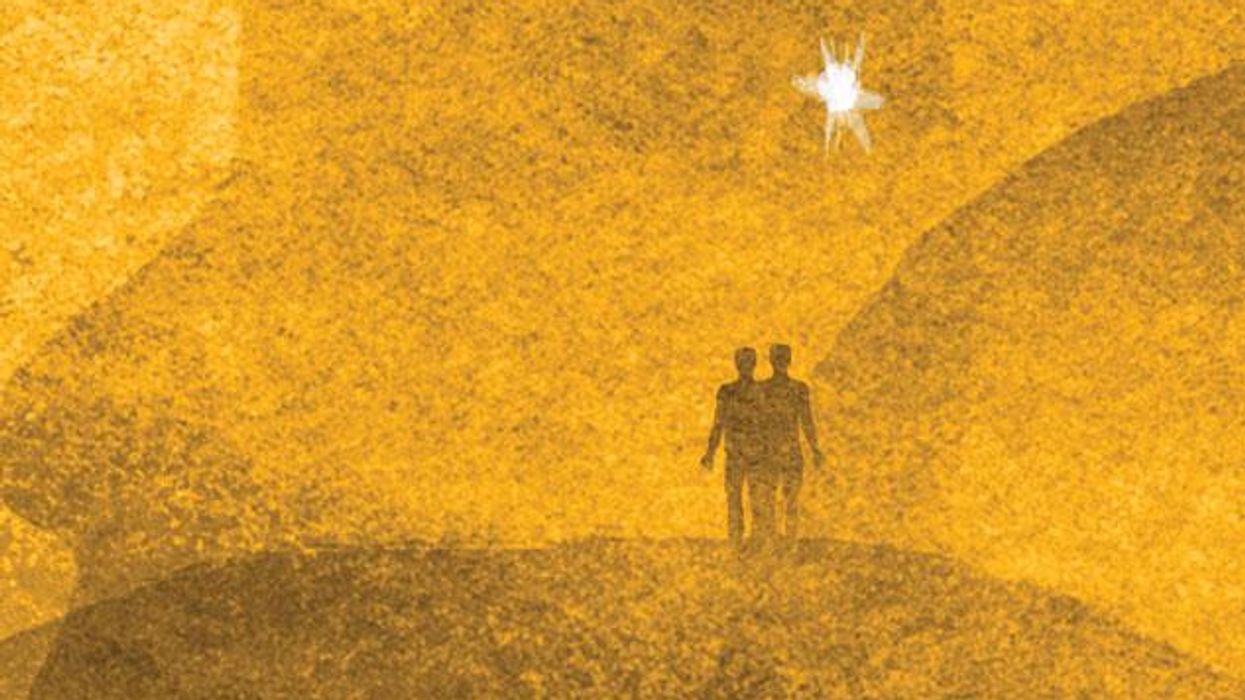
Illustration by Simon Pemberton

Gay couples can’t marry in Washington. But near Seattle, tucked away off the Puget Sound, there’s a sovereign nation whose citizens can marry whoever they choose. They’re called the Suquamish, and they were there before Washington was a president, much less a state.

The Suquamish enjoy the right to same-sex marriage, thanks to Heather Purser, a 29-year-old lesbian tribal member who grew up near the reservation. She’d already tried to come out of the closet twice during her childhood, and retreated both times before she arrived at Western Washington University and started attending LGBT events. “I saw that I could be safe there,” she says. “I decided I wanted to have that feeling back home, too.”

Purser began speaking with her tribe about same-sex marriage in 2007. A year later, she addressed the tribal council, which cautiously encouraged her cause. She did her research: contacting a tribe that had recently passed a similar law, requesting copies of their ordinance, reviewing it with an attorney, and translating it into Suquamish. After three years, she put her petition to a vote at a council meeting. “Everyone said, ‘If you do that, it’ll kill your dream. We have to do this slowly,’ ” she says. Purser demanded a vote anyway. In a room of 300 people, not one dissented. In August of 2011, her dream became law.

This isn’t the first victory for queer Native Americans. In 2006, the First Nations Two Spirit Collective formed, creating a political platform for LGBT native people. In 2008, the Coquille tribe of North Bend, Ore., became the first to allow same-sex marriage. This summer, the Suquamish became the second. Two months later, the Oglala Sioux tribe of Pine Ridge, S.D., issued a proclamation in support of LGBT equality, declaring it “time to ignite the civil rights movement of the 21st century.”

This may sound progressive, but Native Americans’ recognition of queer people predates Columbus. The Navajo call them nadleeh, the Lakota say winkte, the Plains Cree use iskwekan -- there are almost as many terms as native languages. One word you probably won’t hear is berdache, a pejorative (something between a catamite and a male prostitute) introduced by early French colonists. In 1990, a queer Native American caucus settled on “two spirit” as an umbrella term to describe indigenous people of alternative gender or sexuality.

“In traditional communities, ‘gay’ wasn’t even a category,” says Dr. Karina Walters, an out member of the Choctaw Nation of Oklahoma and Director of Washington University’s Indigenous Wellness Research Institute. “Quite often there were third gender statuses, sometimes up to seven,” Walters notes. “These relationships weren’t homosexual, they were heterogendered.” Two spirits often inhabited the in-between spaces, working as medicine people and mediators between rival factions, living on the outer ring of camp to serve as buffers from outsiders. Some two spirits were even present in Washington, D.C., during treaty negotiations. At best, they were revered. At worst, they were tolerated, sometimes teased.

Like smallpox and whiskey, homophobia was a Western import, codified once the U.S. and Canada became nations. Government-run boarding schools spearheaded this reeducation: Students were given Western names, clothes, and haircuts, along with a set of foreign values. Dylan Rose, 24, who describes himself as a mix of Plains Cree, Scottish, Irish, and French, deeply resents the lasting cultural impact of those schools, which flourished through the 1970s. “They taught us not to be Indian,” he says. “We’re devalued because of same-sex relationships now, and that’s not how it used to be.”

Generations of ingrained homophobia and sexism have led to high rates of assault, depression, and suicide among two-spirit youth. They often leave reservations to seek refuge in cities, though cities don’t ensure safety. “I know of two-spirit people who end up homeless in cities because they had to leave the incredible bullying in their home communities,” Walters says. Rose, who spent his youth traveling through reservations in Saskatchewan, now makes his home in Saskatoon. Purser met her girlfriend in Seattle, where she now lives.

Coya White Hat-Artichoker, a member of the First Nations Two Spirit Collective and the Lakota tribe in South Dakota, didn’t meet a queer Lakota man until she visited the Stonewall Inn.

After being forced to recant so much of their heritage, many Native Americans seem poised to reclaim their two-spirit brothers and sisters. “Two spirit was very much an urban term,” says Dr. Alex Wilson, a member of the Opaskwayak Cree Nation. “But it has spread to small communities and reservations, which I think is fabulous.” In many cases, queer native people are reclaiming their roles as mediators -- Walters notes a disproportionate amount of two spirits working as counselors, community liaisons, and activists. Rose documents his experience as a queer indigenous person on his blog, Urban Pionqueer, where he shares his story with anyone who will listen. “Talking about who you are helps you become stronger,” he says.

This resurgence reclaims traditional values, but also recognizes that, more than five centuries since colonization, there is no room in the Native American community for discrimination. More than a gay rights victory, the Suquamish decision sends a strong message that everyone deserves recognition. Purser trusted that when she put her petition to a vote. “We’re a community that supports its own,” she says. “I knew that people would have my back.”

Comments

Jason Meyers 2.1.2012 3:30 PM

This is one of the most inspiring and loving thing I have ever read! Makes me glad to be a Two-Spirt!!!

LAKOTA_MAN 1.28.2012 5:57 PM

A funny thing happened to me on the way to the store. As I approached 7/11 on what was a superbly beautiful January day I noticed four Hispanic women who were also Jehovah Witness. “Here we go again” I told myself. These women are going to try and gang bang my soul with their version of the bible. I made a command decision and decided I was going to facilitate the conversational tone this time. The woman running point stepped in front of me and asked me “Do you want to go to Heaven?” her face determined and even was a bit red due to the pleasant sunny southern California sun. I looked at the four women, their spirituality appeared genuine, and they clung to their bibles as if they were made of gold. Perhaps to them they were. I am an enrolled Oglala, Lakota, so I am inherently spiritual, as are all Native Americans. I believe in and acknowledge there is a higher power or a supreme being who comprises our unique, individual religious beliefs. I looked at the devoutly anticipating women of Jehovah and simply replied: “I am homosexual” I proudly announced to their utter disbelief and reactionary horror, the horror, the horror etc.

In the midst of the apparent spiritual slap in the face I unknowingly gave them I asked god to help me contain the roar of the crowd brewing in my heart and mind. The women, who seconds ago, were quite certain they had another stooge to lay their religious wrap on suddenly looked emotionally crushed. Their mouths agape. How? Why? He looks so masculine. I could literally read these expressions of bewilderment overcome them. Their leader quickly snapped at me, muttering something in Spanish, it wasn’t very forgiving or god like of her I thought. They did an abrupt about face. But “What If I still want to go to Heaven?” I yelled at them. If looks could kill they all would have ripped out my heart and gorged on it.

What hypocrisy. The primary reason why I broke with organized religion. Wakan Tanka, The Great Mystery, the god of my people, loves all livings things. Regardless of race or sex or sexual orientation. My tribal religion is light yeas ahead of Christianity. I have come to loathe Christians for the way they publicly hate homosexuals. My half-brother is gay. I love him with all my heart. Some of the most spiritually gifted people I have ever met were gay. Homosexuality is not some disgraceful birth defect. Just the opposite. I believe, with the same passion those women who believed in Jehovah had, that is: homosexuality is a genetic predisposition. It’s like being born left handed or with curly hair, or dark skin. And there is absolutely no cognitive dissonance associated with homosexuality. Life’s too short to waste time hating someone because they live a lifestyle that’s different or because they choose to love who their heart tells them to love. Those four Jehovah Witness women that delightful January day did accomplish one of their tasks. They reaffirmed what I already knew. My god welcomes all people into his eternal realm. My god loves me for opening up my heart to men and women who choose to love who their wonderful hearts tell them to. These are the words that dwell in my heart.

p.s. I am a straight 4/4 enrolled member of the Lakota, Sioux man in his 40's. :-)

Cody 1.26.2012 1:26 PM

I love this article! It makes me wonder if my tribe (Colville Confederated Tribes) has this in effect. Most likely not but I would love to see this be in effect, I do know that those of us who are out are proud of who we are & don't have any shame. Sure we do get taunted but we know we have loads of people who stand strong behind us and who are proud to call us friend/family/partner, and yes I also do believe we as two spirited people do have other gifts. These gifts that were practiced by two spirited were lost but are slowly being found once more, if anyone is planning on going into a certain area marriage counseling would be the best because we not only see points of view from one sex but also the other, we can control a situation to where we don't take sides because we are balanced out not only having that one spirit in us to lean towards it's counter part but we balance out. This is a great article for young gay men like myself I sure hope that one day those who are being hurt will realize there are others and we are all here for one another.

George(GG) Roberts 1.20.2012 7:17 PM

Although I am not Native American, I am a Two Spirit, Trans/M-F I have Respect, Revere my native Friends. I have been a Nurses aid for 10 years in my life. I am an Amature Herbalist, I want to end with with respect and Peace. God/Father/Grand father bless us all, Geo/GG:)

KKRP AM 1610 1.19.2012 9:57 AM

Great article. As the station owner, I am not only half Cherokee, but am also transgender. This brings to light what many of us have felt for years....Good job.

Anonymous 1.13.2012 2:47 AM

Good article. But I'm wondering about the word berdache. I have a book about the Zuni We'wha, who was accepted by his tribe as both man and woman ("two spirits") and he is referred to throughout the book as a berdache. Nowhere is it used as a pejorative. I'm wondering if this word has gone through a transformation at some point?

Anonymous 1.13.2012 1:20 PM

That's exactly right. Until queer Native Americans settled on "two spirit" in the early 90s, there was no universal word to describe native people of alternative sexuality/gender identity. Only terms that varied between tribes, and berdache, a word especially popular with anthropologists. Lately berdache has mostly fallen out of use, because the etymology behind the word implies catamite, male prostitute and captive. You'll still come across berdache in some academic circles, though. - Jon

Anonymous 1.11.2012 7:41 AM

Good article, but it's "whomever" not "whoever."

Post new comment

The content of this field is kept private and will not be shown publicly.
  • Web page addresses and e-mail addresses turn into links automatically.
  • Allowed HTML tags: <a> <em> <strong> <cite> <code> <ul> <ol> <li> <dl> <dt> <dd>
  • Lines and paragraphs break automatically.

More information about formatting options

Type the characters you see in this picture. (verify using audio)
Type the characters you see in the picture above; if you can't read them, submit the form and a new image will be generated. Not case sensitive.

AddThis