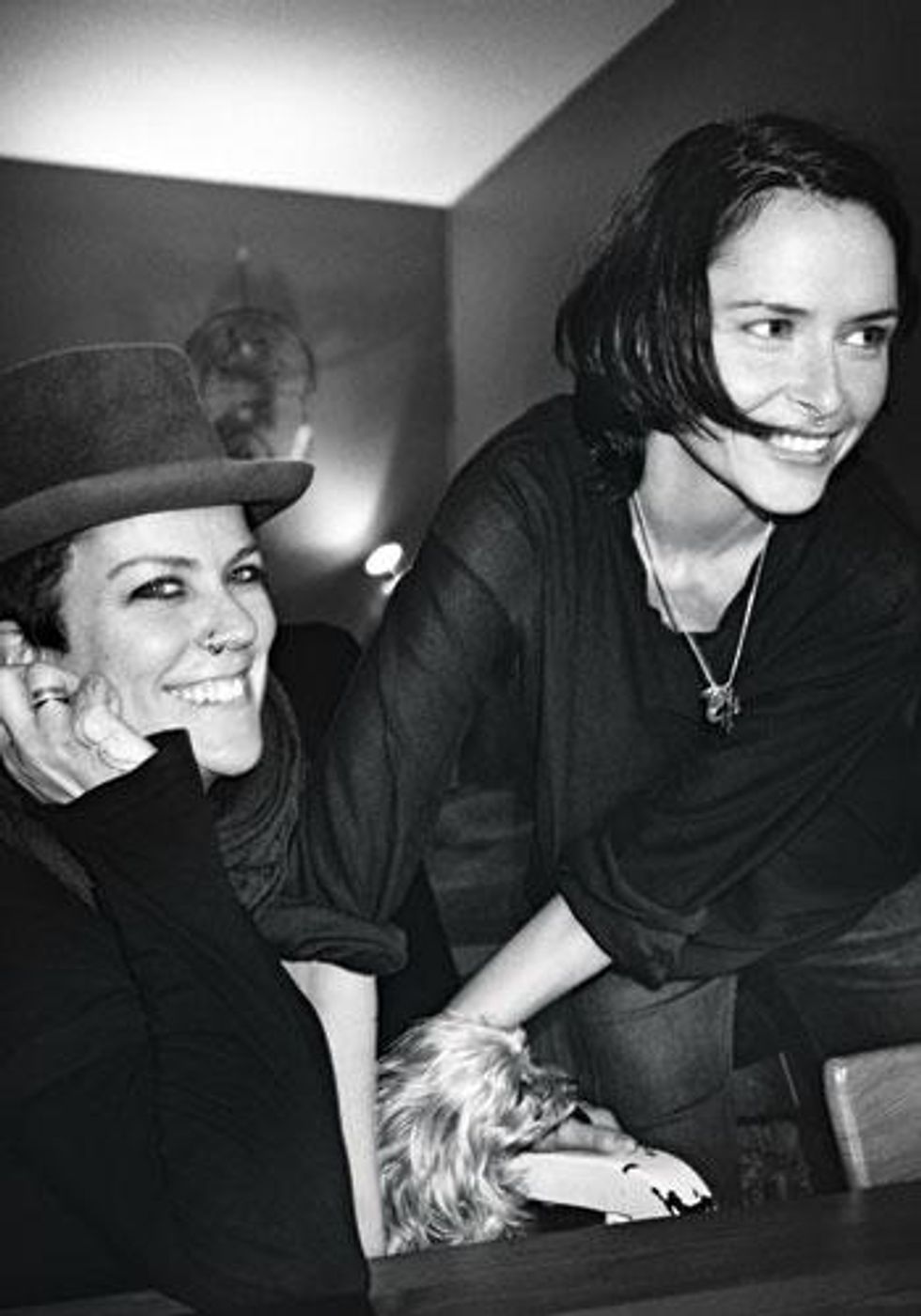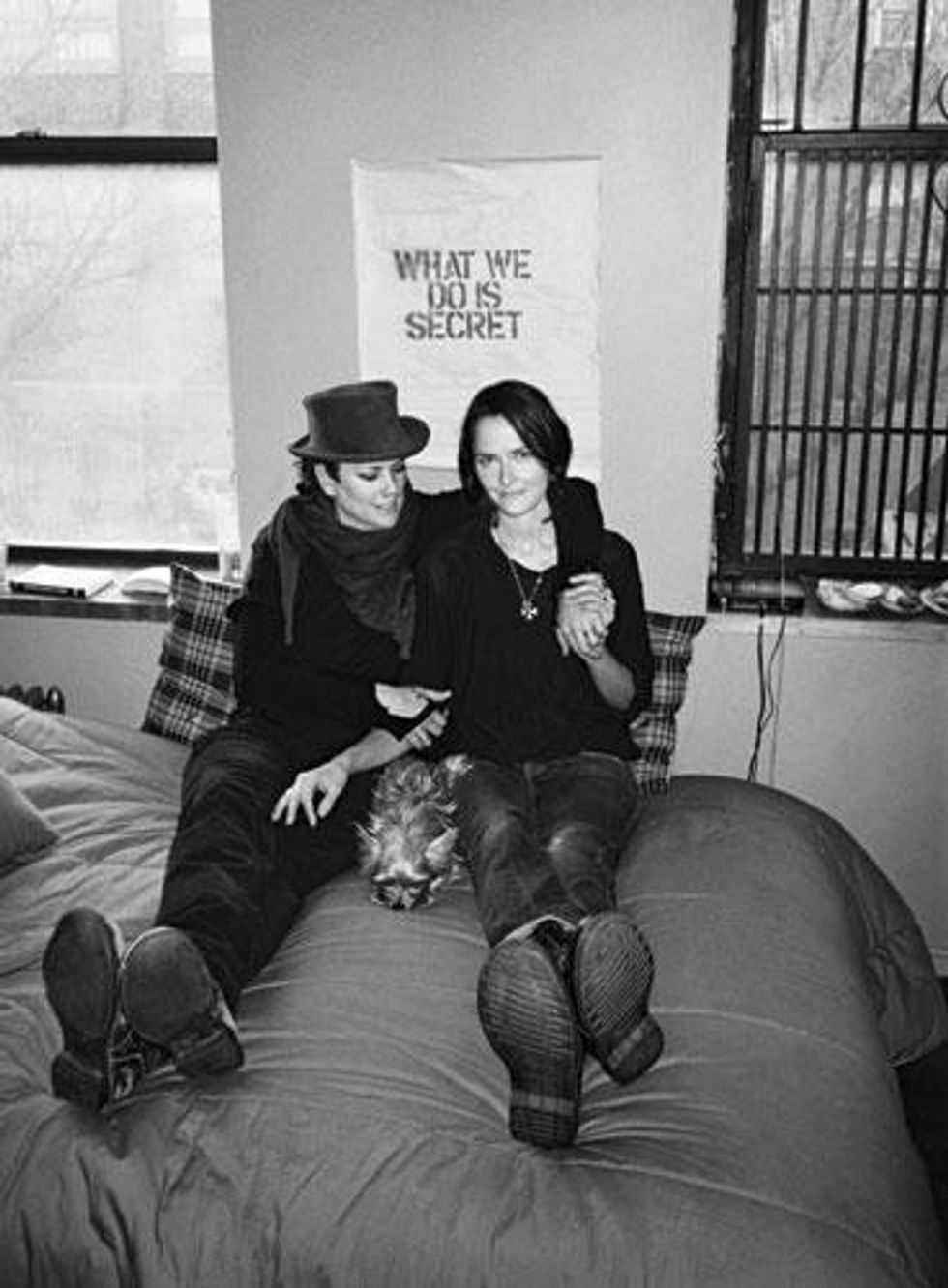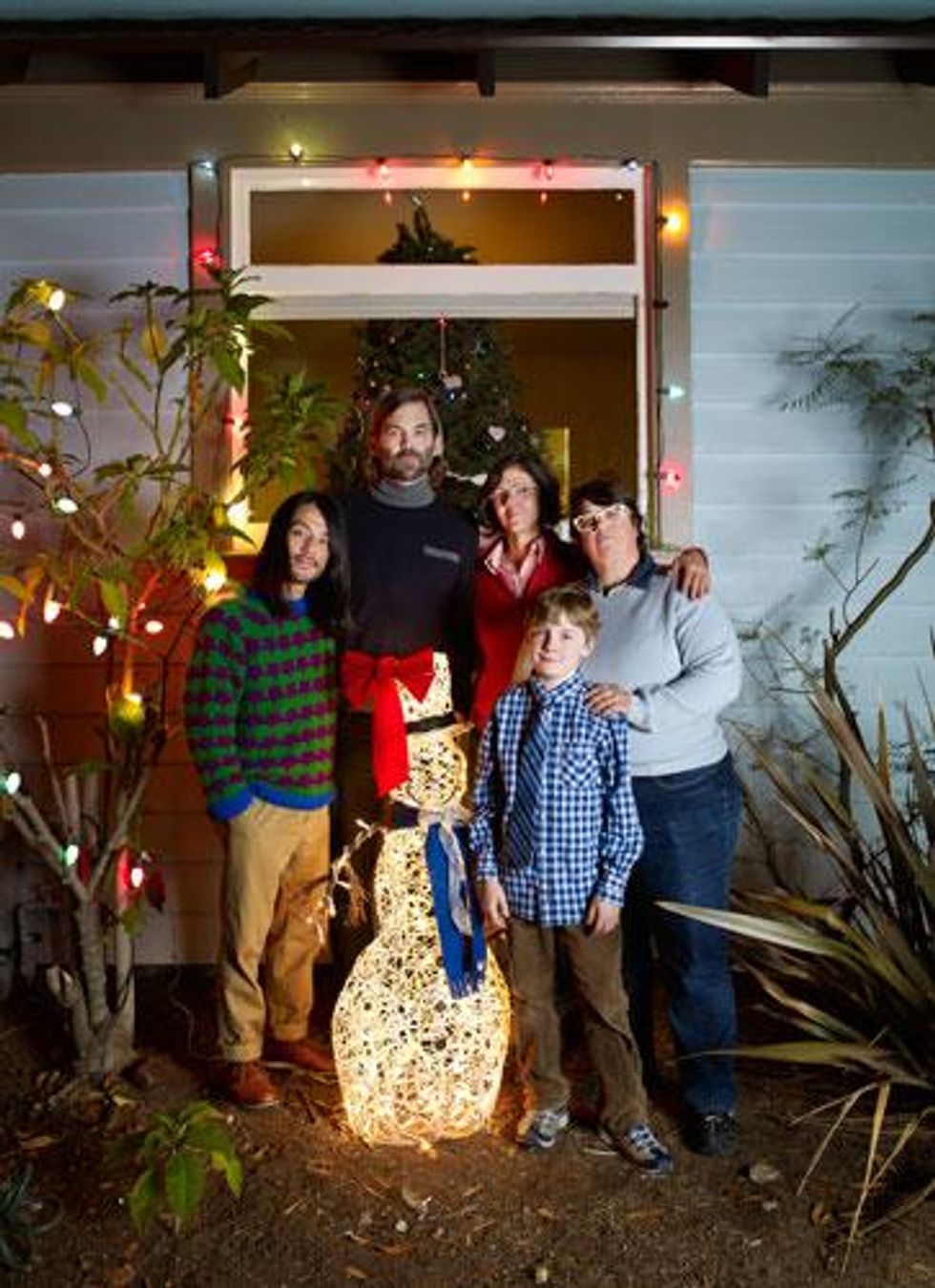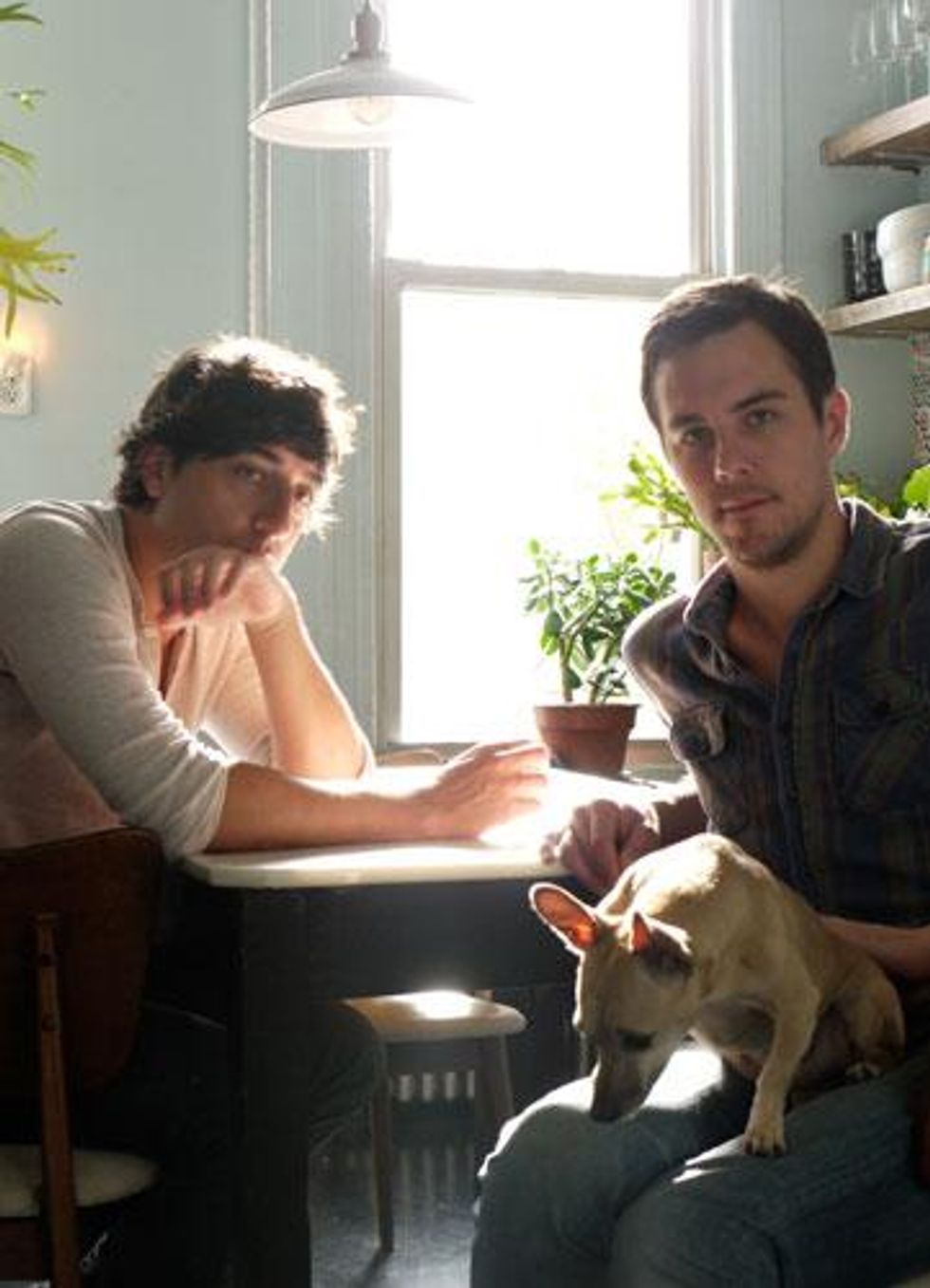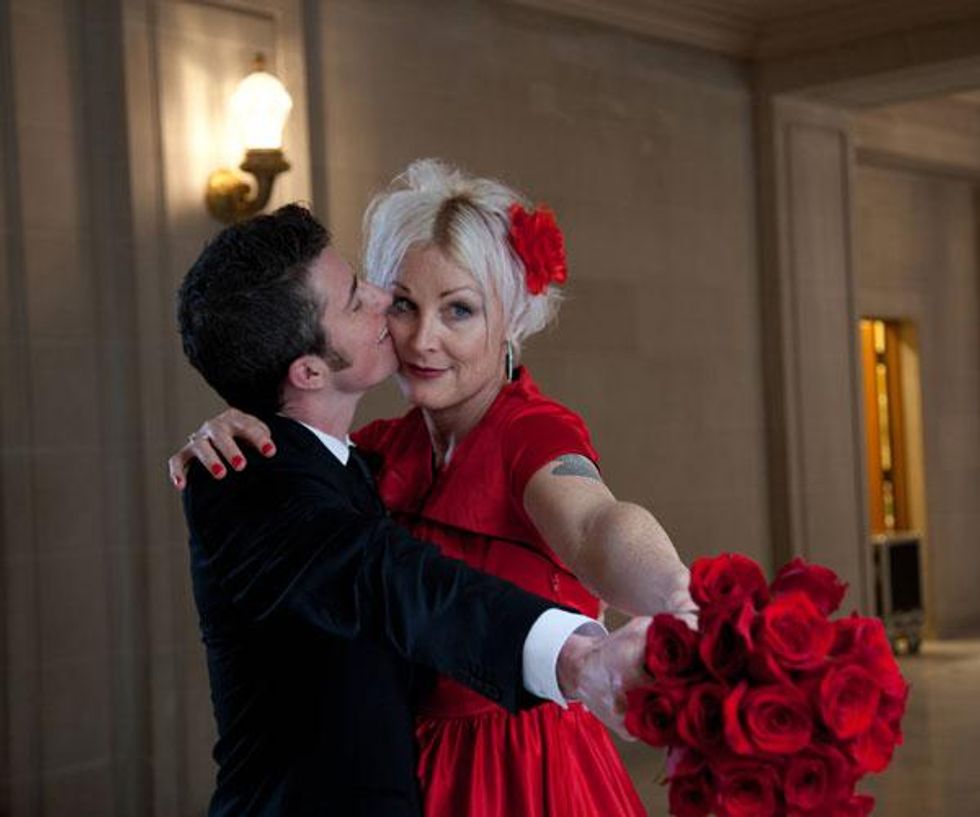



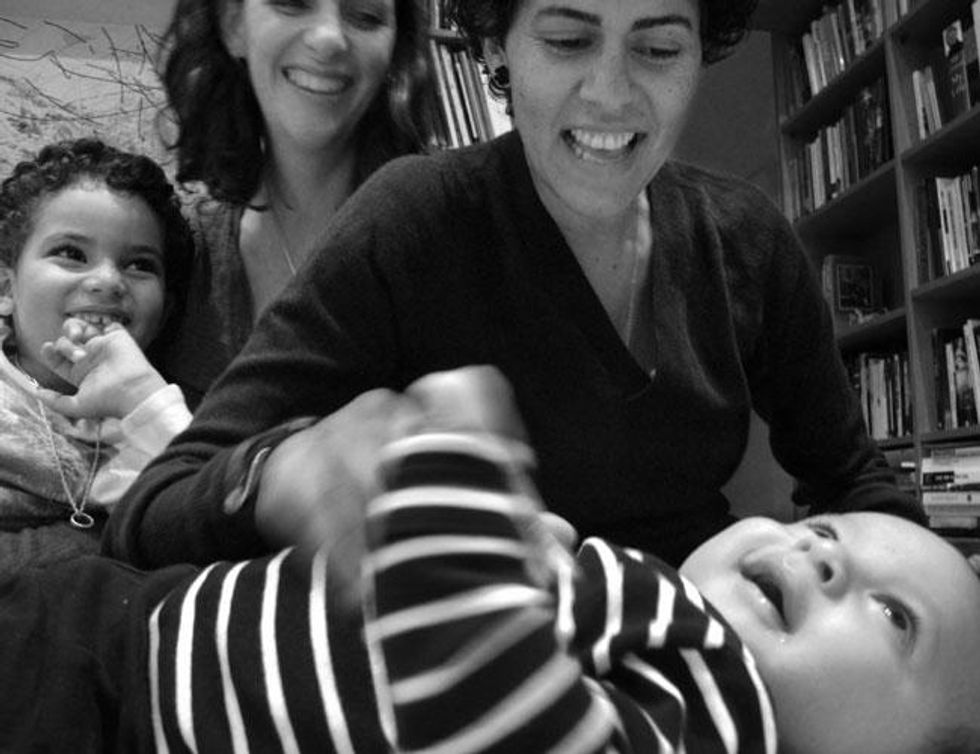
JESSICA RANKIN, ARTIST: We met in 2000, in a bar -the old-fashioned way! We met and had a wonderful summer together, and we were both insistent it wasn't serious, that we didn't want to rush into things, but it was really evident to those around us that what we had was something special. I realized pretty quickly that it was for the rest of my life. I think Julie was a little slower to get there! It was after six months that we started to take it seriously -- something forever. When you leave New York, you see that everyone is two steps ahead of you. I'm from Australia, and when we went there, after a couple of years, everyone I knew had one kid with a second on the way, and I said to Julie: 'What's going on? We need to get cracking on this!' We'd been together three years when we started to talk seriously about it, and we talked about whether we wanted to adopt, or give birth, and if so, who should, and all of that. We thought hard for six months and came very close to asking someone we knew [to be a donor]. We even wrote the letter, and at the last moment we put that letter away for a month. When we took it out, I read it and my heart sank. I thought, It's hard enough to find the person you want to spend the rest of your life with. I don't know if I'm ready to factor in a third party. So we decided to do the anonymous donor. Cade and Haile are five and a half years apart'Haile was born this year. If we have more, I won't do the childbirth thing. Being a family of four is different from being three, and three is different from two. It's infinitely more complicated and infinitely more wonderful.
JULIE MEHRETU, ARTIST: After the first year we were together, I knew Jessica was the person I wanted to be with. A few years into the relationship, we were traveling and came back, and Jessica was at a place where she wanted children, and I said, 'Yes, what else would we do at this stage? It's time!' The minute you have a child you're a unit, and within the first year we started living together, it felt like a family. Now we're four, and we're really a unit, but I can see having more. I'm happy with the two boys we have, but it's always nice to have more. We still manage to travel.It's more difficult with the baby and a 5-year-old, but we're always trying to stay settled and always traveling. This is only the second year Cade has lived in the same place since he was born, and this is the longest period of continuity for him.
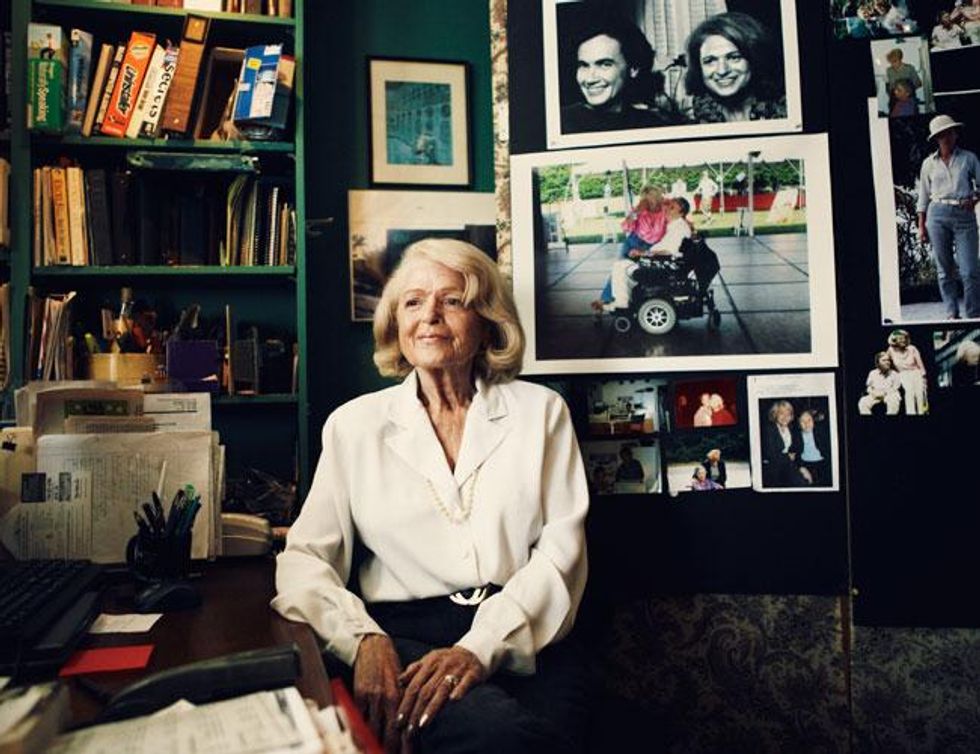
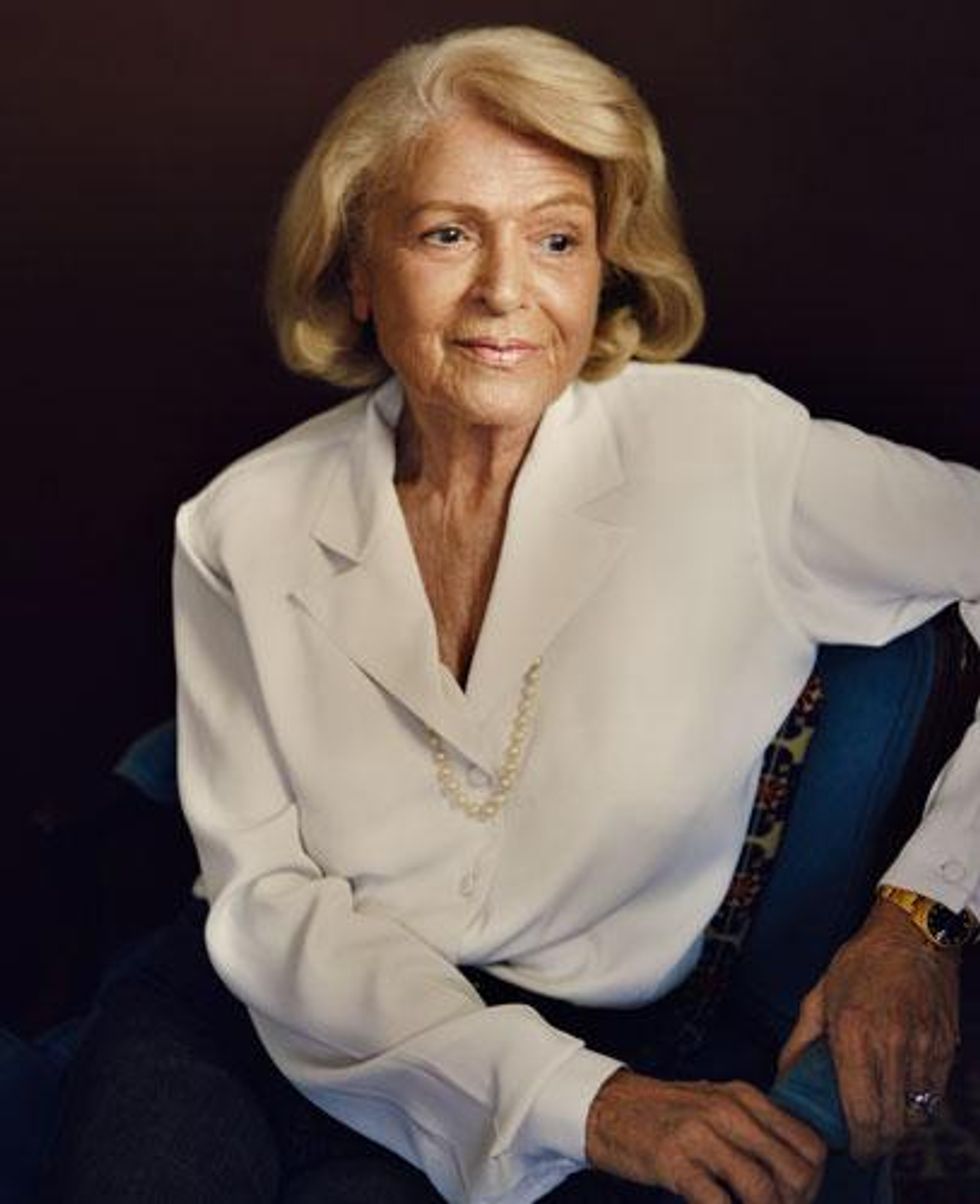
Edie Windsor met Thea Spyer in a distant New York City, before Stonewall, long before AIDS. It was 1965; the Beatles were singing 'Yesterday,' and Bewitched was in its first season. They met, and they danced, and they fell in love. They were both professional women'Thea was a clinical psychologist with a practice in New York; Edie spent much of her life as a computer systems consultant for IBM. In 1975, Thea was diagnosed with multiple sclerosis, which advanced rapidly until she could no longer walk, though she continued practicing throughout her life. The couple married in Toronto in 2007, but Thea's death in 2009 resulted in a $350,000 penalty in estate taxes that would have been voided if their marriage had been recognized in the United States. Last November, Edie -- who was recently the subject of a documentary, Edie & Thea: A Very Long Engagement -- filed a lawsuit challenging the constitutionality of the Defense of Marriage Act, which defines marriage as a legal union between one man and one woman as husband and wife. Here she recalls her 44-year relationship.
I had crushes on girls in my early life, but I mostly dated guys. I married a guy I adored at college, but I was jealous if I saw two women out together. And finally, after less than a year, I said, 'Honey, this is wrong. You deserve more and I need something else.' We didn't talk again until my 70th birthday when he called to say, 'I still love you.' And that was great. My mother never discussed sex with me, but when I told her I was getting a divorce, she said, 'How is the sex?' And I said, 'It's not.' And she said, 'Then there's nothing to hold you there.' That was all. If my parents had known the truth, would they have stopped loving me? I don't think so. Ultimately when they met Thea, it was perfectly obvious that we were together.
I remember reading a little lesbian paperback about a schoolteacher who came to New York for the summer, and she looks in the mirror, and she's all dressed up, and she says, 'You're in New York, where anything can happen.' Then she says, 'Oh, come on, what could happen?' And finally, she says to herself, 'I could kiss a woman.' And I read that, and I said, 'Where!?' I couldn't imagine how you found them. Once, when I came in from Philadelphia for a wedding, I stopped a woman wearing a trench coat and a pink button-down shirt, and I asked if there was a woman's bar around, and she directed me to what was Elle's Bar at the time. So I went to this bar, and I was dressed to the teeth -- and no one was dressed to the teeth -- and I sat there at the bar nursing my drink, but no one talked to me! And that was it. I went back to my hotel. That was my first New York bar experience.
I came to New York to be a lesbian when I divorced. Near Downing Street there was a bar called the Laurels. I went maybe twice a week, and I got to know people, and I never paid for a drink myself. I always ended up with more money on the table than I started with. I would get little notes from girls the next day saying, 'Forget the others,' but I felt most strongly that with a woman you don't touch her until you can't bear not to. I spent a lot of time in that bar. There was a night when it was empty and silent, and I sat there for maybe half an hour, and I thought, There's going to be a raid. Turned out it was Election Day.
I met Thea at the Portofino, a restaurant in the West Village. There was a place near it called the Bagatelle, over on University Place, and I used to go to there five nights a week. I would read the Saturday Review of Literature; I would have my coffee there'me and a bunch of buddies. I thought she was sensational, and mostly she was a great dancer. And we really danced. And then we met over the next two years. We always danced together. But it wouldn't have occurred to me to make any moves on someone who was with someone. And she was always with someone. And then one summer she was not with someone. I knew she had a place in the Hamptons, so I wrangled an invitation through a friend. The day she arrived and we touched was the first time we got laid. We had to go to dancing, obviously, because that's what you did in the evening. I was wild for her. I don't know how to describe it. It was everything. It was just more so. We were profoundly in love and stayed that way. For her, it was all sexual. Many, many years later, I said to her, 'When did you really start to deeply love me?' And she said, 'Mrs. Fordham's house,' which is the house we rented for the summer in the Hamptons. We had very different passions, but we both had enormous love for each other's passions. She played the violin. She played golf. And she did them both obsessively. With golf I had to make certain rules, because if she came home talking her head off about every shot, I would say, 'The idea is for you to go and enjoy it and discuss it completely and then come home.'
Thea was diagnosed with MS the day before my mother died. That was in 1975, and by 1980 she was using two Canadian crutches. The first time we ever danced using the wheelchair -- I would sit in her lap in the wheelchair -- the song on the radio was, 'There's a place for us, there's a time for us.' I can't even sing it because I cry. When I'm sick now -- I have a lot of angina -- that's when I miss her the most. I say to myself, 'Honey, what's become of us?' And I lean against the full-length picture that I have of her. But she had this angina increasingly, and the doctor had said, 'If you can last for two more years, they're very close to having this noninvasive blah, blah, blah,' but it was clear that she wasn't going to survive open-heart to get to the valve. And she said, 'We only have two years at best that they could give me.' And one of those years would be lying in a hospital, lying in her own feces because nurses aren't there the second you need them, and she just said, 'No. I want the summer.' She asked me to call Dr. Farheen and ask what else we could do, but she said, 'I'm not coming to the hospital.' I made her get on the phone so Dr. Farheen would know I wasn't talking without her and asked if there was anything else we could do, and he said, 'Nothing -- give her a little morphine.' And she elected it. That's one of the greatest things, the part of the picture that's most meaningful to me, where she's sitting there saying, 'I had my summer.' And that was her last summer.
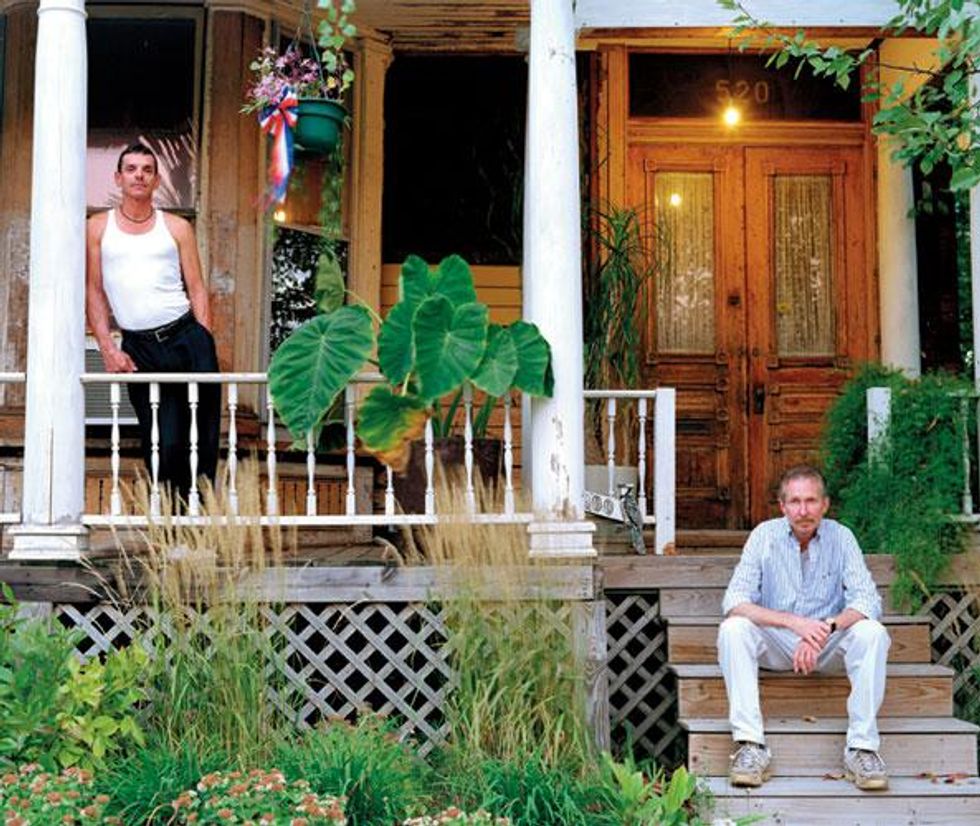
JIM BRUNELL, INFORMATION TECHNOLOGY SPECIALIST: We rehabbed our house and went through an absolute disaster with every wall ripped out. Doing that together is probably the fondest memory for me. It's a big house. When we started there were four kitchens. It was built in 1882. An old house is an ongoing project, and I think that is the basis of our relationship today'going through that and learning the strengths and weaknesses of each other. If you can go through the demolition and rehab of the interior of your home while living in it together, you're guaranteed to stay together. If you can't do that, then give up.
ROB FETZER, SOCIAL WORKER: I have too many fond memories'a couple decades-plus of them. In our time together, all four of our parents passed. I think just the unwavering support, the strength -- I could not have gotten through it without him. I'd have to go back and steal from Gandhi: 'Imperfect myself, I must be gentle with others.' If somebody's getting into a relationship to change that person into somebody of their dreams, they're going to be disappointed and frustrated, and it'll probably end badly. It's a matter of constant acceptance.
For more photos by Molly Landreth, check out her series Queer Brighton on OutTraveler.com
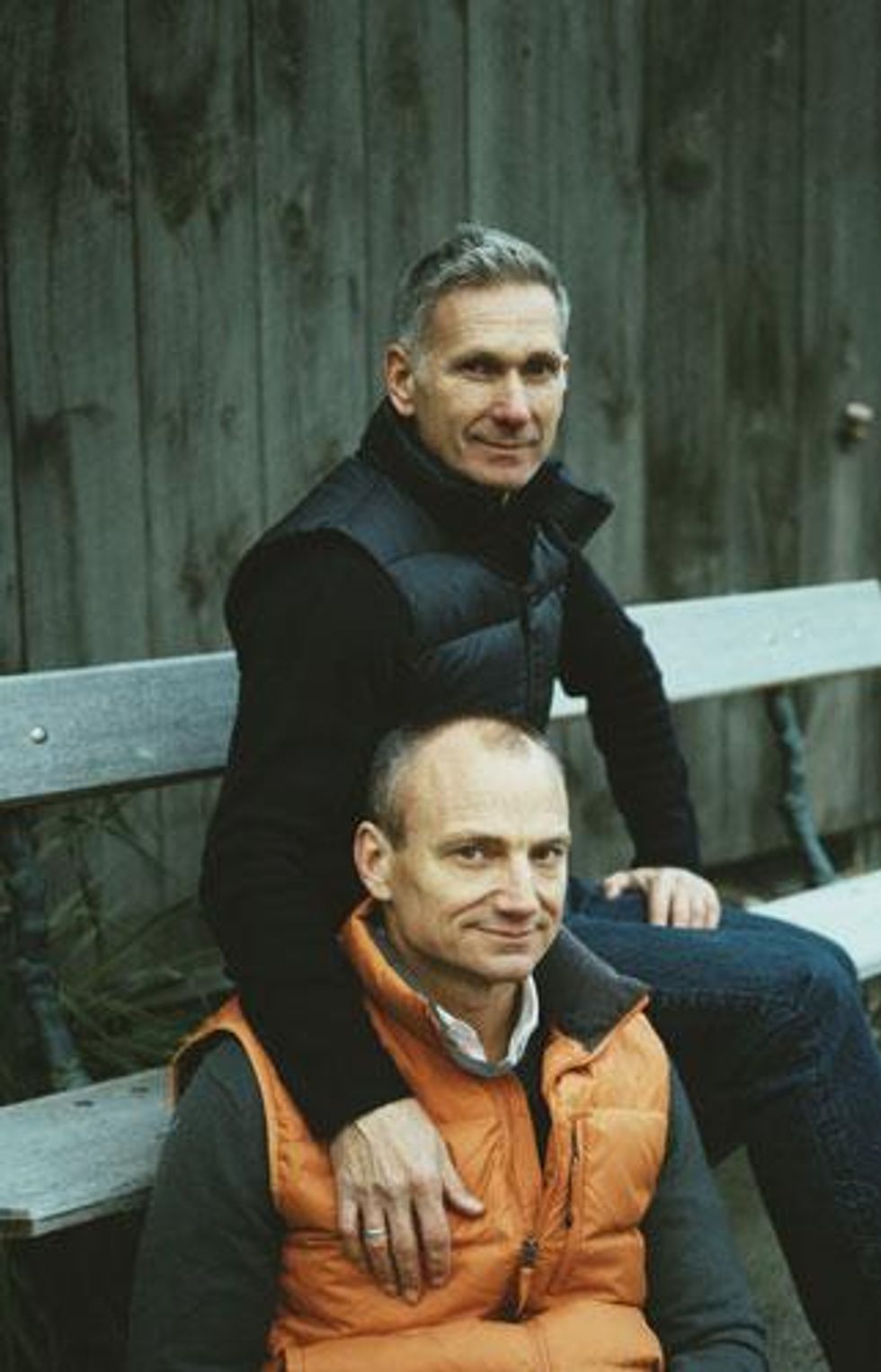
HARLAN BRATCHER (seated on bench), PRESIDENT & CEO, A|X ARMANI EXCHANGE: When we met it was clear that Toby knew what he wanted. I wasn't so sure, so we had time off. We said we'd give it a few months and then meet on top of the Empire State Building. You know the movie? Deborah Kerr runs across the street to meet Cary Grant and gets hit by a taxi and is paralyzed. So that's why I told him, 'If I'm not there, come after me.' I'd been the one who had wanted to take more time, but when I wrote that note to him, I thought, What are you doing? He's the one. What's amazing about Toby is that he is always trying to improve himself and try new things; he definitely lives by a bucket list'things he has to do. One of the things he wanted was to see every continent, which we'd done on our travels'all bar Antarctica. This is where Toby and I diverge. I did not want to sit on a Russian trawler eating bad food for two weeks to get to Antarctica. It was 1999. We were planning to be in Sydney for the millennium, and I told him I was not going to do Antarctica -- that one he had to do himself. Being tenacious, he found out that Qantas had restarted its low flyover flights of Antarctica in a specially fitted 747. The plane would lumber along, two or three thousand feet over the camps, and go in a couple of circles, and then fly back to Sydney. With the aid of some close friends in Sydney, I devised to book the seat next to him. We dropped Toby off at the airport, and right before they closed the door on the plane, I got on and walked down. He was reading or talking to the person next to him, and I said, 'Is this seat taken?' That trip was torture—16 hours in coach. But Toby checked off a big bucket-list item, and I was there with him. Isn't that what you do for a relationship?
TOBY USNIK (left), SENIOR VICE PRESIDENT, CHRISTIES: It was Valentine's Day, 14 years ago, and I was at a party at a friend's house. After dinner he suggested we head to the Sony Building, where a friend of his was hosting a party with Susanne Bartsch. It was just a full-on party, and in the crush of the crowd, I was introduced to Harlan, who was the host. We chatted briefly, swapped cards and agreed to get together later. I knew I was really interested in him, but he was going through a separation after a 13-year relationship. I'd been single for about a year, and I didn't want to compromise the healthy place I'd gotten to because my breakup was a painful process -- it takes time. I thought to myself, I don't want to deny Harlan that experience I had in processing my breakup. So we agreed to go our separate ways for a while, and as corny as it sounds, I said, 'Why don't we do like in An Affair to Remember? You know, where they meet on the top of the Empire State Building? If you think you want to resume something in an exclusive way, then let's do that.' He wrote back -- and I carry this e-mail in my wallet to this day; it's dated October 10, 1997 -- and the first thing he writes is, 'Oh, I've seen that movie. If I don't show up, come looking for me.' And then he adds, 'Meeting you is not a chance or a fluke. I truly believe this. So I go off now with more than mixed feelings and oh-so-many happy memories. Whatever the near future brings, I do hope it brings us together. You are one of the most significant things to happen to me in quite a while. I can't tell you how much you helped me in this transition period with much compassion and honesty. Thank you for being such an amazing man. Your Beau, Harlan Ray.' So I carry that in my wallet as a reminder every day because I think it was meant to be. I don't think there is one soul mate out there, but one has to be willing to be open to the potential. Harlan is serene in a way that I've never really seen in many people. To me, the definition of a leader is someone people want to follow and Harlan is a leader. And gorgeous.
By Steven Thrasher
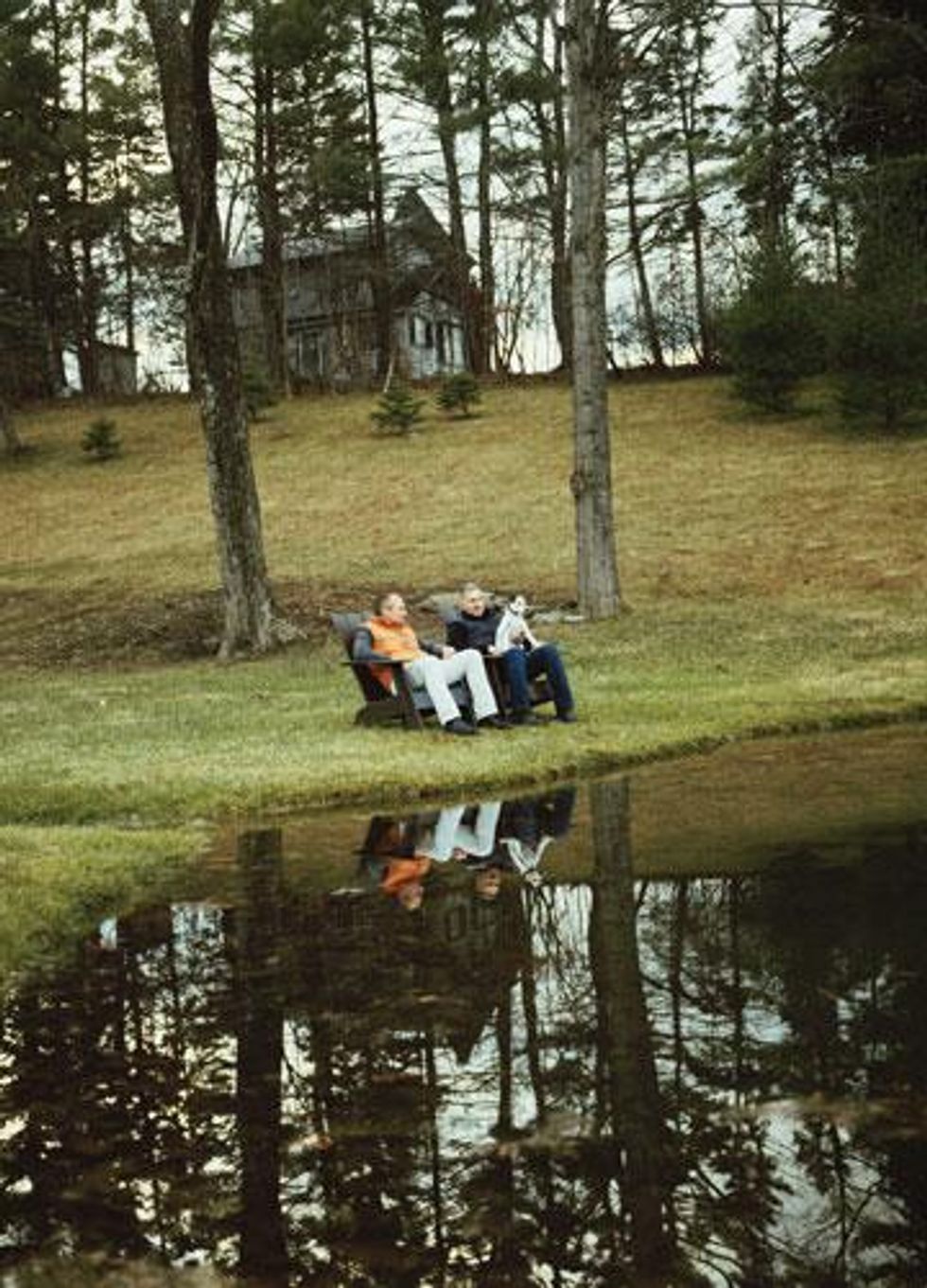
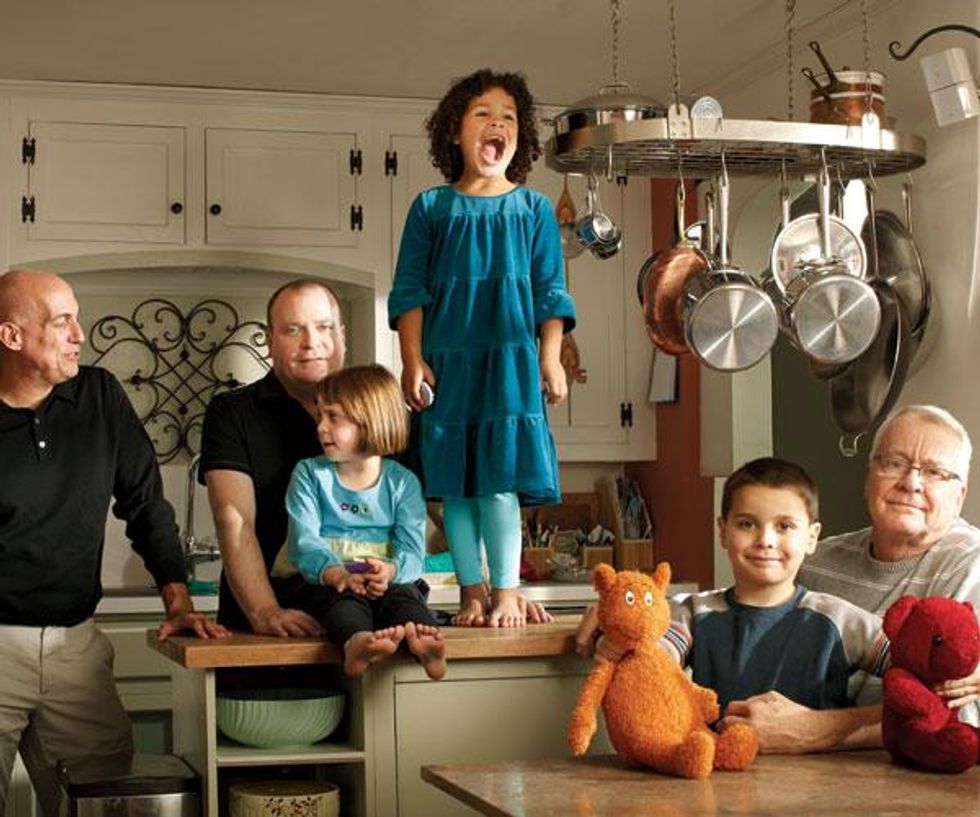
When Robert Christmas invited his gay uncle to move in with him and his partner and their three children, the concept of family took on a new hue.
When David Christmas, a former Broadway actor, was preparing to retire from his job as the volunteer coordinator at God's Love We Deliver in New York City, he wasn't sure how he was going to spend his retirement.
The answer came in the unlikeliest of places. David's nephew Robert Christmas, a lawyer, and his partner, John Buscaglia, a psychotherapist, had begun the process of trying to have a child through surro-gacy several years earlier. After months of trying unsuccessfully with one surrogate in Maryland, they moved on to another in California. Then, right as the California surrogate was about to be implanted, their Maryland surrogate came back to them. She was pregnant as the result of a one-night stand. Did they want to adopt her baby?
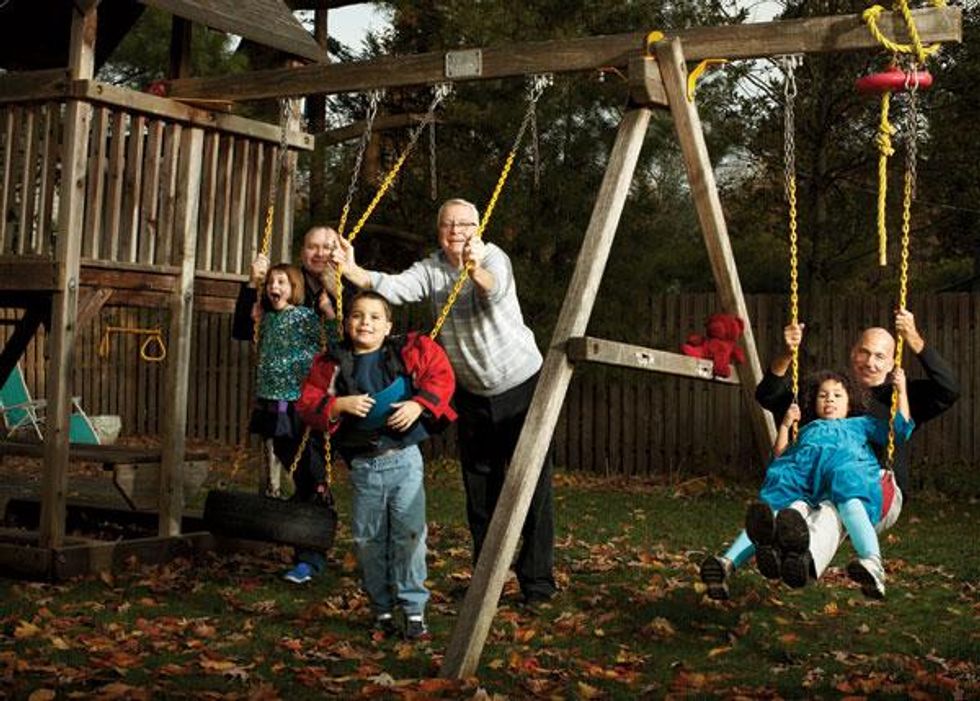
They agreed. Shortly thereafter, their California surrogate became pregnant'with twins. Soon, Robert and John, who had hoped to have one child, had an eight-month infant, Amanda (who is biracial), and premature twins, Spencer and Elizabeth (Izzy).
But their family was incomplete. The children's great-uncle David, who had started spending weekends with them, grew to love the dynamic of being the grandfather figure in their lives. So when he was ready to leave New York, he moved in with them in Montclair, New Jersey. The kids are now all 6 years old.
David, Robert, and John talk to Out about what it's like to raise three children together as a mixed-race, adoptive family headed by intergenerational gay men.
'UNCLE' DAVID, THE GRANDPARENT: I had always liked kids. But when I knew I was gay, the idea of marrying and having a family wasn't something I was big on.
But in 1980, I went to the Children's Aid Society, and I started talking to them [about adopting]. I even did a home study. The talk of being gay never came up, but I was a 'single man of a certain age.' I felt a little hostility from them. All the children they showed me had severe health problems. One was in a wheelchair'and I lived in a sixth-floor walk-up! I eventually wrote them a letter saying I thought they were being homophobic and intentionally offering me children they knew I couldn't take care of. I never heard back from them, and so I thought my dream of being a father was never going to materialize.
For years, I ended up doing a lot of volunteering with children. That's how I dealt with it. And then, when John and Robert got the kids, I just started coming out every weekend, feeding them and burping them and watching them barf all over the place.
I remember saying to John one day, 'I want to live here. I want to be a part of all of this!' And Robert came in with tears in his eyes and said, 'That's the nicest thing anyone has ever said.'
It was the first truly honest family situation I've been in, where everybody knew who everybody was. When I was growing up with my family, I felt loved -- but there was so much unspoken, so much to hide.
I lived alone for a very long time and never had a long-term lover or roommate. And I came out here, with the boys and the kids, and it just came so naturally. I just love being a part of this family -- coming down and having dinner and helping clean up and cook. The kids come home from school now, and I'm sitting at my computer, and they come barging up the stairs, and I just love it. It's a wonderful journey.
'DADDY' ROBERT, THE BREADWINNER: John and I met in 1993, at the house of a mutual friend, on an island in Connecticut. The house was very Grey Gardens. I had just ended a six-year relationship and had just started to date. I thought, Oh, it will be fun to go to this island, but I know the kind of people who will be there. It will be theater people and unemployed musicians and some dysfunctional people.
It was raining and atmospheric in that big craftsman house, and I met John, and we hit it off. I wasn't close to my own mother and father, but I grew up knowing my great-grandparents, and the idea of a big family was always important to me. And it wasn't until the older generation of my family started passing away -- and then losing so many of my own friends to HIV -- that I started thinking of having a family of my own.
My father has five other children, and they're all much younger and in various states of disarray. I started to get involved with them, and I really liked the feeling I got from parenting. My experiences with them really crystallized for me that I wanted to have kids of my own. I wanted to start from scratch.
John and I had been together for 10 years before having kids, so we had a lot of history and commitment to support this new phase of our lives. You can't do it without that, because any difficulties in your relationship are geometrically intensified by the stress of parenting. Still, having kids has made us closer and more committed.
I commute into the city and work long hours. Sometimes I'll think back to when we lived in the city. But you get to the point where you're tired of going out to restaurants and you're thinking to yourself, I just want to be home, making bread with my kids.
'PAPA' JOHN, THE STAY-AT-HOME DAD: Amanda still believes that she comes from my stomach. That's what she believes. The twins see Amanda looking different than they do, but Amanda does not see herself looking different from them.
I have tried to speak to Amanda very gently about how some people have darker skin.
'What kind of skin do you have?' I'll ask. And she'll say, 'I'm like you.' And the truth is, she and I are the same color [John is Italian]. She does kind of get that.
When we moved to Montclair, we wanted to be someplace where Amanda would never be the only child of color in class. This town is filled with people of all different kinds of mixes and multiracial families. We belong to the Montclair Multiracial Adoptive Families Group. So she sees families with the whitest white to the darkest dark siblings. And some of them, their kids came through the foster care system, so they remember their birth parents. They have the advantage of being able to talk about a 'tummy mom.'
Amanda has no memory of anything else because she doesn't know anything else. But she gravitates toward little African-American girls in her class, as does Spencer. I volunteered in his class on Thursday, and suddenly I was swarmed with four little African-American boys, who were Spencer's friends, wanting to hold my hand.
Izzy doesn't see much difference. Last week, Izzy tried to use the same product in her hair that Amanda uses every day. It took a week to get out!
Spencer's asked, 'Am I adopted?' That's a tricky thing because they are all adopted to me. They're not all adopted to Robert [whose sperm was used for the twins]. So we clearly have some hurdles to get through as soon as their awareness comes in. They already have an awareness that there's no mom here.
Sometimes they talk about who's gonna 'marry' who. The other day, we had a conversation about who was going to 'marry' me. Amanda wanted to marry me, and Spencer wanted to marry me, and Izzy said, 'No! Papa's married to Daddy!'
LAURA WILSON left, TALENT AGENT: It was only a month after we really started going out that I knew I loved Tasha. We were staying at a mutual friend's house (the singer Pink, who was on tour at the time), and I remember being in her kitchen and saying 'I love you.' I was the one who proposed, about eight months later. I knew I wanted to spend the rest of my life with her, but in January 2008, she had an accident where she severed a nerve in her hand, and I had to take her to the ER. I wasn't allowed to go with her into the exam room because I wasn't considered immediate family, and something just came over me, and I thought, I need to marry her. I don't ever want to be separated from her again. Watching her walk down the hall with the nurse -- and without me -- was crazy. So I started planning the proposal, and I surprised her with a trip to Mexico for Valentine's Day. Tasha said yes immediately. We were both ready. We had already each done the bad relationship thing before we met each other. She was really ready. I think she asked me to marry her the night we first slept together [laughs].
TASHA TILBERG, MODEL/MUSICIAN: We first met at this club, Nirvana, in Los Angeles. I wasn't available because I was dealing with other things in my life, but she was talking to a friend of mine, and I remember that she had the most beautiful eyes. We didn't meet again for a year and a half'this time it was in New York. After that, we spent all our time together -- I was instantly totally into her. She is really, really funny and a great listener and an amazing mathematician, which is the complete opposite of me. She can do the bills and figures out the tip at dinner -- I'm ridiculously bad at that -- so she comes in handy. When she flew me down to Mexico for Valentine's Day in 2008, I had no idea she was going to propose. I was like, 'This is incredible. Look at those sea turtles. Wait, you're proposing? What?' I was just blown away. We got legally hitched in Canada in April 2009, just the two of us and a wedding officiant. Then, a month later, we had a big wedding with friends and family in L.A. I really like the whole idea of being connected, especially in a legal way. It makes me feel safe.
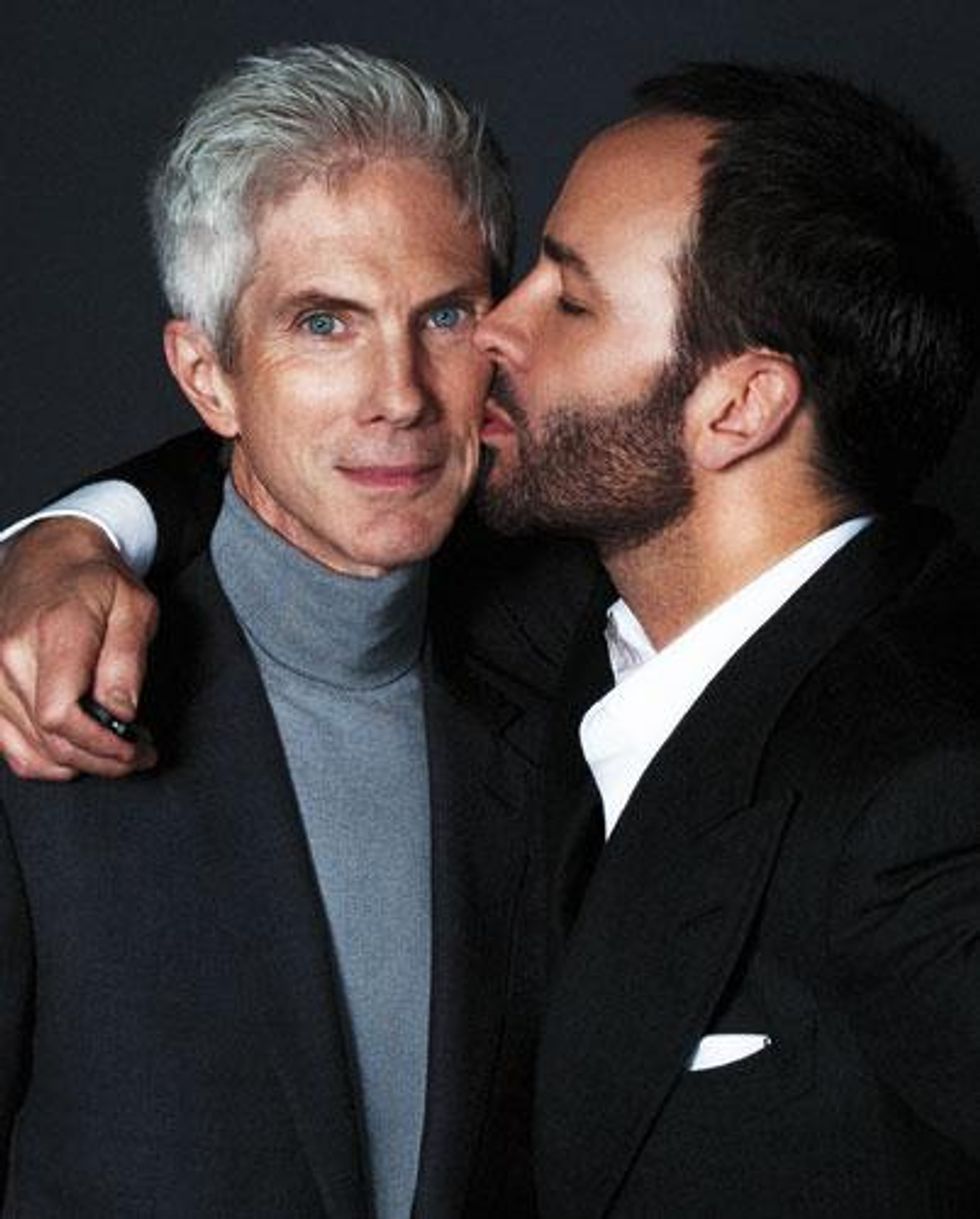
TOM FORD, DESIGNER: You can look at someone and feel like you've known him forever. The first night I ever had drinks with Richard I felt I knew everything about him. He has the wildest eyes -- like an Alaskan husky. They're not blue, they're not gray, they're a color you've never seen before'they approach silver. They give away absolutely nothing, yet they are completely mesmerizing. We first encountered each other at a fashion show in New York in 1986. He was 38 at the time and the fashion editor of Women's Wear Daily. He was confident and handsome in a way that made him almost unapproachable. His stare was so intense that it completely unnerved me, and when the show was over I literally bolted out the door and down the street to avoid him. Ten days later, my employer, Cathy Hardwick, sent me to the office of Women's Wear Daily to retrieve some clothes. I was directed to the roof where they were being photographed, and as the elevator opened, there was the man with the eyes the color of water. He rushed over and introduced himself as Richard Buckley and told me that the clothes were actually downstairs and offered to take me down to what was then called "the fashion closet." He was adorable, and he was a complete fool. He was sort of dancing around, flashing his eyes at me, and trying so hard to be charming. I decided in that elevator ride that I was going to marry him. I'm very pragmatic, and I was, like, OK, there's some kind of connection here. He ticked every box, and'boom'by the time we got to the floor, I was like, OK, sold. He seemed so together. He was so handsome, he was so connected, he was so grown-up, so he was very intimidating. And he really chased me'not that he had to chase that hard. It excited me but it also scared me, because I knew he was different and that whatever it was I felt with him was very different from what I'd felt before.
We did our Christmas shopping together one Saturday, and we spent almost every night together after our first few dates. It was probably a few days before we were saying things like, 'I think I'm in love with you.' Now, we say it to each other every night before we go to sleep, and we say it at the end of every telephone conversation, and we write it at the end of every e-mail. Every time you think, I love you, I really believe you have to say it. If you think about holding their hand or kissing them, you do it. I do it all the time.
We both went home for Christmas, and when we came back, he gave me the key to his apartment and asked if I'd move in, and I did. We'd known each other barely a month. He'd lived with someone for three or four years, but it wasn't really a serious relationship, and he was very consciously looking for that. He had come to that stage of his life at age 38, and I was at that stage at age 25, but we were both ready to settle down and fall in love and have a life with someone. I had slept with a lot of people and done my fair share of drinking and dancing and drugs. I'd had sex for the first time when I was 14. I had a girlfriend in high school who was pregnant twice while we were together. In those days, in the '70s, abortion was considered a form of birth control, and I think in most high schools at the time, it was quite casual. I certainly wouldn't do that if I were with someone today, even as a teenager, so I think it was a part of that era, and the casualness with which sex was treated on television. When you watch an old '70s television show, everyone is just hopping into bed with everyone in a completely casual way. I think AIDS definitely changed it.
One of the very first people to be diagnosed with what was then called gay cancer, in 1981, was a friend of mine. It completely flipped me out, and from then on, I was extremely safe. It probably saved my life, but it damaged the way I think about sex forever. You just associated sex with death -- or at least I did. Richard and I had three dates before we had sex, because my best friend was in the hospital, dying from AIDS, and Richard's best friend was in the hospital, dying of AIDS. So we would have a date, and then he would go to the hospital, and I would go to the hospital; consequently, that was very much on our minds. There was still enormous fear, and that affected our early sexual relationship tremendously, as well as just watching very close friends die at the same time we were falling in love. If we made a list, I would say that half of our friends from the early '80s are no longer with us. It continued into the early '90s -- it just didn't stop.
Three years after we started living together, Richard was diagnosed with cancer and at the time was told that it was most likely going to be fatal. We've had a fair amount of personal family tragedy, and things happen that do, ultimately, bring you closer, because they're things you go through together and they make your history richer.
Getting older together has been interesting because we've both changed. I was very quiet at the beginning of our relationship'I'm actually a very, extremely, almost pathologically shy person, which no one believes today, because I have also mastered a work/public facade that takes an enormous amount of energy to project. And Richard, when we first got together, was very, very social and very talkative. Richard is an extrovert, and I'm an introvert, but meeting us today you would think the opposite. Richard, now, often, can be quite quiet, especially if he knows you well. But if you get Richard at a party, he's extremely animated. I actually hate parties, and I try not to go. I prefer dinner one-on-one or with four or six people.
One of the things that always amuses me -- amuses isn't even the right word, because it doesn't amuse me -- but often, I'm at dinner parties with very close friends, straight, and they realize that Richard and I have been together 24 years, and the response is often, "Wow, you guys have been together 24 years! That's so amazing. I don't think of gay men being together that long." And I'm, like, "Why? What are you talking about?" Some of the longest relationships I know of are same-sex couples. A lot of my straight friends have married and divorced and married and divorced in the time Richard and I have been together. I think that preconception, from even very educated liberal friends, that being gay is possibly more sex-based than emotionally based, is surprising and shocking in today's world. I'm someone who likes being part of a couple and always wanted that and always sought that, and it would probably be true for me whether I was gay or straight. Richard and I are bound together, and I think that's what that recognition is when you look someone in the eyes and you feel like you've known them forever. It is a kind of coming home.
RICHARD BUCKELY, WRITER After three and a half years in Paris, I moved back to New York to be the editor of a new Fairchild magazine called Scene. On my fourth day back in town, I attended the show of a young designer called David Cameron. As I was waiting for the show to begin (it was held in a loft), I noticed a guy standing in the crowd off to the side and thought, Cute. Definitely cute. When the show was over, I sat in my seat, fiddling with my pens and my notebook, until I saw his camel coat out of the corner of my eye. I hopped up and started to walk out with him. Like I said, we were in a loft, and the quickest way out was by the stairs. As we walked, I would look over at him from time to time and smile. He'd give me a weak smile back. This went on until we hit the street, when I swear he sprinted away from me.
Fast-forward 10 days, and I am up on the roof of the Fairchild building on 12th Street doing a hideous shoot for WWD when Owen, the art director, asked if I had a boyfriend.
"No."
"Are you seeing anyone?"
"No. I haven't even been out since I've been back."
"Why is that?"
"I've been away for three and a half years, I have two jobs, and I've got to get back into the work rhythm of New York. I don't want any distractions."
"Hasn't there been someone you've thought of asking out?"'
At that point, I told him about this guy I'd seen at David Cameron's fashion show and how he'd disappeared. Literally two minutes later, Harry, from the photo lab, came up on the roof and said, "There's some guy here from Cathy Hardwick to pick up clothes." It was then that the guy from the fashion show stepped onto the roof. I turned to Owen and said, "That's him."
"Who?"
"That's him."
"Him who?"
"Him!"
"You mean--"
"Yes."
I went over and told the young man I could give him all the clothes except for the dress we were going to photograph, most likely, for a cover. I took him down in the elevator to the WWD floor. The whole time down in the elevator I was babbling on like a schoolgirl. It is at this point, when telling this story, that I like to put my hands up to my head and wiggle my fingers like eyelashes. I was shamelessly flirting with this boy. He, meanwhile, said nothing, and the quieter he was, the sillier I became. As I was bagging the clothes up in the fashion closet, I told him, "Tomorrow night, Cathy is giving me a 'welcome back to New York' dinner at her apartment." I was hoping he'd mention it to her, and Cathy, who is no dummy in the gay department, would invite him to the dinner.
The next night, the dinner was wonderful, but the young man wasn't there. After dinner I took Cathy aside and asked, 'Who is your assistant?'
"Tova."
"No, not Tova, a really cute guy.'
'Tender."
"Tender?"
"His real name is Tom, but I call him Tender." At the time, Cathy was married to a man called Tom Snowden. She said she had to distinguish between her two Tom turkeys, so one was Tough (her husband) and the other (Ford) was Tender.
Like I said, there was never any moss growing on Cathy, and she immediately said, "He's perfect for you. Come for lunch on Monday. I'll arrange the whole thing."
Apparently, when she came in the next morning, Cathy yelled, "Tender, get in here!" She told him, "Richard Buckley, the fashion editor of Women's Wear Daily and editor of Scene, wants to go out with you. He's very important. We need him. You take my credit card and go anywhere he wants to go."
On Monday, it was pouring rain, and I arrived at the Cathy Hardwick offices thinking we would be going out to a restaurant. No. We had tomato soup and bologna sandwiches in her office. Halfway through lunch, Tom got up and said he needed to get back to work. At this point I'm thinking, I'm 38 and he's 25. He's not into geezers. Three strikes, you're out.
I had been back in my office about 10 minutes when the phone rang.
"Hello."
"This is Tom Ford from Cathy Hardwick. I was calling to see if I could ask you out for a drink or dinner some evening."
I was totally thrown off guard, because I was starting to think he was a stuck-up little prick, so I said, "Well, tonight and tomorrow night I have business dinners. Wednesday evening I leave for the country and Thanksgiving weekend. What about a week from Wednesday?" He said that was fine. Then we stayed on the phone for a few minutes and he actually started talking to me, and I thought, He's not stuck-up at all. Finally I said, "Look, the dinner tomorrow night is tentative. If it is canceled, can I call you at the last minute?" He said, "Sure."
Well, that was an adrenaline-charged 24 hours for me, because I had no business dinners, no Thanksgiving in the country. Nothing. Nada. At 4:23 Tuesday afternoon I called him, said dinner had fallen through, and asked if he was still free.
For our first date, we went to this really sleazy cheapo restaurant on the Upper East Side called Albuquerque Eats'I don't think it exists anymore. Tom sat there chit-chatting: 'And in 10 years I'm going to be showing my own collection in Paris, and I'm going to be a millionaire, and I'm going to do this, and I'm going to do that.' And I kept thinking, This guy is really na've. But as we talked about other things, it was almost like seeing down a rabbit hole. I felt like I was looking at his eyes, and it was just spinning around and taking me down inside him. I could see he was a good man with a big heart. It wasn't a physical thing as much as it was a psychic wave.
I'd been through a lot of relationships and was very suspicious of a lot of things, but with Tom I was careful not to repeat the mistakes I'd made with other guys. I'd been burned many times and had learned to keep people at arms' length. And on New Year's Eve 1986, we didn't go out. We stayed at my little apartment on Saint Mark's Place. I gave him a little Tiffany box, and inside was a key to my apartment. He moved in the next day.
Tom's the perfect modern gentleman. We're both old-fashioned that way. We both stand for ladies at the table and open doors for people. If you have good manners, people notice. And they appreciate it. You're showing respect for them. When I got throat cancer in '89, there were people who Tom cut out of our lives because of the way they responded. My best friend and one of my mentors had died -- one in '87 or '88 and one later that year -- both from AIDS, and there were a lot of people who just assumed that I had AIDS, and there were some people who wouldn't come visit me because they were sure they would catch it. And Tom just cut them out -- wouldn't even speak to them if he ran into them on the street.
I couldn't imagine being without Tom now. I couldn't imagine what I'd be like if something happened to him. There's only one Tom for me. He is still that man who I met 24 years ago, who has a good heart.
When artist Catherine Opie decided to have a child, she didn't realize she'd be giving birth to a family of five.
CATHERINE OPIE, ARTIST I'm not one of those people who ever crushed out on straight girls before'I've always been pretty butch-on-butch in my relationships'but Julie had this really great tomboyish attitude. We'd been friends for about a year, and one day as we were driving back from one of my openings, I said, 'Julie Burleigh, you're the kind of girl I would want to marry.' And she said, 'Cathy Opie, I take that kind of proposal very seriously.' And we fell in love. I was already working with Rodney on getting pregnant, and I said, 'I want to let you know that I'm trying to get pregnant, and how do you feel about all that?' And she said, 'Well, I guess I don't have a choice because I'm in love with you, and I would love to do that with you.' And I said, 'Fan-tas-tic!' I just really liked the way she held herself and that she just had all these kooky things about her. When we met, she was breeding Persian cats. Like, really? She moved in with five Persian cats, and then one of them had kittens, and there were nine, and you know -- having a lot of cats in the house is kind of gross, so her farming is now outside the house. We took over this abandoned lot where Julie has 36 families growing their own vegetables and teaches community gardening to kids. She's basically turning our house into a farm.
I've always had this longing for family, and a family that was much more functional than my own childhood. There were moments in the beginning when I thought, Whoa, what is going on here? I didn't expect Rodney to be so completely involved, and being such a very strong feminist, I was like, Well, who are you? But that went away, to the point where Rodney and I just bought a building together, a 1913 duplex near our block. And now Oliver can say, 'I want to go see my dads before dinner.'
I have to say that I feel very settled, and I never felt that before. My partner is my best friend at this point. We've been doing nothing but building since we met. The result is that after 10 years we've built this amazing life together.
JULIE BURLEIGH, GARDEN DESIGNER, ARTIST I was dating someone when I met Cathy, and as we got to be better friends, I found myself wanting to ditch the guy and hang out with her. It was one of those things I had on the back burner: 'I think that one day I'll become a lesbian.' I've always had a strong intuition and followed my intuition, and I thought that this was really who I needed to be with. We made a plan to spend the day together, take our dogs out, and have a picnic in the park'stepping up the intimacy a little. So on that day, she passed by this church sale, and she saw a bamboo cane chair and thought, Julie would really like that. She asked about it, and apparently it was a whole set of living room furniture for sale. She bought it all and said, 'Oh! I got a present for you. I might need your station wagon in addition to my minivan to give it to you.' It was just like the old joke, 'What does a lesbian bring on a second date? A moving van.'
She had already made one or two attempts at getting pregnant by the time we met, but I have a grown daughter of my own, Sarah, so I was a little hesitant at first, I mean totally in love with Oliver when he was born, but also thinking, Wow, here I am again, raising a kid. I thought I did this already. But Sarah and Oliver have always had a great relationship. He worships her. Sunday is daddy day, when Oliver is with Rodney and Taka, so Cathy and I get to spend some time together, see a movie or have dinner. It feels like there's a lot of support. I've heard Oliver say to his friends, 'Oh, and my whole family is gay.' He doesn't know that in some situations that would be damning him. He's just really proud and thinks it's really cool.
OLIVER, AGE 9: I'm not sure what other families are like, because I'm not a part of my friends' families, so I don't really know, But ours isn't strange -- it's great. It's just that having two dads and two moms evens it out a lot. And I have a lot of people caring about me. Do my friends think it's odd? I'm pretty sure one of my friends doesn't think it's odd, 'cause their parents are gay too.
RODNEY HILL, GALLERIST: I was the director of Cathy's gallery in New York, and my boss had told me that Cathy was moving to the city and that when she arrived, she was hoping to get pregnant. I had this totally caveman reaction, which surprised me. I thought, I hope she asks me. Most gay guys don't go hoping to bear children with women, but when she asked, I knew I was going to say yes. It was a real fork-in-the road decision. Having a child is an amazing experience, and one of the things I've discovered is that it takes a long time to create a person. As a parent, I'm even more bewildered by those earlier experiences of the Reagan era, of witnessing duplicity in terms of family values. Like, How could they? Cathy and I were both in ACT UP. Julie, too. We are all from that generation. The idea that I could become a grandparent someday was just flabbergasting.
Taka's Japanese, and we met on MySpace. I was obsessed with Japanese culture all my life, and I got this flirtation that I responded to. We charmed each other with our clumsy language, and now Taka, who was born in Nagasaki, lives in Los Angeles [with us] and New York and is a father to a blond, blue-eyed 9-year-old. I think he got a lot more than he bargained for. Oliver went around the other day thanking his mom for asking me to be his dad, and thanking Taka for sending me a message on the Internet -- he was drawing the lines of how his family was assembled. I asked Taka this morning, 'What's it like?' And he said, 'It's fantastic.' Phew.
TAKA NONAKA, ART DIRECTOR: Rodney and I started exchanging photos and chatting and telling each other our background. I decided to visit for a two-week vacation. I already knew this was the guy for me even before we met. We'd speak on iChat every day, two or three hours, for three months. I'd never seen this big nature -- the desert and Joshua trees. Everything seemed so dynamic. Rodney is a very patient guy. He's never angry, and he never says no. He just makes it very easy for me. On that trip, I met his son, Oliver, and Cathy and Julie, and it felt very natural. That was when I decided I wanted to live here.
ED DROSTE, MUSICIAN, GRIZZLY BEAR: 'We're getting married in September. Chad's proposal is a fond memory for me. It was the end of my tour in Australia and New Zealand. We'd gotten tickets with frequent flyer miles, but we couldn't get a direct flight back to America, so we had to go through French Polynesia. The resort was touristy and horrible and should have been so beautiful. It was the rainy season, and a grilled cheese was like $40. But then there was this moment where the sun literally came out for like 20 minutes and he took the opportunity to go for the ring. It was a huge surprise. But we had felt each other out over the years, so we knew we were ready.'
CHAD MCPHAIL, INTERIOR DESIGNER: 'We've traveled so many places together that I can't even remember. It's one of the main things we have in common. The year we met 2004 we went to Berlin, Paris, and the Caribbean. Since then, we've been to Argentina, Australia, New Zealand, Iceland, and Mexico. We drove around Iceland, just the two of us, for a week. I did not expect to like it, and he was like, 'No, you'll love it.' I was a very tropical beach vacation kind of person. It ended up being one of my favorite places.'
SEAN DORSEY, CHOREOGRAPHER, DANCER: I first saw Shawna performing onstage and was immediately like, Who is that? She strutted out in high-heeled boots and this long slinky dress, and she was singing songs like 'Tranimal' and 'Sailor's Mouth.' I was new in town, so I went up to her after and asked her if she had an e-mail list, and I left with a crush secured firmly in my heart. Tranny Fest was that fall, and Shawna had a film in it and was also performing again, so I made sure to be at both events. On the last day of the festival, I got my nerve up, and I told our mutual friend, 'Tell Shawna Virago I want to kiss her,' and then I ran down to the bar. So he told her, and she remembered me from the spring, and after a weeklong e-mail exchange with some very frothy banter, I finally asked her out. The connection was really deep early on because we both shared a lot of things spiritually, politically, artistically, intellectually -- and our humor. They were all there, so it was really playful and sexy, but it was also really smart and engaging and challenging to find a fellow trans and queer activist who is an artist first. In many ways, marriage for us is an unremarkable thing because we've been in love with each other for over nine years, but I think that this opportunity to marry is remarkable because it marks a deepening of our relationship and also connects our relationship to our community.
SHAWNA VIRAGO, MUSICIAN, FILMMAKER: Our first date was very queer from the get-go. We met in the afternoon at the Starbucks in the Castro, which is a little embarrassing. Then we went to Peet's Coffee a little later. We went our separate ways, and two hours later Sean called me and asked me if I wanted to come over. I went over, and I ended up staying the night, and we've been together for nine years. On the day that Sean proposed to me, we went to Golden Gate Park. In San Francisco, the weather changes every 10 minutes, and it had been really cloudy, but suddenly the sun came out. We were looking through the trees at the sunshine that had appeared out of nowhere, and I turned around, and he had pulled out this ring and asked me to marry him. When you find love, really true love, it's a human victory. It's complicated for queers because we're attacked so much, not only around marriage, but also for just wanting relationships of any kind. I think in our case, since we didn't move in together for five years, and we tried to be really conscious about our relationship, getting married felt like a clean move. There really wasn't any fantasy involved. I'm just old-fashioned in a way, and I wanted to celebrate the love we have.